Predictions for diffraction at the LHC compared to experimental
results
Konstantin Goulianos1,a
1The Rockefeller University, 1230 York Avenue, New York, NY 10065, USA
Abstract. Diffractive proton-proton cross sections at the lhc, as well as the total and
total-inelastic proton-proton cross sections, are predicted in a simple model obeying all unitarity constraints. The model has been implemented in thepythia8-mbrevent
genera-tor for single diffraction, double diffraction, and central diffraction processes. Predictions of the model are compared to recent LHC results.
1 Introduction
Measurements at thelhchave shown that there are sizable disagreements among Monte Carlo (mc) implementations of “soft” processes based on cross sections proposed by various physics models, and that it is not possible to reliably predict all such processes, or even all aspects of a given process, using a single model [1–3]. In thecdfstudies of diffraction at the Tevatron, all processes are well modeled by thembr (Minimum Bias Rockefeller)mcsimulation, which is a stand-alone simulation based on a unitarized Regge-theory model,renorm[4], employing inclusive nucleon parton distri-bution functions (pdf’s) andqcdcolor factors. Therenormmodel was updated in a presentation at eds-2009 [5] to include a unique unitarization prescription for predicting the totalppcross section at high energies, and that update has been included as anmbroption for simulating diffractive processes inpythia8 since versionpythia8.165 [6], to be referred here-forth aspythia8-mbr. In this paper, we briefly review the cross sections [7] implemented in this option ofpythia8 and compare them withlhc measurements.
Thepythia8-mbroption includes a full simulation of the hadronization of the implemented diffrac-tion dissociadiffrac-tion processes: single, double, and central diffracdiffrac-tion. In the originalmbrsimulation used incdf, the hadronization of the final state(s) was based on a data-driven phenomenological model of multiplicities andptdistributions calibrated using S ¯ppS and Fermilab fixed-target results. Later, the
model was successfully tested against Tevatronmband diffraction data. However, onlyπ± andπ0 particles were produced in the final state, with multiplicities obeying a statistical model of a modified Gamma distribution function that provided good fits to experimental data [8]. This model could not be used to predict specific-particle final states. In thepythia8-mbrimplementation, hadronization is performed by PYTHIA8 tuned to reproduce final-state distributions in agreement withmbr’s, with hadronization done in thepythia8 framework. Thus, all final-state particles are now automatically produced, greatly enhancing the horizon of applicability of tpythia8-mbr.
ae-mail: [email protected]
DOI: 10.1051/ C
Owned by the authors, published by EDP Sciences, 2014
/2 01
2 Cross sections
The following diffraction dissociation processes are considered inpythia8-mbr:
sd pp→X p Single Diffraction (or Single Dissociation), (1) or pp→ pY (the other proton survives)
dd pp→XY Double Diffraction (or Double Dissociation), (2)
cd(ordpe) pp→pX p Central Diffraction (or Double Pomeron Exchange). (3)
Therenormpredictions are expressed as unitarized Regge-theory formulas, in which the unita-rization is achieved by a renormalization scheme where the Pomeron (IP) flux is interpreted as the probability for forming a diffractive (non-exponentially suppressed) rapidity gap and thereby its inte-gral over all phase space saturates at the energy where it reaches unity. Differential cross sections are expressed in terms of theIP-trajectory,α(t)=1++αt=1.104+0.25 (GeV−2)·t, theIP-pcoupling, β(t), and the ratio of the triple-IPto theIP-pcouplings,κ≡g(t)/β(0). For large rapidity gaps,Δy≥3, for whichIP-exchange dominates, the cross sections may be written as,
d2σ
S D dtdΔy =
1
Ngap(s) β2
(t) 16π e
2[α(t)−1]Δy
·
κβ2(0)
s s0
, (4)
d3σ
DD dtdΔydy0 =
1
Ngap(s) κβ2
(0) 16π e
2[α(t)−1]Δy
·
κβ2(0)
s s0
, (5)
d4σ
DPE dt1dt2dΔydyc
= 1
Ngap(s)
Πi
β2
(ti)
16π e
2[α(ti)−1]Δyi
·κ
κβ2(0)
s s0
, (6)
wheretis the 4-momentum-transfer squared at the proton vertex,Δythe rapidity-gap width, andy0
the center of the rapidity gap. In Eq. (6), the subscripti=1,2 enumerates Pomerons in adpeevent, Δy= Δy1+ Δy2is the total rapidity gap (sum of two gaps) in the event, andycis the center inηof the
centrally-produced hadronic system.
The total cross section (σtot) is expressed as:
σp±p
tot = 16.79s0.104+60.81s−0.32∓31.68s−0.54 for
√
s≤1.8 TeV, (7)
σp±p
tot = σCDFtot +sπ0 ln
s sF
2
− lnsCDFs
F
2
for √s≥1.8 TeV, (8)
wheres0 andsF are energy and the Pomeron flux saturation scales, respectively [7]. For
√
s≤ 1.8 TeV, where there are Reggeon contributions, we use the global fit expression [9], while for √s≥1.8 TeV, where Reggeon contributions are negligible, we employ the Froissart-Martin formula [10–12]. The two expressions are smoothly matched at√s∼1.8 TeV.
The elastic cross section is obtained from the global fit [9] for √s ≤ 1.8 TeV, while for 1.8 < √
s ≤ 50 TeV we use an extrapolation of the global-fit ratio of σel/σtot, which is slowly varying
with √s,multiplied by σtot. The total non-diffractive cross section is then calculated as σND =
(σtot−σel)−(2σSD+σDD+σCD).
3 Results
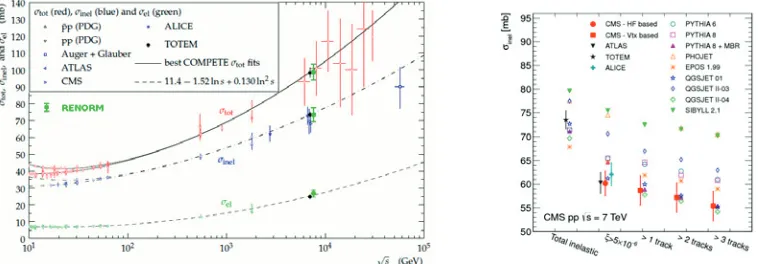
shows a comparison of thetotemtotal, elastic, and total-inelastic cross sections, along with results from other experiments fitted by thecompeteCollaboration [13]; therenormpredictions, displayed as filled (green) squares, are in excellent agreement with thetotemresults. Similarly, in Fig. 1 (right), good agreement is observed between the alice [14] and cms[15] inelastic cross sections and the renormprediction.
The uncertainty shown in therenormprediction ofσtot in Fig. 1 (left) is dominated by that in the
scale parameters0. The latter can be reduced by a factor of ∼4 if
√
s0 is interpreted as the mean
value of the glue-ball-like object discussed in [16] and the data shown in Fig. 8 of [16] are then used to determine its value. Work is in progress to finalize the details of this interpretation.
Figure 1. (left)totemmeasurements of the total, total-inelastic, and elasticppcross sections at √s=7 TeV
shown with bestcompetefits [13] andrenormpredictions added as filled squares; (right)alice[14] andcms[15]
measurements of inelastic cross sections at √s=7 TeV are compared torenormpredictions (pythia8-mbr).
KG*: this “data” point was obtained after extrapolation into the unmeasured low mass region(s) from the measuredcmscross sections [17] using thembrmodel.
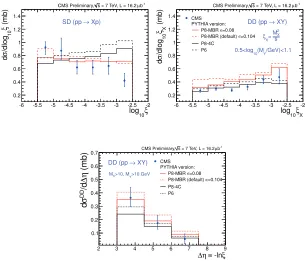
Figure 2.Measuredsd(left) anddd(right) cross sections forξ <0.05 compared with theoretical predictions; the
model embedded inpythia8-mbrprovides a good description of all data.
The justification for using therenormmodel for the extrapolation into the low mass region is presented in Fig. 3, in which the measured diffractive croee sections within a wide (albeit limited) pseudorpidity regions are compared with predictions. In Figs. 3 (top-left and top-middle), the pre-dictions of pythia8-mbr are shown for two values of the parameter of the Pomeron trajectory (α(t) = 1++αt), = 0.08 and = 0.104. Both values describe the measured SD cross sec-tion within uncertainties, while the DD data favor the smaller value of, which is consistent with low masscdfdata. The predictions ofpythia8-4candpythia6 describe well the measured DD cross section, but fail to describe the falling behavior of the data (see details in [17]). The total SD cross cross section integrated over the region−5.5<log10ξ <−2.5 (12MX 394 GeV) was measured
to beσS D
vis =4.27±0.04(stat.)+0
.65
−0.58(syst.) mb (dissociation of either proton).
The event sample after theΔη0>3 selection, was used to extract the differential
ddcross section as a function of the central-gap width,Δη. The cross section forΔη >3, MX >10 GeV and MY >10
GeV is presented in Fig. 3 (right). The totaldd cross cross section integrated over this region was measured to beσDDvis =0.93±0.01(stat.)+0.26
−0.22(syst.) mb.
ξ
10
log
-6 -5.5 -5 -4.5 -4 -3.5 -3 -2.5 -2
(mb) ξ 10 /dlog σ d 0.2 0.4 0.6 0.8 1 1.2 1.4 Xp) → SD (pp -1 b μ
= 7 TeV, L = 16.2 s
CMS Preliminary, -1 b
μ
= 7 TeV, L = 16.2 s CMS Preliminary, X ξ 10 log
-6 -5.5 -5 -4.5 -4 -3.5 -3 -2.5 -2
(mb) X ξ 10 /dlog σ d 0.2 0.4 0.6 0.8 1 1.2
1.4 CMS
PYTHIA version: =0.08 ∈ P8-MBR =0.104 ∈ P8-MBR (default) P8-4C P6 XY) → DD (pp s 2 X M = X ξ /GeV)<1.1 Y (M 10 0.5<log -1 b μ
= 7 TeV, L = 16.2 s CMS Preliminary, ξ -ln ≡ η Δ
2 3 4 5 6 7 8 9
(mb) ηΔ /d DD σ d 0.1 0.2 0.3 0.4 0.5 0.6 0.7 CMS PYTHIA version: =0.08 ∈ P8-MBR =0.104 ∈ P8-MBR (default) P8-4C P6 XY) → DD (pp >10 GeV Y >10, M X M -1 b μ
= 7 TeV, L = 16.2 s
CMS Preliminary, -1 b
μ
= 7 TeV, L = 16.2 s
CMS Preliminary,
Figure 3. sd(top-left) anddd(top-right) cross sections vsξ, andddcross section vsΔη(bottom), compared
topythia6,pythia8-4candpythia8-mbrMC. Errors are dominated by systematic uncertainties (hfcalorimeter
energy scale, and hadronization and diffraction model).
4 Summary
We discuss single diffraction/dissociation, double diffraction/dissociation, and central diffraction or double-Pomeron exchange, comparing predictions withlhcmeasurements. Agreement between data andpythia8-mbrpredictions is found in all cases.
Acknowledgments
I would like to thank Robert Ciesielski, my colleaguea at Rockefeller and collaborator in the im-plementation of the mbr simulation intopythia8, and the Office of Science of the Department of Energy for supporting the Rockefeller experimental diffraction physics programs at Fermilab andlhc on which this research is anchored.
References
[1] K. Goulianos,Predictions of Diffractive Cross Sections in Proton-Proton Collisions, in proceed-ings ofDiffraction 2012: International Workshop on Diffraction in High Energy Physics, 10-15 September 2012, AIP Conf. Proc.1523, 107 (2013) [doi:http://dx.doi.org/10.1063/1.4802128]. [2] See models presented by various authors in proceedings ofDiffraction 2012, AIP Conf. Proc.
1523.
[3] K. Goulianos,Predictions of Diffractive, Elastic, Total, and Total-Inelastic pp Cross Sections vs LHC Measurements, to appear in proceedings ofXXI International Workshop on Deep-Inelastic Scattering and Related Subject -DIS2013, 22-26 April 2013, Marseilles, France.
[4] K. Goulianos, Hadronic Diffraction: Where do we Stand?, in proceedings ofLes Rencontres de Physique de la Vallee d’Aoste: Results and Perspectives in Particle Physics, La Thuile, Italy, February 27 - March 6, 2004, Frascati Physics Series, Special 34 Issue, edited by Mario Greco [arXiv:hep-ph/0407035].
[5] K. Goulianos,Diffractive and Total pp Cross Sections atlhc, in proceedings of13th International
Conference on Elastic and Diffractive Scattering (Blois Workshop) - Moving Forward into the LHC Era, CERN, Geneva, Switzerland, June 29-July 3, 2009, CERN-Proceedings-2010-02, edited by Mario Deile [arXiv:1002.3527v2].
[6] T. Sjöstrand, S. Mrenna and P. Skands,JHEP05 (2006) 026, Comput. Phys. Comm. 178 (2008) 852[arXiv:hep-ph/0603175], [arXiv:0710.3820].
[7] R. Ciesielski and K. Goulianos,MBR Monte Carlo Simulation in PYTHIA8[arXiv:1205.1446]. [8] K. Goulianos, Phys. Lett. B193, 151 (1987).
[9] R. J. M. Covolan, J. Montanha and K. Goulianos, Phys. Lett. B389, 176 (1996). [10] M. Froissart, Phys. Rev.3, 123 (1961).
[11] A. Martin, Nuovo Cimento42, 930 (1966). [12] A. Martin, Phys. Rev. D80, 065013 (2009).
[13] M. Deile (totemCollaboration),Measurements of Proton-Proton and Total Cross Section at the
LHC by TOTEM, in proceedings ofdiffraction2012(figure from talk presented at that Confer-ence).
[14] B. Abelev et al. (aliceCollaboration),Measurement of Inelastic, Single- and Double-Diffraction
Cross Sections in Proton-Proton Collisions at the LHC with ALICE, Eur. Phys. J. C (2013)73:2456, [arXiv:1208.4968], [DOI 10.1140/cpjc/s10052-013-2456-0]
[16] M. G. Albrow, T. D. Coughlin, J. R. Forshaw, Central Exclusive Particle Produc-tion at High Energy Hadron Colliders, Prog. Part. Nucl. Phys 65, 149-184, 2010 [DOI: 10.1016/j.ppnp.2010.06.001].