VOLUME 14 | ISSUE 4 | 2019 | 925
Changes on movement control of dart throwing
under distance and target weight constraints
CARLOS E. CAMPOS1,2, GUILHERME M. LAGE2, ANDRE G.P. ANDRADE2, CRISLAINE R. COUTO2, SUZIANE P. SANTOS3, VITOR L.S. PROFETA4, HERBERT UGRINOWITSCH21
1Department of Physical Education, University of Itauna, Brazil
2School of Physical Education, Physioterapy and Occupational Teraphy, Federal University of Minas Gerais,
Brazil
3School of Physical Education, Federal University of Triângulo Mineiro, Uberaba, Brazil 4Athletics Department, University of Nebraska Lincoln, United States of America
ABSTRACT
The aim of the study was to verify the effects of dart weight and target distance on kinematic variables of the movement control of the underarm dart throwing task. Four women and one man performed the task of throwing a dart at two horizontal circular targets located at 2m (Nt) and 3m (Ft) away, with two different weights, 22g (Ld) and 44g (Hd). On the first phase of the experiment, the human volunteers performed 200 trials per day during four sessions. On the fifth day, it had 40 more trials in a pseudo random order that were recorded and analysed. A high precision camera recorded the kinematic variables amplitude of the movement (AOM), release height, movement time, release velocity and release angle, with a frequency of acquisition of 100 Hz. Performance was measured by the distance from the actual dart position to the target bull’s eye. The analysis revealed that increasing the mass of the dart diminished only the release angle. However, increasing the distance of the target increased in the AOM and the movement time of the arm, the release velocity of the dart and increased the absolute error. The results show that the motor control system has ability to deal with external constraints adjusting control strategies, which is represented by kinematic features. Moreover, our results suggests that varying the mass of implements, as a constraint may be a good candidate to improve the analysis for both motor control and ability during practice. Keywords: Dart throwing; Kinematics; Motor control, Movement control.
1Corresponding author. School of Physical Education, Physioterapy and Occupational Teraphy, Universidade Federal de Minas Gerais, Brazil. https://orcid.org/0000-0003-0317-1940
E-mail: [email protected]
Submitted for publication September 2018 Accepted for publication October 2018
Published December 2019 (in press January 2019)
JOURNAL OF HUMAN SPORT & EXERCISE ISSN 1988-5202 © Faculty of Education. University of Alicante
doi:10.14198/jhse.2019.144.20
Cite this article as:
926 | 2019 | ISSUE 4 | VOLUME 14 © 2019 University of Alicante INTRODUCTION
The accuracy of throwing in games and sports depends on the ability of changing actions accordingly to specific constraints. Motor planning and commands should be adequate for each constraint (Venkadesan & Mahadevan, 2017) whose control can be observed through kinematic features (Dounskaia, 2005). Movement time, amplitude, velocity and acceleration are examples of kinematic features used to describe and analyse human motor behaviour (Hall, 2007), as well as any changes observed in the motor pattern of the body limbs (Schneider, Zernicke, Schmidt & Hart, 1989). Changes can be accounted and analysed through graphic representation of the movements, which is a tool to describe and understand the control strategies adopted when performing specific tasks (Khan et al., 2006). In addition, using kinematic features we can infer on how the higher motor system acts to supervise the limbs (Dounskaia, 2005) changing the muscle activity (Takatoku & Fujiwara, 2010) and improving inter and intramuscular coordination of the muscles (Brindle, Nitz, Uhl, Kifer & Shapiro, 2006) when exposed to different constraints (Dounskaia, 2005). In this way, environment or task constraints can influence coordination patterns and movement control (Newell, 1986). For example, it has been demonstrated that different target distances change the trajectory of the hand (Atkeson & Hollerbach, 1985), the amplitude of the movement (AOM) (Delay, Nougier, Orliaguet & Coelho, 1997) and the velocity of the hand (Dupuy, Mottet & Ripoll, 2000). When target distances were manipulated for expert golf players (1, 2, 3 and 4 meters), there were modifications in the amplitude, velocity and force of the applied movement on the golf club (Delay, Nougier, Orliaguet & Coelho, 1997; Craig, Delay, Grealy & Lee, 2000). In another example observed, when external loads were imposed on the hand there was an initial increase of the movement`s velocity, which diminished during the practice in order to maintain the performance level (Papaxanthis, Pozzo & McIntyre, 2005).
For throwing movements the control is related to both target distance and mass of the object manipulated and this can cause a change of strategies, which reflects on the kinematic features. Dupuy, Mottet and Ripoll (2000) manipulated the distance of the target (4, 5, 6, 7 and 8 meters) and the results showed an influence on the performance, the release angle and the release velocity. However, the participants in the Dupuy, Mottet and Ripoll’s study were novices and it is difficult to identify whether the effects are resultant from constraint manipulation or from the learning process. Hore, Watts and Tweed (1999) manipulated the mass of the ball to be thrown to a target at a constant distance. The results showed that by increasing the mass (14, 55 and 196 grams) the release angle decreased while the performance remained constant. Eastough and Edwards (2007) found similar results by manipulating the mass of an object to be moved (from 140 to 1,380 grams) and keeping the distance constant. The authors found that the higher mass increases the movement velocity but decreases the grasping angle to transport an object.
VOLUME 14 | ISSUE 4 | 2019 | 927 METHOD
Participants
The experimental procedures were approved by the Institutional Review Board and performed in accordance with the ethical standards established in the 1964 Declaration of Helsinki amended in 1989. Five college students participated on this study as volunteers (one man and four women, Mage= 26.2 + 3.3
years). They were self-declared right-handers and had normal or corrected-to-normal vision.
Instruments
The task consisted in throwing saloon darts (SHUTTERSTOCK®, light darts weighing 22 grams and some
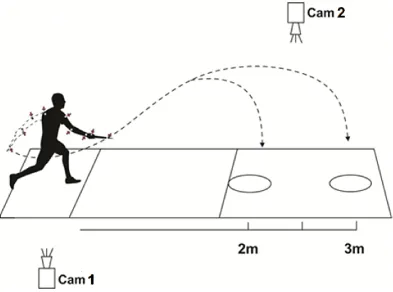
heavy darts weighing 44 grams) with the right hand (this task was adapted from Al-Abood, Davis & Bennett, 2001). The aiming was to hit the bull’s eye of two circular targets with a 26 cm diameter on the floor at two different distances (2 and 3 meters away) from the throwing position (Figure 1). All trials were recorded and the performances were measured using a video camera SONY®-DCR-DVD40/DVD805, with
a frequency of 30 Hz, fixed on the ceiling of the room (Figure 1, Cam2). Another high-speed camera BASLER® A602fc ES (Figure 1, Cam1), which sampled at a rate of 120 Hz, was used for recording
movements for kinematic analysis. Reflective markers were secured onto anatomic landmarks (joints of shoulder, elbow and wrist), based on recommendations from the International Society of Biomechanics (Wu et al., 2005). For the digitalization procedure and posterior analysis, the SIMI MOTION® 7.5 system
was used. The following measures were obtained: amplitude of movement (AOM), release angle, movement time, release velocity and release height.
928 | 2019 | ISSUE 4 | VOLUME 14 © 2019 University of Alicante
Procedures
The experiment consisted of a “Practice phase” followed by a “Test phase”. In both phases the operations were performed under two target distances (two and three meters away) using two different dart weights (22 and 44 grams). These conditions were arranged and coded: Near target (Nt) and light dart (Ld) - NtLd; Near target (Nt) and heavy dart (Hd) – NtHd; far target (Ft) and light dart (Ld) – FtLd; and far target (Ft) and heavy dart (Hd) – FtHd. Before the experiment, all participants watched a video of an expert performing the task. The practice phase started immediately after the participant watched the modelling video. This phase comprised of performing 800 trials divided into 200 trials per day with four blocks of 50 trials for each condition with 30 sec between trials. The four experimental conditions were counterbalanced during the practice. The Test phase was run on the fifth day with two blocks of 40 trials. The first block was to warm up and composed of 10 trials for each condition. The second block was composed of 40 trials (10 for each condition) and arranged in a random order and the 40 trials were recorded and analysed using the SIMI MOTION 7.5®.
Data Analyses
The effects of the four experimental situations were analysed on kinematic variables (amplitude of movement (AOM), release angle, movement time, and release velocity and release height) as well as on Absolute Error-AE (difference between the target bull’s eye and the actual dart position). The ANOVA for repeated measures was applied to compare the four situations and the post hoc of Bonferroni was adopted for pair comparison. The data normality was verified using the Shapiro-Wilk test and the Sphericity test was verified using the Mauchly test. When the sphericity condition was violated, the Grenhouse-Geisser Epsilon was used to adjust the test F. The effect sizes were calculated using eta-squared (ƞ2) for variance
and the significance level was set at 5% for all analysis. Statistical analysis was performed using SPSS 20.0 software® (Statistical Package for Social Sciences).
RESULTS
The results were reported for dependent variables (AE, AOM, movement time, release velocity, release angle and release height) and independent variables related to the mass of the dart (Ld; Hd) as well as to the distance of the target (Nt; Ft). Figure 2 shows that increment in the distance of the target changed significantly the AE (F(2,4, 119,6)=16.950, P˂.001, η2=0.26). The post hoc detected that AE increased in
both, light NtLd to FtLd (P=.001) and heavy weight NtHd to FtHd (P=.001).
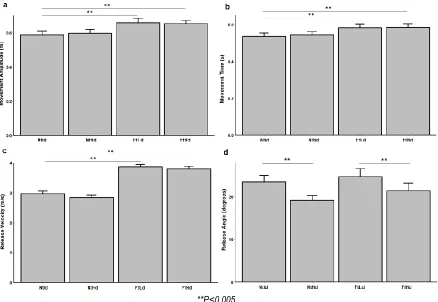
Figure 3 shows that manipulation (target distance and dart weight) changed significantly the AOM (F(1,9, 92,9)=11.189, P˂.001, η2=0.19) and the post hoc test detected that the AOM increased with both, light
NtLd and FtLd (P=.003) and heavy weight NtHd and FtHd (P=.001). The manipulation changed the release angle (F(2,4, 116,1)=11.139, P˂.001, η2=0.19) and the post hoc detected that the increment in the mass
diminished the release angle in both conditions, near NtLd and NtHd (P=.001) and far target FtLd and FtHd (P=.004). Also, the manipulation changed movement time (F(2,6, 126,3)=11.339, P˂.001, η2=0.19)
and the post hoc detected that the movement time increased in both, light NtLd and FtLd (P=.001) and heavy weight NtHd and FtHd (P=.004). Moreover, the manipulation changed the release velocity (F(3, 147)=43.446, P˂.001, η2=0.47) and the post hoc test detected that the release velocity increased in both,
VOLUME 14 | ISSUE 4 | 2019 | 929 **P˂0.005.
Figure 2. Mean performance error according target distance (Nt-near, Ft-far) and dart mass (Ld-light, Hd-heavy).
**P˂0.005.
930 | 2019 | ISSUE 4 | VOLUME 14 © 2019 University of Alicante DISCUSSION
The aim of this study was to verify how both target distance and dart weight affect performance and kinematic variables of the movement control of the underarm dart throwing task. The results showed that kinematics variables were affected differently from both variables, which were investigated in two hypotheses. We first hypothesized that increasing the distance of the target would cause alterations in the AE, AOM, movement time, release angle, and release velocity. The first hypothesis was partially confirmed because increasing the distance of the target decreased the performance (i.e. increase the AE), increased AOM, movement time and release velocity. It is in agreement with several studies which demonstrated that the place where a thrown dart will hit is determined by a combination of release parameters, including the position and velocity of the arm, and the moment of release (Hore, Watts & Tweed, 1999; Nasu, Matsuo & Kadota, 2014; Smeets, Frens & Brenner, 2002).
Regarding the performance, the results of the present study showed that increasing the distance caused reliable increasing of the radial error. Similar results were found for Dupuy, Mottet and Ripoll (2000) as a function of the increasing the target distance. It is reasonable that increasing the distance of throwing tasks generates constraints and elevates the index of difficulty (Fitts & Peterson, 1964). Furthermore, we need to consider the differences between dart and ball throwing in terms of the projectile shape and weight, arm acceleration, and wrist direction during arm acceleration and at the moment of the release (Nasu, Matsuo & Kadota, 2014). It seems the strategy used by the participants were in response to the characteristics of the task. However, they were not able to change the control strategy to maintain the performance in function the distance.
The results of movement time and AOM of the throwing increased with the distance of the target. It is reasonable since the spatial and temporal characteristic changes of the arm can illustrate how force production is controlled during the movement for which the force increases with increasing the distance of the target (Delay, Nougier, Orliaguet & Coelho, 1997; Hirashima, Kudo & Ohtsuki, 2003). In joint limb movements, the amount of force modifies not only from muscles acting at the joint involved but also from the combination between position and velocity of the limbs (Cordo et al., 1994; Hirashima, Kudo & Ohtsuki, 2003; Hore; Watts, 2011). In the present study, the release velocity also increased with the target distance demonstrating the velocity of the arm is specified as a function of the distance. In a similar perspective of the present study, Dupuy, Mottet and Ripoll (2000) studied the kinematic features of the baseball ball during the throwing by novices at different distances (4, 5, 6, 7 and 8 meters away). The authors found that the increasing of the distance caused increases in the velocity and release angle but the error did not change.
VOLUME 14 | ISSUE 4 | 2019 | 931 Thereby, it is possible to infer that the participants tried to learn to compensate the distance but failed to find the correct strategy related to velocity, angle and release height.
We expected that increasing the mass of the dart should change the velocity and release angle of the dart as well as motor performance (second hypothesis). This hypothesis was confirmed partially, since only the release angle changed. The dart mass constraint makes participants change the control strategy decreasing the release angle but not the release velocity to maintain the performance accuracy for the same target distance. This result is consistent with Hore, Watts and Tweed (1999) study’s which manipulated the weight of the ball in a throwing task. The results showed that increasing the mass (14, 55 and 196 grams) the release angle decreased and the performance was constant. In the present study, even doubling the mass of the dart (22 to 44 grams) the participants demonstrated the capacity to maintain the performance changing the control strategy related with release angle and maintaining the release velocity. Previous studies, which reported performance results of darts throwing imposing different forces, indicated that this practice leads to a reduction of both the error (Isableu et al., 2009; Kobayashi et al., 2016; Jaegers et al., 1989) and the variability (Jaegers et al., 1989; Etnyre, 1998). It is possible to infer that the participants of the present study acquired the ability to adjust the upper limb coordination (i.e., release angle) according to the mass of the object manipulated (Hore; Watts; Tweed, 1999; Hore; Watts, 2011; Isableu et al., 2009). At last, the controlled situation adopted in this study provides information about changes in control to reach the task goal. However, our results are limited to use motor skills with more complexity (Wulf & Shea, 2002).
In summary, our results demonstrated that performance on far condition decreased, demonstrating the difficulty of the motor system to calibrate the control strategy. To achieve the goal on this condition, although participants increased the values of some kinematic measures they failed to maintain the performance. However, in both mass conditions, the participants decrease the release angle to maintain the performance. Even though our hypotheses were partially confirmed, the results gave us well enough information to infer about the control strategies using kinematic features. This suggests that varying the mass of implements, as a constraint may be a good candidate to improve the analysis for both motor control and ability during practice. At last, future studies should replicate this design using complex motor skills.
DECLARATION OF CONFLICTING INTERESTS
The author(s) declared no potential conflicts of interest with respect to the research, authorship, and/or publication of this article.
FUNDING
The author(s) received no financial support for the research, authorship, and/or publication of this article.
REFERENCES
Al-Abood, S. A., Davids, K., & Bennett, S. J. (2001). Effects of manipulating relative and absolute motion information during observational learning of an aiming task. Journal of Sports Science, 19(7), 507-520. https://doi.org/10.1080/026404101750238962
932 | 2019 | ISSUE 4 | VOLUME 14 © 2019 University of Alicante Brindle, T. J., Nitz, A. J., Uhl, T.L., Kifer, E., & Shapiro, R. (2006). Kinematic and EMG characteristics of
simple shoulder movements with proprioception and visual feedback. Journal of Electromyography and Kinesiology, 16(3), 236-249. https://doi.org/10.1016/j.jelekin.2005.06.012
Craig, C. M., Delay, D., Grealy, M. A., & Lee, D. N. (2000). Guiding the swing in golf putting: golfers control the pace of a putt by comparing sensory data with an internal guide. Nature, 405(6784), 295-296. https://doi.org/10.1038/35012690
Delay, D., Nougier, V., Orliaguet, J. P., & Coelho, Y. (1997). Movement control in golf putting. Human Movement Science, 16(5), 597-619. https://doi.org/10.1016/S0167-9457(97)00008-0
Dounskaia. N. (2005). The internal model and the leading joint hypothesis: implications for control of multi-joint movements. Experimental Brain Research, 166(1), 1-16. https://doi.org/10.1007/s00221-005-2339-1
Dupuy, M. A., Mottet, D., & Ripoll, H. (2000). The regulation of release parameters in underarm precision throwing. Journal of Sports Science, 18(6), 375-382. https://doi.org/10.1080/02640410050074304 Eastough, D., & Edwards, M. G. (2007). Movement kinematics in prehension are affected by grasping
objects of different mass. Experimental Brain Research, 176(1), 193-198. https://doi.org/10.1007/s00221-006-0749-3
Etnyre, B.R. (1998). Accuracy characteristics of throwing as a result of maximum force effort. Perceptual and Motor Skills, 86(3), 1211-1217. https://doi.org/10.2466/pms.1998.86.3c.1211
Fitts, P. M., & Peterson, J. R. (1964). Information capacity of discrete motor responses. Journal of Experimental Psychology, 67(2), 103-112. https://doi.org/10.1037/h0045689
Jaegers, S. M. H. J., Peterson, R. F. R., Dantuma, B., Hillen, B., Geuze, R., & Schellekens, J. (1989). Kinesiologic aspects of motor learning in dart throwing. Journal of human movement studies, 16(4), 161-171.
Hall, S. Basic Biomechanics. Boston: McGraw-Hill; 2007.
Hirashima, M., Kudo, K., & Ohtsuki, T. (2003). During Ball-Throwing Movements Utilization and Compensation of Interaction Torques. Journal of Neurophysiology, 89(4), 784-1796. https://doi.org/10.1152/jn.00674.2002
Hore, J., & Watts, S. (2011). Skilled throwers use physics to time ball release to the nearest millisecond. Journal of Neurophysiology, 106(4), 2024–2033. https://doi.org/10.1152/jn.00059.2011
Hore, J., Watts, S., & Tweed, D. (1999). Prediction and Compensation by an Internal Model for Back Forces During Finger Opening in an Overarm Throw. Journal of Neurophysiology, 82(3), 1187-1197. https://doi.org/10.1152/jn.1999.82.3.1187
Isabelu, B., Rezzoug, N., Mallet, G., Bernardin, D., Gorce, P., & Pagano, C. C. (2009). Velocity-dependent changes of rotational axes in the non-visual control of unconstrained 3d arm motions. Neuroscience, 164(4), 1632-1647. https://doi.org/10.1016/j.neuroscience.2009.08.065
Khan, M. A., Franks, I. M., Elliot, D., Lawrence, G. P., Chua, R., Bernier, P. M., Hansen, S., & Weeks, D. J. (2006). Inferring online and offline processing of visual feedback in target-directed movements from kinematic data. Neuroscience and Biobehavioral Reviews, 30(8), 1006-1121. https://doi.org/10.1016/j.neubiorev.2006.05.002
Kobayashi, Y. A. M., Miyazaki, A., Fujii, N., Iiboshi, A., & Nakatani H. (2016). Kinetics of throwing arm joints and the trunk motion during an overarm distance throw by skilled Japanese elementary school boys. Sports Biomechanics,15(3), 314-28. https://doi.org/10.1080/14763141.2016.1161820
Nasu, D., Matsuo, T., & Kadota, K. (2014). Two Types of Motor Strategy for Accurate Dart Throwing. Plos One, 9(2), 1-9. https://doi.org/10.1371/journal.pone.0088536
VOLUME 14 | ISSUE 4 | 2019 | 933 Papaxanthis, C., Pozzo, T., & Mcintyre, J. (2005). Kinematic and dynamic processes for the control of
pointing movements in humans revealed by short-term exposure to microgravity. Neuroscience, 135(2), 371-383. https://doi.org/10.1016/j.neuroscience.2005.06.063
Schneider, K., Zernicke, R. F., Schmidt, R. A., & Hart, T. J. (1989). Changes in limb dynamics during the practice of rapid arm movements. Journal of Biomechanics, 22(9), 805-817. https://doi.org/10.1016/0021-9290(89)90064-X
Smeets, J. B.J., Frens, M. A., & Brenner, E. (2002). Throwing darts: timing is not the limiting factor. Experimental Brain Research, 144(2), 268-274. https://doi.org/10.1007/s00221-002-1072-2
Takatoku, N., & Fujiwara, M. (2010). Muscle activity patterns during quick increase of movement amplitude in rapid elbow extensions. Journal of Electromyography Kinesiology, 20(2), 290-297. https://doi.org/10.1016/j.jelekin.2009.03.007
Venkadesan, M., Mahadevan, L. (2017). Optimal strategies for throwing accurately. Royal Society of Open Science, 4, 170136. https://doi.org/10.1098/rsos.170136
Wu, G., Frans C.T., van der Helm, H.E.J. (DirkJan) Veeger, Makhsous M., Van Roy P., Anglin C., Nagels J., Karduna A. R., McQuade K., Wang X., Werner F. W., & Buchholz B. (2005). ISB recommendation on definitions of joint coordinate systems of various joints for the reporting of human joint motion-Part II: shoulder, elbow, wrist and hand. Journal of Biomechanics, 38(5), 981-992. https://doi.org/10.1016/j.jbiomech.2004.05.042
Wulf, G., & Shea, C. H. (2002). Principles derived from the study of simple skills do not generalize to complex skill learning. Psychonomic Bulletin & Review, 9, 185-211. https://doi.org/10.3758/BF03196276