www.astrophys-space-sci-trans.net/2/45/2006/ © Author(s) 2006. This work is licensed
under a Creative Commons License. Astrophysics and Space Sciences
Transactions
The problem with the non-idealness of the MHD heliosheath
V. B. Baranov1and H.-J. Fahr2
1Institute for Problems in Mechanics, Russian Academy of Sciences, 101-1 ,Vernadskii Ave., Moscow, 119526, Russia 2Inst. for Astrophysics and Space Research, University of Bonn, Auf dem H¨ugel 71, D-53121 Bonn, Germany Received: 9 November 2005 – Revised: 15 February 2006 – Accepted: 10 May 2006 – Published: 15 June 2006
Abstract. When describing the plasma - field behaviour in the heliospheric interface the difficulty arises that classi-cal MHD concepts are not fully applicable to this compli-cated multifluid interaction scenario. The classical MHD concept of ideally frozen-in magnetic fields is only strictly valid, if the magnetized medium is fully ionized. As is well known, however, the heliospheric medium represents a par-tially ionized plasma which contains neutral H-atom flows interacting with the ions via resonant charge exchange pro-cesses. Caused by this cross-interaction between the neutral and the ionized media additional non-classical currents are driven which induce additional magnetic fields. These latter fields can be shown to show the tendency to diffuse relative to the ion bulk motion. As we can show this non-classical diffusion is especially pronounced near plasma boundaries or shocks and there act in a way to dissolve the abruptness in the transition structure of the plasma properties. Here we give first estimates of these effects and point to a need to re-vise the classical MHD theory at its application to partially ionized media.
1 Introduction
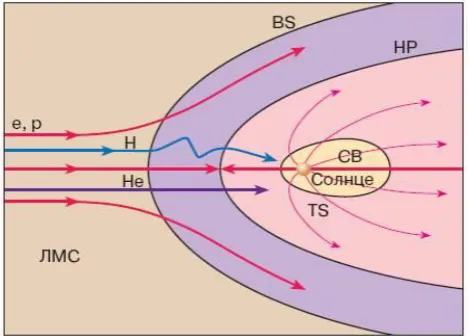
As is well known since long (Baranov et al., 1970) the in-teraction of supersonic flow of the local interstellar plasma component (electrons and protons) with the supersonic solar wind gives rise to the formation of an outer bow shock, a tangential discontinuity (called heliopause) and an inner ter-mination shock (see BS, HP and TS, respectively, in Fig. 1). The region between BS and TS (the so-called interface) is separated by the heliopause into two regions: the outer he-liosheath (decelerated and subsonic flow of the interstellar plasma component between BS and HP) and the inner he-liosheath (decelerated and subsonic solar wind between TS Correspondence to: H.-J. Fahr ([email protected])
Fig. 1. Qualitative picture of the solar wind interaction with the supersonic flow of the local interstellar medium (LISM). Here BS is the bow shock, HP is the heliopause, TS is the solar wind ter-mination shock. The region between the BS and HP is called the outer heliosheath, the one between TS and HP is called the inner heliosheath.
It is evident from classical literature that shocks and tan-gential discontinuities can only be formed in the frame-work of the ideal Euler hydrodynamics, where second order derivatives are absent. Below we will consider a possible ef-fect of the interstellar magnetic field on the outer heliosheath structure taking into account the interstellar plasma compo-nent as well as the neutral H-atom flow. The magnetohydro-dynamic (MHD) eqnarrays to describe the partially ionized flow around the heliopause (see, for example, Florinskii et al., 2003) are critically analysed in Sect. 2. It is shown below that under the actually prevailing conditions in the frame-work of the classic MHD (Kulikovskii and Lyubimov, 1965) a diffusion of the interstellar magnetic field in the outer he-liosheath can become important due to ion currents (Baranov and Fahr, 2003 a, b). It seems to us that the earlier results of a kinetic-MHD approach (Baranov and Malama, 1993), again used for the numerical solution of the above mentioned prob-lem (Izmodenov et al., 2005), confirm the earlier assertion by Baranov and Fahr (2003a,b). These latter results will be shown in Sect. 3.
2 MHD-formulation of the problem
To solve the problem of the interaction between the super-sonic flow of the interstellar gas and the solar wind in the presence of an interstellar magnetic field in several cases in the literature a multifluid model has been used (see, for ex-ample, Florinskii et al., 2003; Fahr et al., 2000), although the Knudsen number for H-atomsKn=l/L∼1 (lis mean free
path of H-atoms with respect to resonant charge exchange with protons,Lis the characteristic length of the interaction region, for example, the extent of the heliosheath). In this case the momentum conservation eqnarrays for a partially ionized hydrogen gas in the presence of an interstellar mag-netic field have the form (stationary problem!):
(Vα· ∇)Vα = − 1
mαnα
∇pα+eα(E+ 1
cVα×B) +XRαβ, Rαβ=
Vα−Vβ
ταβ
, (1) where the indices α=e, p, H are representative for elec-trons, protons and H-atoms, V,E,B and R are vectors of the bulk velocity, the electric field, the magnetic field induc-tion and the mutual interacinduc-tion force due to exchange of mo-mentum between componentsα andβ due to mutual col-lisions, respectively,m, n, p andτ are denote the mass of the particle, the number density, the static pressure and the mean free-flight time. The particle flux continuity eqnarray has the form
∇ ·nαVα =0 (2)
and the eqnarray of the magnetic field induction can be ex-pressed in a form which determines magnetic field freezing
in the proton flow (Florinskii and Zank, 2003; Baranov and Fahr, 2003b)
∇ ×(Vp×B)=0. (3)
To complete and close the system of eqnarrays one must add the eqnarrays of state and of energy conservation for all components as well as Maxwell eqnarrays for the electro-magnetic fields.
On the basis of the above closed system of multifluid eq-narrays we could obtain the eqeq-narrays of the classic one-fluid MHD theory (see, for example, Kulikovskii and Lyubimov, 1962) by simple manipulations and redefinitions. Namely the momentum and continuum eqnarrays take the form
(V· ∇)V= −1 ρ∇p+
1
cj×B; ∇ ·ρV=0, (4)
where ρV=Pm
αnαVα, ρ=Pmαnα, p=Ppα deter-mine the bulk velocity V, the mass density ρ and the static pressurepof the fluid consisting of electrons, protons (ne],≈np) and H-atoms. The electric current is determined by the formula
j= −ene(Ve−Vp), (5) where|e|is the absolute proton or electron charge. Manip-ulations with the momentum Eq. (1) give rise to the gener-alized Ohm’s law for a partially ionized plasma in the form (Kulikovskii and Lyubimov, 1965; Cowling, 1976; Baranov and Fahr, 2003a)
j=σ (E+1
cV×B)+ eτep
me
(∇pe− 1
cj×B) +3
B2
s
1−s∇p×B+
1
c(j×B)×B
, (6) where 3=c(1−s)2ωeτepωpτpH, s=ne/(ne+nH) and
σ=nee2τep/me are the ionization degree and the elec-tric conductivity, respectively,ωα(α=e, p) is the gyrofre-quency of charged particles in the presence of the magnetic field, i.e. Larmor frequency. It should be noted here, that in the outer heliosheath (see Fig. 1) one findsωαταβ1.
As was shown by Baranov and Fahr (2003) the last term of Eq. (6) is comparable or larger than the termσ/c(V×B)
for the problem considered, i.e. the Eq. (6) can be re-written in the following form
E= − 1
c(V×B)−
− 3
B2σ
s
1−s∇p×B+
1
c(j×B)×B
the finite electric conductivity can be neglected. Equation (7) leads to the eqnarray of the magnetic field induction (for the stationary problem, i.e.∇ ×E=0) in the form
∇ ×(V×B)= −∇ ×
c3
B2σ
s
1−s∇p×B+
1
4π[(∇ ×B)×B)] ×B
.
(8) The right hand side (RHS) of this equation is determined by the proton current jp (see, for example, Baranov and Fahr, 2003a,b) which is given by
jp=
2eτpa(1−s)2
mp
− s
1−s∇p+
1
cj×B
. (9)
We see from Eq. (8), that the magnetic field is not frozen in into the plasma. To determine the coefficient of a differ-ential diffusion let us consider the RHS last term of Eq. (8). We obtain, when using some vector identities, the following equalities
[(∇ ×B)×B]×B= −B× [(∇ ×B)×B]
= [−B2∇ ×B+B(B· ∇ ×B)]. (10) First we take into account only the first term on the RHS of this equality and obtain
∇ ×(B2∇ ×B)= −B2∇2B+ ∇ ×B2(∇ ×B), (11) where the first term of the RHS determines the diffusion of the magnetic field. Our estimations then show (Baranov and Fahr, 2003a) that
|∇ ×(V×B)| ≤κ ∇
2B
, (12)
where the diffusion coefficientκdue to the proton current jp is determined by the formula (see Eq. (8))
κ= c3
4π σ [ cm2
s ]. (13)
As is evident, we retain the ideal magnetic field freezing in case of the fully ionized plasma, namely ats=1. In the framework of the multifluid MHD, whereKn <1, and at
s6=1, we haveκ/V L≥1, with L=50 AU being the scale of the heliosheath for the problem of the outer heliosheath structure, i.e. the diffusion of the interstellar magnetic field becomes important. In this case the bow shock is absent due to the presence of the second derivatives in the system of MHD eqnarrays. This result cannot be depending on the use of a multi-fluid or one-fluid approximation, because the tran-sition from first to second order approximation is a result of identical transformations.
3 Mathematical formulation of a kinetic-MHD flow in the outer heliosheath and first results of calculations. The solution of the MHD structure of the outer heliosheath will be satisfactorily correct, if in view ofKn∼1 one uses
a kinetic- MHD approximation to describe the H-atom flow. The MHD eqnarrays for the plasma components (only elec-trons and protons) have the form
∇ ·ρV=0, (14)
(V· ∇)V+1 ρ∇p=
1
4πρ(∇ ×B)×B+F1, (15) ∇ ·ρV V
2
2 +
γ γ +1
p ρ
!
=F2, (16)
∇ ×(V×B)=0, (17)
∇ ·B=0, (18)
(V≈Vp, ρ≈mpnp). (19)
Here the functions F1(fH)andF2(fH)determine the rate of momentum and energy change of the plasma component due to charge exchange interaction processes of H-atoms with protons.
The already developed Monte-Carlo method (Baranov and Malama, 1993) to obtain the solution of the coupled nonlin-ear Boltzmann eqnarray for the H-atom distribution function
fH (the distribution function of the protonsfpis assumed to be a shifted Maxwellian) is now used to determine the above introduced functions F1andF2.
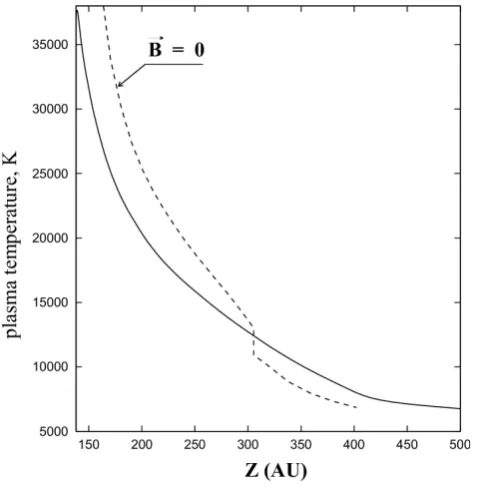
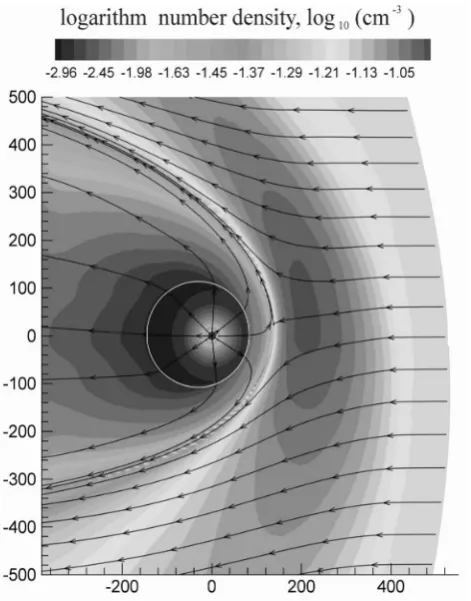
The axis-symmetric 2D problem of the solar wind in-teraction with the partially ionized interstellar plasma in the presence of the interstellar magnetic field was solved by Alexashov et al. (2000) at BkV, and more recently the associated 3D- problem was calculated by Izmode-nov et al. (2005). These authors kindly calculated for us the enlightening unpublished results shown in Figs. 2 through 4. In these Figures the distributions of tempera-ture, electron (proton) number density, and flow lines are presented. To obtain these results it was assumed that the number density, the bulk velocity and the tempera-ture of the solar wind at the Earth’s orbit are equal to:
np,E=ne,E=7.39 cm−3,VE=432 km s−1,TE=51 109 K, respectively. The corresponding parameter values for the local intercloud (LIC) medium are accepted to be equal to: np,LIC=ne,LIC=0.06 cm−3,VLIC=26.4 km s−1,
TLIC=6527 K. The angleθbetween the interstellar magnetic field BLICand the vector of the bulk velocity VLICat Figs. 2 through 4 is equal toθ=π/4,|BLIC| =2.5µG and the ratio of solar radiation to gravitation forces is taken to beµ=1.
Fig. 2. Solutions for the plasma temperature as function of the solar distance are shown on the upwind axis: Dashed lines are obtained for vanishing interstellar magnetic field (i.e. B = 0), fully drawn lines are valid for a finite magnetic fieldB=2.5µG≥0.
MHD approximation, confirm our conclusions already ob-tained in Sect. 2 on the basis of a pure MHD approximation (the bow shock cannot be formed as solution of a system of MHD eqnarrays which keep the second order derivatives).
4 Kinetically enforced deviations from frozen-in flows
As demonstrated above it indeed turns out that under nor-mal interstellar conditions, except for regions close to shocks and discontinuities, MHD theory essentially allows to con-clude a magnetic field behaviour which can be described as a field-freezing into the mass-weighted plasma (ion!) bulk flow with flux-conservation within closed loops, i.e. con-vected flux tubes, transported with the ion bulk flow Vp. Under kinetic studies of the behaviour of charge exchang-ing fluids in the heliosheath regions (see Fahr and Bzowski, 2004a/b; Chashei and Fahr, 2005; Chashei, Fahr and Lay, 2005) it, however, becomes evident that non-negligible de-viations from the adopted, highly relaxated HD distribution functions, i.e. shifted Maxwellians, will occur - not only for neutral atoms - but also for ions. These non-equilibrium ion conditions may partly violate the above conclusions and may require a revision of the usual ideal MHD fluid concepts.
Usually, when applying multifluid MHD to the heliosheath problem, one arrives at the following current eqnarray (see
Fig. 3. Solutions for the plasma density as function of the solar dis-tance are shown on the upwind axis: Dashed lines are obtained for vanishing interstellar magnetic field (i.e. B = 0), fully drawn lines are valid for a finite magnetic fieldB=2.5µG≥0.
e.g. Gombosi, 1998) j= 1
4π∇ ×B= σ0 1+ τe,i
τe,a
[ 1 ene
∇Pe+(E+Vp×B)] 'σ0∗[(E+Vp×B)] (20) where the latter step can only be made under the neglect of electron pressure. Then the above eqnarray can be rewritten in the following form
∇ × [ 1
4π σ0∗∇ ×B] = ∇ ×E+ ∇ × [Vp×B] (21)
This eqnarray is even correct, if the electron pressure is kept, since∇ × ∇Pe always vanishes. For stationary conditions, i.e. ∇ ×E=∂B/∂t=0, one can try to solve this eqnarray by setting B=B0+B1 with the frozen-in part of the field fulfilling
∇ × [Vp×B0] =0 (22)
and the diffusive part solving ∇ × [ 1
4π σ0∗∇ ×B] = ∇ × [Vp×B1] (23)
Assuming that the remaining, charge-exchange induced electric currents jex= ∇ ×B/4π are ion currents connected with kinetically induced deviations from the relaxated ion fluid distribution function in connection with charge ex-change injected newly created ions, i.e. deviations from the shifted ion Maxwellian, we then can fulfill Eq. (23) by
1
σ0∗jex= [Vp×B1] + ∇8B1 (24) where for the most general case a scalar field 8B1 has to be admitted. Now we may aim at the derivation of the charge-exchange induced current jex and according to Fahr and Bzowski (2004a) and Chashei, Fahr and Lay (2005) one finds that this current can be given by
jex'eδn·((Va−Vp)·B0/B0)(B0/B0) (25) where δn is the partial ion density of local perturbations induced by freshly charge-exchange injected, non-relaxated ions, establishing and maintaining a nonequilibrium pertur-bation δn which, for stationary cases, is given by the bal-ance condition between injection and removal of new ions in the form (see Fahr and Bzowski, 2004b; Chashei, Fahr and Lay, 2005)
δn'nanpVrel(H, p)σrel(H, p)τpp (26) where H-atom densities and unperturbed proton densities are denoted bynaandnp, respectively, whereσrelis the average charge exchange cross section of proton - H-atom collisions with an average relative velocity ofVrel(H, p)given by:
Vrel(H, p)=
s
128 9π mp
(TH+Tp)+(Va−Vp)2 (27) Furthermoreτppis the period of the most effective ion (pro-ton) relaxation process, i.e. either Coulomb relaxation or wave-particle relaxation (see Chashei, Fahr and Lay, 2005). Then with the assumption 8B1=const one obtains with Eqs. (25), (26) and (27) the following eqnarray for a par-ticular solution for B1
1
σ0∗0((Va−Vp)·
B0 B0
)(B0 B0
)= [Vp×B1] (28)
where0=0(H, p)=enanpVrel(H, p)σrel(H, p)τpp. To solve for B1we carry out a vector multiplication of the above eqnarray with Vpand obtain
1
σ0∗0
(Va−Vp)·B0
B02 [Vp×B0] = 1
c2[Vp(Vp·B1)−B1V 2
p] (29) Since the left side only contains a vector perpendicular to Vp one thus finds that B1also has to be perpendicular to Vp, and hence that the following relation should be valid:
B1= − 1
σ0∗0
c(Va−Vp)·B0 V2
pB02
[Vp×B0] (30)
Fig. 4. Plasma density contours and plasma flow lines are plotted for the case of a finite interstellar magnetic fieldB=2.5µG≥0.
which means that we simply can calculate a particular solu-tion for B1from first order MHD quantities like:n, Tp,Vp and B0given within the frame of a multi-fluid MHD simula-tion which models the outer heliospheric interface.
To evaluate on the order of magnitude of the kinetically-induced additional fieldsB1one may write for regions, where |Va| '
Vp
is valid, and with representative data for the
outer heliosheath like:
na=0.1cm−3
n=0.1cm−3
Vrel(H, p)' |ua| '20km/s
σrel(H, p)'4·10−15cm2
τpp '4·107s
σ0∗'ne2τe,i/me
τe,i'2.8·10−1
Te √
Te
nLC
'11.2·105s
ωg=
eB0
mec
'18.0s−1
the following relation: |B1|
|B0| ' 1
σ0∗0c
1
|B0| =(τpp/τe,i) νa
ωg
'10−4 (31)
with the charge exchange frequency
νa=naVrel(H, p) σrel(H, p)'3·10−8s−1. Only for re-gions close to the inner and outer surface of the front part of the heliopause where |Va|
Vp
is valid, one may
find results different from the above relation, namely rather given by:
|B1| |B0|
'(τpp/τe,i)
νa
ωg |Va|
Vp
'10−4|Va| Vp
(32)
5 Conclusions
As we have shown in the sections above, ideal MHD condi-tions for mocondi-tions of partially ionized and magnetized plas-mas, usually leading to magnetic fields exactly frozen into the ion fluid, may break down under the influence of charge-exchange induced electric currents. This we have shown when deriving the generalized form of the induction eqnar-ray for partially ionized gases with low or moderate ioniza-tion degreess where charge exchange coupling between H-atoms and protons becomes magnetohydrodynamically im-portant (i.e. ionization degreess≥0.5). The additional elec-tric currents that are induced lead to a term in this induction eqnarray which describes magnetic field diffusion, a kind of freedom of the magnetic fields with respect to a strict como-tion with the ion fluid. This term becomes especially im-portant near structures where abrupt spatial changes of the magnetic field in magnitude or direction occur, i.e. for in-stance as expected near the heliopause or the outer helio-spheric bowshock. In the following we shall give a short es-timate of how much influence the charge-exchange induced non-ideality has on the transition profile of the interstellar magnetic field at the bowshock.
In the following we intend to briefly estimate the charge-exchange induced non-idealness at the MHD bowshock tran-sition. Assuming the situation that the LISM magnetic field is oriented perpendicular to the LISM inflow onto the he-liosheath, one then would obtain with the extended induction eqnarray given by Eq. (12) the following relation describing the behaviour ofBandV at the passage of the magnetized LISM plasma over the bowshock:
∇ ×(V ×B)=κ1B (33)
Applying this to the region near the symmetry axis of the LISM inflow (i.e. the so-called z−axis) one can then, due to symmetry reasons (i.e. ∂/∂x=∂/∂y=0), derive from the above vector relation the following scalar differen-tial eqnarray:
− d
dz(VzBx)=κ d2Bx
dz2 (34)
We shall solve this differential eqnarray explicitly in a forthcoming paper, since the detailed elaboration of this so-lution via reducing the above eqnarray to a Ricatti-type dif-ferential eqnarray would extend this paper here too much. Instead we give an estimate of the solution by entering into a dimensional argumentation. Let us assume a transition scale
1to be typical for the bowshock transition. Then, on the basis of purely dimensional arguments, one can simplify the above eqnarray to the form:
Vz1B1x−Vz2B2
1 'κ
B2x−B1x
12 (35)
leading to the following result:
B2x'B1x
V1z+(κ/1)
V2z+(κ/1) =B1x
V1z
V2z 1+K1 1+K2
(36) What one notices in the above expression is that forκ=0 one regains the normal frozen-in flux behaviour valid for ideal MHD, for κ≥0 one, however, obtains a non-ideal behaviour, i.e. violation of magnetic flux conservation, de-scribed by
B1x≤B2x ≤B1x
V1z
V2z
(37) Taking the values already used earlier in this paper for the quantityκ=(1−s)2vA2τpH one would find withL'50 AU:
K1=(κ/V1z1)'(
κ
LV1z
)(L 1)=(
L
1) (38)
and:
K2=(κ/V2z1)'(
κ
LV1z
)(V1z V2z
)(L 1)=σ (
L
1) (39)
where σ=V1z/V2z denotes the compression ratio at the bowshock. Taking the value for the most efficient proton re-laxation periodτep'2.5·107s calculated by Chashei, Fahr and Lay (2005) one may then estimate the shock transition scale by1'V1zτep=4 AU and finds
B2x'B1xσ
1+(L/1)
1+σ (L/1) 'B1xσ
13.5
1+σ12.5 (40) meaning that the magnetic field compression to be expected under these non-ideal conditions is much less pronounced compared to the ideal MHD case withB2x=B1xσ.
Acknowledgements. This work was supported by INTAS (grant no.
2001-0270), the Russion Foundation for Basic Research (project nos. 03-02-04020, 04-01-00594, 04-02-16559), DFG (grant np. 436 RUS 113/110/12-3), and the Basic Research Program of the Russian Academy of Sciences. We are grateful to the referees for helpful remarks and comments.
References
Alexashov, D. B., Baranov, V. B., Barskii, E. V., and Myas-nikov, A. V.: Axially symmetric MHD model for the solar wind - LISM interaction, Astron. Lett., 26, 743–749, 2000.
Baranov, V. B., Krasnobaev, K. V., and Kulikovskii, A. G.: On the model of the solar wind - interstellar medium interaction with two shocks, Dokl. Akad. Nauk USSR, 194, 41–44, 1970. Baranov, V. B. and Malama, Yu. G.: Model of the solar wind
in-teraction with the local interstellar medium - Numerical solution of self-consistent problem, J. Geophys. Res., 98, 15 157–15 163, 1993.
Baranov, V. B. and Fahr, H.-J.: On nonideal MHD properties of the partially ionized interstellar gas, J. Geophys. Res., 108, SSH 4–1, CiteID 1110, DOI: 10.1029/2001JA009221, 2003a.
Baranov, V. B. and Fahr, H.-J.: Reply to comment by V. Florinski and G. P. Zank on “On nonideal MHD properties of the partially ionized interstellar gas” , J. Geophys. Res., SSH 5–1, CiteID 1439, DOI: 10.1029/2003JA010118, 2003b.
Chashei, I. V. and Fahr, H.-.J.: Ion relaxation processes in the helio-spheric interface: how perturbed are ion distribution functions?, Adv. Space Res., 35, 2078–2083, 2005.
Chashei, I. V., Fahr, H.-J., and Lay, G.: Non-Equilibrium Distribu-tion FuncDistribu-tions in the Heliospheric Interface and Their RelaxaDistribu-tion by Local Wave Particle Interactions, Sol. Phys., 226, 163–185, 2005.
Cowling, T. G.: Magnetohydrodynamics, Adam Hilger, London, U.K., 1976.
Fahr, H.-J., Kausch, T., and Scherer, H.: A 5-fluid hydrodynamic approach to model the solar system-interstellar medium interac-tion, Astron. Astrophys., 357, 268–283, 2000.
Fahr, H.-J. and Bzowski, M.: A kinetic control of the heliospheric interface hydrodynamics of charge-exchanging fluids, Astron. Astrophys., 424, 263–276, 2004a.
Fahr, H.-J. and Bzowski, M.: Charge-exchange-induced perturba-tions of ion and atom distribution funcperturba-tions in the heliospheric interface, AIP Conf. Proc. 719: Physics of the Outer Heliosphere 719, 373–380, 2004b.
Florinskii, V. and Zank, J.: Comment on “On nonideal MHD prop-erties of the partially ionized interstellar gas” by V. B. Baranov and H. J. Fahr, J. Geophys. Res., 108, SSH4–1, 1438–1439, DOI 10.1029/2003JA009950, 2003.
Florinskii, V., Zank, G. P., and Pogorelov, N. V.: Galactic cosmic ray transport in the global heliosphere, J. Geophys. Res., 108, SSH1–1, 1228–1235, DOI 10.1029/2002JA009695, 2003. Gombosi, T. I.: In ”Physics of the space environment”
Cam-bridge Atmospheric and Space Sciences Series, edited by Houghton, J. T., Rycroft, M. J., and Dessler, A. J., Cambridge University Press, Michigan, 72, formula 4.75 et seqq, 1998. Izmodenov, V. V., Alexashov, D. B., and Myasnikov, A. V.:
Direc-tion of the interstellar H atom inflow in the heliosphere: Role of the interstellar magnetic field, Astron. Astrophys., 437, L35– L38, 2005.