Original Research Article
Effectiveness of a health education intervention on the knowledge,
attitude and practices of teachers regarding physical and psychosocial
health of adolescents in Amritsar, Punjab
Pushapindra Kaushal
1*, Tejbir Singh
2, A. S. Padda
2, S. S. Deepti
2INTRODUCTION
Adolescents constitute about 22% of the population of India.1 It is a transition phase from childhood to adulthood. The transition is not only just physical but significant cognitive changes also take place.2 Most of the adolescents go through this period with little or no knowledge of the body‟s impending physical, physiological and psychological changes. 3As they are ill
prepared to deal with these changes, they try to gather information from peers and unauthentic sources. Demands of culture, gender, globalization and poverty push millions of adolescents prematurely into adult roles exposing them to serious risks, which makes them vulnerable to drug abuse, premarital sex, STDs, HIV/AIDS, depression etc. Their level of maturity and social status is no match for these challenges, unless they
ABSTRACT
Background: Adolescents undergo the transition period of adolescence with little knowledge of body‟s impending physical, physiological and psychological changes. After parents, teachers have maximum opportunity to support and educate adolescents. This study attempts to study effectiveness of health education on knowledge, attitude and practices of teachers regarding physical and psychosocial health of adolescents.
Methods: The study was started with 155 teachers (teaching class 9th -12th) who willingly participated from 50 senior secondary schools of Amritsar district. After taking informed consent, teachers filled a pretested questionnaire which was followed by an interactive session on adolescent health. To study impact of health education, they were again administered same questionnaire after a period of 3 months. Statistical analysis was on Microsoft Excel, Chi square test, SPSS.
Results: Maximum 74 (47.7%) teachers were aware of psychosocial problems of adolescents as compared to the physical and sexual problems. Only 11 (7.1%) teachers had adequate knowledge about changes occurring during adolescence. Majority 125 (80.6%) of teachers had no knowledge regarding height and weight gained during adolescence and more than 2/3rd [110 (71%)] of teachers were unaware of daily calorie and protein requirements. Only 28 (18.1%) had adequate knowledge about drug abuse. After intervention significant favourable changes were observed in their knowledge, attitude and practices regarding most of above mentioned topics.
Conclusions: Overall knowledge of teachers in most aspects of adolescent health was found to be low, however significant favourable changes were observed after health education was provided to them.
Keywords: Adolescents, Boys, Health education, Teachers, Drug abuse
Department of Community Medicine, 1Maharishi Markandeshwar Institute of Medical Sciences and Research, Mullana, Ambala, Haryana, 2Government Medical College, Amritsar, Punjab, India
Received: 17 September 2018
Revised: 08 October 2018
Accepted: 09 October 2018
*Correspondence:
Dr. Pushapindra Kaushal,
E-mail: [email protected]
Copyright: © the author(s), publisher and licensee Medip Academy. This is an open-access article distributed under the terms of the Creative Commons Attribution Non-Commercial License, which permits unrestricted non-commercial use, distribution, and reproduction in any medium, provided the original work is properly cited.
are provided with support, information and access to resources.4
School education has been described as a social vaccine and it can serve as a powerful preventive tool. As a large proportion of young people are in schools, schools provide an effective route for communicating with them. School-based programmes for smoking prevention have been widely developed and evaluated.5 After parents, it is the teachers who spend most of the time and have maximum opportunity to communicate and educate adolescents.
A lot of programs are going on for girls but not the same for boys. Boys have become the „new disadvantaged‟ as a result of efforts to eradicate female disadvantage in the education system. Boys have a greater exposure to the external environment than girls. While discussing their problems it was found that male students expressed a preference for male teachers because of the perceived shared experiences, interests and ways of thinking. Boys felt that men have a better comprehension of their play and were better able to relate.6
In our country, especially in Punjab, only a few studies are available about teacher‟s knowledge, attitude and practices regarding adolescent health. Thus this study was planned as it attempts to study the impact of health education on the knowledge, attitude and practices of teachers regarding the physical and psychosocial health of adolescents.
METHODS
This educational intervention study was carried out in the senior secondary schools of Amritsar and the Department of Community Medicine, Government Medical College, Amritsar. Purposive sampling technique was used. Due
permission was taken from the Institutional Ethics Committee before conducting the study. The study was conducted from March 2008 to March 2009. A questionnaire was developed based on the manual “Learning for Life: a guide to family health and life skills education for teachers and students” published by NCERT in collaboration with UNESCO. It was pretested in a pilot study and necessary modifications were done. After obtaining the list of all the 129 senior secondary schools (only co-ed and boys schools) in the district with the due written permission of the District Education Officer, the Principals of these schools were contacted. Principals of 50 schools agreed for the study and gave written permission for the study. A detailed schedule of visits was prepared in consultation with District Education Officer and the Principals of these schools. These schools were visited and written informed consent was taken from the male teachers (teaching class 9th-12th) who agreed to participate in the study (Table 1). No distinction was made regarding the subject they taught during recruitment. All of the 189 male teachers who agreed to participate were then invited in the batches of 20-25 on the prefixed dates to the Department of Community Medicine, GMC, Amritsar for a session on the physical, psychosocial and reproductive health of adolescents of one and half hour duration. 155 teachers finally came for the session. Changes occurring during puberty, nutritional requirements of adolescents, risk factors for drug abuse and its prevention were the main topics discussed during the session based on the standard manual. To assess the retention of the knowledge gained by them, which was also the objective of the study, those 155 teachers were again approached in their respective schools after a period of three months and the same questionnaire was administered. The reproductive health part of the study has already been published.7The present study focuses only on the physical and psychosocial health of adolescents.
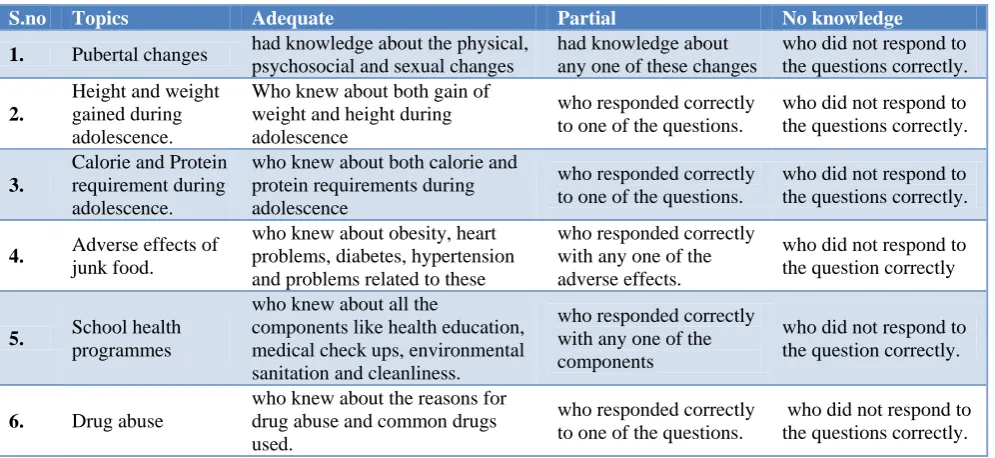
Table 1: The teachers were categorised according to this table during data entry.
S.no Topics Adequate Partial No knowledge
1. Pubertal changes had knowledge about the physical, psychosocial and sexual changes
had knowledge about any one of these changes
who did not respond to the questions correctly.
2.
Height and weight gained during adolescence.
Who knew about both gain of weight and height during adolescence
who responded correctly to one of the questions.
who did not respond to the questions correctly.
3.
Calorie and Protein requirement during adolescence.
who knew about both calorie and protein requirements during adolescence
who responded correctly to one of the questions.
who did not respond to the questions correctly.
4. Adverse effects of
junk food.
who knew about obesity, heart problems, diabetes, hypertension and problems related to these
who responded correctly with any one of the adverse effects.
who did not respond to the question correctly
5. School health
programmes
who knew about all the
components like health education, medical check ups, environmental sanitation and cleanliness.
who responded correctly with any one of the components
who did not respond to the question correctly.
6. Drug abuse
who knew about the reasons for drug abuse and common drugs used.
who responded correctly to one of the questions.
Statistical analysis
Data thus collected was entered into Microsoft Excel and analysed using SPSS version 20 software. Descriptive tables were generated to elaborate the findings while Chi-square test and p-value were applied to find any significant differences between the pre and post intervention levels of knowledge.
RESULTS
The responses of only 155 teachers, who came for the educational session and were followed up, were considered and analysed.
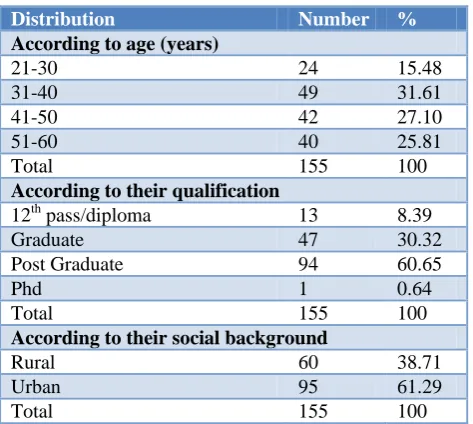
Table 2: Distribution of teachers according to their age, qualification and their social background.
Distribution Number %
According to age (years)
21-30 24 15.48
31-40 49 31.61
41-50 42 27.10
51-60 40 25.81
Total 155 100
According to their qualification
12th pass/diploma 13 8.39
Graduate 47 30.32
Post Graduate 94 60.65
Phd 1 0.64
Total 155 100
According to their social background
Rural 60 38.71
Urban 95 61.29
Total 155 100
49 teachers (31.61%) were in the age group of 31-40 yrs, followed by 42 (27.10%) in 41-50 yrs age group and 40 (25.16%) in 51-60 yrs age group. Majority 94 (60.65%) of teachers were post graduates followed by 47 (30.32%) graduates. 95 (61.29%) of the teachers had urban background while 60 (38.71%) had rural back ground (Table 2).
While assessing the knowledge of the teachers about adolescent problems it was found that maximum 74 (47.7%) teachers were aware of the psychosocial problems of adolescents (depression, anxiety, inferiority complex, behavioural problems, problems in interaction with opposite sex, lagging behind in studies etc). Only 41 (26.5%) teachers knew about the sexual problems (masturbation, nightfall, premarital sex and myths related to sexuality) and 37 (23.9%) teachers were aware of the physical problems (under weight, short height, obesity, common ailments and injuries). The number of teachers having knowledge about the sexual and physical problems increased to 66 (42.6%) and 59 (38.1%) respectively after intervention which was found to be statistically significant (Table 3).
Table 3: Distribution of teachers according to the knowledge about problems of adolescents.
Knowledge about problems of adolescents
Before intervention N (%)
After intervention N (%)
Chi sq, p value
Psychosocial 74 (47.7) 90 (58.1) 3.314, p>0.05
Sexual 41 (26.5) 66 (42.6) 8.920, p<0.01
Physical 37 (23.9) 59 (38.1) 7.303, p<0.01
Multiple responses were permitted for this question.
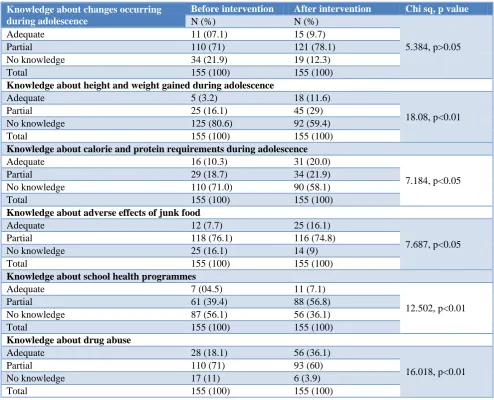
In Table 4, majority 110 (71%) of the teachers had partial knowledge i.e. were aware of either one or two of the physical, sexual and psychosocial changes occurring during adolescence while only 11 (7.1%) teachers had adequate knowledge about these changes. The teachers were imparted the knowledge about physical changes (increase in weight and height, change in body proportions, change in voice, facial hair etc.), sexual changes (development of primary and secondary sexual characters) and psychosocial changes (development of self image self esteem, mental faculties, attraction towards opposite sex etc). After the intervention, number of teachers having adequate and partial knowledge increased to 15 (9.7%) and 121 (78.1%) respectively which was found to be statistically significant. Majority, 125 (80.6%), of the teachers had no knowledge regarding height and weight gained during adolescence which decreased to 92 (59.4%) after the intervention. More than 2/3rd [110 (71%)] of the teachers were unaware of daily calorie and protein requirements which decreased to 90 (58.1%) after intervention. Only 12 (7.7%) were aware about adverse effects of junk food which increased to 25 (16.1%) after intervention. Only 28 (18.1%) had adequate knowledge about drug abuse which increased to 56 (36.1%) after intervention. Although significant favorable changes were observed in the knowledge regarding physical growth, nutrition and drug abuse, still the overall knowledge level remained low only.
Significant changes were observed in the practices of teachers regarding extending help to the adolescents in the form of providing counselling, discussing about their problems with the parents and advising them to consult a doctor (Table 5).
Table 4: Distribution of teachers according to the knowledge about different aspects of adolescent health.
Knowledge about changes occurring during adolescence
Before intervention After intervention Chi sq, p value
N (%) N (%)
5.384, p>0.05
Adequate 11 (07.1) 15 (9.7)
Partial 110 (71) 121 (78.1)
No knowledge 34 (21.9) 19 (12.3)
Total 155 (100) 155 (100)
Knowledge about height and weight gained during adolescence
Adequate 5 (3.2) 18 (11.6)
18.08, p<0.01
Partial 25 (16.1) 45 (29)
No knowledge 125 (80.6) 92 (59.4)
Total 155 (100) 155 (100)
Knowledge about calorie and protein requirements during adolescence
Adequate 16 (10.3) 31 (20.0)
7.184, p<0.05
Partial 29 (18.7) 34 (21.9)
No knowledge 110 (71.0) 90 (58.1)
Total 155 (100) 155 (100)
Knowledge about adverse effects of junk food
Adequate 12 (7.7) 25 (16.1)
7.687, p<0.05
Partial 118 (76.1) 116 (74.8)
No knowledge 25 (16.1) 14 (9)
Total 155 (100) 155 (100)
Knowledge about school health programmes
Adequate 7 (04.5) 11 (7.1)
12.502, p<0.01
Partial 61 (39.4) 88 (56.8)
No knowledge 87 (56.1) 56 (36.1)
Total 155 (100) 155 (100)
Knowledge about drug abuse
Adequate 28 (18.1) 56 (36.1)
16.018, p<0.01
Partial 110 (71) 93 (60)
No knowledge 17 (11) 6 (3.9)
Total 155 (100) 155 (100)
Table 5: Distribution of teachers according to the help they extended to the students.
Help extended by the teachers to adolescent students
Before intervention N (%)
After intervention
N (%) Chi sq, p value
Providing Counselling 56 (36.1) 86 (55.5) 11.695, p<0.01
Discussing with parents 19 (12.3) 29 (18.7) 2.465, p<0.05
Advising them to consult Doctor 12 (7.7) 25 (16.1) 5.187, p<0.05
Table 6: Distribution of teachers according to their opinion about factors which help and which adversely affects health of adolescents.
Before intervention N (%)
After intervention
N (%) Chi sq, p value
Factors which help adolescents to cope up better
Regular health check ups, counselling 120 (77.4) 127 (81.9) 0.976, p>0.05 Social support 101 (65.2) 117 (75.5) 3.957, p<0.05 Health education 91 (58.7) 104 (67.1) 2.336, p>0.05
Sports 76 (49) 90 (58.1) 2.542, p>0.05
Before intervention N (%)
After intervention
N (%) Chi sq, p value
Factors adversely affecting adolescent health
Lack of knowledge about adolescent
problems 92 (59.4) 105 (67.7) 2.353, p>0.05 Exposure to risky behaviour 86 (55.5) 100 (64.5) 2.634, p>0.05 Junk food 66 (42.6) 86 (55.5) 5.163, p<0.05 Internet/TV 64 (41.3) 82 (52.9) 4.195, p<0.05 Peer pressure 38 (24.5) 61 (39.4) 7.851, p<0.01 Lack of health check ups/counselling 26 (16.8) 34 (21.9) 1.323, p>0.05
Table 7: Distribution of teachers according to their opinion regarding the advantages of equipping adolescents with better information about adolescent issues.
Does providing better information helps them to
Before intervention N (%)
After intervention
N (%) Chi sq, p value
Reduce risky behaviours 149 (96.1) 153 (98.7) 2.186, p>0.05
Understand the process of growth 147 (94.8) 153 (98.7) 6.120, p<0.05
Develop personality 147 (94.8) 151 (97.4) 2.054, p>0.05
Develop scientific attitude to remove
myths 145 (93.5) 154 (99.4) 8.071, p<0.05
Most of the teachers were of the opinion that provision of better information from the right sources helps the adolescents to reduce risky behaviours, understand the process of growth better, develop personality and develop a scientific attitude to remove myths (Table 7).
DISCUSSION
The study group of 155 respondents was largely composed of teachers of urban background mostly in the age group of 31-40 yrs. The baseline knowledge of the teachers in most of the aspects of adolescent health was found to be low. A similar study conducted by Shah P et al (2010) in schools of 3 urban cities of north India on 1500 teachers showed that major gaps exist in health and nutrition-related knowledge and behaviour of urban Indian teachers. It also concluded that private school teachers had significantly better knowledge than government school subjects.8
A significant increase in the knowledge was observed post intervention in most of the above areas. In the present study, more number of teachers were aware of the psychosocial problems of adolescent boys as compared to the physical and sexual problems. This might be because psychosocial problems are usually considered as major one as compared to the physical and sexual problems which are considered as a normal part of the developmental process. It is important to have knowledge about adolescent problems as various studies on school going children and adolescents revealed that the prevalence of psychosocial problems in them is in the range of 20%-33%. In a study done by Ahmed et.al (2002-2003) among 390 male adolescents in rural and urban schools of Aligarh, the overall prevalence of psychosocial problems was found to be 17.9%.9
After intervention the number of teachers having adequate knowledge regarding height and weight gained during adolescence and about calorie and protein requirement during adolescence increased. The change was found to be statistically significant. The level of knowledge was more among teachers who had adolescent children as compared to those who did not and this co-relation was found to be statistically significant. This might be due to their personal involvement in the well being and development of their own children in adolescent age. The level of knowledge of the calorie and protein requirement was less among teachers with urban background as compared to those with rural background and this co-relation was found to be statistically significant. However only 7.7 % of teachers had adequate knowledge about the harmful effects of junk food which increased to 16.1% after intervention. The change was statistically significant but still the overall knowledge continues to be inadequate. The knowledge of the teachers about nutritional health plays a great role in inculcating healthy dietary habits in the students. A study conducted by the Department of Community Medicine, GMCH, Chandigarh by Puri et al in 2007 on adolescent school children, in which teachers acted as health educators and health messengers, showed that there was increase in the number of subjects bringing tiffin from one thirdin the pre intervention phase to half in the post intervention phase.10
professionals traditionally have been viewed as critical sources of care and formation. Therefore, if teachers are equipped with accurate health promotion related information, their messages are likely to be perceived as credible and bring about the change in behaviour towards substance abuse.11 Significant changes were observed in the practices of teachers regarding extending help to the adolescents in the form of providing counselling, discussing about their problems with the parents and advising them to consult a doctor. Educating parents and teachers to improve the quality of relationship with children to ensure a safe, secure and appropriate environment has helped in reducing psychological disorders and social misbehaviour.12
Lack of knowledge about adolescent problems, exposure to risky behaviour, junk food, internet/TV, peer pressure, lack of health check ups /counselling were considered as factors adversely affecting adolescent health. Mass media plays an important role in habit picking and decides the lifestyle pattern. Its influence is clearly shown in a study from Chennai done in the age group 11 to 17 yrs reporting that, 90% eat either food or snacks while watching TV, 82% buy food products and snacks based on advertisement, 59% skipped outdoor activities for TV, 42% follows diet and 42% exercise to get the body like their favourite media personality.13 Television viewing in childhood and adolescence is associated with overweight, poor fitness, smoking and raised cholesterol in adulthood.14
CONCLUSION
In the present study the overall knowledge of the teachers in most of the aspects of the adolescent health was found to be low. After the health education was provided to them, significant favourable changes in the knowledge of the teachers were observed. The need for regular in service training of the teachers is being highlighted in this study. It is also emphasised that the teachers can play a proactive role in adolescent health programmes by imparting health education to the adolescents.
Funding: No funding sources Conflict of interest: None declared
Ethical approval: The study was approved by the Institutional Ethics Committee
REFERENCES
1. Kishore J. Concepts and Principles of National Health Programs. In: National Health Programs of India. Dr. J Kishore, Century Publications 11th Ed. 2014: 25.
2. Prakash O, Giri OP, Mishra AK, Kumar S, Kulhara P. Knowledge and attitude of Indian adolescents towards addiction: Findings from an exploratory survey. J Mental Health Human Behavior. 2009;14(2):74-9.
3. Gobalakrishnan C, Shunmapiya K. A study on married girl students in Salem, Tamil Nadu. International Journal of Research in Humanities, Arts and Literature. 2014;2(1):29.
4. Bezbarauh S, Janeeja MK. Adolescents in India-A Profile. UNFPA for UN systems in India, New Delhi, 2000;16:50-6.
5. Thomas R, Perera R. School-based programmes for preventing smoking. Cochrane Database Systmatic Reviews.2006;19;3:CD001293.
6. Mc Grath K, Sinclair M. More male primary school teachers? Social benefits for boys and girls. Gender and Education. 2013;25(5):531.
7. Kaushal P, Singh T, Padda AS, Deepti SS, Bansal P, Satija M, et al. Impact of Health Education on the Knowledge, Attitude and Practices of teachers regarding reproductive health of adolescents of Amritsar, Punjab. J Clin Diagnos Res. 2015;9(5):18-21.
8. Shah PS. Perceptions of school teachers about sexual health education. Indian J Applied Res. 2014;4(1):415-7.
9. Ahmad A, Khalique N, Khan Z, Amir A. prevalence of psychosocial problems among school going male adolescents. Indian J Community Med. 2007;32:219-21.
10. Puri S, Bhatia V, Swami H, Rai S, Mangat C. Impact of a diet and nutrition related education package on the awareness and practices of school children of Chandigarh. Int J Epidemiol. 2008;6(1). 11. Perumbilly SA, Anderson SA. Substance Abuse
Prevention: Perspectives from India‟s Addiction Treatment Professionals. Artha J Social Sci. 2015;14(2):9-32.
12. Sivagurunathan C, Umadevi R, Rama R, Gopalakrishnan S. Adolescent Health: Present Status and Its Related Programmes in India. Are We in the Right Direction? J Clin Diagnos Res. 2015;9(3):LE01–LE06.
13. Priyadarshini R, Jasmine S, Valarmathi S, Kalpana S, Parameswari S. Impact of media on the physical health of urban school children of age group 11-17 yrs in Chennai - A cross sectional study. IOSR J Humanities Social Sci. 2013;9(5):30–5.
14. Hancox R, Milne B, Poulton R. Association between child and adolescent television viewing and adult health: a longitudinal birth cohort study. The Lancet. 2004;364(9430):257–62.