International Journal of Emerging Technology and Advanced Engineering
Website: www.ijetae.com (ISSN 2250-2459,ISO 9001:2008 Certified Journal, Volume 4, Issue 11, November 2014)
449
Adsorption of Phenol on Activated Carbon, Study in Mode
Static and Dynamic
Yassine Morad
1, Mustapha Hilali
2, Lahcen Bazzi
3 Laboratory Materials and Environment. Ibn Zohr University Faculty of Sciences Agadir Abstract--- Water consumption does not cease to increasewith population growth and industrialization. Also declining water supplies and low rainfall are now a major challenge for the human being; hence the need to preserve this resource is essential.
Water treatment is one of the most exploited components for reuse of wastewater or contaminated. Among these methods, adsorption which permits purification, discoloration, deodorization and general detoxification of waters.
Decontamination of polluted water by phenol adsorption using activated carbon was the subject of this study. Studies in dynamic mode, shows that the adsorption and exothermic reaction, as the study of other parameters such as pH, dissolved oxygen, potential and conductivity during the reaction show the evolution of each of these parameters depending on time.
For the study against static mode, indicated a net improvement of phenol adsorption on activated carbon.
Despite the setting of some parameter such as temperature and pH, the study shows that this assumption is not always true following the reactions that can take place and their influence on the process; something which is in contradiction with the fact that the fixing of the parameters can be controlled.
The study of UV adsorption curves of phenol on activated carbon can show us the disappearance of phenol or the appearance of other derivatives from the adsorption reaction.
Keywords--- Adsorption, phenol, activated carbon, temperature, pH, conductivity, dissolved oxygen.
I. INTRODUCTION
Phenol and its derivates are generally considered as the most hazardous organic pollutants since they are harmful to organisms even at the lowest concentrations [1,2]. The major sources of phenol pollution in the aquat-ic environment are wastewaters from paint, pestaquat-icide, coal conversion, polymeric resin, petroleum and petro-chemical industries. The chlorination of natural waters for disinfection produces chlorinated phenols [3]. The utilization of phenol-contaminated waters causes protein degeneration, tissue erosion, paralysis of the central nervous system and also damages the kidney, liver and pancreas in human bodies [4].
The depollution of wastewaters containing phenolic compounds is considered as one of the top priority since they are not only carcinogenic but also cause bad taste and odor even at low concentrations [5].
Various processes were developed to treat the phenol-containing effluents including catalytic oxidation [6], biodegradation [7], solvent extraction [8] and adsorption [9]. Among these methods, adsorption is still the most versatile and widely used method, since it can remove many types of pollutants. The design and the operation are convenient and is proved to be one of the most attrac-tive and effecattrac-tive techniques for purification and separa-tion in wastewater treatment [10,11]. Adsorpsepara-tion is used for the removal of low concentrations of organic pollu-tants from large volumes of potable water, process efflu-ents, wastewater, and aqueous solutions [12]. Adsorption is an economical method for water decontamination applications and for separation analytical purposes and it is frequently used for the removal of phenolic pollutants [13].
Different adsorbents such as: activated carbon [2], zeolites [14], and clay [15] were investigated for the removal of phenol and phenolic pollutants from wastewater. Even if activated carbon, obtained by differ-ent carbonaceous materials such as wood, nutshells and fruit stones, peat, charcoal, lignite, bituminous coal, and petroleum coke, are the most widely used adsorbents.
II.MATERIALS AND METHODS
The activated carbon used is brand Scharlau CA0351 powder extra pure.
Measures the concentration of phenol in solutions at different reaction times were followed by UV spectro-scopic method.
Temperature measurements, pH, dissolved oxygen po-tential and are controlled by the D230 camera and con-ductivity we used the concon-ductivity
International Journal of Emerging Technology and Advanced Engineering
Website: www.ijetae.com (ISSN 2250-2459,ISO 9001:2008 Certified Journal, Volume 4, Issue 11, November 2014)
450
III. RESULTS AND DISCUSSION
[image:2.595.317.561.157.317.2]A.Phenol characterization
Figure 1. UV spectrum phenol and phenate.
Phenol UV spectrum is characterized by a maximum absorption at 265 nm but the lambda phenate is about 285 nm. So in this study, we will be based on the maxi-mum absorbance because the passage of the phenol to form other form as phenate or other we will skew the results; especially since most studies not vary the pH and keeps the fixed maximum absorbance at 265 nm. And say the phenol adsorbed 100%.
[image:2.595.56.271.429.594.2]B.Activated carbon characterization
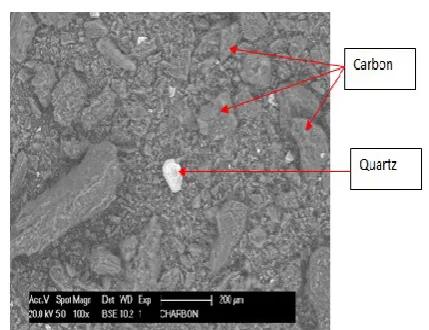
Figure 2. Activated carbon in MEB.
TABLE 1
ICP ANALYSIS OF ACTIVATED CARBON.
SiO2 (%) Al2O3 (%) Fe2O3 (%) CaO (%) MgO (%)
<0,01 0,03 0,03 0,15 0,13
B (ppm) Ba (ppm) Be (ppm) Bi (ppm) Cd (ppm)
<10 12 <0,2 <20 <2
Mo (ppm) Nb (ppm) Ni (ppm) Pb (ppm) Sb (ppm)
<8 <1 <17 <26 32
K2O (%) MnO (%) TiO2 (%) P2O5 (%) As (ppm)
0,04 <0,01 <0,01 <0,01 15
Co (ppm) Cr (ppm) Cu (ppm) Ge (ppm) Li (ppm)
<7 3 <10 <10 25
Se (ppm) Sn (ppm) Sr (ppm) W (ppm) Zn (ppm)
<40 5 10 <23 10
Characterization of adsorbate, by the MEB reveals the presence of carbon and quartz (Figure 1) and the ICP Table 1 shows the existence of trace elements outside atoms.
Also the measurement of the specific surface experi-mentally displays a value of 793.76 m2 / g, for against porosity of 37.13%.
A.Adsorption of phenol in dynamic mode
The study of the adsorption reaction in dynamic mode without setting any of the parameters studied, reveals the following phenomena:
[image:2.595.315.548.462.625.2]1. pH of evolution
International Journal of Emerging Technology and Advanced Engineering
Website: www.ijetae.com (ISSN 2250-2459,ISO 9001:2008 Certified Journal, Volume 4, Issue 11, November 2014)
451
The pH changes during the adsorption reaction show an increasing trend over time to stabilize after 60 minutes.
[image:3.595.52.267.177.366.2]2. Evolution of the potential
Figure 4. Evolution of the potential during the adsorption reaction. For the potential we before a fall from the first minute to stabilize in the 5th minute. This drop can be justified by a reaction between activated carbon and doubled dis-solved oxygen in solution.
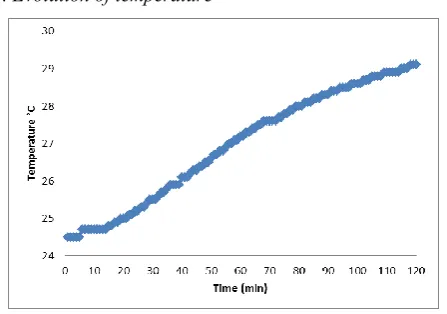
[image:3.595.319.546.305.480.2]3. Evolution of temperature
Figure 5. Evolution of the temperature during the adsorption reaction.
As regards the temperature, we have a rising curve with time, indicating that the adsorption reaction of the phenol on activated carbon is an exothermic reaction.
4. Impact of pH on adsorption of phenol on activated carbon
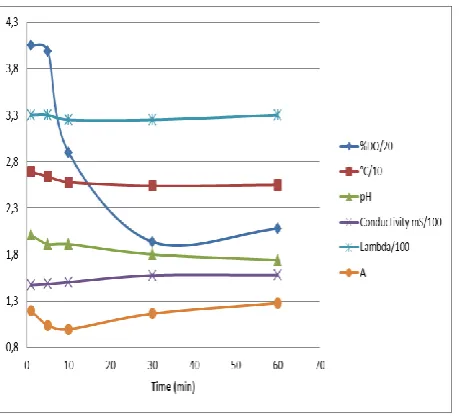
First, we set the temperature with a water bath with temperature control, as we realized the adsorption reaction in acidic or pH 2.
From Figure 6, we find that the temperature is at least controlled by against the pH decreases with time despite binding to the beginning of the reaction to 2.
For conductivity, the curve is increasing over time as against the potential is decreasing.
Conductivity believed from the outset of the reaction to stabilize after 30 minutes at 157 mV. Regarding the potential, the change did not begin until the fifth minute to stabilize after a 50% after 20 min.
Figure 6. Evolution of pH, conductivity and dissolved oxygen dur-ing the adsorption reaction in acid medium.
[image:3.595.52.276.448.605.2]International Journal of Emerging Technology and Advanced Engineering
Website: www.ijetae.com (ISSN 2250-2459,ISO 9001:2008 Certified Journal, Volume 4, Issue 11, November 2014)
[image:4.595.313.543.124.335.2]452
Figure 7. Evolution of the parameters studied during theadsorp-tion reacadsorp-tion of the phenol on activated carbon under acidic condi-tions pH = 2.
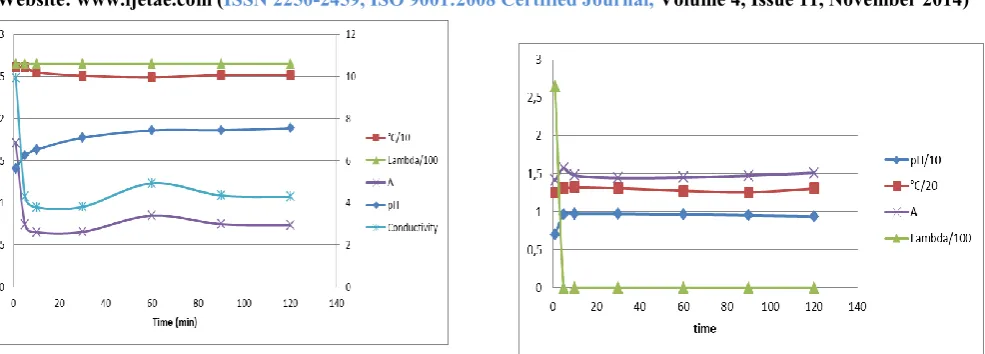
[image:4.595.51.281.132.341.2]Next, we studied the adsorption reaction in basic me-dium, Figure 8 shows that for a fixed tempera-ture, we have also fixed conductivity against a pH which increas-es with time, but dissolved oxygen decreasincreas-es with time.
Figure 8. Evolution of pH, conductivity and dissolved oxygen dur-ing the adsorption reaction in a basic medium.
[image:4.595.320.544.359.529.2]The fig 9 shows the same as from the 5th minute we change the parameters, except that here we do not have a maximum adsorption. 10 shows the absorbance at time t = 0 has a maximum absorption at 285 nm which is the absorption wavelength of the phenolate ion. And during changing times, we do not have a maximum adsorption.
Figure 9. Evolution of the parameters studied during the adsorp-tion reacadsorp-tion of the phenol on activated carbon in a basic medium.
[image:4.595.49.288.427.619.2]International Journal of Emerging Technology and Advanced Engineering
Website: www.ijetae.com (ISSN 2250-2459,ISO 9001:2008 Certified Journal, Volume 4, Issue 11, November 2014)
453
Figure 11. Evolution of the parameters studied during theadsorp-tion reacadsorp-tion of phenol on activated carbon at pH 4. Figure 12. Evolution of the parameters studied during the adsorp-tion reaction of phenol on activated carbon at pH 7. Summarizing these variations:
TABLE 2
SUMMARY OF RESULTS
Factors pH = 2 pH = 4 pH = 7 pH = 10,75
pH decrease increase increase increase
Conductivity increase decrease -- decrease
Absorbance decrease decrease increase increase
Change Lambda yes No yes yes
Dissolved Oxygen decrease -- -- decrease
From these results (table 2), we can conclude that the best in terms of adsorption pH is the pH 4, because we have an absorbance reduction with lambda keeping at 265 nm. However at pH 2, we have a lambda traveling with pentachlorophenol formation hypothesis.
IV. CONCLUSION
The adsorption reaction of the phenol on activated carbon is an exothermic reaction, as this reaction is char-acterized by the depletion of dissolved oxygen and pH increase.
The study mainly in static mode for pH, reveals that acidic pH environment 2, it is not a phenol adsorption but rather the formation of another compound that is penta-chlorophenol.
The best adsorption efficiency is found in the middle acid to pH 4 with a 66% removal efficiency.
The change in conductivity is decreasing pH 4 and against increasing by 10.75 at pH 2.
For dissolved oxygen, we have a decreasing trend at pH 2 and 10.75.
REFERENCES
[1] M. Sobiesiak, B. Podkoscielna, Preparation and characterization of porous DVB copolymers and their applicability for adsorption (solid-phase extraction) of phenol compounds, Appl. Surf. Sci. 257 (2010) 1222–1227.
[2] Z. Ioannou, J. Simitzis, Adsorption kinetics of phenol and 3-nitrophenol from aqueous solutions on conventional and novel carbons, J. Hazard. Mater. 171 (2009) 954–964.
[3] Md. Ahmaruzzaman, Adsorption of phenolic compounds on low-cost adsorbents: a review, Adv. Colloid Interface Sci. 143 (2008) 48–67.
[4] H.B. Senturk, D. Ozdes, A. Gundogdu, C. Duran, M. Soylak, Removal of phenol from aqueous solutions by adsorption onto or-ganomodified Tirebolu bentonite: equilibrium, kinetic and ther-modynamic study, J. Hazard. Mater. 172 (2009) 353–362. [5] U. Beker, B. Ganbold, H. Dertli, D.D. Gülbayir, Adsorption of
phenol by activated carbon: influence of activation methods and solution pH, Energy Convers. Manage. 51 (2010) 235–240. [6] I. Kumakiri, J. Hokstad, T.A. Peters, A.G. Melbye, H. Ræder,
Oxidation of aromatic components in water and seawater by a cat-alytic membrane process, J. Petrol. Sci. Eng. 79 (2011) 37–44. [7] J. Yan, R. Nanqi, C. Xun, W. Di, Q. Liyan, L. Sen,
[image:5.595.56.549.125.302.2]International Journal of Emerging Technology and Advanced Engineering
Website: www.ijetae.com (ISSN 2250-2459,ISO 9001:2008 Certified Journal, Volume 4, Issue 11, November 2014)
454
[8] J. Fan, Y. Fan, Y. Pei, K. Wu, J. Wang, M. Fan, Solvent extrac-tion of selected endocrine-disrupting phenols using ionic liquids, Sep. Purif. Technol. 61 (2008) 324–331.
[9] J.M.R.R. Arana, R.R. Mazzoco, Adsorption studies of methylene blue and phenol onto black stone cherries prepared by chemical activation, J. Hazard. Mater. 180 (2010) 656–661.
[10] X. Zeng, Y. Fan, G. Wu, C. Wang, R. Shi, Enhanced adsorption of phenol from water by a novel polar post-crosslinked polymeric adsorbent, J. Hazard. Mater. 169 (2009) 1022–1028.
[11] Q. Liu, T. Zheng, P. Wang, J. Jiang, N. Li, Adsorption isotherm, kinetic and mechanism studies of some substituted phenols on ac-tivated carbon fibers, Chem. Eng. J. 157 (2010) 348–356. [12] O. Hamdaoui, E. Naffrechoux, Modeling of adsorption isotherms
of phenol and chlorophenols onto granular activated carbon Part I. Two-parameter models and equations allowing determination of thermodynamic parameters, J. Hazard. Mater. 147 (2007) 381– 394.
[13] M.A. Hararah, K.A. Ibrahim, A.H. Al-Muhtaseb, R.I. Yousef, A. Abu- Surrah, A. Qatatsheh, Removal of phenol from aqueous so-lutions by adsorption onto polymeric adsorbents, J. Appl. Polym. Sci. 117 (2010) 1908–1913.
[14] L. Damjanovi´c, V. Raki´c, V. Rac, D. Stosi´c, A. Auroux, The investigation of phenol removal from aqueous solutions by zeo-lites as solid adsorbents, J. Hazard. Mater. 184 (2010) 477–484. [15] S. Froehner, R.F. Martins, W. Furukawa, M.R. Errera, Water
remediation by adsorption of phenol onto hydrophobic modified clay, Water Air Soil Poll. 199 (2009) 107–113.