Analysis of the Scientific Production of Articles on
Innovation Environment: A Bibliometric Study
Rudicler Silveira Belem
Post-Graduate Program in Business Administration, University of Caxias do Sul, Brazil
Jean Muchel Baú
Post-Graduate Program in Business Administration, University of Caxias do Sul, Brazil
Marta Elisete Ventura da Motta
Post-Graduate Program in Business Administration, University of Caxias do Sul, Brazil
Ademar Galelli
Post-Graduate Program in Business Administration, University of Caxias do Sul, Brazil
Abstract
The purpose of this article is to verify how scientific studies are being developed in the area of innovation management, more precisely on the theme of innovation environment. In the accomplishment of this study, the data of scientific production in the Portal of Periodicals of CAPES (Coordination of Improvement of Personnel of Graduate Level) was initially carried out. This database was selected for this research because it indexes all national scientific journals and, thus, allows to scrutinize the national intellectual production. Among the search terms, the following expressions were defined: "environment" AND "innovation", because these items are representative for the researched topic. The articles show the use of tools to analyze the innovation environment in organizations and the importance of human capital as a source of ideas and knowledge enhancement. It is also concluded that most of the articles in this time interval are exploratory in nature and have a qualitative approach. Keywords: Innovation environment, bibliometrics, content analysis
1 INTRODUCTION
In developed countries, innovation has been evidenced as an essential factor of national economic policies, that is, it has been adopted as an indispensable factor to reach a significant pattern of development (SCHUMPETER, 1988).
Considering competition pressures, increasing the need to continually adapt and develop innovations has become a basic foundation for organizational excellence. Deficiencies to innovate eventually can lead companies to stagnate in a dynamic environment.
For a long period of time, competitiveness between organizations sought in the economic theory, especially under the approach of perfect competition, the explanations on the market oscillations. From this perspective, no single economic agent, in this case an organization, is able to change or influence market prices.
According to Leite (2005), the innovation process is directly influenced by the organizational environment. An invention is generally not predictable, but business managers should provide an environment conducive to new ideas, standards and mechanisms that promote innovation. Van de Ven, Angle and Poole (2000) emphasize that the process of innovation is a consequence of the relationship between the internal environment and the events that take place in the external environment of the organization. These facts stimulate the transformations, causing the development team to adopt new attitudes, which in turn results on more innovations.
According to Barbieri et al. (2010), it is difficult to maintain a constant rhythm of innovations, even of development or incremental character. The authors suggest that innovations, both technological and organizational, are processed in complex ways, involving activities carried out by people both inside and outside the organizations, forming interpersonal networks.
Some of the factors that can be analyzed in the internal environment to the organizations for the emergence of new technologies and innovations are in the organizational, personal, marketing, production, financial and cultural aspects. An organization that does not have a culture conducive to the development of innovations may collapse. The conditions for companies to operate more efficiently and effectively can be achieved with the use of these indicators, which will guide the formulation and implementation of management models for supporting and maintaining an innovative internal environment, leading to a culture of innovation.
management, intra entrepreneurship, reward system and innovative climate are some themes related to management models that interfere in innovation processes.
2 LITERATURE REVIEW
2.1Innovation
Schumpeter (1988, p. 105) was one of the pioneers to conceptualize the term innovation. Responsible for contributions that influenced economic theories for decades, the author defended the understanding of innovation as: "the introduction of new products; new production methods; the opening of new markets; the expansion of new sources of supply; and the adoption of new forms of organization."
Schumpeter (1988) suggested that it is through innovation that firms renew their asset base. Despite the recognized importance of innovation for organizational competitiveness and economic development, data from Brazilian industry show that innovation in the country grows very slowly.
One of the most used concepts in research on innovation, even by the Research for Technological Innovation (PINTEC), is found in the Oslo Manual. This manual, formulated by the Organisation for Economic Co-operation and Development (OECD), proposes guidelines for collecting and interpreting data on technological innovation. According to paragraph 146 of the Oslo Manual (2005), innovation is characterized by the implementation of a new or substantially improved product, service or process, or again new marketing method, new business practices, new organization of working site and new external relations (OECD, 2005, p. 55). It is observed, however, that innovation is extended to all organizational areas and that it is not only associated with technology in electronic and computational equipment.
For Van de Ven, Angle and Poole (1999), innovation is, above all, a method of creating and applying novelty, including new methods and development of new ideas, such as a new technique, article, process or arrangement. The authors also argue that new ideas can be a combination of old ideas, challenging the current order. They classify innovations in technical (new technologies, products and services) and administrative (new procedures, policies and organizational structure), and argue that innovations must be systemic in such a way that separation of these two types can lead to fragmentation of the process, damaging the innovations.
2.2 Innovation Environment
According to Lewis and Ricard (2014), the innovation capacity of any public organization is related to the environment in which it is located. Innovation environment refers to the set of political, economic, social and cultural factors that stimulate or hinder innovation.
The analysis of the innovation environment is not only about the process, it goes further, evaluating the "before" and "after" generation of the idea. Thus, in addition to the relationships between the individuals involved in innovation, an environment conducive to it also includes people who interact with the areas of innovation development, responsible for the implementation of the Methodology by Competencies in the context of vocational education.
According to Porter (2004), general environment can be a set of structural aspects that can influence the different companies that have products with the same attributes and do business in a specific country.
Innovation process is a theme studied by many authors, such as Damanpour (1991), Kimberly and Evanisko (1981), Van de Ven, Angle and Poole (1999). These authors emphasized that an environment that stimulates and promotes innovation and synergy with a good management process is a prime factor that drives the success of services and products offered to a consumer market.
Thus, the process of innovation consists of motivating and coordinating people to develop and implement ideas through engaging in transactions (or relationships) with others and making the necessary adaptations to achieve desired outcomes within an institutional and organizational context (Van de Ven et al., 1999).
The Van de Ven, Angle and Poole (1999) approach reflects that innovation is a process of implementing and developing novelty, including the development of new ideas, processes, products, technology or arrangements. Nevertheless, studies by the MIRP (Minnesota Innovation Research Program) group examine the relationship between 14 innovations in terms of four main concepts: people, new ideas, context, and transactions. The innovations varied from product innovation to business and management innovation.
3. METHODOLOGY
is an important tool considering the need and growing efforts to use indicators for national planning of research activities (Mugnani et al., 2004).
3.1Methodological Procedures
The chosen terms were searched in the title, abstracts, and keywords of peer-reviewed scientific articles published in the last 5 years (2012-2016). This preliminary search found 2,046 articles. In order to further refine the search and to match the results to the objectives of this study, the filters "peer-reviewed journals" (resulting in 1,776 articles), "published in Portuguese" (resulting in 959 articles) and "Brazil" (resulting in 145 articles) were added. No limitations were defined in relation to fields of study or areas of science, in order to seek a broader analysis of national production.
The abstracts of all the articles were also read, in order to carry out a final filtering, confirming its adherence to the terms researched. In addition, the exclusion of duplicate articles and those that had an abstract in English only was carried out, followed by the exclusion of articles published in non-Brazilian journals, resulting in a final number of 112 articles. The searches were conducted in October 2017.
The data were imported into Microsoft Excel® software for a descriptive and quantitative analysis of the publications. To measure the frequency of the keyword, in the "keywords" section the WordCount360 software was used, followed by the graphic construction of a word cloud through the Jasondavies tool.
4 RESULTS ANALYSIS
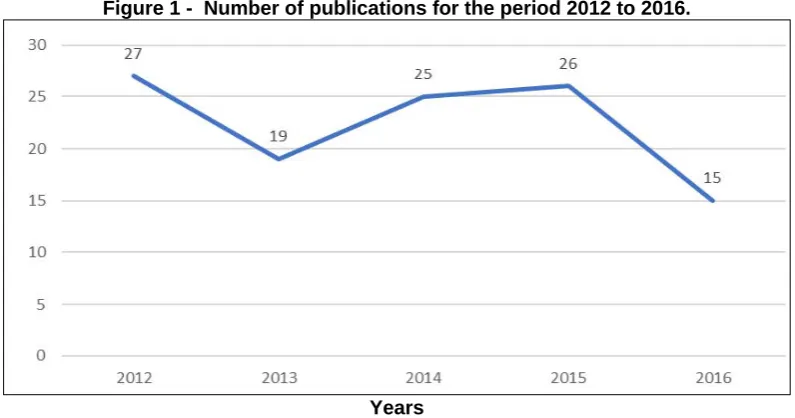
In order to organize the selected articles, bibliometrics was used to tabulate the information about them, which follow in the form of graphs to illustrate the results. Bibliometry theorists have developed "Laws" that guide the analysis of scientific publication. Chen et al. (1994) highlighted as the main laws of bibliometric distribution: Lotka, Zipf and Bradford. Figure 1 shows the number of publications for the period 2012 to 2016.
It can be noticed that the year with the highest number of publications was 2012, with 27 publications. The year with the lowest number of published articles was 2016, with only 15 publications, indicating a possible decrease in the scientific community's interest in the themes.
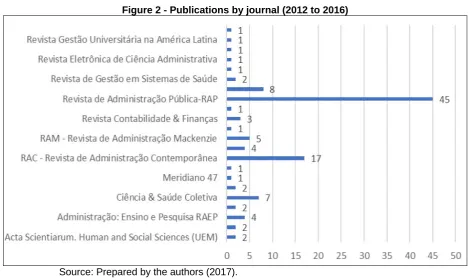
For Vanti (2002), the Bradford Law allows to suggest the nucleus and the areas of dispersion on a subject in the same group of periodicals, with measures of productivity of each journal. Figure 2 shows a presentation of the evolution of the publications by journal, maintaining the period from 2012 to 2016.
Figure 1 - Number of publications for the period 2012 to 2016.
Years
Source: Prepared by the authors (2017).
When the number of publications by journals is taken into account, there is a distinct leadership (45 articles) of the Revista de Administração Pública (Journal of Public Administration), which shows an effective interest of the academic community in the study of innovation environments and their relations with public spheres. The second journal with the highest number of publications is the Revista de Administração Contemporânea (Contemporary Administration Journal), with 17 articles published in the period (2012-2016).
Figure 2 - Publications by journal (2012 to 2016)
Source: Prepared by the authors (2017).
During the study, 298 authors signed the 122 articles found by this bibliometry. Only seven authors published more than one article containing the requisites of this study. All seven authors published two articles. They are: Alan Ferreira de Freitas, Alexandre de Padua Carrieri, Emerson Antonio Maccari, Leo Heller, Marcelo Mina Dias, Marlete Beatriz Macaneiro, and Sylmara Lopes Francelino Gonçalves-Dias.
Vanti (2002) addresses the Law of Zipf, which measures the frequency of occurrence of words in texts, providing an ordered list of terms of a certain subject. If words that occur in a text of considerable size are listed in descending order of frequency, the ranking of a particular word in the list will be inversely proportional to the frequency of the word.
Analyzing the set of keywords found in the "summary" section of the papers studied in this study, the word "management" was the one with the highest density, representing about 2% of the total frequency of words. We can also highlight four words related to the public sphere, which are among the seven most frequently: public, political, public and social.
Through a cloud of words, which points out the 50 most frequently used words, we found other words that stand out in frequency such as entrepreneurship, planning, innovation and performance.
5 FINAL CONSIDERATIONS
This study aimed to analyze the scientific production related to the Innovation Environment theme. In order to do so, a bibliometric research was carried out to verify the state of the art on the subject, and later a content analysis was carried out in order to identify the main application areas of this type of innovation.
To analyze the topics of interest in this article, the MIRP (Minnesota Innovation Research Program) system was used as a basis. MIRP served, in turn, as the basis for developing another program called the Minnesota Innovation Survey (MIS) as a model of environment analysis conducive to the development of innovations. Another important aspect addressed by several authors is the importance of managing innovation, encouraging creative capacity, developing personal characteristics of employees, and leadership.
REFERENCES
BARBIERI, J. C. et al. Inovação e Sustentabilidade: novos modelos e proposições. RAE - Revista de Administração de Empresas, v. 50, n. 2, abril-junho, p. 146-154. Fundação Getúlio Vargas. São Paulo, Brasil. 2010.
CHEN, Y.; CHONG, P. P.; TONG, M. Y. The Simon-Yule approach to bibliometric modeling. Information Processing & Management, v. 30, n. 4, p. 535-56, 1994.
FREEMAN, Christoph. Technology policy and economic performance. Londres: Pinter Publishers London and New York, 1987.
JASONDAVIES – available at: www.jasondavies.com, acess on Sept 08, 2017. LEITE, L. F. Inovação: o combustível do futuro. Rio de Janeiro: Qualitimark, 2005.
LEWIS, J. M. and Ricard, L. M., 2014a. Innovation Environments in the Public Sector: Formal Structures and Informal Structures. The International Research Society for Public Management (IPRSM) Conference, Ottawa, 9–11 April 2014. Berne, Switzerland: IPRSM
LOTKA, A. J. The frequency distribution of scientific productivity. Journal of the Washington Academy of Sciences, v. 16, n. 12, p. 317-323, june 1926.
MORIN, Edgar. O método II: a vida da vida. Porto Alegre: Sulina, 2001.
MUGNANI, Rogério; JANNUZZI, Paulo; QUONIAM, Luc. Indicadores bibliométricos da produção científica brasileira: uma análise a partir da base Pascal. Ciência da Informação, Brasília, v. 33, n. 2, p. 123-131, maio/ago. 2004.
OCDE - Organisation for Economic Co-operation and Developmet e FINEP – Financiadora de Estudos e Projetos. Manual de Oslo: diretrizes para coleta e interpretação de dados sobre inovação. 3. ed. Brasília, 2005.
PORTER, M. E. Estratégia Competitiva: técnicas para análise de indústria e da concorrência. Tradução de Elizabeth Maria de Pinho Braga. 2 ed. Rio de Janeiro: Elsevier, 2004
SCHUMPETER, J. A. A teoria do desenvolvimento econômico. São Paulo: Nova Cultural, 1988.
VAN DE VEN, A. H.; POOLE, M. S. Methods for studying innovation. Development in the Minnesota Innovation Research Program. Organizational Science, v. 1, n. 3, p. 313-35, 1990.
VAN DE VEN, A. H.; ANGLE, H. L.; POOLE, M. S. Research on the management of innovation: the Minnesota studies. New York: Oxford University Press, 2000. 719 p.
VANTI, N. Da bibliometria à webometria: uma exploração conceitual dos mecanismos utilizados para medir o registro da informação e a difusão do conhecimento. Ciência da Informação, v. 31, n. 2, p. 152-162, maio/ago. 2002.