Original Research Article
A cross sectional study on knowledge, attitude and practice of dengue
fever among high school students in Villupuram municipality
of Villupuram
Sasikaladevi S. Singaravel
1*, Elayaraja K. Kandaswamy
2INTRODUCTION
Dengue is a rapidly spreading mosquito-borne viral disease which has become the major international public health problem in recent times. The global incidence has increased to an extent that nearly half of the world's population is at risk of dengue in recent decades. In some Asian and Latin American countries, dengue is a leading cause of death among children due to its lethal
complications like dengue hemorrhagic fever (DHF) and dengue shock syndrome (DSS).1 Dengue an emerging disease has an endemicity in 31 states and union territories of India.2-4 In 2017, Tamil Nadu has reported 14.5% of the national burden of dengue cases.5
Due to developmental activities and improper water storage practices, dengue has spread to rural areas.6-9 As school playgrounds and buildings favours the mosquito
ABSTRACT
Background: School-based education is an important way of transfer of knowledge and practices of dengue from classrooms to homes which helps to maintain clean environment for source reduction of dengue. Thus, this study was conducted with the main purpose of examining the knowledge, attitude and practices of dengue fever among school children in Villupuram.
Methods: The study area was at high school students of Villupuram municipality from November 2017 to December 2017. The sample size is calculated from Dimbulagedara et al study where the prevalence was 47.2%. Considering Confidence level of 95%, relative precision of 7% the sample size derived was 216. Multistage sampling was used. The required information obtained by means of validated questionnaire.
Results: Majority were of 14 years. More than 75% had a good knowledge on breeding source of infection, 50% were not aware that trashes were a breeding source with a significant p value of <0.05 between age and knowledge. The major source of knowledge was the school. More than half of them were of attitudes that they are not at risk of dengue. 59.7% of the respondents felt they were scared if they were to be infected. Removal of water stagnation (80.1%) was the commonly practiced preventive measures.
Conclusions: School students had adequate basic knowledge regarding dengue. There were some misconceptions regarding to dengue. Personal protection and trash removal was least practiced which can be made successful by behaviour change, communication.
Keywords: Dengue, School children, Villupuram
1
Department of Community Medicine, 2Department of Paediatrics, Govt. Villupuram Medical College, Villupuram, Tamil Nadu, India
Received: 01 January 2018
Revised: 14 January 2018
Accepted: 16 January 2018
*Correspondence:
Dr. Sasikaladevi S. Singaravel, E-mail: [email protected]
Copyright: © the author(s), publisher and licensee Medip Academy. This is an open-access article distributed under the terms of the Creative Commons Attribution Non-Commercial License, which permits unrestricted non-commercial use, distribution, and reproduction in any medium, provided the original work is properly cited.
breeding, school children are more prone to the risk of dengue.10 The important factors that increases dengue prevalence are urbanization, population growth, travel and improper vector control.11 There is no specific medication for treatment of dengue.12 Hence WHO and CDCP signifies community educational campaigns for reducing vector breeding sites and avoidance of mosquito bites as an effective preventive method for dengue.13,14
School-based education is an important way of transfer of knowledge and practices of dengue from classrooms to homes which helps to maintain clean environment for source reduction of dengue. Therefore knowledge of school children is an important preventive measure for dengue eradication.15 Thus, this study was conducted with the main purpose of examining the knowledge, attitude and practices of dengue prevention among school children in Villupuram.
METHODS
Study design:Cross-sectional study.
Study population: High school students of Villupuram municipality.
Study duration:November 2017 to December 2017.
Sample size
The sample size is calculated from Dimbulagedara et al study where the prevalence was 47.2%. Considering Confidence level of 95%, relative precision of 7% with 10% excess sampling to account for non- response, the sample size derived was 216.
Sample size was calculated using the formula:
N = Z 1-2pq/d2
Where, Z 1-= standard normal deviant at 95% confidence
level i.e. 1.96, p=prevalence =47.2%, d=relative precision of 7%, N=196.
Allowing a 10% non-response rate the sample size came around 216.
Sampling method
Multistage sampling method was used.
First stage
One municipality selected from 3 municipalities of the villupuram district by simple random sampling
Second stage
One high school was selected from the high schools of Villupuram municipality.
Third stage
216 students selected from the selected high school by simple random sampling from the total 225 students of std. VIII to X.
Inclusion criteria
An inclusion criterion was all students of standard VIII, IX and X.
Exclusion criteria
Exclusion criteria were students of other standards; students who were not willing to participate
Study tool
Validated semi-structured questionnaire was used. The questionnaire contained questions on
1. Dengue related knowledge 2. Attitudes related to dengue
3. Practice regarding prevention of dengue
Data collection
Official permission to conduct the study in high school students was obtained from the Headmaster of the school and the Institutional ethics committee. After obtaining the informed consent from the students, the semi-structured questionnaire was administered to them.
Outcome variables
Responses regarding knowledge of dengue, breeding sources, attitude, source of information, preventive measures on dengue.
Analysis
The data were entered in MS Excel and were analyzed using SPSS Version 21.
Appropriate descriptive and inferential statistics were used to analyze the data p<0.05 was considered statistically significant. Data was checked for normality before applying appropriate tests of significance.
RESULTS
Male and female respondents were 62% and 38% respectively. Of the respondents 38, 22.2 and 49.1% were at 13, 14 and 15 years of age respectively. Thus the single largest group of respondents was at 14 years (Table 1).
respondents. Only 24.1% of the respondents were of the view that a person can be infected by dengue more than once. 76.9% of the respondents told that the outbreak of dengue occur only during rainy times and did not know that dengue has become a perennial one (Table 3). 91.7% of the respondents knew that dengue mosquitoes bite only during day times (Table 4).
Table 1: Characteristics of participants.
Details of the study
participants Frequency Percentage (%)
Sex Female 82 38
Male 134 62
Age (years)
13 48 22.2
14 106 49.1
15 62 28.7
84.7% of the respondents told that stagnant water has been a breeding site for dengue mosquitoes with a significant p value of <0.05 between age and knowledge of the respondents. According to 95.8% of the respondents flower pots, thrown away tyres and pots were the sources of mosquitoes breeding places. Containers and jars with clean water were also the breeding places of dengue mosquitoes as per 82.9% of the respondents. Only 50.0 percent of the respondents considered trash as a source of dengue mosquito breeding sites. Thus majority of the respondents had a good knowledge that stagnant water, flower pots, tyres, pots, clean water storage containers, jars were breeding source of infection, whereas 50 percent of the respondents were not aware that trashes were a breeding source of mosquitoes with a significant p value of <0.05 between age and knowledge (Table 5).
Table 2: Knowledge on dengue transmission.
Knowledge questions
Age in years
13 yrs
Frequency (%)
14 yrs
Frequency (%)
15 yrs
Frequency (%)
Total
Frequency (%)
Knowledge on mode of transmission dengue
By contacting a dengue
patient 1 (16.7) 3 (50.0) 2 (33.3) 6 (2.8)
An infected dengue
mosquito bite 45 (24.2) 89 (47.8) 52 (28.0) 186 (86.1)
By drinking dirty water 2 (10.5) 9 (47.4) 8 (42.1) 19 (8.8)
don’t know 0 5 (100.0) 0 5 (2.3)
Table 3: Knowledge on dengue.
Knowledge questions
Age in years
13 yrs
Frequency (%)
14 yrs
Frequency (%)
15 yrs
Frequency (%)
Total
Frequency (%)
Very high fever sustained for 2-7 days is
usually a sign of dengue 47 (24) 92 (46.9) 57 (29.1) 196 (90.7)
Yes 47 (24.0) 196 (100.0 )
Person can be infected with dengue fever
more than once 10 (19.2) 28 (53.8) 14 (26.9) 52 (24.1) The rainy season is the only season outbreak
of dengue infection 35 (21.1) 92 (55.4) 39 (23.5) 166 (76.9)
Table 4: Knowledge on dengue mosquito biting time.
Knowledge questions
Age in years
13 yrs
Frequency (%)
14 yrs
Frequency (%)
15 yrs
Frequency (%) Total
Frequency (%)
Bite time of dengue mosquito
Night time 0 (0) 8 (80) 2 (20) 10 (4.6)
Day time 47 (23.7) 92 (46.5) 59 (29.8) 198 (91.7)
Don’t know 1 (12.5) 6 (75.0) 1 (12.5) 8 (3.7)
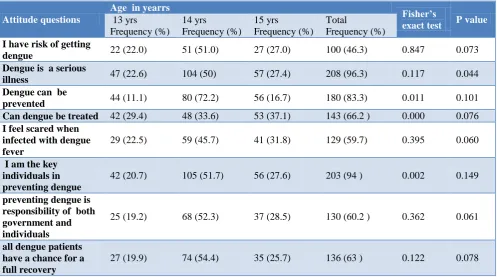
The major source of knowledge regarding dengue to school students was the school itself according to 67.6 percent of the respondents (Table 6). 53.7% of the respondents were of the attitude that they were not at the risk of dengue infection. 96.3% of the respondents
were scared of dengue infection. 94.0% of the respondents realised that it was their key responsibility of dengue prevention. 60.2% felt both government and individuals were responsible to prevention of dengue.
Only 63% responded that all dengue patients have a chance for full recovery, 37% of the respondents perceived wrongly that all dengue patients do not have a chance for full recovery (Table 7).
Table 5: Knowledge on breeding site of dengue mosquitoes.
Breeding sites
Age in years
Fisher’s
exact test P value
13 yrs
Frequency (%)
14 yrs Frequency (%)
15 yrs Frequency (%)
Total
Frequency (%)
Stagnant water 42 (23.0) 92 (50.3) 49 (26.8) 183 (84.7) 0.361 0.047
Flower pots, tyre and
pots 47 (22.7) 101 (48.8) 59 (28.5) 207 (95.8) 0.820 0.153 Water storage jars/
containers 39 (21.8) 89 (47.5) 55 (30.7) 179 (82.9) 0.342 0.054 Trash 29 (27.1) 52 (48.6) 26 (24.3) 107 (50.0) 0.158 0.012
Table 6: Source of knowledge about dengue fever.
Source of knowledge Frequency Percentage (%)
1. Television 44 20.2
2. News paper 34 15.7
3. Radio 6 2.8
4. Friends 13 6
5. Doctor 25 11.4
6. School 146 67.6
Table 7: Attitude towards dengue fever.
Attitude questions
Age in yearrs
Fisher’s
exact test P value
13 yrs Frequency (%)
14 yrs Frequency (%)
15 yrs Frequency (%)
Total
Frequency (%)
I have risk of getting
dengue 22 (22.0) 51 (51.0) 27 (27.0) 100 (46.3) 0.847 0.073 Dengue is a serious
illness 47 (22.6) 104 (50) 57 (27.4) 208 (96.3) 0.117 0.044 Dengue can be
prevented 44 (11.1) 80 (72.2) 56 (16.7) 180 (83.3) 0.011 0.101 Can dengue be treated 42 (29.4) 48 (33.6) 53 (37.1) 143 (66.2 ) 0.000 0.076
I feel scared when infected with dengue fever
29 (22.5) 59 (45.7) 41 (31.8) 129 (59.7) 0.395 0.060
I am the key individuals in preventing dengue
42 (20.7) 105 (51.7) 56 (27.6) 203 (94 ) 0.002 0.149
preventing dengue is responsibility of both government and individuals
25 (19.2) 68 (52.3) 37 (28.5) 130 (60.2 ) 0.362 0.061
all dengue patients have a chance for a full recovery
27 (19.9) 74 (54.4) 35 (25.7) 136 (63 ) 0.122 0.078
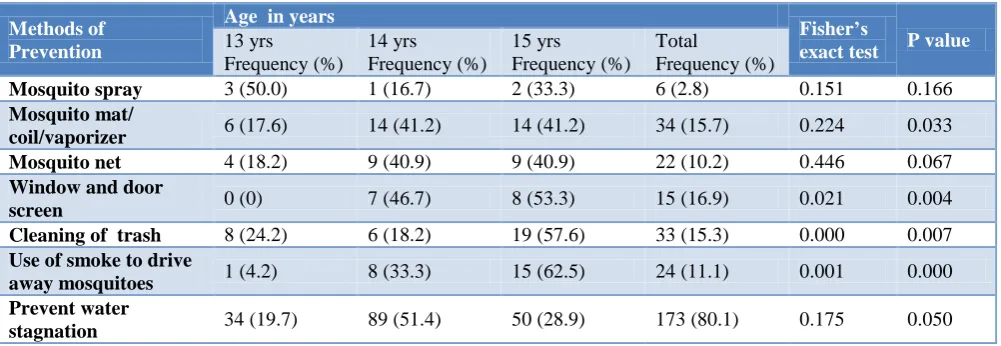
At home the common preventive practices followed were prevention of water stagnation as per 80.1% of the respondents with a significant of p value of 0.05 between
significant p value of <0.05 between age and practice. 10.2% of the respondents used mosquito nets, 6.9% used mosquito nets on windows with a significant p value of
<0.05 between age and practice. Only 2.8% of the respondents used mosquito spray to prevent mosquito bite (Table 8).
Table 8: Methods of prevention against dengue.
Methods of Prevention
Age in years
Fisher’s
exact test P value
13 yrs
Frequency (%)
14 yrs
Frequency (%)
15 yrs
Frequency (%) Total
Frequency (%)
Mosquito spray 3 (50.0) 1 (16.7) 2 (33.3) 6 (2.8) 0.151 0.166
Mosquito mat/
coil/vaporizer 6 (17.6) 14 (41.2) 14 (41.2) 34 (15.7) 0.224 0.033 Mosquito net 4 (18.2) 9 (40.9) 9 (40.9) 22 (10.2) 0.446 0.067
Window and door
screen 0 (0) 7 (46.7) 8 (53.3) 15 (16.9) 0.021 0.004 Cleaning of trash 8 (24.2) 6 (18.2) 19 (57.6) 33 (15.3) 0.000 0.007
Use of smoke to drive
away mosquitoes 1 (4.2) 8 (33.3) 15 (62.5) 24 (11.1) 0.001 0.000 Prevent water
stagnation 34 (19.7) 89 (51.4) 50 (28.9) 173 (80.1) 0.175 0.050
DISCUSSION
The study was done to find out the prevalence of knowledge, attitude and practice of dengue fever prevention among school children of VIII, IX, and X standard in Villupuram. In the present study majority of students were at age group of 14 years.
Majority (86.1%) were aware that dengue was a mosquito borne disease. This is similar to a study by Taran et al in Malwa region where 80% responded the same view.16 75.9% of the respondents were unaware that dengue infected person can be infected more than once. 76.9% of the respondents considered dengue outbreak occurred only in rainy seasons. The fact that dengue has now become perennial is not known to them. In the present study more than 3/4th of the students were aware that stagnant water, water stored containers, jars and flower pots, tyres and pots (84.7%, 82.9%, 95.8% respectively) were breeding sites for dengue mosquitoes. This knowledge of breeding sites for dengue mosquitoes was only 47% of children in Bhatnagar et al UP and 19.5% of students in Taran et al.16,17 In this study only 50% of the respondents considered trash as a source of breeding factor which needs to be emphasised for prevention of breeding of mosquitoes.
School was the major source of knowledge regarding dengue (67.6%) which revealed that dengue prevention activities such as educational campaigns in schools are considered significant tool to create awareness to public through student’s community.
Television and newspapers contributed to only 20.2% and 15.7% respectively as source of information in contrast to Bhatnagar et al study and Taran et al and patel et al where newspaper and television were the major source of information.16,17 This may be contributed to the
awareness created by the public health system in the schools. The knowledge that dengue mosquitoes are a day biter was known to 91.7% which was only 49% at Bhatnagar et al study and 48% in Majra et al.17,18
Almost 94.0% of the respondents felt that individuals have the key responsibility in dengue prevention and 60.2% felt it should be a combined responsibility of Government and individuals with a significant p value (<0.05) between age and attitude. More than half of the students were of the attitudes that they are not at risk of dengue. Majority (59.7%) of the respondents felt that they were scared if they would to be infected with dengue and only 63% of the respondents were of the view that dengue patients could be recovered fully. This reveals that more emphasis should be given on pattern of disease, signs and symptoms and their early detection and admission in hospitals will lead to a greater chance of full recovery and the fears of the respondents regarding dengue could be alleviated.
CONCLUSION
The study revealed that school students had adequate basic knowledge regarding dengue. There was some misconceptions regarding to dengue. Personal protection against dengue and need to trash removal was least practiced which can be made successful by behaviour change, communication.
Literacy and media exposures are factors that determine awareness among school students and can be helpful to raise their knowledge regarding dengue. Education
regarding knowledge and prevention should be
introduced and made compulsory in schools.
Therefore with adequate knowledge, positive attitudes and practice to stay healthy on the part of students, the spread of disease can be halted.
Limitations
The study was limited to only one school in rural municipality of Villupuram. The study cannot to generalized. Absence of a comparative group.
ACKNOWLEDGEMENTS
We gratefully acknowledge the students, teachers, Headmaster of the Government Municipality School without whom this study wouldn’t be possible.
Funding: No funding sources Conflict of interest: None declared
Ethical approval: The study was approved by the Institutional Ethics Committee
REFERENCES
1. WHO. Media centre Fact sheet, Dengue and dengue hemorrhagic fever. Updated April 2017. Available at: http://www.who.int/mediacentre/factsheets/ fs117/en/. Accessed on 3 August 2017.
2. Sharma SN, Raina VK, Kumar A. Dengue/DHF: an
emerging disease in India. J Commun Dis. 2000;32(3):175-9.
3. Chaturvedi UC, Nagar R. Dengue and dengue hemorrhagic fever: Indian perspective. J Biosci. 2008;33(4):429-41.
4. Park K. Parks Textbook of Preventive and Social Medicine.23rd ed. Jabalpur: Banarasidas Bhanot Publishers; 2015.
5. National Vector Borne disease Control Program; 2017. Available at: http://www.nvbdcp. gov.in/den-cd.html. Accessed on 3 August 2017.
6. Mehendale SM, Risbud AR, Rao JA, Banerjee K. Outbreak of dengue fever in rural areas of Parbhani
district of Maharashtra (India). Indian J Med Res. 1991;93:6-11.
7. Arunachalam N, Murty US, Kabilan L,
Balasubramanian A, Thenmozhi V, Narahari D, et al. Studies on dengue in rural areas of Kurnool District, Andhra Pradesh, India. J Am Mosq Control Assoc. 2004;20(1):87-90.
8. Paramasivan R, Dhananjeyan KJ, Leo SV, Muniaraj M, Thenmozhi V, Rajendran R, et al. Dengue fever caused by dengue virus serotype-3 (subtype-III) in a rural area of Madurai district, Tamil Nadu. Indian J Med Res. 2010;132:339-42.
9. Hati AK. Studies on dengue and dengue
haemorrhagic fever (DHF) in West Bengal State, India. J Commun Dis. 2006;38(2):124-9.
10. WHO SEAR Prevention and control of dengue &
dengue hemorrhagic fever: comprehensive
guidelines. New Delhi, 1999.
11. Wilder-Smith A, Gubler DJ. Geographic expansion of dengue: the impact of international travel. Med Clin North Am. 2008;92(6):1377-90.
12. Nalongsack S, Yoshida Y, Morita S, Sosouphanh K, Sakamoto J. Knowledge, attitude and practice regarding dengue among people in Pakse, Laos. Nagoya J Med Sci. 2009;71(12):29-37.
13. Center for disease control. Dengue fever Colorado. 2005. Available at: http.//www.cdc.gov/ncidod/ dubid/dengue-99.html. Accessed on 3 October 2017. 14. Thomas SJ, Endy TP. Vaccines for the prevention of
dengue: development update. Hum Vaccin.
2011;7(6):674-84.
15. Winch PJ, Leontsini E, Rigau-pe´rez JG, Ruiz-pe´rez M, Gary G, Clark GG, et al. Community-based dengue prevention programs in Puerto Rico: Impact On knowledge, behavior, and residential Mosquito infestation. Am J Trop Med Hygiene. 2002;67(4):363-70
16. Taran SJ, Taran R, Bhandari V. Knowledge, awareness and practice study for mosquito borne diseases among school children of Malwa region of India. Indian J Child Health. 2016;3(2):125-8.
17. Bhatnagar PK, Garg SK, Bano T, Jain S.
Knowledge, attitude and practice regarding dengue and chikungunya in secondary school children in a city of north India. Eur J Pharm Med Res. 2016;3(11):423-8.
18. Majra JP, Acharya D. Impact of knowledge and practices on prevention ofChikungunya in an epidemic area in India. Ann Trop Med Public Health. 2011;4:3-6.