Performance Improvement in Wireless Sensor
Network using Game Theory
Prof. J. Jeyavel Mr. Aditya Sharma
Department of Electronics & Telecommunication Engineering
Department of Electronics & Telecommunication Engineering
Bharati Vidyapeeth College of Engineering, NaviMumbai, Maharashtra, India
Bharati Vidyapeeth College of Engineering, NaviMumbai, Maharashtra, India
Mr. Vineet Singh Mr. Dhiraj Upadhyay
Department of Electronics & Telecommunication Engineering
Department of Electronics & Telecommunication Engineering
Bharati Vidyapeeth College of Engineering, NaviMumbai, Maharashtra, India
Bharati Vidyapeeth College of Engineering, NaviMumbai, Maharashtra, India
Abstract
Wireless sensor network (WSN) comprising of tiny, power-constrained nodes are gaining popularity due to their effective use in a wide variety of application like monitoring of environmental attributes, intrusion detection and various other application. The IEEE 802.15 standard along with enhanced (medium access control) MAC layer is responsible for connecting various multimedia services to wireless sensor network, while the sensing objectives devices are unique and application dependent, some common performance criteria has been established for prolonged network connectivity and enhancing performance of the system. In this paper, we look at the problem of performance and energy efficiency and different formulation of these problem based on the approach of game theory. The suitability of using game theory to study performance and energy efficiency problems and forming various scenarios using WSN models is because of the strategic interaction between nodes. Approaches from game theory can be used to optimize node-level as well as network-wide performance by exploiting the distributed decision-making capabilities of WSNs. The strategic formulation takes into account the distributed coordination function of various node, their contention window, based on that an optimal back off is selected. These formulations are tested on a network simulator creating an environment where nodes are monitored based on their performance and energy efficiency.
Keywords: Wireless Sensor Network, Back Off Algorithm, Throughput, Packets, Game Theory, NS2
________________________________________________________________________________________________________
I. INTRODUCTION
The wireless arena has been experiencing exponential growth in the past decade. We have seen great advances in network infrastructures, growing availability of wireless applications, and the emergence of omnipresent wireless devices such as portable or handheld computers, PDAs, and cell phones, all getting more powerful in their capabilities. These devices are now playing an ever-increasingly important role in our lives. The history of wireless networks started in the 1970s and the interest has been growing ever since. At present, this sharing of information is difficult, as the users need to perform administrative tasks and set up static, bi-directional links between the computers. This motivates the construction of temporary networks with no wires, no communication infrastructure and no administrative intervention required. Such interconnection between mobile computers is called a WSN Network. WSN networks are emerging as the next generation of networks and defined as a collection of mobile nodes forming a temporary (spontaneous) network without the aid of any centralized administration or standard support services. A WSN network is usually thought of as a network with nodes that are relatively mobile compared to a wired network. A WSN network is a dynamically reconfigurable wireless network with no fixed wired infrastructure. It is a Self-Configuring network that means it does not require any infrastructure to communicate. It can be connected everywhere because it has a very good adapting capability.
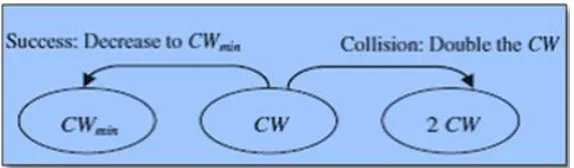
progressively to zero, the wireless node can start the transmission. When two or more wireless nodes decrease to zero at the same time, the transmission packets of wireless nodes will collide. Accordingly, in order to reduce the collision rate, IEEE 802.15.4 adopts the BEB (Binary Exponential Backoff) algorithm. In the BEB algorithm, the wireless node selects a backoff time to count backwards at random from the competition window. When the time of counting backwards is zero, the wireless node will start the transmission. If the transmission is successful, the contention window will be set to a minimum value (CWmin). If collision happens, the contention window will be doubled. The shortcoming of the BEB algorithm is that the collision rate will increase because of the rapidly reset to minimum value of the contention window. In recent years, plenty of proposals have been carried out with the aim of increasing stability, network performance and other aspects
II. LITERATURE SURVEY
Game theory has been employed in the analysis of resource management in telecommunication network for at least 20 years. As interest in decentralized wireless network grew, so did the usefulness of game theoretic models to help us understand and predict the performance of complex wireless system that cannot be completely modeled using traditional optimization tool, while the simplest game theoretic models assume that all players have complete information about each other action spaces and objectives it is possible to extend such modes to consider how incomplete information affects the outcome. The incomplete information can be in terms of players type (example-a jammer that does not know whether there are radios in its vicinity that it would like to jam), utility, parameter (example-energy cost of transferring packet and energy cost of jamming) or data transfer being supported network. By releasing assumption on what a transmitter and jammer know about each other, they are able to generate model to prevent attacks in WSN.
The routing problem in WSN is one of most interesting research fields in the communication network and there are lots of papers published recently in this field. Among of these works, we can mention the methods that introduce in [1-5], e.g. Flooding Routing, Energy-Aware Routing, Sensor Protocol for Information Negotiation (SPIN), Directed Diffusion Routing, Rumor Routing, Low Energy Adaptive Clustering Hierarchy(LEACH), Geographic Adaptive Fidelity (GAF), etc. There are different methods to optimize the various parameters in the networks, e.g. the methods for optimizing the traffic load distribution (load balancing) discussed in [6]. One of the methods used for routing in WSN is GameTheory. The game theory approach in routing is usually basedon the reputation and punishment model, or pricing and
payment model. The functionality of pricing and payment model [7-12] is described that for each successfully delivered data packet from a source to a destination, the destination node pays a credit to source node, and all intermediate nodes that participate in routing game. However, each data packet transmission has a cost for each node that participates in the route (which is depending on the various parameters). These nodes, want to maximize their profit. Therefore, each node is located on the path if its profit is not negative. In a quick view of references, [7, 8] are reviewed the game theory in networks, and introduced game-theoretic models for WSN. [8-11] are introduced a pricing and payment model for WSN with the path reliability. Consequently, [12] is introduce a model that is added source and destination to it, and available for all players to pick a null strategy. With this model, we can simply find a path with Nash equilibrium. Also, in this paper introduce an algorithm for finding optimal path with usage of Dijkstra algorithm, and additional stage for checking the utility function of nodes. This algorithm can find a path with positive utility function for all nodes that participate in it, and maximizing the reliability of path. In this paper, whit usage of, a model that optimizes by the network lifetime and network load distribution is introduced simply by adding the remained energy and traffic load in nodes. Also, a modified Dijkstra algorithm is developed for finding optimal path.
III. ALGORITHM
Backoff Algorithms
Binary Exponential Backoff (BEB)
IEEE 802.11 DCF is based on a CSMA/CA technique and employs a contention resolution method, called Binary Exponential Backoff (BEB) in order to minimize the probability of collisions. BEB reduces packet collisions due to the case of two or more stations transmitting simultaneously. Under BEB, the contention window (CW) dynamically controls medium access and is doubled every time a station experiences a packet collision. Conversely, if a station successfully transmits its packet, the CW is reset to the minimum value. The back off counter for every station depends on the collisions that the packets have experienced in the past. The collision avoidance protocol procedures specify that before transmitting, a station uniformly selects a random value for its back off counter in the interval [0; CWi -1] where, "CWi" is the current CW size and "i" is the back off stage. The value of CWi is equal to CWi = 2^i* CW; i depends on the number of failed transmissions of a packet. At the first transmission attempt of a packet, CW0 = CWmin = CW that is the minimum CW size. If a packet collision occurs, CWi is doubled up to a maximum value,
CWm = CWmax = 2^ m * CW; Where,
m = log2(CWmax - CWmin)
process; it has to sense the wireless medium. If the shared media is found idle for a minimum time equal to DIFS, the head-of-line MAC frame will be transmitted. Then the station enters into back off procedure and sets its back off timer randomly within the range of Contention Window (CW). When the channel is sensed "idle", the back off timer is decremented by one; when the medium is sensed "busy" the back off timer is frozen. When the back off timer reaches zero, the station commences the frame transmission as the next consequence. When the delivered frame is received correctly, the receiver is required to send an acknowledgment (ACK) after a time equal to Short Inter Frame Space (SIFS). If no ACK is received, the sending station assumes either a collision or frame corruption, and then it doubles its current CW, resets its back off timer randomly, and retransmits the previous frame when the timer reaches zero again.
Modified BEB
As indicated earlier, BEB algorithm stated above might introduce long transmission delays without any significant benefit in respect of contention resolution due to node mobility. In fact, contending mobiles are likely to move to a different location during a large waiting time for retransmission after a packet collision and might get involved into another independent collision process elsewhere. Thus, the large growth rate in waiting time might not be appropriate in a mobile scenario as in a MANET.
In particular, the backoff time is increased exponentially, but with a reduced base value (less than 2) after each unsuccessful transmission until a prescribed maximum value (CWmax) is reached. Whenever a node transmits a packet successfully, its backoff time is reduced to a specified minimum value (CWmin). The base value equal to 1.8 offers better performance as compared to other possible base values. The modified backoff algorithm can therefore be expressed as,
In case of Collision CW = min [1.8*CW, CWmax]
In case of Successful Transmission CW = CWmin
Double Increment Double Decrement (DIDD)
The DIDD Back off algorithm utilizes a ‘smooth’ decrease of the CW after a successful packet transmission. More specifically, if a packet collides, DIDD operates exactly as BEB and doubles the CW in order to reduce the probability of a packet collision. However, in the case of a successful packet transmission, DIDD halves the CW (BEB reduces it to CWmin) to avoid potential packet collisions [6]. Another characteristic of the DIDD scheme is that packets that reach their maximum number of retransmission attempts are not discarded as under BEB.
The DIDD backoff algorithm can therefore be expressed as, In case of Collision
CW (new) = 2 * CW
In case of Successful Transmission CW = CW / 2
IV. RESULTS
Graphical Analysis
Throughput Variation
Throughput in Kbps with varying Number of Nodes
Number of Nodes 10 20 50 100 150
BEB 296.18 271.39 227.73 227.31 240.90 Modified BEB 534.26 561.21 680.26 433.59 339.09 DIDD 680.80 629.81 680.27 537.05 680.60
Fig. 10: Graphical Analysis of Throughput variation for BEB, Modified BEB, DIDD Back off algorithms.
Total Energy Consumption
Total Energy Consumption in J with varying Number of Nodes
Number of Nodes 10 20 50 100 150
BEB 163 145 160 08 39
Modified BEB 171 171 171 154 56
DIDD 171 171 171 171 171
Fig. 13: Graphical Analysis of Total Energy variation for BEB, Modified BEB, DIDD Back off algorithms.
V. CONCLUSION
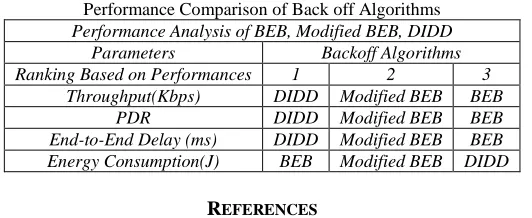
Table 3, as compared to BEB and Modified BEB back off algorithm, improved Throughput and PDR are obtained when DIDD algorithm is used. Also, the End to end Delay is reduced using DIDD back off algorithm.
When BO algorithm chooses larger CW size to reduce the collision probability, delay is increased which is not suitable for delay sensitive networks. On the other hand, when BO algorithm selects smaller CW, the collision probability is increased thereby reducing the throughput. Hence there will be always tradeoffs between CW size and the performance. Hence designing a BO algorithm to enhance the network performance remains a very crucial research area in the future. Future work includes designing of a new Backoff Algorithm that will further increase the performance of the Wireless Network.
Table – 3
Performance Comparison of Back off Algorithms Performance Analysis of BEB, Modified BEB, DIDD
Parameters Backoff Algorithms
Ranking Based on Performances 1 2 3
Throughput(Kbps) DIDD Modified BEB BEB
PDR DIDD Modified BEB BEB
End-to-End Delay (ms) DIDD Modified BEB BEB Energy Consumption(J) BEB Modified BEB DIDD
REFERENCES
[1] Jennifer J.-N. Liu and Imrich Chlamtac, “Mobile WSN Networking with a View of 4G Wireless: Imperatives and Challenges” A JOHN WILEY & SONS, INC., PUBLICATION.
[2] Madhuri Agrawal, Chirag Sharma, Sheveta Vashisht, “Behaviour Analysis of Wireless sensor Networks under Different Transmission Rate”, Madhuri Agrawal et al, / (IJCSIT) International Journal of Computer Science and Information Technologies, Vol. 3 (3) , 2012,4261 – 4264
[3] B.Nithya, C.Mala, Vijay Kumar B,“Simulation and Performance Analysis of Various IEEE 802.15 Backoff Algorithms”2nd International Conference on Communication, Computing & Security [ICCCS-2012].
[4] Behrouz A. Forouzan, “Data communication and Networking”, Fourth Edition, McGraw-Hill Publications.
[5] Vikram Mehta, Dr. Neena Gupta, “Performance Analysis of QoS Parameters for Wi max Networks”, International Journal of Engineering and Innovative Technology (IJEIT) Volume 1,Issue 5, May 2012.
[6] P. Chatzimisios, V. Vitsas, A. C. Boucouvalas and M. Tsoulfa, “Achieving performance enhancement in IEEE 802.15 WSNs by using the DIDD backoff mechanism”, INTERNATIONAL JOURNAL OF COMMUNICATION SYSTEMS Int. J. Commun. Syst. 2007; 20:23–41
[7] Ramaz Samhan, Amer Khoulani, Dr. Jorgen Nordberg, “Performance Analysis of WSN MAC algorithms” Blekinge Institution of Technology November 30, 2010.
[8] C Rama Krishna, Saswat Chakrabarti and Debasish Datta, “A MODIFIED BACKOFF ALGORITHM FOR IEEE 802.11 DCFBASED MAC PROTOCOL IN A MOBILE AD HOC NETWORK”.
[9] Jae Chung, Mark Claypool,” NS by Example”, WPI, Worcester Polytechnic Institute, [Online] available: http://nile.wpi.edu/NS/ [10] “The Network Simulator ns-2”, [Online] available: http://www.isi.edu/nsnam/ns, 2013.
[11] Ming-Hwa Cheng, Wen-Shyang Hwang, Cheng-Han Lin, Hui-Kai Su, “A Oneself Adjusts Backoff Mechanism for Channel Access in IEEE 802.11 DCF WLAN”, 2013 Seventh International Conference on Complex, Intelligent, and Software Intensive Systems.
[12] Parul Goel, “Performance Analysis of Various Backoff Algorithms at MAC Layer Based on IEEE 802.15 ZIGBEE”.
[13] Raul Palacios, Fabrizio Granelli, Dzmitry Kliazovich, Luis Alonso and Jesus Alonso-Zarated, “An Energy Efficient Distributed Coordination Function Using Bidirectional Transmissions and Sleep Periods for IEEE 802.11 WLANs” 978-1-4799-1353-4/13 ©2013 IEEE.