A Survey Paper on Truss Structure optimal
parameter selection
Vipul Prajapati Dr. I.C Sharma
M.Tech Scholar Professor
Arya Collage of Engineering & Research Centre, Rajasthan, India
Arya Collage of Engineering & Research Centre, Rajasthan, India
Mayank Mehandiratta Assistant Professor
Arya Collage of Engineering & Research Centre, Rajasthan, India
Abstract
The buildings and structure are the very important terms for the research point of view. In the civil research field the Truss structure is the main idea to develop a full strength building structure. This paper present the various studied on truss structure parameters selection. State of art different optimization algorithm proposed for the truss structure module designed. We study various papers which find better results with optimization algorithm.
Keywords: Truss Structure, Optimization, 10 Bar Structure
_______________________________________________________________________________________________________
I.
I
NTRODUCTIONIn the present day scenario the civil engineer structures like buildings and bridges provide many advantages in our daily life. The traditional and optimum design process is used for the construction of these. Like traditional approaches the design firstly introduced after that the analyze all the parameters are accurate or not. The design process can be terminated. But in optimum case design approach is not terminated after finding an adequate design. The basic feature of optimum design technique criteria to be minimized or maximized (objective function) depends on the designer’s needs. Modal analysis is applied to find the various periods that the structure will naturally resonate at, by using the structure's overall mass and stiffness. The main advantage of modal analysis is in earthquake engineering. The vibration period can be checked it helps to improve the natural frequency of the structure which not be matched with earthquake frequency. When the models are subjected to cyclic or vibration loads, the dynamic response of structures due to these external loads acting, which include resonance frequencies (natural frequencies), mode ,shape and damping, are estimated.
Natural Frequency:
A model is depend on dynamic load that it is nearby the natural frequency range. Every model has a natural frequency. The model oscillates to a large extent than in normal condition.
Modes:
The main purpose of modes to measure vibration of an structure at a particular frequency. The number is assigned to each mode. The free vibration mode is introduced. It is the node at which vibrates after all external loads are removed. It is assigned as mode1 and it is not oscillates.
Mode shape:
The mode shape depends on two factors: 1) on the shape of the surface
2) The boundary conditions of that surface.
Eigen values and Eigen vectors:
Both Eigen values and vectors have some physical meaning in terms of stiffness matrix. They can be interpreted as a strain energy with respect to displacement mode. The set of an Eigen value and associated eigenvector is termed “Eigen mode ”.
Shear building:
(J4R/ Volume 05 / Issue 5 / 001)
II.
L
ITERATURE REVIEWS. M. Seyedpoor [2015] used (FBDPI) flexibility based damage probability index and (DEA) differential evolution algorithm for multiple damage detection of truss systems. There are two stage methods are implemented first stage- the damage is identified by the concept of changes of elemental strain of the structure due to damage in truss system. In the second stage an optimization algorithm is implemented called DEA , the purpose of DEA find the exact damage location and severity. The main advantage is that the identification of damage is more efficient for 2,3,4,5 modes of shape. It also reduced the damage detection problem by using DEA. The only limitation is that requiring a few optimization iterations. [1]
Ying Lei at.al [2011] used Extended Kalman filter for the detection of structural damage with limited input and output measurement. The algorithm is based on the sequential application of EKF. The algorithm is used to detect the large size of structural damage based upon the substructure approach. the proposed algorithm can identify structural parameters and unknown excitation in a sequential manner, which simplifies the identification problem compared with other approaches available. Advantage is that the structural damage can be detected by tracking the degrading of the identified values of stiffness parameters. Limitation of the work is measurements (sensors) must be available at the DOFs where the external excitations act.[2].
C.A.M. Escobar et.al [2017] used firefly algorithm (FFA) for optimization of damage detection structure. a methodology was developed that addresses the problem of the detection of damage in structures as an optimization problem. ANSYS finite element software was used for the dynamic characterization of the structures. The noise in the shape modes has a greater negative effect on the accuracy of the results. The main advantage of FFA is structural health monitoring (SHM) system is improved.[3]
Bo Zhao et.al [2015]provided the single nonfirst mode for the structure damage detection. The system is updated by the shape of modes. The many parameters like mass matrix and stiffness matrix are updated find the derived ones. A updated system is obtained with respect to the changes and sensitivity called generalized flexibility matrix. The main purpose of this matrix find out the location and severity. This method is used for single ,double and multiple damage detection structure by using single nonfirst node.[4]
U. Muthuraman et.al [2016] used a 3-storey and a 4-storey building are taken and Modal Strain Energy (MSE) for finding the initial locations of sensors. The genetic algorithm is used for optimization to obtained sensors. The (FMBT) Flexibility Matrix Based Technique used for the localization of the damage structure. A hybrid optimization and damage detection strategy “MSE-GA” and “FMBT used for the structure detection.[5]
H. Ghaffarzadeh et.al[2016] proposed a new heuristic algorithm for damage identification in truss structures. Imperialist Competitive Algorithm (ICA), used for the optimization depend on the dynamic property of the structure. The finite element model (FEM) of structure used. This method provided the advantages among the model data damaged and undamaged structure.. Results show the superiority and effectiveness of the proposed method.[6]
M. Farshchin et.al [2015] used (MC-TLBO) multi-class teaching-learning based optimization for the structural detection phenomena. There are two stages in (TLBO). First stage-parallel classes explore to the search space and second stage the best solution of the first stage. MC-TLBO used to solve shape and size truss optimization problems with multiple natural frequency constraints. The MC-TLBO technique is more robust than the TLBO. The efficient low cost design generate by using this algorithm.[7]
HJ Xu et.al [2016] A cuckoo search algorithm is used for the damage structure detection. It is based on the shape of the modes and natural frequencies. These two are the main requirement for optimization.[8] The simulation and experiment results show that the present method can produce more accurate damage identification results even under measurement noise, comparing with genetic algorithm.
M. Nobahari et.al [2011] used a new approach of Genetic algorithm modified form (MGA) for the detection of damage in structural system. It have two new operators health and simulator for the location detection of damage portion. The objective function is basically (ECBI) efficient correlation based index. The algorithm applied on this objective function. The benefits of MGA is determine the site exact damage location.[9]
Young-Wung Kim et.al [2016] used mathematical programming technique on the basis of force method and free vibration observation. Then a matrix is obtained which is in equilibrium form. It shows the force-displacement relations. Then both the matrix like equilibrium and compatibility combined together with force-displacement relations. Genetic algorithm is used on the matrix data and find out the location of multiple damage structure of a truss structure. The combined method of force-displacement matrix and genetic algorithm provide the reliability to the detection process. So the accurate and efficient results are obtained in the multiple damage of truss structure.[10]
S.krenk et.al[2013] it gives brief idea about the truss structure. The truss advantages and drawback explain in this work. In case of truss structure all the straight members are connected to the joints. The joints do not allow any free location for the air. A truss consists of a number of joints which are connected by bars. The triangle is very important term in the layout of truss structure. After making the triangle than counts the joints and bar. There are various shapes of truss structure like V-truss, N-truss, Roof truss, K-truss. The planner type and space type trusses structure are useful in the damage detection process.[11]
static response data (deflection) was used for the prediction of existence of damage. Row-echelon form has an advantage of partitioning matrix into subgroup for smaller Portion of the structural component monitoring.[12]
Moradipour et.al[2013] improve the modal strain energy (MSE). The mathematical equations of MSE improved and detection of structural damage in early stage of formation. There are two models are used steel truss bridge and concrete frame bridge models. The detection process is done by single and multiple damage in each structure. The simulation results and natural frequency can be obtained by the matlab code. This methods is fast in nature and perform well in agreement with numerical assumption. The output is more feasible and accurate for the detection procedure.[13]
P. Sangeetha et.al [2015] provide the matlab programming for the truss detection structure. It analyze the space truss step by step in finite element analysis. The finite element analysis is a numerical method. A coding was generated for the double layer grid space truss structure. Static analysis of space truss is done by stiffness method where formulation is simpler for most structural analysis problems.[14]
Henri P. Gavin [2014] provide the matrix stiffness method for the 2D trusses. The method used for number of all nodes and elements. Identify the Displacement Degrees of Freedom in Global Directions. Number all the structural degrees of freedom in your truss. In a 2D (planar) truss, each node can have a maximum of two degrees of freedom: one in the global X-direction and one in the global Y -direction. If a degree of freedom is restrained by a reaction,then it doesn’t get a number. Node Locations. Write the (x, y) coordinates of each node using units consistent with E and A. In other words, if E and A are given in kN/cm2 and cm2, write the (x, y) coordinates in terms of centimeters. Define each element. Draw each element of your truss individually and draw the local coordinates in the global directions.[15]
S.M. Seyedpoor [2011] provide a two stage approach for the damage detection of structure. In first stage the location is identified by the (MSEBI) model strain energy based index. Basically analysis will be done in the MSEBI for finite element modelling. After the first stage the actual damage determine by the PSO( Particle Swarm optimization) using the results of first stage. This method is used for both static as well as dynamic test data. The numerical results considering the measurement noise demon- strate that the combination of modal strain energy and optimization concepts can provide an efficient tool for properly identifying the multiple damage in structural systems.[16]
Khac-Duy Nguyen et.al[2016] used a new method ratio of geometric model strain energy to Eigen value (GMSEE). The stiffness reduction has been formulated using by a sensitive matrix. The main purpose of the matrix is find out the model parameters and basic idea about the structure. The technology work in two stage first stage estimate the damage location of the structure by applying the GMSEE. The genetic algorithm is basically used in this type of GMSEE. The size of the damage part can be find out by the GMSEE. It is commonly used in 2D trust bridge .The method does not require information of material and sectional properties of structural elements is the basic advantage of this technique.[17]
Seyedali Mirjalili et.al[2014]-provided the optimization theory called Grey Wolves Optimization (GWO). The basic principle of this algorithm is nature of grey wolves. It completely mimics the nature of grey wolves. The GWO algorithm is the benchmark of 29 well known test function. The comparison is also done with various other optimization techniques like, PSO, DE, GSA, EP and ES. In this work the three classical engineering design problems (tension/compression spring, welded beam, and pressure vessel designs) and presents a real application of the proposed method in the field of optical engineering. The GWO is used for the damage detection purpose for the structure.[18]
D. Wang et.al[2004] provided a method for three dimensional truss structure optimization with multiple constraints on its natural frequency. a single constraint based on differentiation of the Lagrangian function optimally criteria is developed which means at the optimum all the variable efficiency should be equal. The natural frequencies are posed as constraints for the structure to avoid resonance with the external excitations. The sensitivity number of a design variable is defined for truss shape and sizing variables irrespective of their distinct natures an optimality criteria algorithm in conjunction with the weighted sum of the sensitivity numbers is applied to optimization.[19]
R. V. Grandhi et.al [ 2013] purpose a design optimization algorithm for structural weight minimization with multiple frequency constraints. As like previous paper the algorithm is same Lagrangian density and optimum results . The effectiveness of the algorithm was demonstrated by designing a number of truss structures with as many as 489 design variables. the minimum weight design of structures with multiple frequency constraints was obtained using an optimality method. A simple resizing scheme in conjunction with a scaling procedure has been used. Once again, the optimality criterion method has shown to be very efficient in designing large practical structures with a small number of iterations.[20]
R. Sedaghati et. al[2002] provided an algorithm to minimize the weight of the truss structure and beam type members using the single and multiple constraints. This algorithm is the combination of finite element technique and the mathematical programming. Firstly the equilibrium matrix is obtained using the finite element analysis and compares it with the compatibility matrix. The equilibrium and compatibility equations are solved simultaneously. A direct method has been developed to generate the compatibility matrix for indeterminate Structures. The method is based on the displacement-deformation relation and singular value decomposition (SVD) technique, and there is no need to select consistent redundant members. The main objective is to investigate the relative performance of the force and displacement methods to design and optimize truss and frame-type structures with frequency constraints. It is concluded that in some problems with multiple-frequency constraints the optimization based on the force method can result in a lighter design.[21]
(J4R/ Volume 05 / Issue 5 / 001)
calculation of natural frequency on the different modes and shape of the structure. Main reason behind it natural frequencies are fundamental parameters affecting the dynamic behavior of the structures. In the ABC algorithm, each food source exploited by the bees represents a possible solution to given optimization problem.[22]
Messina et.al [1998] using multiple damage location assurance criteria (MDLAC) for the detection of size of damage part of the structure. The numerically data can be used for the size detection of two truss structure and applying on the three beam test structure. The MDLAC approach offers the practical attraction of only requiring measurements of the changes in a few of the structures natural frequencies between the undamaged and damaged states and is shown to provide good predictions of both the location and absolute size of Damage at one or more sites[23]
III.
A
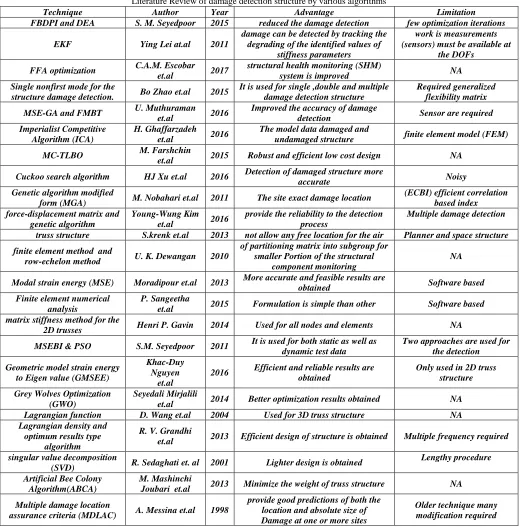
NALYSISThere is lots of paper studied related to the truss structure. In [1] FBDPI technique is used for the damage of truss structure. The damaged detection reduced in this process with DEA algorithm. The EKF [2] method proposed for the damaged detection by observing the stiffness parameters of the truss structure. The FFA optimization algorithm proposed in [3] which provided better structural health monitoring system. The MSE-GA and FMBT proposed in [5] which improved the accuracy of damage detection. Similarly ICA proposed in [6] for the better model and undamaged structure. MC-TLBO [7], CS [8] and Modified GA were proposed for the structure damage detection. More accurate damaged detection attained by the optimization algorithm. So we get an idea from paper [8] will propose the hybrid optimization algorithm by combining the GWO and CS algorithm. The results may be more accurate than the previous proposed method. The literature review table of different proposed method for damaged detection provides in appendix.
IV.
C
ONCLUSIONIn this study we present the literature review of truss structure damaged detection by proposing different techniques. The optimization algorithm mostly used for the accurate parameters selection. The truss structure damaged identification performed by the various parameters of building. We get an idea for making the hybrid optimization algorithm for the optimal parameters selection of truss structure.
R
EFERENCES[1] S. M. Seyedpoor & M. Montazer (2016) A damage identification method for truss structures using a flexibility-based damage probability index and differential evolution algorithm, Inverse Problems in Science and Engineering, 24:8, 1303-1322
[2] Lei, Ying, Jiang, Yongqiang, Xu, Zhiqian, ‘Structural damage detection with limited input and output measurement signals’ . Mechanical Systems and Signal Processing, v.28, 2012 April, p.229(15) (ISSN: 0888-3270) Elsevier B.V., 2012 April
[3] Camilo Manrique Escobar, Octavio Andr_es Gonz_alez-Estrada, Heller Guillermo S_anchez Acevedo. Damage detection in a one-dimensional truss using the _rey optimization algorithm and finite elements . 2017.
[4] Bo Zhao, Zili Xu, Xuanen Kan, Jize Zhong, and Tian Guo, “Structural Damage Detection by Using Single Natural Frequency and the Corresponding Mode Shape,” Shock and Vibration, vol. 2016, Article ID 8194549, 8 pages, 2016
[5] Muthuraman, U & M. Sai Hashita, M & Sakthieswaran, N & Suresh, P & Raj Kumar, M & Sivashanmugam, P. (2016). An Approach for Damage Identification and Optimal Sensor Placement in Structural Health Monitoring by Genetic Algorithm Technique. Circuits and Systems. 07. 814-823. 10.4236/cs.2016.76070.
[6] Hosein Ghaffarzadeh and Farzad Raeisi , ‘Damage Identification in Truss Structures Using Finite Element Model Updating and Imperialist Competitive Algorithm’ Jordan Journal of Civil Engineering, Volume 10, No. 2, 2016
[7] Farshchin, Mohammad & Camp, Charles & Maniat, Mohsen. (2016). Multi-class teaching–learning-based optimization for truss design with frequency constraints. Engineering Structures. 106. 355-369. 10.1016/j.engstruct.2015.10.039.
[8] Xu, H., Liu, J., & Lu, Z. (2016). Structural damage identification based on cuckoo search algorithm. Advances in Structural Engineering, 19(5), 849–859. [9] M. Nobahari, S.M. Seyedpoor, Structural damage detection using an efficient correlation-based index and a modified genetic algorithm, Mathematical and
Computer Modelling, Volume 53, Issues 9–10, 2011,
[10] Kim, Y.-W., Kim, N.-I., & Lee, J. (2016). Damage identification of truss structures based on force method and free vibration analysis. Advances in Structural Engineering, 19(1), 3–13
[11] U. K. DEWANGAN, ‘STRUCTURAL DAMAGE EXISTENCE PREDICTION WITH FEW MEASUREMENTS’ U. K. Dewangan et al. / International Journal of Engineering Science and Technology (IJEST), ISSN : 0975-5462 Vol. 3 No.10 October 2011
[12] Moradipour, Parviz, Chan, Tommy H.T., & Gallage, Chaminda (2013) Health monitoring of short-and medium-spen bridges using an improved modal strain energy method. In Miyamoto, Ayaho, Hakola, Ilkka, Yabe, Akito, & Emoto, Hisao (Eds.) Proceedings of the 5th International Workshop on Civil Structural Health Monitoring (CSHM-5), International Society for Structural Health Monitoring of Intelligent Infrastructure, Ube, Yamaguchi, Japan, pp. 166-181. [13] P. Sangeetha, P. Naveen Kumar and R.Senthil,‘FINITE ELEMENT ANALYSIS OF SPACE TRUSS USING MATLAB’ ARPN Journal of Engineering and
Applied Sciences, VOL. 10, NO. 8, MAY 2015.
[14] Seyedali Mirjalili a,⇑, Seyed Mohammad Mirjalili b, Andrew Lewis a, ‘Grey Wolf Optimizer, Advances in Engineering Software 69 (2014) 46–61 [15] Henri P. Gavin, ‘The Matrix Stiffness Method for 2D Trusses’ Matrix Structural Analysis Department of Civil a Environmental Engineering Duke University,
2014
[16] Seyedpoor, S. (2012). A two stage method for structural damage detection using a modal strain energy based index and particle swarm optimization. International Journal of Non-Linear Mechanics. 47. 1-8. 10.1016/j.ijnonlinmec.2011.07.011.
[17] Nguyen, Khac-Duy, Chan, Tommy H.T., & Thambiratnam, David P. (2016) Structural damage identification based on change in geometric modal strain energy–eigenvalue ratio. Smart Materials and Structures, 25(7), Article number: 075032.
[20] R. Sedaghati , A. Suleman and B. Tabarrok, ‘Structural Optimization with Frequency Constraints Using the Finite Element Force Method’ AIAA JOURNAL Vol. 40, No. 2, February 2002
[21] M. Mashinchi Joubari1, M. H. Pashaei2, A. Fathi3, ‘ Sizing optimization of truss structures under Frequency Constraints with Artificial Bee Colony Algorithm’ Journal of mathematics and computer Science 9 (2014), 77 – 88.
[22] A. MESSINA, E. J. WILLIAMS and T[.CONTURSI, ‘STRUCTURAL DAMAGE DETECTION BY A SENSITIVITY AND STATISTICAL-BASED METHOD’ Journal of Sound and Vibration "0887# 105"4#\ 680_797 Article No[ sv870617
A
PPENDIXTable – 1
Literature Review of damage detection structure by various algorithms
Technique Author Year Advantage Limitation
FBDPI and DEA S. M. Seyedpoor 2015 reduced the damage detection few optimization iterations
EKF Ying Lei at.al 2011
damage can be detected by tracking the degrading of the identified values of
stiffness parameters
work is measurements (sensors) must be available at
the DOFs
FFA optimization C.A.M. Escobar et.al 2017
structural health monitoring (SHM)
system is improved NA
Single nonfirst mode for the
structure damage detection. Bo Zhao et.al 2015
It is used for single ,double and multiple damage detection structure
Required generalized flexibility matrix
MSE-GA and FMBT U. Muthuraman et.al 2016
Improved the accuracy of damage
detection Sensor are required Imperialist Competitive
Algorithm (ICA)
H. Ghaffarzadeh et.al 2016
The model data damaged and
undamaged structure finite element model (FEM)
MC-TLBO M. Farshchin
et.al 2015 Robust and efficient low cost design NA
Cuckoo search algorithm HJ Xu et.al 2016 Detection of damaged structure more
accurate Noisy
Genetic algorithm modified
form (MGA) M. Nobahari et.al 2011 The site exact damage location
(ECBI) efficient correlation based index force-displacement matrix and
genetic algorithm
Young-Wung Kim et.al 2016
provide the reliability to the detection process
Multiple damage detection
truss structure S.krenk et.al 2013 not allow any free location for the air Planner and space structure
finite element method and
row-echelon method U. K. Dewangan 2010
of partitioning matrix into subgroup for smaller Portion of the structural
component monitoring
NA
Modal strain energy (MSE) Moradipour et.al 2013 More accurate and feasible results are
obtained Software based
Finite element numerical analysis
P. Sangeetha
et.al 2015 Formulation is simple than other Software based matrix stiffness method for the
2D trusses Henri P. Gavin 2014 Used for all nodes and elements NA
MSEBI & PSO S.M. Seyedpoor 2011 It is used for both static as well as dynamic test data
Two approaches are used for the detection
Geometric model strain energy to Eigen value (GMSEE)
Khac-Duy Nguyen
et.al
2016 Efficient and reliable results are obtained
Only used in 2D truss structure
Grey Wolves Optimization (GWO)
Seyedali Mirjalili
et.al 2014 Better optimization results obtained NA Lagrangian function D. Wang et.al 2004 Used for 3D truss structure NA Lagrangian density and
optimum results type algorithm
R. V. Grandhi
et.al 2013 Efficient design of structure is obtained Multiple frequency required
singular value decomposition
(SVD) R. Sedaghati et. al 2001 Lighter design is obtained
Lengthy procedure
Artificial Bee Colony Algorithm(ABCA)
M. Mashinchi
Joubari et.al 2013 Minimize the weight of truss structure NA
Multiple damage location
assurance criteria (MDLAC) A. Messina et.al 1998
provide good predictions of both the location and absolute size of Damage at one or more sites