February, 22nd and 23rd, 2019
149 | P a g e
Utilization of waste for manufacturing of construction material by
using foaming agent
Mane Monika R.1 Raut Prajakta R.2
Pattewar Manik H.3 Karpe Govind M.4
(1, 2, 3, 4) B.E. Civil Engineering Student Dr. V. V. P. C O E
Ahmednagar, India [email protected]
Dr. S. L. Hake (Associate Professor)
Dr. V. V. P. C O E Ahmednagar, India
Abstract- Fly ash brick can be extensively used in all building construction activities. Since fly ash is being accumulated as waste material in large quantity near thermal power plant and creating serious environmental pollution problem. The objectives of this project is to investigate low cost and light weight fly ash brick using various raw material like unprocess fly ash, lime, dust, etc. To study the use of 5combined concept of AAC and CLC block for manufacturing of fly ash brick. Instead of using standard construction material, this study deals with use of raw waste material with cost effectiveness.
Keywords- ( Fly ash brick, AAC Block, CLC block)
1 INTRODUCTION
AAC was prefect in the mid 1920s by the Swedish architect and invented Dr. Johan Axel Eriksson working with Professor Henrik Kreiiger at the Royal institute of technology. It went into Hallabrottet and quickly became very popular. Siporex was established in Sweden in 1939 and presently license and owns plants in 35 locations. Around the world in the 1940s the trademric Young was introduce and was often referred to as “ blue concrete’’ in sweden due to its blueish tinge. This version of young was produce from alum shale, whose combustible carbon content made it beneficial to use in the production process.
AAC is one of the material which can cope of with the shortage of building of raw material and can produce a light weight energy efficient and environmentally friendly concrete. AAC is the construction material that is factory made and available to that user in block and precast unit for wall, floors and roofs. It has grained widespread use in many areas of the world including Europe, South America the Middle East and the Far East.
An often reported advantages of AAC is the combination of relatively low thermal conductivity and load bearing capacity for use in structural application other advantages include relatively low density, high strength to weight ratio, fire resistance, good thermal resistance and high sound insulation values. Its low density permits use of large building units, which is a reported advantage in frabication.
This is not a new innovation. Autoclave aerated concrete has been around for over 8 year. Invented in 1923 AAC has been use extensively Europe and Asia a comprises over 40% of construction in the untied kingdom & 60% in germen AAC consist of basic material that is widely available. These include sand, cement, lime, gypsum, water and an expansion agent greatest volume in AAC is one of the world most abundant natural resources.
February, 22nd and 23rd, 2019
150 | P a g e exposed to the atmosphere, allowing the hydration
process of the cement to progress in its eve r-continuing strength development. Global warming and Environmental pollution is now a global concern. Cellular Light Weight Technology blocks can be used as an alternative to the red bricks, to reduce Environmental pollution and Global warming. CLC blocks are environment friendly. The energy consumed in the production of CLC blocks is only a fraction compared to the production of red bricks and emits no pollutants and creates no toxic products or by products. It is produced by initially making slurry of Cement + Fly Ash + Water, which is further mixed with the addit ion of pre-formed stable foam in an ordinary concrete mixer under ambient conditions. Based on the trial mixes, it is found that compressive strength of CLC blocks is more than the compressive strength of conventional clay bricks. The addition of foam to the concrete mixture creates millions of tiny voids or cells in the material, hence the name Cellular Concrete. Fly ash brick are manufacturing using major percentage of fly ash generate from thermal power plant other raw material used along with fly ash are lime and calcined gypsum. Fly ash is a fine, glass like powder recovered from coal-fired electrical power generation. They consist mostly of silicon dioxide (sio2) aluminum oxide (Al2o3) and iron oxide (Fe2o3).
The brick is the simplest and most ancient of all building material. Disposal of solid waste generated from agricultural and industrial production activity is the other serious problem in fast developing country like India. Brick is one of the important materials for construction industry.
2 LITERATURE REVIEW
Literature on Fly ash bricks:
Alim sheikh [2017] investigated that from most of literature it was observed that AAC blocks are relatively new material in construction industry. Despite of drastic growth in manufacturing of AAC blocks, market share of AAC blocks is very small as compared to red clay bricks. As on the basis of soil consumption of AAC blocks, it has zero soil consumption. Primary raw material for AAC blocks is fly ash. Fly ash is industrial waste generated by coal based thermal power plants. Clay bricks of one sq ft carpet area consume 25.5 kg of top soil. AAC block consumes 1 kg of coal whereas Clay bricks consume 8 kg of coal. AAC Blocks with CO2 emission is 2.2 kg per sq ft area as compared to clay.
Brick which emits 17.6 kg per sq ft of CO2. Hence it environment friendly too. In market AAC Blocks are available in sizes 600/625 X 200/240 X 100-300 mm whereas clay bricks are available in sizes 225 X 100 X 65 mm. Experiment shows that compressive strength of AAC is 3-4 N/m2 whereas clay brick have 2.5-3 N/m2. This means high compressive strength of AAC blocks over Clay Bricks. On the basis of density of both the blocks, AAC have 500-700 Kg/m3 whereas clay bricks have 1800 kg/m3 which indicates light weight nature of AAC blocks over clay bricks. Due to this, dead weight of the structure is reduced to far more extent and hence the structural members passes on reduced sizes and reduced reinforcement; this indicates economy attained by the structure constructed using AAC Blocks. AAC Blocks is also for better material providing 30% more insulation and sealing from the environment. All the above points are taken from the various research papers published.
Experimental studies:-
Size of different brick taken in analysis:-
Clay brick = 200mm x 100mm x 100mm AAC block = 300mm x 200mm x 100mm Density of different brick:-
Density of clay brick = 5.5 KN/m3 Density of AAC block = 19 KN/m3 Load efficiency analysis A) Assumptions The buildings has the following criteria:
1) Building is 3 storey (G+2) high and floor area 16m x 12m.
2) Building is framed concrete structure.
3) Building is residential and has layout as shown 4) The building is design for static loading or say for gravity load i.e. Dead load & Live load
February, 22nd and 23rd, 2019
151 | P a g e and 20%. In order to increase the strength of foam
concrete, test were conducted on specimens with Fly ash as the partial replacement of cement and quarry dust as the partial replacement of sand at varied percentages. Based on the experimental investigations optimization the foam concrete masonry blocks with an appreciable strength and density is carried out.
A. K. Marunmale, A. C. Attar [2014] proposed that Although building techniques and materials have evolved over thousands of years, construction is still a long, complex, and expensive process. Construction industry boom can be seen in almost all the developing countries. With the increase in material costs in the construction industry, there is a need to find more cost saving alternatives so as to maintain the cost of constructing houses at prices affordable to people. There is need to develop an alternative system of building component which would impart more benefits and are multifunctional with optimum use of labour and material. Cellular light weight brick wall in Rat-trap bond is an innovative technique for building masonry unit which reduces the construction cost, time and labor considerably. This may not solve all construction problems but they do resolve many issues associated with traditional materials.
Anurag Wahane [2017] investigated that AAC blocks are light weight Aerated Autoclave Concrete Block. It is manufactured through a reaction of aluminium powder and a proportionate blend of lime, cement, and fly ash or sand. Autoclaved aerated concrete (AAC) is a lightweight cellular concrete that has been used for more than 80 years. Currently, however, no good recycling options for AAC from construction and waste exist. During this process, the hydrogen gas escapes create lots(billions) of tiny air cells, applying AAC with a strong cellular structure. The hydrogen gas or bubbles cause the concrete to expand to roughly thricetimes its original volume, further strengthened by high pressure steam curing. The product thus formed is not only light weight concrete but also has higher compressive strength. AAC is a masonry material that is lightweight, easy to construct, and economical to transport. AAC is one of the materials which can cope up with the shortage of building raw materials and can produce a light weight, energy efficient and environmentally friendly concrete. This study deals with the manufacturing process of the autoclaved aerated concrete blocks. K. Shyam Prakash and Dr. Ch. Hanumantha Rao [2016] studied that the replacement of natural fine aggregate by using quarry dust leads to consumption of generated quarry dust, the requirement of land fill area can be reduced and solves the natural sand scarcity problem. The sand availability as a fine
aggregate at low cost which needs the reason to search as a alternative material. Even it causes saddle to dump the crusher dust at one place which causes environmental pollution. The chemical analysis, specific gravity, sieve analysis and compressive strength is identified for various percentage and grades of concrete by replacement of sand with quarry dust.
Biswaprakash Das and Mahendra Gattu [2018] examine that the suitability of quarry dust as alternative material for the river sand in concrete manufacturing is studied. M25 grade concrete was prepared with 0%, 20%, 40%, 60%, 80% partial replacement of sand with quarry dust. The physical properties of quarry dust namely specific gravity; water absorption; silt content; and fineness modulus were measured using standard tests. This was followed by compression, split tensile and bending tests on cubes, cylinders and RC beams respectively to study the strength of concrete made of quarry rock dust. The results were compared with the conventional concrete (0%). The results showed that with increasing proportion of quarry dust, the strength increased to peak value (at 40%) followed by a subsequent drop in strength and a decreased workability.
February, 22nd and 23rd, 2019
152 | P a g e utilized as a part of building development. The
compressive strength of foamed concrete is found to be within the prescribed limits as mentioned in IS code. The percentage of water absorption was also found to be within the prescribed limits. The density of foamed concrete blocks is less than that of burnt clay bricks & that of conventional concrete. Thus it reduces the dead load on the columns; this indirectly reduces the amount of reinforcement to be provided. Hence makes the construction economical. The cost of construction of foamed concrete blocks is less as it uses a waste product i.e. fly ash obtained from thermal power plant. Some of the features of foamed concrete blocks are as low investment, future product as burnt clay bricks are getting banned in India, The plant is easy to install, more profit as initial investment is less, Minimum 6000 sq. ft. area is required for setting the plant, green product.
3 METHODOLOGY Material use-
Fly ash: Fly ash is a coal combustion by-product a finely divided residue resulting from combustion of coal in power plants. In the thermal power stations, coal is pulverized into fine powder and pumped into the boiler along with compressed air. Coal powder is fired to generate heat, which in turn produces steam to run the turbine. After burning, the coarse ash or ‘bottom ash’ gets collected below the boiler. The finer particles of coal are collected in the Electro-Static Precipitators (ESP). This is Fly ash.
Physical Properties:
Table no. 1 Physical properties of fly ash
Color Whitish grey
Bulk density (g/cm3) 0.994
Specific gravity 2.288
Moisture (%) 3.14
Avg. particle size (micrometer)
6.92
Chemical Composition:
Table no. 2 Chemical properties of fly ash
Compound Content % wt
Silicon dioxide (sio2) 59
Aluminium oxide (Al2O3) 21
Iron oxide (Fe2O3) 3.70
Calcium oxide (CaO) 6.90
Magnesium oxide (MgO) 1.40
Sulfur trioxide (So3) 1
Potassium oxide (K2O) 0.90
Loss of ignition LOI 4.62
Fig. 1 Fly ash
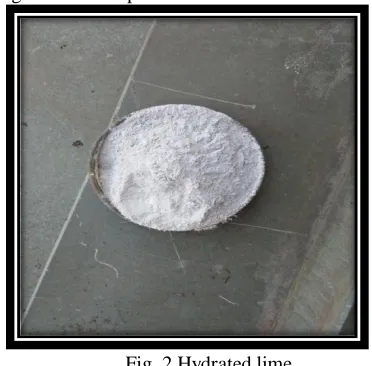
Hydrated lime: Lime is an important binding material in building construction. It is basically Calcium oxide (CaO) in natural association with magnesium oxide (MgO).Lime reacts with fly ash at ordinary temperature and forms a compound possessing cementitious properties. After reactions between lime and fly ash, calcium silicate hydrates are produced which are responsible for the high strength of the compound.
Fig. 2 Hydrated lime
February, 22nd and 23rd, 2019
153 | P a g e Fig. 3 Gypsum
Quarry dust: It is residue taken from granite quarry. Due to excessive cost of transportation from natural sources locally available river sand is expensive. Also creates environmental problems of large-scale depletion of these sources. Use of river sand in construction becomes less attractive, a substitute or replacement product for concrete industry needs to be found. Whose continued use has started posing serious problems with respect to its availability, cost and environmental impact. In such a case the Quarry rock dust can be an economic alternative to the river sand. Usually, Quarry Rock Dust is used in large scale in the highways as a surface finishing material and also used for manufacturing of hollow blocks and lightweight concrete prefabricated Elements. After processing fine particles of size less than 4.75 mm is used in this work.
Fig. 4 Quarry dust
Mud: Naturally available agricultural soil from the field black cotton soil is used in the conventional brick making procedure in large quantity But excessive use of clay is hurtful to society as all the bricks kilns in India requires good quality clay of agricultural field and uses a weight of 3 kg. Per brick. The total clay taken out from agricultural field per day was over 300mllion tones for 10000 crore bricks ( Er. Rinku Kumar et al, 2014). And, clay available in somewhat regions is poor in quality and property and costly which have forced engineers to search for better material able of reducing the expenditure on
construction. So it is advantageous and economically as well as ecologically to use industrial waste product such as fly ash for making bricks since helps to save precious top agricultural soil.
Fig. 5 Mud
Compressive strength controlled evaporation of the free water surrounding the particles in plastic clay minimizes excessive shrinkage and defect in the structure of the brick.
Foaming agent: A chemical which facilities the process of forming foam and enables it with the ability to support its integrity by giving strength to each single bubble of foam is known as foaming agent. It may categorize in two parts Protein and Synthetic.
Protein based is commonly used for the low density and for higher densities synthetic foaming agents were preferred. Foam can create through forcing the chemical, air and water by restriction which results foam formation. Synthetic foam requires less energy while protein foams need more. Energy required during the foam formation decides its quality.
February, 22nd and 23rd, 2019
154 | P a g e CLC concrete etc where the high density is needed
and it requires less energy for formation as compared to other foaming agents. It is highly recommended to
use in the constructional fields where requirement of light weight concrete is increasing by time.
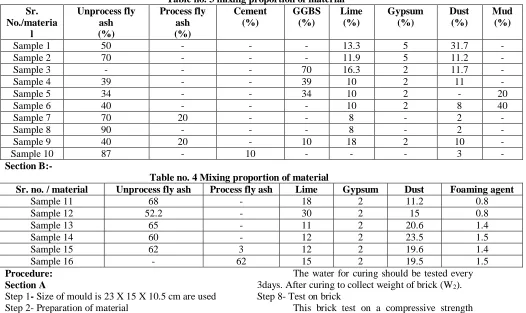
Method: AAC and CLC block Mixing proportion:
Section A:-
Table no. 3 mixing proportion of material Sr.
No./materia l
Unprocess fly ash (%)
Process fly ash (%)
Cement (%)
GGBS (%)
Lime (%)
Gypsum (%)
Dust (%)
Mud (%)
Sample 1 50 - - - 13.3 5 31.7 -
Sample 2 70 - - - 11.9 5 11.2 -
Sample 3 - - - 70 16.3 2 11.7 -
Sample 4 39 - - 39 10 2 11 -
Sample 5 34 - - 34 10 2 - 20
Sample 6 40 - - - 10 2 8 40
Sample 7 70 20 - - 8 - 2 -
Sample 8 90 - - - 8 - 2 -
Sample 9 40 20 - 10 18 2 10 -
Sample 10 87 - 10 - - - 3 -
Section B:-
Table no. 4 Mixing proportion of material
Sr. no. / material Unprocess fly ash Process fly ash Lime Gypsum Dust Foaming agent
Sample 11 68 - 18 2 11.2 0.8
Sample 12 52.2 - 30 2 15 0.8
Sample 13 65 - 11 2 20.6 1.4
Sample 14 60 - 12 2 23.5 1.5
Sample 15 62 3 12 2 19.6 1.4
Sample 16 - 62 15 2 19.5 1.5
Procedure: Section A
Step 1- Size of mould is 23 X 15 X 10.5 cm are used Step 2- Preparation of material
List of material like process fly ash, unprocess fly ash, lime, gypsum, dust, GGBS, mud, cement and water. As per proportion of material to collection of material by using weight batching. Step 3- Dosing and mixing
A dosing and mixing unit is use to form the correct mix to produce AAC and CLC block. This material mix by using hand mixing.
Step 4- Casting procedure
After through mixing, the mix material is poured in mould. Before casting, moulds are coated with a thin layer of oil.
Step 5- Demoulding
After through casting this material demoulded on after 1 hours.
Step 6- Curing
The brick are stored in moist air for 24 hours (W1). After this period the brick from the mould and kept submerged in clear fresh water until taken out prior to test.
Step 7- Precaution for test
The water for curing should be tested every 3days. After curing to collect weight of brick (W2). Step 8- Test on brick
This brick test on a compressive strength test, water absorption test.
Section B
Step 1- Size of mould is 23 X 15 X 10.5 cm are used Step 2- Preparation of material
List of material like process fly ash, unprocess fly ash, lime, gypsum, dust, GGBS, mud, cement and water. As per proportion of material to collection of material by using weight batching. Step 3- Dosing and mixing
A dosing and mixing unit is use to form the correct mix to produce AAC and CLC block. This material mix by using drill machine.
The foaming agent is mix with water by sung drill machine the foam are created and then this material added in a foam by using drill machine. Step 4- Casting procedure
After through mixing, the mix material is poured in mould. Before casting, moulds are coated with a thin layer of oil.
February, 22nd and 23rd, 2019
155 | P a g e After through casting this material
demoulded on after 1 hours. Step 6- Curing
The brick are stored in moist air for 24 hours (W1). After this period the brick from the mould and kept submerged in clear fresh water until taken out prior to test.
Step 7- Precaution for test
The water for curing should be tested every 3days. After curing to collect weight of brick (W2). Step 8- Test on brick
This brick test on a compressive strength test, water absorption test.
Test :
As per mix proportion of fly ash brick test carried out are compressive strength test, water absorption test.
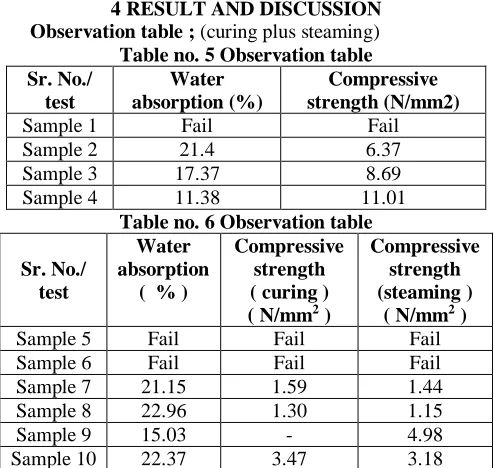
4 RESULT AND DISCUSSION Observation table ; (curing plus steaming) Table no. 5 Observation table Sr. No./
test
Water absorption (%)
Compressive strength (N/mm2)
Sample 1 Fail Fail
Sample 2 21.4 6.37
Sample 3 17.37 8.69
Sample 4 11.38 11.01
Table no. 6 Observation table
Sr. No./ test
Water absorption
( % )
Compressive strength ( curing ) ( N/mm2 )
Compressive strength (steaming )
( N/mm2 )
Sample 5 Fail Fail Fail
Sample 6 Fail Fail Fail
Sample 7 21.15 1.59 1.44
Sample 8 22.96 1.30 1.15
Sample 9 15.03 - 4.98
Sample 10 22.37 3.47 3.18
4.2 Calculation: Sample 2-
Water Wet weight – Dry weight Absorption = ---X100
Dry weight
6.65 – 5.58 = ---X100 5.58
= 21.4 %
Compressive Applied load Strength = ---
Cross sectional area 220 X 1000
= --- 230 X 150
= 6.37 N/MM2
5 CONCLUSION
This study has shows that use of fly ash brick, either can greatly improve its proportion. Most of the clearance production effort is required in India and hence fly ash block may be used for construction purpose, which is advantageous in term of general construction properties as well as eco-friendliness.
6 ACKNOWLEDGMENT
We are honored to express our deep sense of gratitude towards our guide Dr. S. L. Hake, Department of Civil Engineering, D.V.V.P. College of Engineering, Ahmednagar for his creative suggestions, helpful discussion, unfailing advice, constant encouragement during the project work. We consider our self-privileged to have worked under him, as he always shared his experience so generously and patiently in spite of his busy schedule. We sincerely appreciate the interactive help, received from him by the way of advice, suggestions.
At the outset, we take this opportunity to express our sincere gratitude to Dr. U. R. Kawade, Head of Civil Engineering Department, We are also thankful to Dr. U. P. Naik, Principal, D.V.V.P College of Engineering, for his helpful support during the project work.
We have been always graced by our parents, their support and blessings have driven our performance and success. We are grateful to our family and friends for their kind support and motivation have helped us to complete this work successfully
7 REFERRANCES
February, 22nd and 23rd, 2019
156 | P a g e 2 Geethu Kallunkal, Dr. Elson John,
“Optimization of foam concrete masonry blocks” International Journal of Engineering Research and General Science Volume 4, Issue 5, September-October, 2016 ISSN 2091-2730.
3 A. K. Marunmale, a.c.attar, “designing, developing and testing of cellular lightweight concrete brick (CLC) wall built in rat-trap bond”, current trends in technology and science issn: 2279- 0535. Volume: 3, issue: 4 (june-july 2014)
4 Anurag Wahane, “manufacturing process of aac block”, international journal of advance research in science and engineering volume no. 06, special issue no. (02), September 2017, ICITTESE-17.
5 K. Shyam Prakash and Dr. Ch. Hanumantha Rao, “Strength Characteristics of Quarry Dust in Replacement of Sand”,International Conference on Advanced Material Technologies (ICAMT)-2016 27th and 28th December 2016.
6 Biswaprakash Das and Mahendra Gattu, “study on performance of quarry dust as fine aggregate in concrete”, International Conference on Advances in Construction Materials and Structures (ACMS-2018) IIT Roorkee, Roorkee, Uttarakhand, India, March 7-8, 2018.
7 Ghanshyam Kumawat, Dr. Savita Maru, “Analysis and Comparison of R.C.C. Structure Using CLC Block With Burnt Clay Bricks”, International Journal of Engineering Research and General Science
Volume 4, Issue 3, May-June, 2016 ISSN 2091-2730.
8 Nagesh. Mustapure, H.Eramma,
“experimental investigation on cellular lightweight concrete blocks for varying grades of density”, International Journal of Advanced Technology in Engineering and Science Volume No.02, Issue No. 08, August 2014.
9 K. Shyam Prakash, Ch. Hanumantha Rao (2016), ‘Study on compressive strength of quarry dust as fine aggregate in concrete’, Advances in Civil Engineering, Volume 2016, Article ID 1742769, Hindawi Publishing Corporation.
10 Anzar Hamid Mir, “Improved Concrete Properties Using Quarry Dust as Replacement for Natural Sand”, International Journal of Engineering
Research and Development, Vol. 11, issue 03, pp. 46 – 52, March 2015.
11 K.Krishna Bhavani Siram (December 2012), International Journal of Engineering and Advanced Technology (IJEAT) ISSN: 2249 – 8958, Volume-2, Issue-2, Cellular Light Weight Concrete Blocks as a Replacement of Burnt Clay Bricks.
12 S. Nandi, arnabch atterjee, prantik samanta, tanushree hansda, Cellular Concrete & its facets of application in Civil Engineering, International Journal of Engineering Research ISSN:2319-6890(online), 2347-5013(print),Volume No.5, Issue Special 1 pp : 37-43 8 & 9 Jan 2016.
13 Ashish S. Moon, Dr. Valsson Varghese , S. S. Waghmare, “Foam Concrete as A Green Building Material,” international journal for research in emerging science and technology, volume-2, issue-9, sep-2015. 14 Soumini A K ,(Mar2015), “An overview of
cellular lightweight concrete,” International journal of advanced research trends in
engineering and technology,
volume2,special issue X.
15 Y.H. Mugahed Amran, Nima Farzadnia, A.A. Abang Ali, “Properties and Applications of Foamed Concrete” a review a Journal of Construction and Building Materials ELSEVIER, Vol. 101, pp. 990-1005, 2015.
16 Yuanyuan Zhang, Yin Chi and Lihua X, “Study on the Preparation and Properties of High-porosity Foamed Concretes Based on
Ordinary Portland Cement”, journal of
material design ELSEVIER Vol.100, 2015. 17 Ameer A. Hilal, Nicholas Howard Thoma,
Andrew Robert Dawson, “Void Structure and Strength of Foamed Concrete Made without/wit Additives”, Construction and Building Materials, Vol.85, pp. 157–164, 2015.