Complexity Metrics for Component Based Software
—
A
Comparative Study
Sonal Gehlot
1, PoojaRana
1, Rajender Singh
2* 1 Maharshi Dayanand University, Rohtak, Haryana, India.
2
Department of Computer Science & Application, Maharshi Dayanand University, Rohtak, Haryana, India.
*Corresponding author: Tel. 08199023624, email: [email protected] Manuscript submitted March 10, 2019; accepted May 20, 2019.
doi: 10.17706/jcp.14.6 389-396.
Abstract:
The Component Based Software Development (CBSD) approach is becoming the trend for software
development and is based on developing the software from existing components instead of developing
software from the scratch level. Measuring the software complexity is an important aspect during software
development as it is an important determinant of software development effort, testing effort, cost,
maintainability etc. Interactions/interfaces among components play an important role in contributing
complexity to a component based software. In this paper a comparison between different complexity metrics
developed by different authors is performed. These metrics are performed by taking different factors to
calculate the complexity of the components based software, these factors are instance variables, instance
methods, control flow and interface methods etc.. The comparison is performed by taking some quality
factors into consideration like maintainability, Integrity, complexity, testability, customizability etc.
Key words:
CBAD, coupling, weighted assignment technique, complexity metrics, cyclometric complexity,
and black box component.
1.
Introduction
Software metrics play a very important role in assessing and predicting various attributes of software such
as complexity, reusability, maintainability, testability etc. Among these attributes complexity affects all other
attributes of the software [1]. Software Complexity measures have great importance because it indicates
scope of further improvement in software development. Higher value of complexity increases efforts of
testing, maintenance and also difficult to reuse.
The component based software development (CBAD) is one of the most important paradigms. CBAD
approach is increasingly being adopted for software development. This approach uses reusable components
as building blocks for constructing software application. The main aim of this approach is to minimize the
development cost, time and efforts by mean of reuse [1].
The major problem faced in Component development is its complexity. So it is necessary to measure the
software complexity and reduced it to achieve the maximum benefits of CBAD with minimum cost and efforts.
There are several metrics which are available for measuring software complexity but they are not suitable for
CBAD.
whereas the metrics for object-oriented and component based software applications should depend mainly
on the granularity and interoperability aspects of the classes and components. The major factor influencing
the CBAD is the dependency among software components, which is necessary and desirable because one
component may provide the services to another component. Then there should be an interface between the
components.
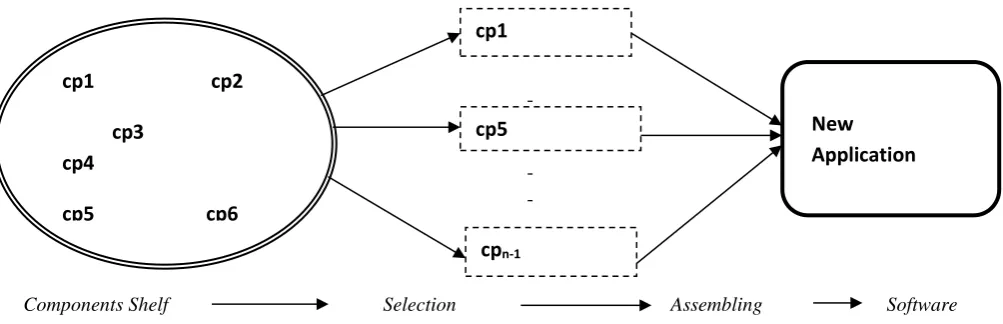
The following figure (Fig. 1) shows the technique for developing software application from existing
components (cp).
-
-
- - -
Components Shelf Selection Assembling Software
Fig. 1. Component based software development technique.
The paper is divided into sections. First section is introduction; second section has comparison of different complexity metrics. Section 3 has key observation and Section 4 concludes the paper.
2.
Complexity Metrics for Component Based Application
The dependency among components may be defined as the reliance of a component on others to support
a specific functionality or configuration. In CBSE application the components interact with other components
by sharing information in order to provide application functionalities. This composition creates interaction
that promotes dependencies among components. Application functionalities cannot solely encapsulate
within one component. Therefore changing a component may affect that composite functionality, which is
reflected in different components. In addition, replacing a new version of a specific component might involve
replacing the component on which it depends, in order to preserve a specific application‘s functionality.
The component complexity closely depends on what contributes to develop the components. Thus there
are four elements that affect the component complexity. First element is Variable factor that tells complexity
of the variables defined in the component. The variables may consist of member variables of a class having
scope for the entire class and the parameters, which are local to a particular method. The second element is
interfaces, which are the access points of component, through which a component can request a service
declared in an interface of the service providing component.
Interface complexity is defined as sum of complexity of the interface methods of the class. Third element is
coupling factor that tells rate of coupling of the methods in the component. Fourth element is cyclometic
complexity of the methods of the component.
In this paper we will review the different types of complexity metrics and compare them.
Nael SALMAN et al. [2] 2006 author in this paper developed several complexity metrics for component based system. The main focus of the author is to find out the strength of the software, by defining metrics on its structural complexity [2]. The main factors that determine the complexity are components, connectors and composition tree.
cp1
cp5
cp
n-1cp1
cp2
cp3
cp4
cp5
cp6
cp
nFor components three metrics are defined such as TNC, ANMC and TNIC, for connectors three metrics are developed like TNL, ANLC, ANLI [2]. the author defined a suite of metrics for component based software and the definition of component based software is adopted by author which is given by Szyperski (1999) [2].
Gill and Balkishan et al. [3] 2008 their attempt was to identify the impact of dependency among components on software complexity. They proposed
two metrics CDM and CIDM. Both the metrics can be applied once the
directed graph and adjacency matrix of the design is found [3]. The result of these metrics is analyzed in order to determine as how the interaction among components and number of components affect the complexity of component based application. These metric shows higher interaction between components increases the complexity because of more coupling among component. Higher complexity means more expensive software and less maintainability [3].Gui Gui and Paul. D. Scott et al. [4] 2009 in this paper the author develop new metrics for coupling and cohesion to measure the reusability of a component. These metrics are different from other metrics in three aspects, first is degree of resemblance of one component with other component, degree of coupling, direct coupling and cohesion relationship. Author measures quantitatively measure the complexity by taking these factors into consideration [4]. A comparative analysis is performed between new metrics and existing metrics and found that new metrics are much superior then existing metrics [4].
Narasimhan and Hendradjaya’s metric suite et al. [5] 2009 in thispaper author defined a metric suite for component based software. Author defined two sets of metrics for measuring complexity and criticality. First set of metrics are Component Packing Density (CPD) which describe the binding of the components. These metrics relate all component constituents to the number of integrated component. Another set of metrics are Component Interaction Density (CID), these metrics relates interaction between components and available number of interaction in the system [5].
Kumari and Bhasin et al. [6] 2011 the authors aimed to design a composite complexity measure to quantify important aspects of complexity of a component based application. Two major complexity metric of CBS are one due to individual component named as TC (CBS) and other due to its interaction with other component named as IACC [6]. They take different factors like size, type of variables, nesting level of control structure to calculate the individual component complexity. Graph theoretic notions and concept of weights have been used for interface component complexity. The result shows that the effect of these parameters (Size, Nesting Structure, Control Structure etc.) on complexity of a CBS is quite significant. The results also show that higher interaction between components increases the complexity because of more coupling among the components [6].
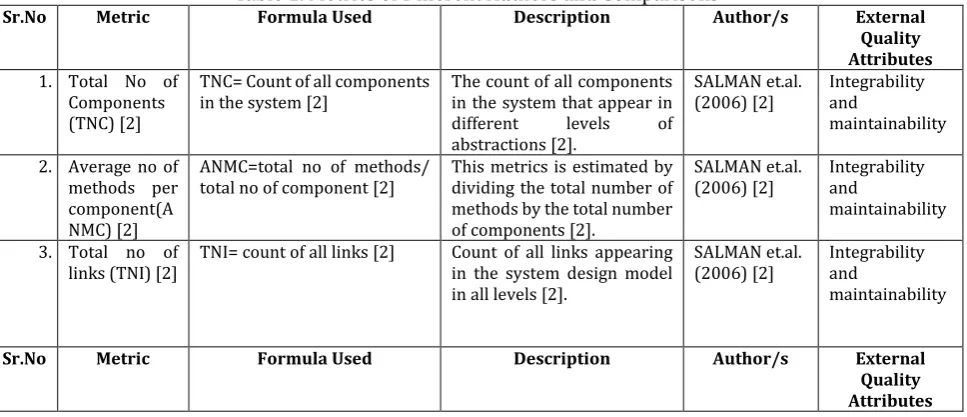
Table 1. Metrics of Different Authors and Comparisons
Sr.No Metric Formula Used Description Author/s External Quality Attributes
1. Total No of Components (TNC) [2]
TNC= Count of all components
in the system [2] The count of all components in the system that appear in
different levels of
abstractions [2].
SALMAN et.al.
(2006) [2] Integrability and maintainability
2. Average no of methods per component(A NMC) [2]
ANMC=total no of methods/
total no of component [2] This metrics is estimated by dividing the total number of methods by the total number of components [2].
SALMAN et.al.
(2006) [2] Integrability and maintainability
3. Total no of
links (TNI) [2] TNI= count of all links [2] Count of all links appearing in the system design model in all levels [2].
SALMAN et.al.
(2006) [2] Integrability and maintainability
4. Average
number of
links between components (ANLC) [2]
ANLC= Total no of links/ Total
no of components [2] Total number of links divided by the total number of components [2].
SALMAN et.al.
(2006) [2] Integrability and maintainability
5. Average
number of
links per
interface (ANLI) [2]
ANLI= Total no of links between interfaces/ Total no of interfaces [2]
Total number of links between interfaces divided by the total number of interfaces [2].
SALMAN et.al.
(2006) [2] Integrability and maintainability
6. Total number of interfaces (TNI) [2]
TNI=count of all interfaces in
all components [2] Count of all interfaces of all Components in the system [2].
SALMAN et.al.
(2006) [2] Integrability and maintainability 7. Average
number of
interfaces per component (ANIC) [2]
ANIC= Total no of interfaces/
Total no of components [2] Total number of interfaces divided by the total number of components [2].
SALMAN et.al.
(2006) [2] Integrability and maintainability
8. Depth of the composition tree (DCT) [2]
DCT= Count of the number of
levels [2] Count the number of levels of the composition tree [2]. SALMAN et.al. (2006) [2] Integrability and maintainability
9. Component
Dependency Metric (CDM) [3]
CDM=∑𝑛 𝐷𝑗
𝑗=1 [3]
Dj=∑𝑛 𝑝𝑎𝑡ℎ(𝑖, 𝑗)
𝑗=1 [3]
The complexity results from
dependencies among
application components.
Dependency of a component Ci to other component is the
number of all the paths in the graph from Ci to the other
component [3].
Gill and
Balkishan et. al. (2008) [3]
Complexity Maintainability
10. Component Interaction Density Metric (CIDM)[3]
CIDM𝐼
𝑁= [3] This Metric computes the ratio of total number of direct interactions between the components to the total number of components [3].
Gill and
Balkishan et. al. (2008) [3]
Complexity Maintainability
11. Direct Coupling [4]
[4]
It measures the direct
coupling between
Components [4].
Gui and Paul et.al. (2009) [4]
Complexity Reusability
12. Transitive Coupling [4]
[4]
It measures the transitive coupling between classes Ci and Cj due to a specific path P [4].
Gui and Paul et.al. (2009) [4]
Complexity Reusability
13. Weighted Transitive Coupling [4]
[4]
It measures the total
coupling of the software system [4].
Gui and Paul et.al. (2009) [4]
Complexity Reusability
14. Transitive Cohesion of the class [4]
𝐶𝑙𝑎𝑠𝑠𝐶𝑜ℎ𝑇 =∑ 𝑆𝑖𝑚(𝑖, 𝑗)
𝑚 𝑖,𝑗=1
𝑚2− 𝑚 [4]
It measures the cohesion of class by summing the similarities of all methods and dividing by total number of methods [4].
Gui and Paul et.al. (2009) [4]
Complexity Reusability
15. Intransitive Cohesion of class [4]
𝐶𝑙𝑎𝑠𝑠𝐶𝑜ℎ𝐷 =∑ 𝑆𝑖𝑚𝐷(𝑖,𝑗) 𝑚
𝑖,𝑗=1
𝑚2−𝑚
[4]
It measures the direct
cohesion between
components [4].
Gui and Paul et.al. (2009) [4]
Complexity Reusability
16. Weighted Transitive Cohesion [4]
𝑊𝑇𝐶𝑜ℎ =∑ 𝐶𝑙𝑎𝑠𝑠𝐶𝑜ℎ𝑇𝑗) 𝑛
𝑗=1
𝑛 [4]
It measures weighted
transitive cohesion. The value of WTCoh should lie between 0 to 1 [4].
Gui and Paul et.al. (2009) [4]
Complexity Reusability
17. Weighted Intransitive Cohesion [4]
𝑊𝐼𝐶𝑜ℎ =∑ 𝐶𝑙𝑎𝑠𝑠𝐶𝑜ℎ𝐷𝑗) 𝑛
𝑗=1
𝑛 [4]
It measures weighted
intransitive cohesion. The value of WICoh should lie between 0 to 1 [4].
Gui and Paul et.al. (2009) [4]
Complexity Reusability
18. Component Packing Density [5]
CPDconstituent_type=
#<𝐶𝑜𝑛𝑠𝑡𝑖𝑡𝑢𝑒𝑛𝑡> # 𝐶𝑜𝑚𝑝𝑜𝑒𝑛𝑒𝑛𝑡 [5]
It is a ratio between Number of constituents and Number of components [5].
Narasimhan et.al. (2009) [5]
Complexity Criticality
19. Interaction Density Metric [5]
IDC= # 𝐼
# 𝐼𝑚𝑎𝑥 [5] It is a ratio between actual interaction and available interaction [5].
Narasimhan et.al. (2009) [5]
Complexity Interdependenc e
Interface 20. Incoming
Interaction
Density of
Component [5]
IIDC= # 𝐼𝐼𝑁
# 𝐼𝑚𝑎𝑥𝐼𝑁 [5]
It is a ratio between number of incoming interaction used and available number of incoming interaction [5].
Narasimhan et.al. (2009) [5]
Complexity Interdependenc e
Interface
21. Outgoing Interaction
Density of
Components [5]
OIDC = # 𝐼𝑂𝑈𝑇
# 𝐼𝑚𝑎𝑥𝑂𝑈𝑇 [5]
It is a ratio between number of outgoing interaction used and available number of outgoing interaction [5].
Narasimhan et.al. (2009) [5]
Complexity Interdependenc e
Interface
22. Average Interaction Density Metric [5]
AIDC=𝐼𝐷𝐶1+𝐼𝐷𝐶2+⋯+𝐼𝐷𝐶𝑛
# 𝐶𝑜𝑚𝑝𝑜𝑛𝑒𝑛𝑡𝑠 [5] It is a sum of each components interaction density and divided by total number of components [5].
Narasimhan et.al. (2009) [5]
Complexity Interdependenc e
Interface 23. Total
Complexity of a Component Based System (TC(CBS)) [6]
TC(CBS)= ∑𝑛 ((𝐼𝐶𝐶)𝑗 ∗
𝑗=1
(𝑊𝑡)𝑗) ∗ (𝐼𝐴𝐶𝐶)𝑗 [6]
This composite metric takes
different attributes of
complexity. The result shows
the effect of these
parameters on complexity of a CBS [6].
Kumari and
Bhasin et.al. (2011) [6]
Complexity Testing Maintainability
24. Interaction Among Components Complexity(I ACC) [6]
IACC= IIC+OIC [6] This metric shows the
interaction with other
component. The concept of link is used to quantify
interface aspect of a
component [6].
Kumari and
Bhasin et.al. (2011) [6]
Complexity Testing Maintainability
25. Average Incoming Interactions Complexity (AIIC) [7]
AIIC= ∑𝑚𝑖=1𝐼𝐼𝑖
𝑚 [7]
This metric shows the average of the incoming
interactions of one
component [7].
Kumari and
Upadhyaya et. al. (2011) [7]
Complexity Reliability
26. Average Outgoing Interactions Complexity (AOIC) [7]
AOIC= ∑𝑚𝑖=1𝑂𝐼𝑖
𝑚 [7]
This metric shows the average of the outgoing
interactions of one
component [7].
Kumari and
Upadhyaya et. al. (2011) [7]
Complexity Reliability 27. I , j Average Interface Complexity of a Component Based System (AIC(CBS)) [7]
AIC(CBS)=
∑𝑚𝑖=1𝐼𝐼𝑖 𝑚 +
∑𝑚𝑖=1𝑂𝐼𝑖
𝑚 [7]
This Metric shows the average interface metric by summation of incoming
interface and outgoing
interface metrics [7].
Kumari and
Upadhyaya et.al. (2011) [7]
Complexity Reliability
28. Complexity of Interface Component (CI) [8] CI= CSI+ICC(internal)+ICC(extern al) [8]
This metric measured in term of size of interface,
interface coupling with
internal subcomponents and interface coupling with outer components [8].
Chillar and
Ahlawat et.al. (2012) [8]
Complexity Reusability Customizability
29. Average Complexity of CBS [8]
AC(CBS)=∑𝑛 𝐶𝐼/𝑛
𝑖=1 [8] This complexity measured
the average complexity of interface component [8].
Chillar and
Ahlawat et. al. (2012) [8]
Sr.No Metric Formula Used Description Author/s External Quality Attributes
30. Interface Dependency Metric (IDM) [8]
IDM = Functionality obtained
from other
component/functionality of a component [8]
The dependency of a component can be as the functionality obtained from other components apart from its own functionality [8].
Chillar and
Ahlawat et.al. (2012) [8]
Complexity Reusability Customizability
31. Average interface dependency metric of CBS [8]
AIDM(CBS)=∑𝑛 𝐼𝐷𝑀/𝑛
𝑖=0 [8] This metric measured the
average complexity of
interface dependency metric [8].
Chillar and
Ahlawat et.al. (2012) [8]
Complexity Reusability Customizability
Kumari and Upadhyaya et al. [7] 2011 they attempted to design an interface complexity metric for black box components to quantify an important aspect of complexity of a CBS. In CBAD a component is linked with other component and has interfaces with them. A link means that a component submits an event and other component receive it. Interface between two components can be through incoming and outgoing interactions. They proposed AIIC, AOIC and AIC (CBS) which calculate average incoming interaction complexity, average outgoing interactions complexity and average interface complexity of a component based application [7]. The result shows that the effect of interface parameter on complexity of CBS is quite significant. They propose that average no of interaction per component in CBS should not be greater than five otherwise that CBS would be highly complex and will be more prone to errors and hence unreliable [7].
Chillar and Ahlawat et al. [8] (2012) they proposed two metrics CI and IDM for measuring complexity of interface and interface dependency of CBS. These metrics are based on different constituents of an interface like interface methods and interface variables with different weights assigned to them. Strength of proposed metrics is computed using weighted assignment technique. Interface methods are classified according to data type of return type and data type of arguments [8]. These metrics shows that higher dependency among components increases complexity because of more coupling. There is a positive relation between complexity of interface metric and interface dependency metric. It is clear that complexity of interface and dependency of interface increases with increase in parameter involved [8].
3.
Key Observations
Conducted a systematic study of the literature available for the interface metrics for component based
applications. These included research publications involving validations, proposals and all other studies
related to interface metrics [9]. The search for relevant publications was conducted through various ACM
journals. Reference checking was used to make sure that no relevant work was being left out [9]. The
contribution of different interface metrics based on the mapping level addressed by them was also studied,
which revealed that most of the interface metrics proposed to measure the interdependence of different
component using interface component [9].
Further analysis shows that most of the interface metrics address the maintainability, reusability and
testability quality factors. Hence a lot of work is still left to be done to prove these metrics are good indicators
of the overall software quality.
4.
Conclusion and Future Scope of Work
• Most of the interface metrics studied lack of validations which limits their usefulness.
• The relationship of these metrics with external quality attributes was also studied and it was found that most of the interface metrics proposed share a relationship with maintainability, testability and reusability.
• Interface Metrics need to be evaluated for a wide range of large scale real world applications for both metric validation and effective utilization for software quality assessment.
The overall study revealed that the interface complexity metrics domain is still has a scope in the field of
software engineering and faces a number of research challenges in term of empirical validation and
relationship with external software quality attributes. For the future research work, researchers can use these
metrics for indirect coupling measure as well as indicator for predicting the various qualities attributes like
maintainability, testability and reusability of component based software application.
References
[1]
Kozaczynski, W., & Booch, G. (1998). Component-based software engineering.
IEEE Software
,
155,
34–36.
[2] Noel, S. (2006). Complexity metrics as predictors of maintainability and integrability of software components.Journal of Arts and Sciences, 5, 39-50.
[3] Gill, N. S. B. (2008). Dependency and interaction oriented complexity metrics of component-based systems. ACM SIGSOFT Software Engineering Notes, 33(2), 1-5.
[4] Gui, S. (2008). New coupling and cohesion metrics for evaluation of software component reusability. Proceedings of the 9th International Conference For Young Computer Scientists.
[5]
Narasimhan,
V. L., Parthasarathy, P. T., & Das, M. (2009). Evaluation of a suite of metrics for component based software engineering (CBSE). Issues in Informing Science and Information Technology, 6.[6] UshaChhillar, S. (2011). A journey of software metrics: Traditional to aspect-oriented paradigm. Proceedings of the 5th National Conference on Computing for Nation Development (pp. 289-293). New Delhi.
[7]
Usha, K.,
& Shuchita, U. (2011). An interface complexity measure for component-based software systems. International Journal of Computer Applications (0975-8887), 36(1).[8]
Rajender, S. C., Priyanka, A., & Usha, K. (2012). Measuring complexity of component based system using
weighted assignment technique. Proceedings of the 2nd International Conference on Information Communication and Management (ICICM 2012).[9] Rani, G., & Paramvir, S. (2014). Dynamic coupling metrics for object oriented software systems- A survey.