Implementation Of Agent Based Web Service
Composition Using Dependency Relation
Algorithm
Francis Michael R.T, Siva Pragasam. P
Researh Scholar, Dept. of Computer Science, Bharathiar University, Coimbatore, TamilNadu, India Associate Prof., Dept. of Computer Science, Sri Vasavi College, Erode, TamilNadu, India
Email: [email protected]
ABSTRACT: In the modern world of web service community expands its way with increasing the number of web services to facilitate their users. This expansion also comprises several problem like identification, selection and composition of web services. We have proposed and implemented a method that may give the solution to such problems. This method can be very useful when number of web services are very high in number. It is an agent based model that uses the dependency relation algorithm to identify the web services which are participate in the composition. The experimental part of the article shows that there is an improvement in the approach.
Keywords: Web service agent, Dependency relation, Web service composition, SOA agent, Web services parameters
1 I
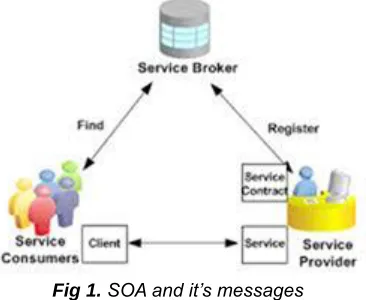
NTRODUCTIONTHe development of distributed application environment in-tended to realize the capability of agent based applications [1]. Most of the existing approaches have more pitfalls. The ne-cessity of developing agent based system is to enable the au-tonomous composition of web services, dynamic and intelli-gent in nature. To make the aintelli-gent as dynamic and intelliintelli-gent it must incorporate the attributes such as integrity, consistency, undependability and adoptability. Integration of SOA and SOC strengthen the advantages of developing an agent based web service composition [2]. One of the emerging application archi-tecture SOA provides the software services are elementary known as web services (WS) can be composed and used it to achieve the complex tasks. WS are the methods created, pub-lished and accessed over the web. The UDDI, WSDL and SOAP are involved in this invocation process [3-6]. Fig 1 shows the messages of SOA.
Fig 1. SOA and it’s messages
SOA employs various approaches to compose the WSs they are semi-automatic and fully automatic. Choosing of this ap-proaches depends upon the domain and the respective pro-cess model. Web services are heterogeneous and loosely coupled over the SOA. One of the important characteristics of this type of the system is that adoptivity of the ad-hoc changes in the components of distributed system. The primary task of an agent based WS composition model is searching the ser-vices in the UDDI and providing the composition of serser-vices
for the service requestors. This article implements a multi-agent model and the contents are organized as follows, Sec-tion-I describes the introductory part, SecSec-tion-II reviews the existing approaches, Section-III implements the relevant mod-el and evaluates the results and Section-IV concludes the ap-proach.
2
O
VERVIEWproposed a multi agent model dealt with the service selection planning problem. The service planning is done by considering the relationships among the different service consumers and providers [14]. Ontology enabled intelligent software agent is a multi-agent system. It processes the user requests based on the functionality and OS requirements. The similarity between the services are calculated by the input and output parameters [15]. Cosine similarity between the web services are
deter-mined to match the web services with respect to the user’s request [26]. Automated score based indexing may not suita-ble for comparison based model. The semantic similarity measures have been introduced by to measure to measure the similarity between the words and sentences [27]. Features and limitations of the various agent models reviewed and are listed in the Table 1. The general characteristics of the agent listed in the Table 2
TABLE 1
Features of existing WS-agent models
e Models Features Additional requirements
1 Centralized broker [8] Domain specific, heterogeneous data stream, dynamic
agent High speed query processing
2 Fujitsu EO prototype [10] Supports B2C environment, AAP and FIPA, applicable
to large scale environments Supports only underlying domain 3 Multi agent framework (WSAF) [13] SA exists between service consumers (SC) and service
providers (SP) Aware of QOS requirements
4 SWSCPA [14] Supports concurrence Implements complex behavior
5 Intelligent software agent [15] Considers functionality and QOS WS composition TABLE 2
GENERAL CHARACTERISTICS OF THE AGENT
S.No Agent characteristics Description
1 Communicative Respond to all the messages
2 Cooperative Supports Multi-agent
3 Adoptive Consistent in all the situation
4 Autonomy Act independently
3
A
GENTS
YSTEMI
MPLEMENTATIONMajor advantages of the SOA is that it supports the loosely coupled application development environment, where compo-nents can be created independently called as web services. These services are described using the WSDL and the de-scriptions are stored in a centralized repository UDDI. The agents are providing an interface to select, invoke and com-pose these web services [19].
3.1 System Architecture
Web service composition is required whenever one or more services are involved in a process. The proposed model identi-fies the appropriate services which are take part in the compo-sition. The following Fig 2 shows our system architecture con-sists of the following components performs the various tasks related to identify the dependency relation and web service selection with respect to current query (requests). Service Providers (SP) giving the web service descriptions in the form of WSDL and they are available in the centralized repository. WSDL parser component process the description of the web services and identifies the input and output parameters of the various operations [20]. Fig 3 shows parameters description in a WSDL. Service Consumers (SC) are requesting the services by giving the query through the Request Process (RP). RP identifies web services which are plays the important role in producing the composite services. The module called depend-ency relation responsible for getting the relationships among the services by receiving parameter information from the data store and also produces the service plan. Service plan gives the execution sequence of the operation using the plan gener-ator. Dependency visualizer generates the graphical view of
the relationships of the services.
Fig 3. Parameters description in a WSDL
6.1 Dependency Relation Algorithm (DRA)
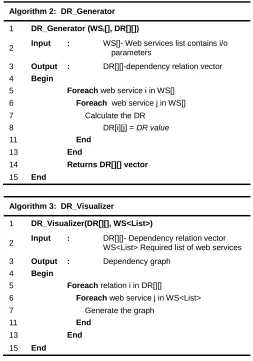
The concept behind the Dependency Relation Algorithm (DRA) is getting the parameters list from the repository and identifies the between the input and output parameters. To identify the dependency between the input and output parame-ters of service is done through the semantic comparison. There are vectors namely WS consists of input and output parameters of the web services and DR provides the depend-ency relation among the input and output parameters of the services. User queries processed using the following Algorithm 1 [21] [22]. The services are identified for the corresponding query and the composition sequence plan is generated to vis-ualize the operation execution. User query is processed using the following algorithm which is depicted in the Algorithm 1 [23] [24]. The impact of DR among the services are discussed in [25]. Algorithm 2 is for dependency relation generation and is listed below. DR visualizer gives the graphical representa-tion for the composirepresenta-tion plan. It is achieved with following Algo-rithm 3 listed below
Algorithm 1: Query_Processor
1 Query_Processor (Qry, WS<List>)
2
Input : Qry – User query includes relevant and non-
relevant informations
3 Output : Partially identified web service list WS<List>
4 Begin
5 Tokenize the Qry
6 Remove the non-relevant informations 7 Prepare partially identified WS 13 End
14 Returns Classifications
15 End
Algorithm 2: DR_Generator
1 DR_Generator (WSi[], DR[][])
2 Input : WS[]- Web services list contains i/o parameters
3 Output : DR[][]-dependency relation vector 4 Begin
5 Foreach web service i in WS[] 6 Foreach web service j in WS[] 7 Calculate the DR
8 DR[i][j] = DR value
11 End
13 End
14 Returns DR[][] vector
15 End
Algorithm 3: DR_Visualizer
1 DR_Visualizer(DR[][], WS<List>)
2 Input : DR[][]- Dependency relation vector WS<List> Required list of web services 3 Output : Dependency graph
4 Begin
5 Foreach relation i in DR[][]
6 Foreach web service j in WS<List> 7 Generate the graph
11 End
13 End
4
R
ESULTS ANDA
NALYSIS 4.1 Case StudyTo simulate the entire approach, the following case study of E-University Information scenario is considered. We assumes that this scenario consists of number of web services that pro-vides the numerous information to the students who wants to know about the course details, university details, fees details etc. This E-University Information environment must provide the information on basis of the students’ requests (Eg. Part-Time MTech Degree). The degree of composition is relies on
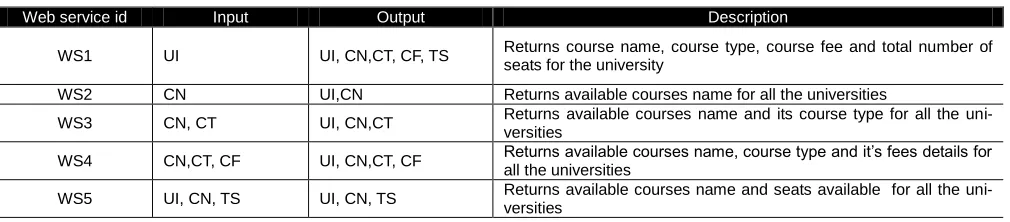
the number of web services which are involved in the compo-sition. Each and every relation’s attribute can be treated as web services. In this scenario we have considered the follow-ing web services: WS1, WS2, WS3, WS4 and WS5 providfollow-ing the following details University Information (UI), Course-Name(CN), CourseType (DT), CourseFees(CF) and Total-Seats(TS) respectively. Depends upon the query the either one or more services will be returned to the users. The num-ber of web services in the response will decide the composi-tion is required or not and is defined by the composicomposi-tion plan. Table 3 shows the input and output of each service
TABLE 3
CASE STUDY -INPUT AND OUTPUT DESCRIPTION FOR E-UNIVERSITY INFORMATION WEB SERVICES
Web service id Input Output Description
WS1 UI UI, CN,CT, CF, TS Returns course name, course type, course fee and total number of seats for the university
WS2 CN UI,CN Returns available courses name for all the universities
WS3 CN, CT UI, CN,CT Returns available courses name and its course type for all the uni-versities
WS4 CN,CT, CF UI, CN,CT, CF Returns available courses name, course type and it’s fees details for all the universities WS5 UI, CN, TS UI, CN, TS Returns available courses name and seats available for all the
uni-versities From the above Table 3 the dependency relation can be
de-fined as WS5 -> WS4 -> WS3 -> WS2 ->WS1 -> none. After identifying the dependency among the web services then de-pendency order can be determined to prepare the composition plan. Based on the composition plan the web services are in-voked and executed to produce the appropriate results.The evaluation for this model analyses the consistency between the systems generated and manually obtained composition list. We have classified the web services based on the de-pendency category given in the Table 4.
Definition 1: Let WS be the service set WS= {WS1, WS2, WS3, …………. WSn}.The dependency relation between two services WSi and WSj can be defined as follows WSi (op) = {O1, O2, O3,………. Om} and WSj (ip) = {I1, I2, I3,………. In}
Highly dependent ∀x ∃y DR(x,y) m=n Low dependent ¬∀x ∃y DR(x,y) m≠n Not dependent ¬∀x ¬∃y DR(x,y) m≠n
Where
O is output parameter I is input parameter
m and n are number of output and input parameters respectively DR is dependency relation
Where Dij ={1
TABLE 4 DEPENDENCY CATEGORY
S.No Value Description
1 0 Not dependent
2 1 Low dependent
3 2 High dependent
TABLE 5
USER INPUTS VSPERFORMANCE
Request No of services in the composition Performance %
Part-time MTech for CSE 4 83.3245
Course Fee for Part-time courses 5 80.01
Course Details for the University X 6 78.5
University details 2 92.21
MTech Course types 4 75.12
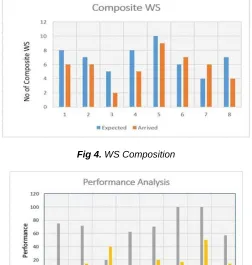
This domain specific agent model obtains the results and compared with various dimensions. The accuracy of the de-pendency for the existing web service calculated by DRA and compared with manually calculated values which is given in the Fig 4. Fig 5 shows efficiency of the composition.
Fig 4. WS Composition
Fig 5. Performance Analysis
5
C
ONCLUSIONImplementation of this approach uses a web service dataset consists of 1333 WSDL descriptions and a QOS dataset for the QOS optimization. The results of this model shows that there is an improvement in the composition of web services. This model finds the dependency relation between the service parameters. The efficiency of the system is verified by giving different datasets as inputs. The results shows that the per-formance of the system is improved in-terms number of rele-vant web services in the composition into 80% accuracy. The performance of the system suffers due to the irrelevant key-words in the user’s query and also the system is domain spe-cific. By considering the multiple domain the future work can be enhanced to get better results.
R
EFERENCES[1] Willmott, S., Dale, J., Burg, B., Charlton, P. and O’Brien, P. Agentcities: A Worldwide Open Agent Network. In: The Agentlink Newsletter 8, pp.13-15, 2001.
[2] WenJuan, L., YongQuan, L., Qingtian, Z.: Integrating Se-mantics and Agent Technology to Automatic Web Service Composition. In: IEEE 2nd Symposium on Web Society, pp. 201–206, 2010.
[3] http://www.uddi.org/pubs/uddi_v3_features.htm
[4] http://en.wikipedia.org/wiki/Universal_Description_Discove ry_and_Integration
[5] http://en.wikipedia.org/wiki/Web_Services_Description_La nguage
[6] http://en.wikipedia.org/wiki/SOAP
[7] V. Benjamins, E. Plaza, E. Motta, D. Fensel, R. Studer, B. Wielinga, G. Schreiber, and Z. Zdrahal. IBROW3 - an intel-ligent brokering service for knowledge-component reuse on the world wide web. In Proceedings of KAW'98, 1998.
[8] Gibbins, Nicholas, Stephen Harris, and Nigel Shadbolt. "Agent-based semantic web services." Web Semantics: Science, Services and Agents on the World Wide Web 1, no. 2 (2004): 141-154.
[9] Dale, J. April Agent Platform Reference Manual. Fujitsu
Laboratories of America,
2002.http://sf.us.agentcities.net/aap/
[10]Dale, Jonathan, et al. "Implementing agent-based web services." Proceedings of the AAMAS’03 workshop on challenges in open agent systems, Melbourne. 2003.
[11]Huhns, Michael N. "Software agents: The future of web services." Agent Technologies, Infrastructures, Tools, and Applications for E-Services. Springer Berlin Heidelberg, 2003. 1-18.
[12]Bian, W. U., and W. U. Xincai. "A QoS-aware method for web services discovery." Journal of Geographic Infor-mation System 2.01 (2010): 40.
[14]Pan, ShanLiang, and QinJiao Mao. "Case Study on Web Service Composition Based on Multi-Agent System." Journal of Software 8.4 (2013): 900-907.
[15]Benaboud, Rohallah, Ramdane Maamri, and Zaïdi Sahnoun. "Semantic Web Service Discovery Based on Agents and Ontologies." International Journal of Innova-tion, Management and Technology 3.4 (2012): 467-472.
[16]Nikolai, Cynthia, and Gregory Madey. "Tools of the trade: A survey of various agent based modeling platforms." Journal of Artificial Societies and Social Simulation 12.2 (2009): 2.
[17]Heath, Brian, Raymond Hill, and Frank Ciarallo. "A survey of agent-based modeling practices (January 1998 to July 2008)." Journal of Artificial Societies and Social Simulation 12.4 (2009): 9.
[18]Dia, Hussein. "An agent-based approach to modelling driver route choice behaviour under the influence of real-time information." Transportation Research Part C: Emerging Technologies 10.5 (2002): 331-349.
[19]Michael Raj TF, An Integrated Approach to Rapid Auto-mated Service Discovery of Semantic Web Service, Jour-nal of Theoretical and Applied Information Technology, Vol. 40 No. 1, pp:78-82, JUNE 2012
[20]T.F. Michael Raj, K.S. Ravichandran,K. Rajesh, Domain Specific Web Service Composition by Parameter Classifi-cation Using Naïve Bayes Algorithm, World Applied Sci-ences Journal 29 (Data Mining and Soft Computing Tech-niques): 99-105, 2014
[21]Nguyen, Doan. "Query preprocessing: improving web search through a Vietnamese word tokenization ap-proach." Proceedings of the 31st annual international ACM SIGIR conference on Research and development in information retrieval. ACM, 2008.
[22]Domenig, Ruxandra, and Klaus R. Dittrich. "Query Pre-processing for Intergrated Search in Heterogeneous Data Sources." Datenbanksysteme in Büro, Technik und Wis-senschaft. Springer Berlin Heidelberg, 2001.
[23]Shuying Wang, Miriam A. M. Capretz, “A Dependency Impact Analysis Model For Web Services Evolution”, IEEE International Conference on Web Services, pp: 359-365, 2009
[24]Zibin Zheng, Yilei Zhang, and Michael R. Lyu, “Distributed QoS Evaluation for Real-World Web Services,” in Pro-ceedings of the 8th International Conference on Web Ser-vices (ICWS2010), Miami, Florida, USA, July 5-10, 2010, pp.83-90.
[25]Zibin Zheng and Michael R. Lyu, Collaborative Reliability Prediction for Service-Oriented Systems, in Proceedings of the ACM/IEEE 32nd International Conference on Soft-ware Engineering (ICSE2010), Cape Town, South Africa, May 2-8, 2010, pp. 35-44.
[26]Fethallah, Hadjila, and Amine Chikh. "Automated retrieval of semantic web services: a matching based on concep-tual indexation." Int. Arab J. Inf. Technol. 10.1 (2013): 61-66.