Fostering Academic Genre Knowledge of EFL Learners through
Content and Language Integrated Learning (CLIL)
Wubalem Yitbarek Abebe1a
Abstract
With the advent of the distinctive characterization of academic language in the past thirty years, there has been a tremendous move in the ESL/EFL world towards formulating instructional techniques compatible with the very nature of these skills. As a part of this effort, this study investigated the role of content and language integrated learning (CLIL) approach in achieving these ends. The study employed quantitative tools of data collection and analysis. The results of the study revealed that this pedagogical approach is far better than the conventional approaches to the teaching of English for academic purposes (EAP) in raising academic genre awareness and thereby fostering writing skills indispensable for learners in the learning context at hand. Also, the procedures followed in the investigation process have important pedagogical implications in targeting academic language skills across various disciplines.
© 2013 IJSCL. All rights reserved.
1
PhD Candidate, Email: [email protected] Tel: +251-918-769249
a
Bahir Dar University, Ethiopia
ARTICLE HISTORY:
Received April 2013
Received in revised form July 2013 Accepted July 2013
Available online July 2013
KEYWORDS:
CLIL Genre PQA
1. Introduction
astery of academic language skills is one of the most reliable ways of achieving academic success and career advancement in today’s world. Yet, these bundles of language skills are the most demanding to develop both for the second and foreign language learners. With the recognition of this fact, many writers endeavored into characterizing these bundles of language skills with the ultimate goal of formulating better instructional methods (Anderson, 1983, 1985; Cummins, 1986, 1996, 2000; Schelppegrell, 2004; Shih, 1986).
Cummins (1986) in his characterization of these skills makes a distinction between cognitive academic language proficiency (CALP) and other language skills which he calls basic interpersonal communicative skills (BICS). The latter category is the skills learners use and develop in their everyday communication including those in the home environment; whereas, the former category includes the skills developed mainly through language practices made in academic milieu.
Thus, academic language is the language used in schooling for purposes of learning. It evolves along with the knowledge students develop across the years of schooling and across different subject areas, becoming more dense and abstract as students advance. Because what takes place in school is the development of new knowledge that is specialized, the language used to construe that knowledge takes on specialized features that make it different from the language we use in living our everyday lives. Students encounter the linguistic patterns of academic language in the contexts, tasks, talk, texts, and tests of school subjects (Horowitz, 1986; Schleppegrell et al., 2004).
Studies by several authors (Cummins, 1981; Currie, 1993; Shih, 1986) demonstrated that these skills are indispensable for the academic success of learners in the secondary and
tertiary levels of learning. Christie (1985) summed up the voice of these writers, saying that language is the “hidden curriculum” of academic life and that success in school is largely a language matter. Those who fail in schools are those who fail to master genres of academic communication.
2. Theoretical Framework
2. 1. Theoretical Foundation and Previous Research
As practitioners and researcher in the ESL/EFL world realize the nature of academic language skills, many, in particular English for academic purposes (EAP) specialists, have been drawing insights from various theories of learning that may lead to the formulation of instructional approaches to the teaching of these skills. One such theoretical insight that considerably attracted ESL/EFL educators’ attention is the constructivist genre theory (Currie, 1991, 1993; Freedman, 1987; Johns, 1981; Silva, 1993)
This theory postulates that individuals learn the language of the speech communities to which they are a member or they are naturally born into; and every speech community has evolved ways of using language that are functional for that community’s needs. Also, every speech community has complex ways of using language, elaborated genres, and speech events (Bakhtin, 1986; Ballard & Clanchy, 1991). Hence, ESL and EFL learners become functional members of their discourse communities (for example, the discourse community of medical sciences, history, law, etc.) when they get socialized into this community through effective pedagogical techniques. To this end, the teaching of EAP courses has been employed as a tool to socialize students into their disciplinary discourse community (Currie, 1991; Currie & Cray, 1987; Horowitz, 1986).
1991, 1993; Schelpgrell, 2004; Snow & Wesche, 1989) show that conventional EAP instructions largely involve the use of simulative texts contrived by EFL/ESL teachers with the purpose to focus on rhetorical patterns, vocabulary spheres, and specific grammatical structures supposed to be transferred to the content area classroom practices. Further, these contrived activities inherently do not appear to be occurring in a situation in which there is a real sense of community and community-related purpose for communication (Adamson, 1993; Dias, 1994; Johns, 1988). Also, the conventional approach to EAP instruction ignores the fact that academic language skills are the manifestation of socially determined ways of sharing knowledge, arguing, and carrying out conceptual activities. Hence, according to constructivist genre theorists, mastery of isolated language or rhetorical entities do not provide a complete sense of what production of genre entails and is insufficient to allow a student to reinvent new genres in the new contexts of the subject area tasks. Knowledge of the skills alone limits transferability and usefulness unless it is complemented by social interaction dictated by the real purpose to communicate and manipulate meanings (Krueger & Ryan, 1993; Mohan, 1986; Shih, 1986; Snow & Brinton, 1988; Swales, 1990).
Finally, these writers suggested the need for inquiring into pedagogical approaches that would realize the ideals of the constructivist genre theory, and thereby can remedy the deficiencies of the conventional approach to EAP instruction. Yet, despite these suggestions, little research output has been reported to this effect (Gaffield-Vile, 1996; Kasper, 1996; Schelppegrell, 2004; Schleppegrell & Colombi, 2002; Tsai, 2010).
Also, the suggestions sparked counter reactions from other writers in EAP instruction. For example, Spack (1988) argues that English teachers cannot and should not be held responsible for teaching academic writing
and thinking skills unique to specific disciplines. The best they can accomplish is (1) to create programs in which students can learn general inquiry strategies, rhetorical principles, and tasks that can transfer to other course work, and (2) to use content topics or texts as vehicles for the conventional teaching of specialized vocabulary or high frequency language forms. Yet, other group of ESL/EFL educators such as Johns (1988) and Knoblauch and Brannon (1983) hold that language teachers should and can play a role in assisting students to acquire academic literacy through integrating authentic academic tasks in EAP courses.
2. 2. The Current Study
The subjects of these essays are (1) non-legal themes such as human disabilities, man and house pets, chewing chatt, smoking, and (2) themes of legal touch from the common law literature (capital punishment, UK Acts of Parliament, etc.); yet, with no direct relationship with the substantive or procedural Ethiopian Civil Law literature. The assumption in the course has been that once students practice the skills of process writing, persuasion, narration, description, and oral arguments, they will be able to use the same patterns appropriately in legal academic tasks and exams across their courses at law school and in their professional practices later.
Yet, students in the study site who have passed through these practices were reported to be deficient in the linguistic, rhetorical, and organizational skills useful to deal with their academic tasks and exams at law school. Their deficiency was reported by their legal academic course instructors and researcher (Mizanie, 2009; Zelalem, 2010). Moreover, the researcher observed a significantly low motivation with the learners in their engagement with the tasks of this course material.
Driven by this evidence and drawing on insights of the social constructivist approach to the teaching of ESP courses, the writer of this article embarked on inquiring into the impact of the content-based teaching approach in fostering the genre awareness, academic achievement, and motivation of learners of legal academic discourse for a large scale investigation. This study, making up part of the larger investigation, explores the impact of the CLIL in raising the academic genre knowledge of the learners.
As a preliminary step in this study, the researcher assessed the types of academic tasks actually required across academic disciplines of law and about instructors' purposes in assigning these tasks. To this end, a survey of 20 exam papers and 15 assignments in four regimes of law, namely
criminal law, civil law, international law and business law, were examined. The assessments of these documents show that 80% of law school exam questions in the study site present the students with an original and often hypothetical fact pattern that demands to discuss the legal consequences of the sets of facts. These consequences are required to be expressed in terms of the availability of some legal remedy for the legal problem presented. The students are mostly required to respond to the questions by providing hypothetical verdict on the case or by developing an argument on behalf of one of the parties in the case (plaintiffs or defendants).
This genre, widely known as problem-question-answer (PQA), is used at all levels of law school learning in the study site in testing law students’ understanding of the applications of legal rules in core legal branches like Contract, Criminal Law, Commercial Law, and Tort. Although the immediate purpose of such academic tasks is to test the students’ knowledge of the content area, an equally important purpose is to teach students how to “think like a lawyer”.
Looking into the contents of the English for Lawyers II - the language course in question - vis-à-vis the demands of the academic tasks outlined above, the researcher could see that the PQA genre was not clearly focused on. This evidence further prompted an experimentation of a pedagogical strategy to draw the insights of social constructivist genre theory for the teaching of the PQA genre.
As such, the approach seeks identification of genres used among members of discourse communities to share the knowledge within their discipline. Once the genre is identified, the method employs it as a vehicle to teach content and language in an integrated manner (Berkenkotter & Huckin, 1993; Davies, 1988; Raimes, 1991; Shih, 1986).
This pedagogical approach has been used as an instructional tool to raise learners’ knowledge of academic genre in science classes (Huang & Morgan, 2003; Parkinson, 2000) and social science classes (Gaffield-Vile, 1996; Kasper, 1996; Pally & Bailey, 1999; Schelppegrell, 2004; Tsai, 2010; Woodward-Kron, 2009). Yet, its role in law school settings has not been investigated.
Hence, this study sought to investigate the role of CLIL in raising the PQA genre knowledge, and thereby to assess its impact -in comparison with the conventional EAP instruction- on the writing performance of the students in real life academic writing tasks.
The following question was formulated to guide the inquiry:
Does the integrated teaching of the legal content and language significantly enhance learners’ awareness of the PQA genre and their writing performance in their law school exams?
3. Methodology
3. 1. Participants
This study employed a quasi-experimental design that involves the treatment of two different classes of students passing through two instructional processes in the real classroom settings. The subjects for the study (N=110) are first year law school students in two consecutive academic years (2010 and 2011).The two groups were selected through a pre-arranged purposive sampling technique. The students in the two groups received different language instructions. The students
of the 2010 academic year received the conventional EAP instruction indicated in the course material and were labeled as non-CLIL class students (N=54). Students of the 2011 academic year, on the other hand, received CLIL and were labeled as CLIL group learners (N=56).
3. 2. Procedure
A. on-CLIL class instructions
The EAP instruction for these groups of students involves critical reading and writing practice on argumentation, exposition, narration, and process writing. Also, they were engaged in oral argument on controversial issues such as chewing chatt, human disabilities, man and house pets, smoking, etc. A close monitoring and scaffolding was made on the students learning for the oral and writing practices. Also, the process approach to teaching of academic writing was employed in the writing practices.
B. CLIL Class instructions
Different models of content and language integrated instruction are available in the professional literature. In this study, the adjunct model of content-based instruction is employed. This model involves the integration of an English language course with a sister academic content course concurrently offered to the students in the semester. The target treatment group students took a course in family law in the same semester when the target English language course was offered. Hence, an integrating framework was established to realize the content-based language instruction.
the purpose of the research and he became willing to take any role he could play in the research process. Accordingly, upon the request of the teacher/researcher, he briefed him with the objective of his course, its scope, the instructional techniques, and the assessment methods to be employed. From the conversation, the language teacher/researcher understood that the whole instructional processes will fit the purpose of the research at large and particularly the experimentation.
Finally, the language teacher/researcher agreed with the law school instructor to design language learning tasks from the content areas of family law. It was arranged that the CLIL tasks be developed at an interval after the content area instructor fully covers a weeks’ lesson. Hence, every Friday (once the law teacher covers the academic topics for the week), the language teacher/researcher and the content area instructor would come together and collaboratively develop a legal problem from the contents covered. This problem would be used as a language learning task in the following week. This was arranged to be accomplished every Friday for 10 weeks.
Having established the pre-planning and the teacher collaborative framework for the study, the teacher/researcher accomplished the instructional treatment on two phases. In the first phase, a ground work was made in making the target group students aware of the demands of their future academic tasks and the role of the PQA genre in dealing with these tasks. Also, an awareness-raising task was made on how this genre will be helpful for them in enabling them to think and argue like a lawyer. Model scenario with a legal problem was presented to them. Then a PQA text was given to them in which the legal problem was solved. The students at this stage were not asked to solve the problem because they had not yet fully acquired knowledge of the substantive and procedural law relevant to the legal scenario presented.
Yet, through this model text, the students were introduced to the rhetorical moves and language structures that can be employed in PQA genre. The rhetorical moves characteristically involve:
(1) Identification of the relevant and assumed facts through a close reading of the scenario given,
(2) Identification of the contentious issues to be resolved in the legal problem given, (3) Identifying the relevant law supported by authority i.e. proclamations, regulations, directives, and decisions of the Federal cassation court,
(4) Application of the law to the facts through a sound legal analysis,
(5) Use of appropriate linguistic tools (vocabulary, rhetorical structures, tenses, mechanics, etc.) and
(6) Conclusion
As part of the groundwork the students were made to pay attention how the writer of the model text would pass through the six steps in composing the text. Also, the students’ attention was drawn to the salient language structures used by the writer in the legal text. The ground work of introducing the PQA genre took two weeks, and meanwhile in those same weeks the students were gaining knowledge of the substantive and procedural laws in the family law classes.
In the third week of the instruction the actual practice of the PQA genre started and the students practiced the rhetorical patterns of the genre for ten weeks. During the practice close and rigorous scaffolding was made on the part of the teacher/researcher. Even at a point where the content knowledge was required, the students were provided with the support. This was done by the language teacher/researcher who also took his degree in law.
3. 2. 1. Data Generation
(CLIL and non-CLIL) took an authentic family law exam. The exam papers were scored with respect to the students’ performance in employing: (1) identification and statement of legal issue, (2) identification of relevant facts and application of rules to the facts, (3) soundness of the legal analysis made, (4) appropriacy of the linguistic tools (vocabulary, rhetorical structures, tense, and mechanics) employed, and (5) statement and soundness of conclusion.
The results of the assessments on these five parameters for the two groups of learners were
made in a way that would lend itself to a comparative analysis.
4. Results
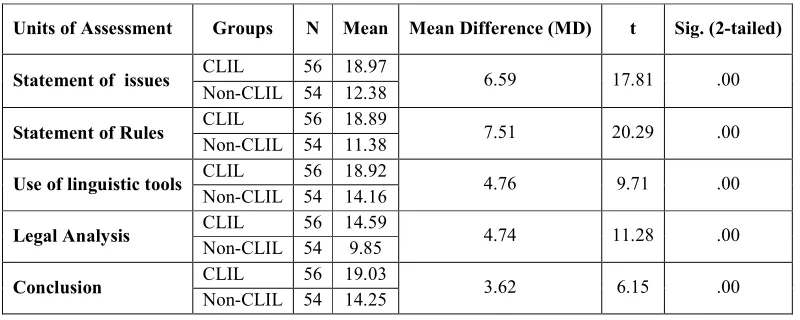
The t-test was run to compare the performance of the CLIL and the non-CLIL group learners on their performance in the use of the PQA genre in organizing their answers of an authentic content area exam in law (Table 1). The results from the test were ultimately meant for assessing the impact of the CLIL instruction on the development of the academic language skills relevant to the academic life of the students.
Table 1
Comparison of CLIL and on-CLIL Students’ Writing Performance in Using the PQA Genre in a Content Area Exam
Units of Assessment Groups 6 Mean Mean Difference (MD) t Sig. (2-tailed)
Statement of issues CLIL 56 18.97 6.59 17.81 .00 Non-CLIL 54 12.38
Statement of Rules CLIL 56 18.89 7.51 20.29 .00 Non-CLIL 54 11.38
Use of linguistic tools CLIL 56 18.92 4.76 9.71 .00 Non-CLIL 54 14.16
Legal Analysis CLIL 56 14.59 4.74 11.28 .00 Non-CLIL 54 9.85
Conclusion CLIL 56 19.03 3.62 6.15 .00 Non-CLIL 54 14.25
Table 1 reveals that the students who passed through the CLIL performed far better than the control group learners in organizing their answers to their exams. This difference in the performance between the two groups is reflected across the units constituting the PQA genre.
The CLIL group showed better clarity in the statement of the legal issues to be addressed in the legal problem in question (t=17.81, MD=6.59, P<0.01). Among the marked differences in this respect is the ability of this group of learners in setting the stage for a coherent organization of their answers by pinpointing the issues to be resolved in the legal problem at hand. In contrast, the
non-CLIL group learners started their paragraphs by merely rewriting the facts given in the scenario of the legal problem with no clear purpose what to write next or by superficially answering the question asked, inhibiting the flow of the ideas to move forward.
flows from their framing of the issues to be addressed.
Also, a marked difference is visible in the depth of analysis (t=11.28, MD=4.74; P<0.01) in their use of linguistic tools (t=9.71, MD=4.76, P<0.01), and concluding statements (t=6.15, MD=3.62, P<0.01).
This difference in the performance of the two groups of learners clearly shows the positive impact of the CLIL instruction on learners’ PQA genre awareness and the degree of knowledge transfer made to the real life writing setting.
5. Discussion
The evidence substantiates the claims of constructivist genre theory, which is consistent with the theoretical foundations of CLIL pedagogy. This view holds that cognitive academic language skills, particularly academic writing skills, can be fostered through purposeful communicative activities made in response to what a learner is trying to express (Sawyer & Watson, 1987), and the purpose of that expression is embedded in the communicative activities of a discipline (Bakhtin, 1986; Berkenkotter & Huckin, 1993). According to these writers, this purpose for communication (e.g., purpose for writing) needs to be a social purpose in which a need must exist from both the students' and teacher's point of view as a shared means of communicating meaning which is worth communicating.
Consistent with these theoretical claims, the results in the study suggest that the CLIL practices which involve authentic legal communicative activities gave students the opportunity to discover and develop the very rhetorical structures and discourse tools employed in the tasks where they write and speak in the target language to solve real legal problems. It also implies that the intensive practices in the PQA genre of problem solving and the continuous scaffolding from the
teacher/researcher gave them the chance to retain and transfer the academic language skills to other learning tasks far easier than those learners who passed through the conventional approach to EAP instruction.
Conversely, the conventional approach to the teaching of English for legal academic purposes −though develops the academic language skills for common genres of argumentation, exposition, narration, and process writing− fall short of the potential to enable the learners to transfer these skills to the academic tasks they encounter daily in their legal studies. This is mainly because the conventional approach bases itself on the assumption that a mastery of general language skills in argumentation, exposition, narration, description, and process writing will lead to success in carrying out other academic activities across courses in their legal training programs. Of course, the students, who passed through the conventional EAP instruction, have mastered these skills with varying degrees. This is evidenced by the marks they scored in the course they were taught through a teaching material designed for the conventional teaching of EAP. Yet, these students are not to the level expected when it comes to the use of rhetorical tools to accomplish legal problem tasks which are prevalent across courses at all levels of learning at law school.
consistent community and social purpose for communication.
This is also visible in the teaching materials of the conventional EAP course material in question. In this material the students are supposed to write argumentative essays on different themes such as the role of chewing chatt, noise pollution in urban areas, broadcasting rights of religious institutions, etc. Yet, these writings are writings for the sake of practicing the writing rather than the purpose for communicating the meanings for a defined community of readers in the discourse community, or to use the words of constructivist and CLIL theorists. These activities are not surrounded by the necessary social community that exists in content courses, the community that acts to elicit those tasks, and guides the students in determining the tasks' expectations.
Hence, the results from the experimentation suggest that the content-language integrated teaching is a viable approach to address the deficiencies of the conventional teaching of English for academic purposes by raising the genre awareness of the learners and paving the way for transferability of that knowledge. Also, the results of the study shades light on the fact that academic language skills are manifestations of socially determined ways of sharing knowledge. The development and transferability of academic skills do not arise from a mere teaching of rhetorical pattern; rather, the pattern is the result of how knowledge is shared in a community, more a result of the nature of what needs to be communicated, why, and to whom.
Further, it shows that students acquire these academic language skills better in a language learning milieu that closely approximates the real academic communications prevailing across the academic classrooms.
Creating such learning contexts has not been a common practice in EFL settings, especially in Ethiopia EFL classes. Creating such contexts has been taken to be impossible either. This
made it difficult in EAP instructions to target those academic language skills which are easily transferable to the actual academic settings. Yet, the CLIL approach employed in this study proved promising in targeting those skills and socializing students into the disciplinary discourse community, by placing students in language practices within the exigencies of their academic settings.
The results have also further implications for practices in ESL/EFL material writing and syllabus design. The conventional processes of syllabus design and material writing traditionally derives its input from needs analysis of learners and stakeholders with regard to the target language skills needed for a defined communicative use (Currie, 1991; Rimes, 1991; Sawyer, & Watson, 1987). Yet, the genre of the community in which these language skills operate is not largely a part of the traditional process of needs analysis. Hence, the needs analysis phase of ESL/EFL material may benefit from the insights of the constructivist genre theory by identifying the prevailing genre through which the future discourse community of the learners share their experiences rather than limiting the analysis to mere language skills and rhetorical patterns.
medicine, and other non-academic learning settings.
References
Adamson, H. D. (1993). Academic competence- theory and classroom practice: Preparing ESL students for content courses. New York: Longman.
Anderson, J. R. (1983). The architecture of cognition. Cambridge, MA: Harvard University Press.
Anderson, J. R. (1985). Cognitive psychology and its implications (2nd ed.). New York: Freeman.
Bakhtin, M. M. (1986). The problem of speech genres (V. W. McGee, Trans.). In C. Emerson, & M. Holquist (Eds.), Speech genres and other late essays (pp. 60-102). Austin, TX: University of Texas Press. Ballard, B., & Clanchy, J. (1991). Assessment
by misconception: Cultural influences and intellectual traditions. In L. Hamp-Lyons (Ed.), Assessing second language writing in academic contexts (pp. 19-35). Norwood, NJ: Ablex.
Benesch, S. (1988). Linking content and language teachers: Collaboration across the curriculum. In Benesch, S. (Ed),
Ending remediation: Linking ESL and content in higher education. Washington, D. C.:Teachers of English to Speakers of Other Languages.
Berkenkotter, C., & Huckin, T. N. (1993). Rethinking genre from a sociocognitive perspective. Written Communication, 10, 475-50.
Brinton, D. M., Snow, M. A., & Wesche, M. B. (1989). Content-based second language instruction. New York: Newbury House. Crandall, J., & Tucker, G. R. (1990).
Content-based language instruction in second and foreign languages. In S. Anivan (Ed.),
Language teaching methodologies for the nineties (pp. 83-96). Singapore: SEAMEO Regional Language Centre.
Christie, F. (1985). Language and schooling. In S. Tchudi (Ed.), Language, schooling
and society (pp. 21-40). Upper Montclair, NJ, Boynton/Cook.
Cummins, J. (1981). The role of primary language development in promoting educational success for language minority students. In Leyba, F. C. (Ed.), Schooling and language minority students: A theoretical framework (pp. 3-49). Los Angeles, CA: Evaluation, Dissemination, and Assessment Center, California State University.
Cummins, J. (1986). Empowering minority students: A framework for intervention. Harvard Educational Review, 56, 18-36. Cummins, J. (1996). egotiating identities:
Education for empowerment in a diverse society. Los Angeles: California Association for Bilingual Education.
Cummins, J. (2000). Language, power and pedagogy: Bilingual children in the crossfire. Clevedon: Multilingual Matters. Currie, P. (1991). Basically academic: An introduction to EAP. New York: Newbury House.
Currie, P. (1993). Entering a disciplinary community: Conceptual activities required to write for one introductory university course. Journal of Second Language Writing, 2, 101-117.
Currie, P., & Cray, E. (1987). Strictly academic: A reading and writing text. New York: New bury House.
Davies, F. (1988). Designing a writing syllabus in English for academic purposes: Process and product. In P. C. Robinson (Ed.),
Academic writing: Process and product
(pp. 130-142). Hong Kong: Modern English Publications.
Dias, P. (1994). Initiating students into the genres of discipline-based reading and writing. In A. Freedman, & P. Medway (Eds.), Learning and teaching genre (pp. 194-206). Portsmouth, NH: Heinemann. Dupuy, B. C. (2003). Content-based instruction:
Freedman, A. (1987). Learning to write again: Discipline-specific writing at university.
Carleton Papers in Applied Language Studies, 4, 95-115.
Grabe, W., & Stoller, F. L. (1997). Content-based instruction: Research foundations. In M. A. Snow, & D. M. Brinton (Eds.),
The content-based classroom: Perspectives on integrating language and content (pp. 5-21). White Plains, NY: Longman. Gaffield-Vile, N. (1996). Content-based second
language instruction at the tertiary level
ELT Journal, 50(2), 108 -114.
Horowitz, D. M. (1986). What professors actually require: Academic tasks for the ESL classroom. TESOL Quarterly, 20,
445-462.
Huang, J., & Morgan, G. (2003). A functional approach to evaluating content knowledge and language development in ESL students’ science classification texts.
International Journal of Applied Linguistics,
13(2), 234-262.
Johns, A. M. (1981). Necessary English: A faculty survey. TESOL Quarterly, 15, 51-57.
Johns, A. M. (1988). The discourse communities dilemma: Identifying transferable skills for the academic milieu. English for Specific Purposes, 7, 55-60.
Kasper, L. F. (1996). Using discipline-based texts to boost college ESL reading instruction. Journal of Adolescent & Adult Literacy, 39(4), 298-306.
Knoblauch, C. H., & Brannon, L. (1983). Writing as learning through the curriculum.
College English, 45(5), 465-474.
Krueger, M., & Ryan, F. (Eds.). (1993).
Language and content: Discipline- and content-based approaches to language study. Lexington, MA: Heath.
Mizanie, A. (2009). Clinical legal education: Challenges and possible wayout.
Ethiopian Journal of Legal Education,
1(2), 34- 49.
Mohan, B. A. (1986). Language and content.
Reading, MA: Addison-Wesley.
Pally, M., & Bailey, N. (1999). Sustained content teaching in academic ESL/EFL: A practical approach. New York, NY: Houghton Mifflin.
Parkinson, J. (2000). Acquiring scientific literacy through content and genre: A theme-based language course for science students. English for Specific Purposes,
19, 269-287.
Raimes, A. (1991). Out of the woods: Emerging traditions in the teaching of writing. TESOL Quarterly, 25, 407-430. Shih, M. (1986). Content-based approaches to
teaching academic writing. TESOL Quarterly, 20,617-648.
Schleppegrell, M. J., & Colombi, M. C. (Eds.). (2002). Developing advanced literacy in first and second languages: Meaning with power. Mahwah, NJ, Lawrence Erlbaum. Schleppegrell, M. J., Achugar, M., & Oteíza,
T. (2004). The grammar of history: Enhancing content-based instruction through a functional focus on language.
TESOL Quarterly, 38(1), 67-93.
Silva, T. (1993). Toward an understanding of the distinct nature of L2 writing: ESL research and its implications. TESOL Quarterly, 27, 657-677.
Snow, M. A., & Brinton, D.M. (1988). Content-based language instruction: Investigating the effectiveness of the adjunct model. TESOL Quarterly, 22, 553-574.
Spack, R. (1988). Initiating ESL students into the academic discourse community: How far should we go? TESOL Quarterly, 22, 29-5I.
Swales, J. M. (1990). Genre analysis.
Cambridge: Cambridge University Press. Sawyer, W., & Watson, K. (1987). Questions
of genre. In I. Reid (Ed.), The place of genre in learning: Current debates
(pp.46-57). Australia: Deakin University. Tsai, Y. (2010). The Impact of content-based
Woodward-Kron, R. (2009). Learning the discourse of a discipline: The nature of the apprenticeship. Graduate School of Education: University of Wollongong.