ISSN (e): 2250-3021, ISSN (p): 2278-8719 Vol. 05, Issue 01 (January. 2015), ||V2|| PP 22-35
Distributed Beamforming Using Multi-Antenna Backscattering
Network
Vikram Surendra
1, Maciej Zawodniok
2 1Electrical and Computer Engineering Department, Missouri S&T, Rolla, USA
2
Electrical and Computer Engineering Department, Missouri S&T, Rolla, USA
Abstract: - This paper proposes two novel beam-forming methodologies, which employ passive RF devices to enhance received signal through a passive, scattering based beam forming. Currently available backscattering systems, e.g. the radio frequency identification (RFID), suffer from a poor communication in an environment with multiple passive devices. The intermediate antennas create severe scattering environment with nulls. In contrast, the proposed approach changes the scattering properties of a subset of the multiple antennas such that the received signal strength and quality is maximized. The schemes employ Taguchi system and Learning Automaton to quickly identify such a suitable set of scattering intermediate devices. The theoretical limits of these schemes are studied mathematically and in simulations. For a 100-device network, the proposed schemes achieve power improvements over the line of sight equal to 37.5dB and 33dB for Taguchi and Learning Automaton-based schemes respectively. Moreover, the schemes are shown to perform well in an environment with the Rayleigh fading.
Keywords: - RFID networks, Beamforming, scattering, Learning automata, Taguchi method,
I INTRODUCTION
In recent years, a passive scattering based wireless communication is an attractive alternative to the traditional, active transmission systems. The main benefits are a low power, inexpensive, and often battery-less design since the device requires less power to operate and can be implemented as a system-on-a-chip (SOC). The most commercialized backscattering solution is the Radio Frequency Identification (RFID) system with passive RFID tags that communicate a unique identification to an active reader. Furthermore, such systems are increasingly employed in sensing applications [1][2][3]. The low power, small form factor wireless sensors have potential to make the concept of a “smart dust” a reality. However, due to path loss and signal fading in wireless links, the communication range of passive systems is limited to no more than several tens of feet. Furthermore, such passive devices often harvest energy from the original RF signal transmitted by the reader/base station. There is a minimal amount of RF power required to wake and power such a passive device up. Consequently, in presence of fading channel, for example due to shadowing and multipath propagation, a passive device is often unable to receive sufficient energy to operate and successfully communicate. This limits the usage of backscatter-based communication to short-range wireless applications.
Several works studied this issue in the RFID systems with passive tags [1][2][3][23]. A typical deployment of RFID system includes a large number, densely placed passive devices, called RFID tags. Such scenario creates sever fading environment with number of nulls where tags cannot be read. The existing works focus on static design improvements, for example a tag’s antenna redesign, or experimentally test the performance in different system configuration, e.g. antenna types and placement. In contrast, the proposed work aims at dynamically adjust the scattering properties of the multiple tags to improve the received signal and improve effective communication range.
signal at the receiver. The inexpensive and energy-constrained design of passive devices, for example RFID tags, makes such beamforming approaches impractical. The main reason is that such passive, backscattering transceivers are unable to perform complex signal processing operations and computations.
In the past, the authors have proposed a passive beamforming method to improve SNR in a backscattering network [10]. This preliminary study employed a brute force (B-F), Taguchi-based, and Learning Automata (LA) based beamforming algorithms. It is assumed that the intermediate passive devices could be set to operate in one of two modes: scattering and inhibition wherethe device either scatters the reader’s signal or minimizes the scattering. The proposed approach selects the states of intermediate devices such that the received signal strength and quality is maximized. In contrast to the preliminary results in [10], this paper revises the proposed approach and introduces two novel beamforming methods: a Taguchi- and LA-based, which increase SNR in a passive RFID network under realistic, large-scale scenarios with random topologies. Also, the selection of the scheme’s design parameters is studied here. The exhaustive search of the brute force (B-F) method, while impractical for more than few tags, provides a reference, optimal selection of scattering tags.
The main contributions of this paper are: (1) development of a model that describes RF signal propagation between two nodes in the presence of scattering devices distributed, (2) development of a scheme for distributed beamforming using Taguchi system and LA that achieve the maximum power possible using individual scattering devices, and (3) theoretical study of the performance, and (4) a comparative performance study for the discussed schemes.
The paper is organized as follows. In section II, the background is presented. Section III defines the problem statement. The proposed algorithms are discussed in details in Section IV. The simulation results are presented in Section V, and conclusions are given in Section VI.
II BACKGROUND
In a wireless passive scattering scenario an original RF signal impinges antennas of all intermediate devices and is scattered on all of them. Consequently, at the destination, the original signal is received as a summation of several components, including line-of-sight signal (LOS), multipath, and scattering copies. In the best scenario, these components may constructively interfere thus increase strength and quality of the received signal. However, more often a destructive interference occurs thus impeding the communication. In general, to compensate for phase difference of replicas of an original signal in a distributed beam forming, synchronization has been studied in the literature [11][12][13][14]. The method of random phase adjustment at the transmitter is discussed in [11] a feedback signal is sent indicating whether the signal-to-noise ratio has improved or worsened and the transmitters adjust their phases accordingly. The concept of division of nodes into master and slave nodes is discussed in [12] where the slave nodes estimates the distance from the master node and calculate the delay and phase. The problem is addressed in [13] by using a 1-bit feedback register at the receiver and the phase adjustment is done according to the feedback from it. The work in [14] starts with the correlation of noise and the design of the relay gains based on the addition of copies of desired signal. While most of the previous works focus on the time synchronization to compensate for the scattering induced fading, the added complexity and overhead of the synchronization renders those methods impractical.
Conversely, the same scattering phenomenon could be used to boost the SNR at the destination. In general, scattering devices can be divided in two groups: (a) the devices that have constructive interference, and (b) the ones that have destructive interference. Instead of correcting phase errors, the system could activate scattering only for the intermediate devices that create the constructive interference. The rest of devices should be set to absorb the signal to avoid injecting a destructive scattering. When the appropriate passive devices are selected the constructive interference does improves the received signal. As a result, a distributed, passive beamforming is realized. The increased signal strength and quality allows for either higher transmission (modulation) rates or extended communication range or reduce power consumption.
The main challenge addressed by the proposed approaches is the selection of the best set of the scattering intermediate devices while minimizing the overhead and convergence time. The schemes have to maximize the received power and SNR. In contrast to traditional beamforming, which employs an antenna array, the proposed approach does not require precise timing and synchronization among the individual antennas.
improve the received signal strength and SNR. In contrast to other approaches, the Taguchi-based scheme takes the non-linear interactions among the individual devices into account.
III PROBLEMSTATEMENT
First, the scattering is discussed in the context of the proposed beamforming approach. Then, the received signal composition is modeled and the device selection problem is defined.
Destructive Constructive
Figure 1. An efficient algorithm should select constructive tags and deactivate destructive ones. III.1 A scattering network of passive RFID tags
The concept of a distributed beam forming using a scattering network is shown in Fig. 1. We consider a communication link between the transmitter, , and the receiver, . In between there are N scattering devices, which are assumed to be passive components whose scattering properties can be varied. Notably, such passive devices, for example the RFID passive tags, are small and inexpensive since they have simple, integrated design, and require no batteries to operate. When the transmitter, , interrogates a target device, , the intermediate devices will generate scattered copies of the signal. The N non-unisonous signals interfere with the LOS signal at the receiver, . These signals arrive with variable delays, or offsets, depending on their position and scattering property, i.e. the antenna and chip impedance. Such a scattering based multipath propagation contributes to the already existing channel fading and lowers overall signal quality. Potentially, the combined signal at the destination will become stronger when the phase shifts align. However, in a random topology the effect is often negative due to phase mismatch among the signals. Generally, variation of phase occurs due to three factors: (a) distance: scattered signals propagate through a different-length paths thus introducing phase variation; (b) medium: channel properties variation may also cause phase shift; and (c) reflection/scattering: the reflecting/scattering object may cause a phase shift due to electric properties. It is well understood that when an electromagnetic field encounters an object, transmitted and reflected fields will be produced:
Er= Γ Ei (1)
Et= Τ Ei= (1+ Γ) Ei (2)
where Ei , Er and Et are respectively incident, reflected, and transmitted fields, and Γ is reflection coefficient.
Za
ZL antenna
Figure 2. Simplified circuitry of RFID tag
A simplified model of the internal circuits of a RFID tag is depicted in Fig. 2; where Za is the complex impedance of tag’s antenna and ZL is the complex impedance of chip of the tag. The reflection coefficient Γ is equal to:
Γ= (3)
Two modes of operations are expected from a RFID tag: scattering and inhibition. In scattering mode, the tag switches to ZL=∞ acting as a reflecting object. In ZL=∞ reflection coefficient will be Γ=1, giving no amplitude or phase shift to the reflecting signal. In inhibition mode, the scattered energy should be minimized by setting its impedance . Overall, the reflected signal energy and its phase shift is modeled as:
(4)
III.2 Signal propagation in a scattering network of passive devices
Consider a single tone transmitted from an active transmitter, for example an RFID reader. The received signal in a presence of a network of scattering passive devices can be written as
, (5)
where is received signal at destination, c0, c1, c2,… are attenuation coefficients and t1,t2,… are related time delay of received signal from reader (LOS). Then, the received power of the signal (1), can be written as
(6) where Pi and are the power and phase shift related to the scattering node. Assuming the intermediate passive devices are scattering the signal, the power attenuation from each node at destination is calculated by
(7) where is transmitted power from reader, , are antenna gains of the reader and tag respectively, is operating wavelength, and is the fading coefficient. Let with and are respectively the distance from reader to intermediate node and from the intermediate and the destination node. Applying (7) to (6) the received signal power can be modeled as
(8) where is the carrier frequency. The passive devices, for example the passive RFID tags, harvest energy from the RF signal to power internal circuitry. For a passive receiver, there is a minimum power, , that is required to activate it, that is . This constraint can be used to derive a theoretical limit on the distance between the active reader and passive receiver:
. (9)
After transformation we get following condition
(10)
Remark 1: The condition (10) simplifies to when only LOS signal is considered.
Remark 2: In a realistic, random topology, the phase shifts, , are not aligned coherently thus adding to the destructive interference. The resulting fading and low read-rate is widely observed for the RFID systems in scenarios with multiple tags.
III.3 Problem formulation
Let’s consider scattering network of N passive devices, e.g. RFID tags, randomly placed in a square of m×m meters as shown in Fig. 1. The target device, which the reader wants to communicate with, is located at the farthest distance to the reader. The desired goal is to maximize the power available at the destination tag. Let’s define X as a random variable taking values from a set , where “1” indicates that the corresponding passive device is scattering, and “0” indicates that the device has a negligible scattering power. Then, indicates the set of variables which shows the scattering status of all tags. For two tags, j and k, the received power can be written as
, (11)
to the interaction of these two signals at destination tag. Also, Xj and Xk are the variables taken from and are equal to 1.
Remark 3: The power coefficients are typically unknown in real deployments. Hence, a set of experiments would have to be carried out to determine their values.
In general, there can be M out of N tags that do scatter the reader’s signal to the destination tag and the
generalized power equation can be rewritten as
(12)
Remark 4: For k= , we use below notation to show a total k states
, where is an element array of the
state from the total of k states. The variable is the element out of the total elements of the state out of a total states, i.e.
Each term in (12) shows summation of received power from the tags and m=1,2,…,M. The term indicates the power coefficient related to that set of tags in the received power model. Equation 12 can be written as
(13)
By substituting M with N in 13, will be a function of .
(14)
We are interested in maximizing equation 15.
(15)
To maximize (16), all combination of tags for N=1,2, …, shouldbe examined to find the combination
which achieves maximum possible power
(16) The simple, brute force approach is to evaluate all possible combination and select the best combinations of intermediate devices. In ideal channel condition, this will determine the optimal solution to (15). It requires knowing all parameters in (15), which are not known in a realistic scenario. Moreover, the number of combination to be evaluated increase at the order of . Consequently, the brute force approach is impractical for large networks due to the time and processing overheads.
IV THEPROPOSEDBEAMFORMINGSCHEMES
IV.1 Taguchi-based method
Taguchi system evaluates the effect of multiple variables on a performance metric [19][20][21]. It employs orthogonal arrays to minimize number of experiments that have to be carried out while maximizing the amount of available information. The analysis of the results corresponding to the orthogonal array leads to the selection of the variables that optimize performance. The proposed Taguchi-based method of selecting the best set of scattering tags is shown next. The performance and low overhead is demonstrated in both theoretical and simulation analysis. Although Taguchi method does not guarantee the optimal solution all possible scenarios, it does approach the optimal solution. In concert with the quick convergence it is an appropriate solution for realistic deployment.
IV.1.1 Orthogonalisation in the Taguchi method
Vectors in an orthogonal array form a basis, i.e. any vector can be expressed as a linear combination of the basis vectors. In the proposed scheme, the vectors correspond to the states of the intermediate devices, as in (14). Hence, the orthogonal array will form the basis for any combination of scattering devices.
Lemma. A combination of a particular set of N tags can be shown by
Proof. It is well proven that, to show any combination of N elements we can find P sets from themselves so that
(18)
In a matrix format (18) can be expressed as
(19) where takes values from {0,1} and we define . Using , any set of different combination of tags can be written using XOR operator. Thus, Equation (14) can be shown as
(20) In (17), is defined based on N tags or NX’s. As N increases, however, using (19) might not be very easy since the length of also would increases. To solve this problem, in this paper, we used orthogonal arrays of table 1 to write equation (14) based on orthogonal combination of tags. Thus, according to OA(8,5,2,2), introduced in table 1, we divide all tags in groups of 5. By using 8 orthogonal arrays in table 1, we write equation (14) as
(21) where is the number of groups and is the jth orthogonal array in the ith group of tags.
Table 1. Orthogonal array in Taguchi scheme
Y X1 X2 X3 X4 3X5
O A Device 1 Device 2 Device 3 Device
4 Device 5
SNR
Y1 1 1 1 1 1 SNR1
Y2 1 1 1 0 0 SNR2
Y3 1 0 0 1 1 SNR3
Y4 1 0 0 0 0 SNR4
Y5 0 1 0 1 0 SNR5
Y6 0 1 0 0 1 SNR6
Y7 0 0 1 0 1 SNR7
Y8 0 0 1 1 0 SNR8
IV.1.2 The proposed Taguchi-based device selection approach
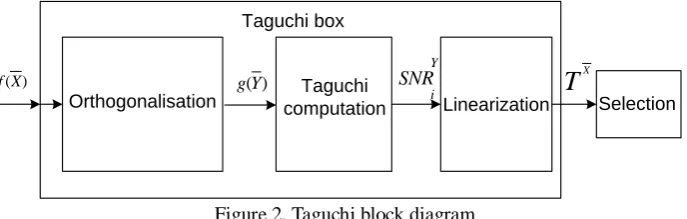
The proposed scheme selects the passive devices for scattering if their Taguchi coefficient, which is presented below, is positive. Considering the power at the destination devices written as (21), we proceed to detailing the Taguchi approach. The search for solution in a large domain X faces scalability issues in convergence time and complexity. Instead, we proposed to transform the problem into a smaller domain (orthogonal array).
Orthogonalisation Linearization
) (X
f g(Y)
T
X Selection Taguchi box Taguchi computation Y i SNR
Figure 2. Taguchi block diagram
linear problem. In this paper, we name this coefficient as a Taguchi coefficient and represent as TX. The SNR
value is calculated for each set of as follows:
=10 log (22)
where is calculated upon the status of X’s in array. The Taguchi coefficient of Xk, device is calculated as
(23) Taguchi coefficient is a measure of being effectiveness of variable in comparison to the other X’s.
The effect of the device increases with its Taguchi coefficient. All devices whose Taguchi coefficient is negative should be considered as negatively contributing devices since their presence in a given set reduced the received power.
(24)
Accordingly, all devices are sorted on the Taguchi coefficient {S’} first , where S’ is the set of scattering nodes, and K is a number to be chosen. Table 1 shows an example Taguchi array with 8 orthogonal vectors. The vectors model the S space,
. The equivalent are calculated based on SNR of each set of .
IV.2 Learning Automata
Learning automata is a feedback oriented, adaptive algorithm for a system whose input has to be selected in such a way that its output performance is maximized. In this paper, the LA is applied to search the best combination of passive devices to be used in scattering to the destination node. The proposed LA-based scheme selects a set of devices based on corresponding probabilities. The probabilities are updated based on the received power when the selected devices are set to scatter the signal. The update equations are chosen such that the probability of the positive, desired devices increases over time. We have considered and studied performance of several variants of the LA-based schemes with varying group sizes and update gains. The details of the scheme are presented next.
IV.2.1 The proposed LA-based approach
Our model is represented using a quintuple as it is described hereafter. Let’s consider 1,2,…,N RFID tags as it is depicted in Fig. 1. Tags are randomly set in groups of size GS which leaves groups. We define k groups as k actions, , taken by system. Next, we define k
system states for our model by . Current state of system shows the last action taken by the system and it is updated each time a response is received from the environment to determine next action by the system. The response from environment is called and is measured at reader side. A response is considered a rewarding ( ) when the total measured power is higher than LOS; and a penalty ( ) when it is lower than LOS. The feedback from environment is exerted to the system by updating current state and through State Transition Function, , which is a function of current system state and the response from environment. State transition function is composed of a set of probabilities representing the probability of a transition between a state i and any other state, say j, and is shown by . Thus, at each state should be held. State transition function is updated each time a response is received from environment to rather intensify or weaken the probability of sets.
Corollary. The described passive RFID network is a P-model, variable structure automaton.
Proof. A P-model LA is a model in which the input from environment takes only two values. Further, a LA whose state transition coefficients are variable over time is categorized in variable structure automaton, contrary to fixed-structure automaton where state transition coefficients are independent of time intervals.
The proposed LA based approach starts as a pure chance automaton. Since no prior information is available, no action preferred. Hence, the algorithm starts with k. Let’s assume
. (25) When the received power decreases, that is the interference is destructive, the last (“failed”) action is penalized by decreasing its probability:
(26)
The state transition matrix (STM) is calculated as . If during updating process a state transition coefficient, e.g. , reduces to zero, that action, in this case p, is omitted from state transitions. To maintain :
(27)
Since a transition to a state means the same action should be taken state transition coefficients can be viewed as . The output of the system is characterized by Output Function: . By using state transition matrix, output coefficients are calculated as . This implies , where is the probability of a transition from state i
to j. By choosing a next action is determined by LA and this process will iteratively continue. After several iterations, device groups with negative effect on the received power have their probability decreased and are omitted. In contrast, the probabilities increase for groups that improve the received power, and they will be selected for scattering. When a state transition coefficient reaches a design threshold, , i.e.: , the updating process stops. The groups with probabilities higher than the desired threshold are selected for
scattering: .
V SIMULATIONRESULTS
The performance of the proposed schemes is evaluated in simulations using MATLAB. The convergence time and the received power are two main metrics used for comparison. A network of passive scattering devices is considered, as illustrated in Fig. 1 with network and cell dimension set to 4m, 0.25m respectively. We assume that there is a communication link that controls scattering of the devices. The simulations assume the following parameters: , , , Γ=0.1 and f=100 MHz.
For Taguchi method we used OA (8,5,2,2) , shown in Table 1, to orthogonalize the space of N
scattering variables of RFID tags. All tags with are considered as scatterers to destination tag.
On the other hand, successful application of the LA requires tuning of its design parameters: group size (GS), probability update gain ( ), convergence criteria ( ) and . Optimal values of these parameters depends on number of factors including network size and topology, channel conditions, etc. In this work, we varied these parameters to understand their impact on the performance. Overall, there is a general guidance for selecting the LA design parameter selection. For a large “stop” threshold, , the LA will take longer to converge and only the strongest groups will be selected. The groups with smaller constructive interference will be omitted thus resulting in a suboptimal solution. On the other hand, for a very small , LA converges quickly thus preventing the LA from discovering all the groups that improve the signal strength. Thus, a careful and informed selection of is needed. Also, the group size has an impact on the proposed beamforming performance. For small group size, , the number of groups is high and they start with low probability. Consequently, the convergence time increases with the number of groups. However, the final selection can be more precise if smaller groups are considered. In contrast, for large group sizes, , the convergence is faster since they start with high initial probability.
Fig. 4 shows performance of LA using groups of Gs = 1, 5, and 10 devices, while “stop” threshold is set to , and respectively. The final selection threshold is set to = . The LA variant with Gs =
1 achieves the highest power since the selection considers each individual devices. The devices are evaluated independently from each other and only those that contribute positively to received power will have high probability at the end of the learning period. In contrast, the larger groups contain randomly selected devices that do not have coherent phase shift.
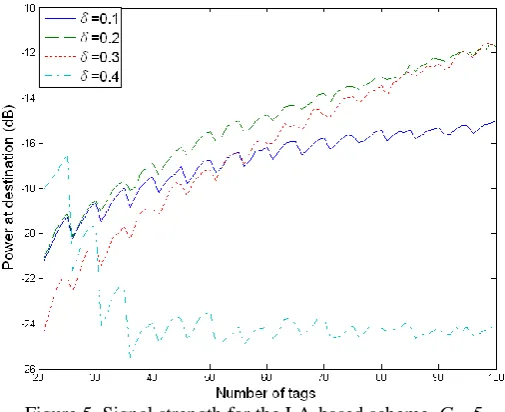
We also examined performance of using different probability update gain ( ) in LA. Large gain results in larger changes in the state coefficients thus speeding up the convergence time. However, as convergence time decreases the performance of the final device set decreases, as observed in Fig. 5 illustrates for varying network size. The LA-based scheme achieves the lowest power for . In such case, the final selection includes only few groups, which cannot achieve more than -24dB power. In contrast, for the probability update steps are small thus increasing convergence time. However, the extended learning period may result in LA singling out only the strongest groups due to the absorbing behavior of LA [4][5][6]. In contrast, cases with and result in best balance between convergence speed and selection accuracy.
Figure 5. Signal strength for the LA-based scheme, Gs=5 V.1 Random topology results in ideal and fading channel
scattering devices had been measured individually. Then, it selects only the devices with a constructive phase with respect to LOS, i.e. .
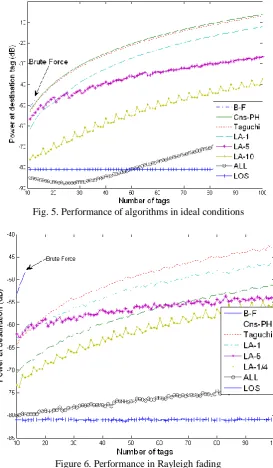
Remark: Both the brute force (B-F) and Constructive Phase algorithm (Cns-PH) approaches while resulting in large received power have significant limitations when practical implementation is considered. For larger networks, the brute force (B-F) scheme is extremely slow and requires large memory and time overhead. Hence, it is evaluated for less then N<15 device networks. In case of Cns-PH, the precise phase measurements are required, which is difficult due to complexity of the hardware and relatively small signals from individual scattering devices.
Fig. 5. Performance of algorithms in ideal conditions
Figure 6. Performance in Rayleigh fading
For the “ALL” baseline, it is observed that when N<30 tags are destructively added while by increasing N, the cumulative power at destination tag slightly increases.
Fig. 7 illustrates the results for a fading channel. In general, the fading of a realistic channel results in reduction of the power when compared with Fig. 6. Also, all but Cns-PH schemes maintain relative performance to each other. In case of Cns-PH, the phase shift of each device cannot be estimated precisely; hence, the device selection is not accurate. Also, the B-F achieves the highest power even in the fading environment.
Figure 8. Processing time
Fig. 8 shows the required time for all algorithms to select their scatterers including both convergence time for algorithms (simulation iterations) and propagation delays. It is observed that Taguchi algorithm requires more time than the other algorithms, and increases with network size. In contrast, the LA needs a relatively constant time to determine the solution since the convergence criterion for LA is not adaptive. Consequently, it converges faster at the expense of a lower, achieved power level. For the ALL and Cns-PH cases, the required time is approximately propagation time since no repeated trials have to be performed.
Figure 9. N=100 , f=100 MHz
which do not select individual devices, i.e. ALL, LA-1/4, and to some extent LA-5, the decrease in power is periodically fluctuating. The reason is that as the network dimension increases, the average number of positive and negative scatterers varies. Thus, for certain network dimensions the devices are more likely to cause a constructive interference at destination. This phenomenon is more pronounced in the ALL scenario.
Figure 10. Rayleigh fading, N=100 , f=100 MHz
However, in Fig. 10, where a Rayleigh fading is included, these periodic variations are no longer observed since the changes due to fading overshadow the dimension impact. Further, the Cns-PH faces a significant decline in received power since the fading prevents it from accurately estimating the phase shifts. Consequently, the set of selected devices is sub optimal in realistic scenarios.
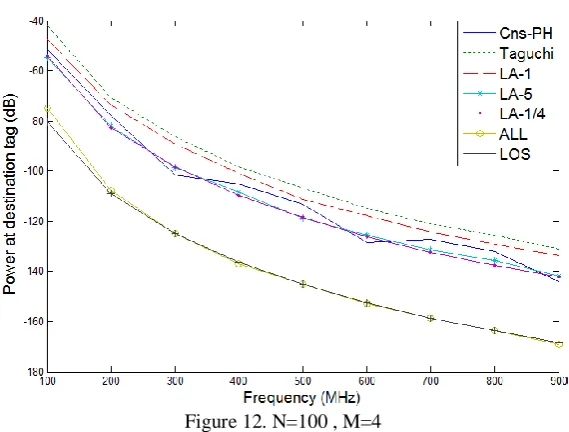
Figure 12. N=100 , M=4
Fig. 11 shows the variation of power based on frequency at destination. Again, the order of performance is kept as in Fig. 6. Moreover, it is understood that by increasing frequency the achieved power decreases. This phenomenon can be verified through Equation (7) whereas there is a direct relationship between wavelength and achieved power. Again in fading environment, as shown in Fig. 12, the algorithms achieve less power with Cns-PH suffering the largest decrease.
VI CONCLUSIONS
We proposed and evaluated two novel beamforming schemes based on the Learning Automaton and
Taguchi system frameworks. The schemes have been shown to improve the received signal strength and quality for multi-device, passive RFID network. We demonstrated that in ideal condition the achieved performance for Learning Automaton with GS=1 is 68 dB higher than LOS for N=100 devices. Moreover, we showed that in ideal condition the Taguchi-based approach achieves 75dB higher power then the LOS but requires more processing time than other methods. In Rayleigh fading environment with 100 nodes, we observed the 37.5 dB
and 33dB improvement over LOS respectively for Taguchi-based and LA-1 schemes. Future works include studying the effect of using orthogonal arrays of different lengths in the Taguchi method, and adaptively setting design parameters of the Learning Automata based scheme.
VII ACKNOWLEDGEMENTS
This material is based upon work supported by the National Science Foundation under Grant No. 0954031.Any opinions, findings, and conclusions or recommendations expressed in this material are those of the author(s) and do not necessarily reflect the views of the National Science Foundation.
REFERENCES
[1] Beiwei Zhang Kunyuan Hu Yunlong Zhu “Network architecture and energy analysis of the integration of RFID and Wireless Sensor Network”, Control and Decision Conference (CCDC), May 2010, Page(s): 1379 – 1382.
[2] Oka, A., Lampe, L. , Distributed target tracking using signal strength measurements by a wireless sensor network, Selected Areas in Communications, IEEE Journal, September 2010, Volume 28 , Issue:7 , Page(s): 1006 – 1015.
[3] Jaekyu Cho ; Yoonbo Shim ; Taekyoung Kwon ; Yanghee Choi , “SARIF: A novel framework for integrating wireless sensor and RFID networks”, IEEE Wireless Communications , December 2007 , Volume : 14 , Issue:6 , Page(s): 50 – 56.
[4] C. U¨ nsal, “Intelligent Navigation of Autonomous Vehicles in an Automated Highway System: Learning Methods and Interacting Vehicles Approach,” Ph.D. dissertation, Virginia Tech., Blacksburg, 1997. [5] Learning Automata: An Introduction, Prentice Hall, 1989, Kumpati S. Narendra Mandayam A. L.
Thathachar.
[7] Ubaidulla, P., Chockalingam, A., “Robust distributed beamforming for wireless relay networks” Personal, Indoor and Mobile Radio Communications, 2009 IEEE 20th International Symposium, Sept. 2009, Page(s): 2345 – 2349.
[8] Antonis Kalis, Athanasios G. Kanatas, George P. Efthymoglou , “A co-operative beamforming solution for eliminating multi-hop communications in wireless sensor networks”, IEEE Journal on Selected Areas in Communications - Special issue on simple wireless sensor networking solutions archive, Volume 28 Issue 7, September 2010.
[9] Tao Cui, Tellambura, C. , “Analysis and optimization of pilot symbol-assisted Rake receivers for DS-CDMA systems”, Vehicular Technology, IEEE Transactions, July 2006, Volume : 55 , Issue:4 , Page(s): 1159 – 1170.
[10] Surendra, Vikram Reddy; Zawodniok, Maciej; “Distributed Beamforming Using a Scattering Network “, Communication Networks and Services Research Conference (CNSR), May 2010, Page(s): 116 – 123. [11] R. Mudumbai, J. Hespanha, U. Madhow and G. Barriac, “Distributed Transmit Beamforming using
Feedback Control,'' Communications Magazine, IEEE, Feb. 2009, Vol. 47, No. 2, Page(s):102-110. [12] Johnson, M. Mitzenmacher, M. Ramchandran, K., "Distributed beamforming with binary signaling",
2008. ISIT 2008. IEEE International Symposium on Information Theory, July 2008 Page(s): 890-894. [13] G. Barriac, R. Mudumbai, and U. Madhow, ``Distributed beamforming for information transfer in sensor
networks,'' in IPSN'04: Proc. of the Third International Symposium on Information Processing in Sensor Networks, 2004, Page(s): 81--88.
[14] Gomadam, K.S. Jafar, S.A., “Optimal Distributed Beamforming in Relay Networks with Common Interference", Global Telecommunications Conference, 2007. GLOBECOM '07. IEEE Nov. 2007. [15] Nikitin, P.V. Rao, K.V.S., "Theory and measurement of backscattering from RFID devices", Antennas and
Propagation Magazine, IEEE Publication Volume: 48, Issue: 6, Dec. 2006 , Pages 212-218.
[16] Rao, K. V. S., “An Overview of Backscattered Radio Frequency Identification System (RFID)”, IEEE Asia Pacific Microwave Conference, December 1999,vol. 3, Page(s): 746-749.
[17] Palat, R.C.; Annamalai, A.; Reed, J.H., "Node Density and Range Improvement in Cooperatve Networks using Randomized Space-Time Block Coding with Time Synchronization Errors", Sensor Array and Multichannel Processing, 2006. Fourth IEEE Workshop Volume , July 2006, Page(s): 466 – 470.
[18] Georgios I. Papadimitriou, Dimitris G. Maritsas, "Learning automata-based receiver conflict avoidance algorithms for WDM broadcast-and-select star networks", IEEE/ACM Transactions on Networking (TON), Volume 4 , Issue 3 (June 1996), Pages: 407 - 412 Year of Publication: 1996.
[19] A primer on the Taguchi method, Van Nostrand Reinhold, 1990, Ranjit K. Roy.
[20] The Mahalanobis-Taguchi System, McGraw-Hill Professional, 2000, Genichi Taguchi, Subir Chowdhury, Yuin Wu.
[21] Wei-Chung Weng; Fan Yang; Elsherbeni, A.Z.; “Linear Antenna Array Synthesis Using Taguchi's Method: A Novel Optimization Technique in Electromagnetics”, Antennas and Propagation IEEE Transactions on, Volume: 55 Issue:3(March 2007). , Page(s): 723 – 730.
[22] Lukac, K. Lukac, Z. Tkalic, M., "Behaviour of F learning automata as multicriteria routing agents in connection oriented networks", Fuzzy Systems, 2003. FUZZ '03. The 12th IEEE International Conference on Publication Date: 25-28 May 2003 Volume: 1, On page(s): 296- 301 vol.1.