Model for Repair Urgency in RC Structure using
NDT Data
Harsh Mahajan Sudhir S Bhadauria
Assistant Professor Professor
Department of Civil Engineering Department of Civil Engineering
Shri Vaishnav Institute of Technology & Science Indore [M.P.] Rajiv Gandhi Proudyogiki Vishvavidyalaya, Bhopal [M.P.]
Shakti Sagar Pandey Junior Research Fellow
Shri Govindram Seksaria Institute of Technology and Science Indore [M.P.]
Abstract
Monitoring of concrete structure like buildings, bridges etc is very essential to ensure safety, stability and serviceability. The structure should, not only being safe, also be functioning as its intended use. Heavy cracking, excessive deflections, corrosion, spalling of concrete, surface stains are main characteristics of the degraded properties of a RC structure. The final goal of condition assessment of a building is to find the urgency of repair, nature of repair and cost associated with repairing. A condition assessment model based on five parameter: Visual inspection, ultrasonic pulse velocity, resistivity of concrete and age factor was prepared. On the basis of above condition index, repair urgency associated with structure was assigned. Prepared model then applied to existing structures.
Keywords: Condition assessment, Degradation of concrete, Non-destructive tests, Repair urgency, Structural health monitoring
________________________________________________________________________________________________________
I.
INTRODUCTION
The reinforced cement concrete has been the first choice to be used as building material, because of its high strength, economy and durability. Reinforced concrete structures have the potential to be durable and capable of withstanding a variety of adverse environmental conditions however premature failure of structure often observed as a result of corrosion of reinforcement due to chloride ingress and carbonation, sulphate attack, cracks due to temperature/moisture fluctuations etc. Assessment of structural characteristics viz. residual Strength of concrete, corrosion etc are used to identify current situation and future durability problem of structure, which is the basic need of maintenance plan. Current durability status of structure helps in prediction of its residual life. This assessment also helps in determining the life cost of structure which includes construction cost, maintenance cost, operational cost etc. By condition assessment, one can decide the repair urgency of RC structure.
II.
RELATED WORK
III.
PROBLEM FORMULATIONAs explicit relation between the variety of condition assessment data and the corresponding repair urgency cannot be achieved and also implicit functions are also difficult to develop. Hence a rational formulation for comparison of urgency of repair can be a useful and a consistent tool. A number of factor will be introduce viz. visual inspection, rebound hammer, ultra sonic pulse velocity, resistivity meter and age factor. All arrange in a condition indexing say 0-5 every parameter will be measured as Condition Index.
Table - 1
Proposed condition rating and associated repair priority Condition Index Definition based on repair priority scale
0 No requirement of repair
1 Very low priority, repair can be delayed for long time, not urgent 2 Low priority repair, Repair can be delayed for significant time 3 Medium priority repair, Repair action might be required 4 High priority repair, Repair action required urgently 5 Very high priority repair, Condition is critical
IV.
MODEL FOR REPAIR URGENCYParameters used in condition assessment: Visual inspection, Concrete Strength, Concrete Quality, Concrete resistivity, Actual Life / Estimated service life.
Visual Inspection A.
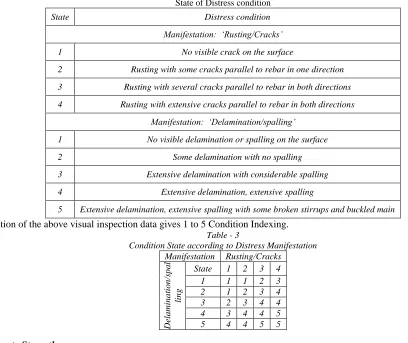
Rational categorization for visual inspection is done by combining two inputs Rusting/cracks, Delamination/spalling are used on basis of manifestation presented in Mitra et al. [6]:
Table - 2 State of Distress condition
State Distress condition
Manifestation: ‘Rusting/Cracks’
1 No visible crack on the surface
2 Rusting with some cracks parallel to rebar in one direction
3 Rusting with several cracks parallel to rebar in both directions
4 Rusting with extensive cracks parallel to rebar in both directions
Manifestation: ‘Delamination/spalling’
1 No visible delamination or spalling on the surface
2 Some delamination with no spalling
3 Extensive delamination with considerable spalling
4 Extensive delamination, extensive spalling
5 Extensive delamination, extensive spalling with some broken stirrups and buckled main
Combination of the above visual inspection data gives 1 to 5 Condition Indexing. Table - 3
Condition State according to Distress Manifestation Manifestation Rusting/Cracks
De
la
min
a
tio
n
/sp
a
l
li
n
g
State 1 2 3 4
1 1 1 2 3
2 1 2 3 4
3 2 3 4 4
4 3 4 4 5
5 4 4 5 5
Concrete Strength B.
In condition assessment practices, the estimated in situ concrete strength values are checked against acceptance criteria (British standard 2007) is adopted.
finsitu≥ 0.85(fck− 4) ...1
Repair action will not be required if the estimated concrete strength value satisfies acceptance criteria by considering Factor of Safety. FOS=1.2(BS 1981).
finsitu≥ (0.85X1.2)(fck− 4) ...2
Concrete Quality C.
Concrete quality is generally assessed by measuring ultra-sonic pulse velocity by penetrate it through concrete. International atomic energy agency (IAEA [9] ) recommends concrete quality corresponding to different pulse velocity.
Deterioration Specific Parameters D.
Resistivity of concrete: According to CPWD Handbook [10] and IAEA [9], resistivity of concrete and corrosion susceptibility was taken
Current Age/ Estimated Service Life E.
Only carbonation is considered as degradation parameter, following equations may be used to calculate estimated service life. From Sarja & Vesikari [11] Initiation period due to carbonation
𝑡𝑜= ( 𝑐 𝐾𝑐)
2
...3
to = Time of initiation in years; c= Concrete cover (mm) Kc = Carbonation Depth depends on various factors
According to Hakkinen[14]:
Kc= cenvcaira(fck+ 8)b ...4
cenv = environmental coefficient= 1 and 0.5 for structures sheltered from rain and structures exposed to rain respectively; cair =
air content coefficient= 1 and 0.7 in non air- entrained and air-entrained concrete, respectively; a and b = 1,800 and −1.7 for Portland cement = 360 and −1.2 for Portland cement +28% fly ash
Propagation time based on cracking of concrete cover: t1= 80
c
Dr .... .5
where, c = Concrete Cover in mm ; D = Diameter of Bar in mm; r= rate of corrosion of steel in concrete µm/year; According to Firodiya et al. (2015): Average Corrosion rate
Table - 8
Average Corrosion rate (Firodiya et al)
Reinforcement Bar
Exp
o
su
re
co
n
d
iti
o
n Mild Steel Cold Deformed bar
Wet 5.2 µm/year 7.7 µm/year
Dry 5.7 µm/year 11.1 µm/year
Service Life = to+ t1
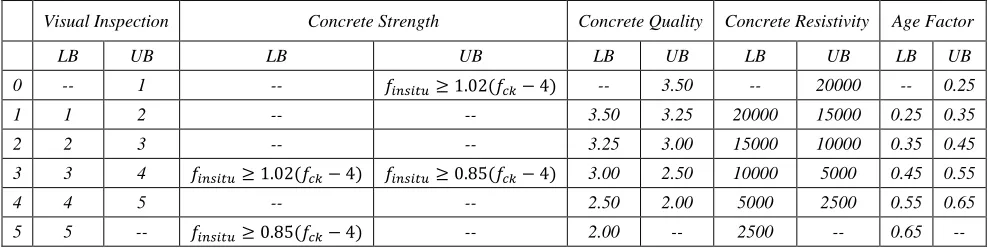
By estimating approximate service life of RC building, following condition indexing can be assigned to each member. For combining all condition index of various parameters mean of all has been take
x̅ = ∑ wn1 ixi
∑ wn1 i
.. ...6
Table - 9
Condition index and upper-lower limit of various parameters
Visual Inspection Concrete Strength Concrete Quality Concrete Resistivity Age Factor
LB UB LB UB LB UB LB UB LB UB
0 -- 1 -- 𝑓𝑖𝑛𝑠𝑖𝑡𝑢≥ 1.02(𝑓𝑐𝑘− 4) -- 3.50 -- 20000 -- 0.25
1 1 2 -- -- 3.50 3.25 20000 15000 0.25 0.35
2 2 3 -- -- 3.25 3.00 15000 10000 0.35 0.45
3 3 4 𝑓𝑖𝑛𝑠𝑖𝑡𝑢≥ 1.02(𝑓𝑐𝑘− 4) 𝑓𝑖𝑛𝑠𝑖𝑡𝑢≥ 0.85(𝑓𝑐𝑘− 4) 3.00 2.50 10000 5000 0.45 0.55
4 4 5 -- -- 2.50 2.00 5000 2500 0.55 0.65
V.
OBSERVATION AND RESULTS
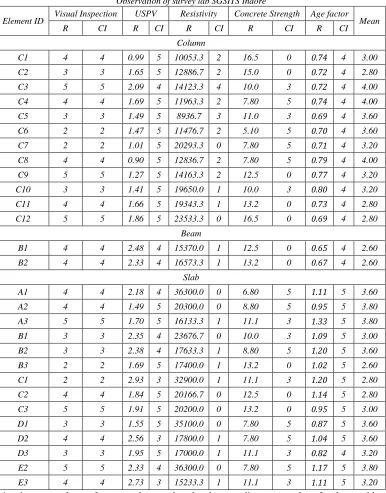
Above model was applied on existing building, constructed 60 years ago. The USPV is measured by ultrasonic pulse velocity meter, resistivity by concrete resistivity meter, Concrete strength by rebound hammer, age factor by applying specified model of carbonation. On the basis of result Condition index and its normalised values are calculated and same produced in following table. (R= reading)
Table - 10
Observation of survey lab SGSITS Indore
Element ID Visual Inspection USPV Resistivity Concrete Strength Age factor Mean
R CI R CI R CI R CI R CI
Column
C1 4 4 0.99 5 10053.3 2 16.5 0 0.74 4 3.00
C2 3 3 1.65 5 12886.7 2 15.0 0 0.72 4 2.80
C3 5 5 2.09 4 14123.3 4 10.0 3 0.72 4 4.00
C4 4 4 1.69 5 11963.3 2 7.80 5 0.74 4 4.00
C5 3 3 1.49 5 8936.7 3 11.0 3 0.69 4 3.60
C6 2 2 1.47 5 11476.7 2 5.10 5 0.70 4 3.60
C7 2 2 1.01 5 20293.3 0 7.80 5 0.71 4 3.20
C8 4 4 0.90 5 12836.7 2 7.80 5 0.79 4 4.00
C9 5 5 1.27 5 14163.3 2 12.5 0 0.77 4 3.20
C10 3 3 1.41 5 19650.0 1 10.0 3 0.80 4 3.20
C11 4 4 1.66 5 19343.3 1 13.2 0 0.73 4 2.80
C12 5 5 1.86 5 23533.3 0 16.5 0 0.69 4 2.80
Beam
B1 4 4 2.48 4 15370.0 1 12.5 0 0.65 4 2.60
B2 4 4 2.33 4 16573.3 1 13.2 0 0.67 4 2.60
Slab
A1 4 4 2.18 4 36300.0 0 6.80 5 1.11 5 3.60
A2 4 4 1.49 5 20300.0 0 8.80 5 0.95 5 3.80
A3 5 5 1.70 5 16133.3 1 11.1 3 1.33 5 3.80
B1 3 3 2.35 4 23676.7 0 10.0 3 1.09 5 3.00
B2 3 3 2.38 4 17633.3 1 8.80 5 1.20 5 3.60
B3 2 2 1.69 5 17400.0 1 13.2 0 1.02 5 2.60
C1 2 2 2.93 3 32900.0 1 11.1 3 1.20 5 2.80
C2 4 4 1.84 5 20166.7 0 12.5 0 1.14 5 2.80
C3 5 5 1.91 5 20200.0 0 13.2 0 0.95 5 3.00
D1 3 3 1.55 5 35100.0 0 7.80 5 0.87 5 3.60
D2 4 4 2.56 3 17800.0 1 7.80 5 1.04 5 3.60
D3 3 3 1.95 5 17000.0 1 11.1 3 0.82 4 3.20
E2 5 5 2.33 4 36300.0 0 7.80 5 1.17 5 3.80
E3 4 4 2.73 3 15233.3 1 11.1 3 1.11 5 3.20
In slab total 14 points were chosen for test and on each point three readings were taken. In above table readings are the average reading of observations taken. So, from above values and study, condition index of Survey lab = 3.28, hence its repair urgency lies in high priority repair.
VI.
CONCLUSION
departmental guidelines. The produced model is applied on existing building and its repair priority was found to be High Priority.
REFERENCES
[1] Sasmal S, Ramanjaneyulu K., Gopalakrishnan S and Lakshmanan N. (2006) “Fuzzy Logic Based Condition Rating of Existing Reinforced Concrete Bridges “,Journal of Performance of Constructed Facilities Vol. 20, No. 3, 261–273
[2] Grigg N (2006), “Condition Assessment of Water Distribution pipe”, Journal of infrastructure System © ASCE 12(3)/ September 2006, 147-153
[3] Bhadauria S and Gupta M (2006), “In- Service Durability Performance of Water Tanks”, Journal of Performance of Constructed Facilities © ASCE 20.(2) / May2006
[4] Caner A, Yanmaz A., Yakut A, Avsar O and Yilmaz T (2008). “Service Life Assessment of Existing Highway Bridges with No Planner Regular Inspections.” Journal of Performance of Constructed Facilities © ASCE, 22(2)/March- April 2008, 108-114
[5] Semaan N and Zayed T(2009) “Subway Station Diagnosis Index Condition Assessment Model”, Journal of Infrastructure System © ASCE 15(3)/ September 2009, 222-231
[6] Mitra G, Jain K and Bhatacharjee B (2010) “Condition Assessment Of Corrosion Distressed Reinforced Concrete Buildings Using Fuzzy Logic” Journal of Performance of Constructed Facilities © ASCE 24(6)/ November 2010, 562-570.
[7] Yokota H., Kato E. & Iwanami M. (2010) “Simplified members assessment on structural performance of deteriorated concrete” Proceedings of FraMCoS-7, May 23-28, 2010, 274-279
[8] British Standards Institution (2007). ”Assessment of in-situ compressive strength in structures and precast concrete components”, BS EN 13791, London [9] International Atomic Energy Agency (IAEA) (2002) “Guidebook on non-destructive testing of concrete structures”, Training course series no.17,
IAEA-TCS-17, Vienna, Austria
[10] Central Public Work Department (CPWD)(2002) “Handbook on repair and rehabilitation of RCC buildings, Government of India , New Delhi, India [11] Sarja A and Vesikari E (1996) “Durability design of concrete structures”, Report of RILEM technical Committee 130-CSE, ISBN 0419214100