CSEIT172434 | Received : 02 August 2017 | Accepted : 11 August 2017 | July-August-2017 [(2)4: 566-571]
International Journal of Scientific Research in Computer Science, Engineering and Information Technology © 2017 IJSRCSEIT | Volume 2 | Issue 4 | ISSN : 2456-3307
566
Aging Face Recognition: A Hierarchical Learning Model Based on
Local Patterns Selection
Dr. Shubhangi D C
1, Maryam
2 1HOD, Department of Computer Science & Engineering,VTU PG Centre, Kalaburgi, Karnataka, India
2
P.G.Student, Department of Computer Science & Engineering, VTU PG Centre, Kalaburgi, Karnataka, India
ABSTRACT
Aging face recognition refers to matching the same person’s faces across different ages, e.g. matching a person’s older face to his (or her) younger one, which has many important practical applications such as finding missing children. The major challenge of this task is that facial appearance is subject to significant change during the aging process. In this paper, we propose to solve the problem with a hierarchical model based on two-level learning. At the first level, effective features are learned from low-level microstructures, based on our new feature descriptor called Local Pattern Selection (LPS). The proposed LPS descriptor greedily selects low-level discriminant patterns in a way such that intra-user dissimilarity is minimized. At the second level, higher-level visual information is further refined based on the output from the first level. To evaluate the performance of our new method, we conduct extensive experiments on the MORPH dataset (the largest face aging dataset available in the public domain), which show a significant improvement in accuracy over the state-of-the-art methods.
Keywords : Face Recognition, Aging Faces, Feature Descriptor
I.
INTRODUCTION
Automatic face recognition is an important yet challenging problem, and has gained great progress in recent years due to better feature representation methods and feature classification models. An emerging research topic in face recognition community is aging face recognition, which has many useful real-world applications, e.g., finding missing children and identifying criminals based on photographs or identity ’mug shots’. While considerable progresses have been made on face recognition, aging face recognition still remains as a major challenge in real world application of face recognition systems. This challenge is mostly attributed to the significant intra-personal variations caused by the aging process. As illustrated in Figure 1, the cross-age faces (for one of the subjects in MORPH database) contain significant intra-personal variations. Actually, age related face image analysis has only been studied in recent years. Most existing works focus on age estimation, and aging simulation. There are very limited amount of works
works on aging face recognition include, which has notably improved the performance of aging face recognition.
Aging face recognition mentioned to matching the similar person’s faces across different ages, e.g. matching a person’s older face to his (or her) younger one, which has many important practical applications such as finding missing children. In this work, we propose to solve the problem with a hierarchical model based on two-level learning. At the first level, effective features are learned from low-level microstructures, based on our new feature descriptor called Local Pattern Selection (LPS). The proposed LPS descriptor greedily selects low-level discriminant patterns in a way such that intra-user dissimilarity is minimized. At the second level, higher-level visual information is further refined based on the output from the first level. The Matlab tool is used for the implementation. The results are evaluated in this environment.
II.
Related Work
The authors [1] have shows the performance of biometric authentication systems is affected by discrepancies between data stored in biometric templates and corresponding data derived from the actual owners of biometric templates. Such discrepancies are mainly attributed to within-person variations of biometric features. Among all types of within-person variations, aging-related variation displays unique characteristics that make the process of dealing with aging a challenging task. In this paper we discuss how aging affects different types of biometric features and discuss possible approaches that aim to eliminate the effects of aging so that deterioration in the long-term performance of biometric authentication systems is minimized.The authors [2] Facial aging, a new dimension that has recently been added to the problem of face recognition, poses interesting theoretical and practical challenges to the research community. The problem which originally generated interest in the psychophysics and human perception community has recently found enhanced interest in the computer vision community. How do humans perceive age? What constitutes an age-invariant signature that can be derived from faces? How compactly can the facial growth event be described? How does facial aging impact recognition performance? In this paper, we give a thorough analysis on the problem of facial
aging and further provide a complete account of the many interesting studies that have been performed on this topic from different fields. We offer a comparative analysis of various approaches that have been proposed for problems such as age estimation, appearance prediction, face verification, etc. and offer insights into future research on this topic.
Yun Fu and Thomas S. Huang, [3] recently considered extensive studies on human faces in the human-computer interaction (HCI) field reveal significant potentials for designing automatic age estimation systems via face image analysis. The success of such research may bring in many innovative HCI tools used for the applications of human-centered multimedia communication. Due to the temporal property of age progression, face images with aging features may display some sequential patterns with low-dimensional distributions. In this paper, we demonstrate that such aging patterns can be effectively extracted from a discriminant subspace learning algorithm and visualized as distinct manifold structures. Through the manifold method of analysis on face images, the dimensionality redundancy of the original image space can be significantly reduced with subspace learning. A multiple linear regression procedure, especially with a quadratic model function, can be facilitated by the low dimensionality to represent the manifold space embodying the discriminative property. Such a processing has been evaluated by extensive simulations and compared with the state-of-the-art methods. Experimental results on a large size aging database demonstrate the effectiveness and robustness of our proposed framework.
image is determined by the projection in the subspace that can reconstruct the face image with minimum reconstruction error, while the position of the face image in that aging pattern will then indicate its age. In the experiments, AGES and its variants are compared with the limited existing age estimation methods (WAS and AAS) and some well-established classification methods (kNN, BP, C4.5, and SVM). Moreover, a comparison with human perception ability on age is conducted. It is interesting to note that the performance of AGES is not only significantly better than that of all the other algorithms, but also comparable to that of the human observers.
The authors Guodong Guo, Yun Fu, Charles R. Dyer, and Thomas S. Huang, [5] estimating human age automatically via facial image analysis has lots of potential real-world applications, such as human computer interaction and multimedia communication. However, it is still a challenging problem for the existing computer vision systems to automatically and effectively estimate human ages. The aging process is determined by not only the person’s gene, but also many external factors, such as health, living style, living location, and weather conditions. Males and females may also age differently. The current age estimation performance is still not good enough for practical use and more effort has to be put into this research direction. In this paper, we introduce the age manifold learning scheme for extracting face aging features and design a locally adjusted robust regressor for learning and prediction of human ages. The novel approach improves the age estimation accuracy significantly over all previous methods. The merit of the proposed approaches for image-based age estimation is shown by extensive experiments on a large internal age database and the public available FG-NET database. Index Terms—Age manifold, human age estimation, locally adjusted robust regression, manifold learning, nonlinear regression, support vector machine (SVM), support vector regression (SVR).
III.
PROPOSED SYSTEM
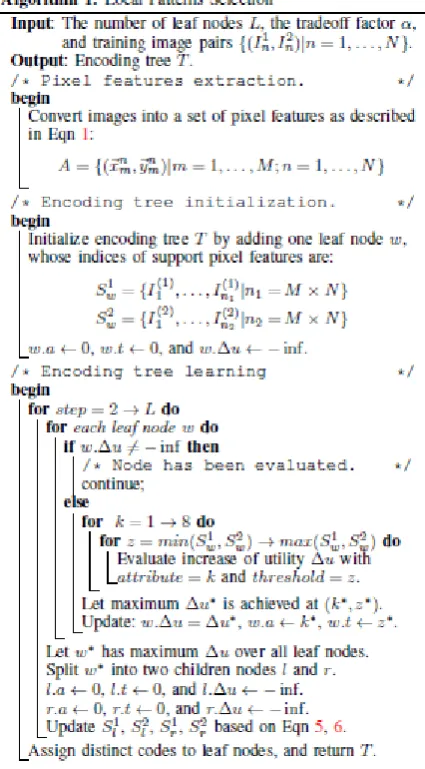
In this paper, we propose a two-level hierarchical learning model to address this problem. In this model, effective features are first learned from low-level pixel structures, based on our new feature extraction algorithm called Local Pattern Selection (LPS). Low-level common information is widely believed to be
very beneficial to cross-age face recognition, and the LPS algorithm maximizes this information between cross-age faces. At the second level, higher-level visual information is refined by learning subspace analysis algorithms. The advantage of this model is that, when compared with traditional paradigms where learning happens only in higher levels via classification algorithms, our model has better learning capabilities and is thus able to adaptively capture more useful information. Also note that strong model learning capability is essential to a successful face recognition algorithm, as confirmed by the recent success in deep learning. Extensive experiments are conducted on the MORPH dataset (Album 2), the largest publicly available facial aging dataset, to validate the effectiveness of our new approach over the state-of-the-art ones.
IV.
Implementation
Modules Description:
1. Input older face image is given
To start with the process, the input image that is older face image is passed as a input to the program. Here we have not put any condition to the user to pass any specific kind of image. The user can pass any image type.
2. Low level features with Local Position Selection is extracted
In this module, effective features are first learned from low-level pixel structures, based on our new feature extraction algorithm called Local Pattern Selection (LPS). Low-level common information is widely believed to be very beneficial to cross-age face recognition, and the LPS algorithm maximizes this information between cross-age faces.
3. High Level features with LFDA is extracted
increment at each step. For fair comparison, we use the same low-level features extracted by LPS algorithm for both frameworks.
4. Both features are combined
The comparative results are reported in Table II. The LBP feature descriptor is the original LBP descriptor. The Multiscale LBP (MLBP) feature descriptor is an extension of LBP, by computing the LBP descriptor at four different sampling radii f1; 3; 5; 7g. Note that for fairness, we use the same sampling patterns with MLBP for our method. The HOG features are extracted with the suggested settings in this paper, where face images are processed at three different scales. The SIFT feature descriptor quantizes both the spatial location and orientation of image gradient within an image patch, and computes a histogram in which each bin corresponds to a combination of specific spatial location and gradient orientation. The SIFT-Rank algorithm is a revised version of SIFT, which uses the ranking of the SIFT values as features.
5. The above features are extracted for all training images. This is called training features
In this module, we investigate the effectiveness of our high-level feature refinement framework by comparing it against the LFDA framework. The LFDA is a state-of-the art approach to handle the high dimensional feature vector. In the experiment, we fix the testing set as 10; 000 pairs of images, and gradually enlarge the size of training set from 1; 000 to 10; 000 with 1; 000 increments at each step. For fair comparison, we use the same low-level features extracted by LPS algorithm for both frameworks.
6. Random subspace classifier is applied for training
and input features to classify the input image
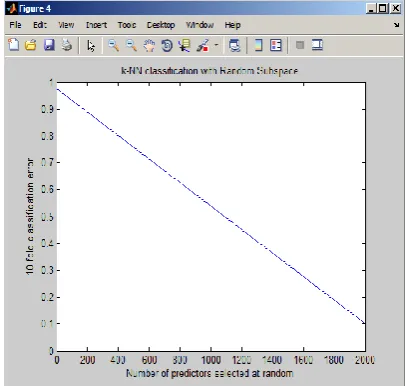
The input image is classified by applying Random subspace classifier for training features and also for input features.
V.
RESULTS
Figure 2. Resultant of Feature Extraction level
Figure 3. k-NN Classification with Random
Subspace
VI.
CONCLUSIONS
In this paper we present a two-level hierarchical learning model for aging face recognition. At the first level, effective features are extracted by adaptively selecting the local patterns that optimize the common information. At the second level, the high-level feature refinement framework to form a final powerful face representation. Extensive comparison experiments based on the MORPH Album 2 dataset reveals a significant improvement over the state-of-the-art.
VII.
REFERENCES
[1]. Andreas Lanitis, "survey of the effects of aging on biometric identity verification," Int. J. Biometrics, vol. 2, no. 1, pp. 34-52, Dec. 2010.
[2]. Narayanan Ramanathan, Rama Chellappa, and Soma Biswas, "Computational methods for modeling facial aging: A survey, J. Vis. Lang. Comput., vol. 20, no. 3, pp. 131-144, 2009. [3]. Yun Fu and Thomas S. Huang, "Human age
estimation with regression on discriminative aging manifold," IEEE Transactions on Multimedia, vol. 10, no. 4, pp. 578-584, 2008. [4]. Xin Geng, Zhi-Hua Zhou, and Kate Smith-Miles,
"Automatic age estimation based on facial aging patterns," IEEE Trans. Pattern Anal. Mach. Intell., vol. 29, no. 12, pp. 2234-2240, 2007. [5]. Guodong Guo, Yun Fu, Charles R. Dyer, and
Thomas S. Huang, "Imagebased human age estimation by manifold learning and locally adjusted robust regression," IEEE Transactions on Image Processing, vol. 17, no. 7, pp. 1178-1188, 2008.
[6]. Guodong Guo, Guowang Mu, Yun Fu, and Thomas S. Huang, "Human age estimation using bio-inspired features," in CVPR, 2009, pp. 112-119.
[7]. Young H. Kwon and Niels Da Vitoria Lobo, "Age classification from facial images," in Proc. IEEE Conf. Computer Vision and Pattern Recognition, 1999, pp. 762-767.
[8]. A. Lanitis, C. Draganova, and C. Christodoulou, "Comparing different classifiers for automatic age estimation," IEEE Trans. Syst., Man, Cybern, vol. 34, no. 1, pp. 621-628, Feb. 2004.
[9]. Albert Montillo and Haibin Ling, "Age regression from faces using random forests," in ICIP, 2009, pp. 2465-2468.
[10]. Narayanan Ramanathan and Rama Chellappa, "Face verification across age progression," IEEE Transactions on Image Processing, vol. 15, no. 11, pp. 3349-3361, 2006.
[11]. Junyan Wang, Yan Shang, Guangda Su, and Xinggang Lin, "Age simulation for face recognition," in ICPR (3), 2006, pp. 913-916. [12]. Shuicheng Yan, Huan Wang, Xiaoou Tang, and
Thomas S. Huang, "Learning auto-structured regressor from uncertain nonnegative labels," in ICCV, 2007, pp. 1-8.
[13]. Shaohua Kevin Zhou, Bogdan Georgescu, Xiang Sean Zhou, and Dorin Comaniciu, "Image based regression using boosting method," in ICCV, 2005, pp. 541-548.
simulation of aging effects on face images," IEEE Trans. Pattern Anal. Mach. Intell., vol. 24, no. 4, pp. 442-455, 2002.
[15]. Jin-Li Suo, Song Chun Zhu, Shiguang Shan, and Xilin Chen, "A compositional and dynamic model for face aging," IEEE Trans. Pattern Anal. Mach. Intell., vol. 32, no. 3, pp. 385-401, 2010. [16]. Jin-Li Suo, Xilin Chen, Shiguang Shan, and Wen
Gao, "Learning long term face aging patterns from partially dense aging databases," in ICCV, 2009, pp. 622-629.
[17]. Norimichi Tsumura, Nobutoshi Ojima, Kayoko Sato, Mitsuhiro Shiraishi, Hideto Shimizu, Hirohide Nabeshima, Syuuichi Akazaki, Kimihiko Hori, and Yoichi Miyake, "Image based skin color and texture analysis/synthesis by extracting hemoglobin and melanin information in the skin," ACM Trans. Graph., vol. 22, no. 3, pp. 770-779, 2003.
[18]. Unsang Park, Yiying Tong, and Anil K. Jain, "Age-invariant face recognition," IEEE Trans. Pattern Anal. Mach. Intell., vol. 32, no. 5, pp. 947-954, 2010.
[19]. Haibin Ling, Stefano Soatto, Narayanan Ramanathan, and David W. Jacobs, "Face verification across age progression using discriminative methods," IEEE Transactions on Information Forensics and Security, vol. 5, no. 1, pp. 82-91, 2010.