Impact Factor- 4.015
INTERNATIONAL JOURNAL OF ENGINEERING SCIENCES & MANAGEMENT
204-212
I
NTERNATIONAL
J
OURNAL OF
E
NGINEERING
S
CIENCES &
M
ANAGEMENT
Design & Analysis of Micro boring in Aerospace Material by Parametric
Optimization
Alok Kumar and Prof. P. K. Sharma
Department of Mechanical Engineering, NIIST, Bhopal, (M.P.), India
Abstract
Boring is one of the fundamental machining procedure of making openings and it is basically to manufacture industry like Aerospace industry, watch producing industry, Automobile industry, medicinal businesses and semiconductors.. In this examination, an endeavor has been taken to limit the push powers, Circularity Error and Burr estimate lessening in the miniaturized scale boring procedure on a PMMA (Poly methyl methacrylate) piece of 90*30*4mm by use of the DOE (Design of Experiment) strategy coordinated with Gray Relational Analysis. Considering the boring push, Circularity and burr measure, 2 machining Controllable parameters, for example, combine, shaft speed, and are streamlined in view of the DOE technique. A Run arranges was produced by taking the two factors each having 3 levels utilizing Statistical bundle. In view of the grouping, penetrating was finished by taking HSS boring apparatus of size 1mm dia. The resultant information is broke down by Gray social investigation to discover a blend of ideal boring conditions. Specifically, it is discovered that rapid and low bolster is giving a superior outcome having low circularity blunder and little burr measure
.
Boring apparatusKey words:. Poly methyl methacrylate, Design of Experiment, HSS,Micro boring,Aerospace
Introduction
Drilling is a procedure of delivering round gaps in a strong material or growing existing openings with the utilization of multitooth cutting devices called penetrates or boring tools. Different cutting devices are accessible for boring, however the most widely recognized is the turn bore
.
Literature review
M. K. A Mohd Ariffin, M. I. Mohd Ali, S. M. Sapuan and N. Ismail,et.al (2009)The present work is focusing on an optimization of the drilling cutting process for the composite sandwich panel. The study provided machinist with a simple procedure in order to minimize the damage events occurring during drilling process for composite material. A statistical approach is used to analyse the experiment data and it is called as design of experiment (DOE). The technique minimizes the number of test required and maximizes the amount of reliable information. A glass fiber reinforced plastic (GFRP) sandwich part number of BMS 4 - 17 forms Boeing Corporation is used for testing. There are 2 type of drill bit material were selected and 4 variable such as drill bit material, cutting velocity, feed rate and hole diameter. The results from this study shows that the minimum damage length is 0.05 mm and the maximum is 0.44 mm which are done at 3000 rpm, feed rate of 80.2 mm/rev for HSS and spindle speed at 500 rpm, feed rate of 246.8 mm/rev using carbide tool respectively.
Hyun-Ho Kim, Siyon Chung, Seung-Chul Kim et.al. (2011)Optical and medical devices require micro drilling of holes on glass. Brittle fracture occurs during the drilling. Cone and radial cracks are generated due to impact load and walking when a drill hit a glass to make a hole. To produce good holes without cracks and fracture, a condition monitoring of glass drilling processes is required. In this paper, to develop a cost-effective direct monitoring system in micro drilling processes on glass, a machine vision unit with the edge detection and 3D measurement functions is studied. It consists of a CCD camera with a zoom lens attached to the precision servo stage and a novel illumination unit. Performance of the developed machine vision system is verified in micro-drilling processes on glass using diamond and carbide drills.
INTERNATIONAL JOURNAL OF ENGINEERING SCIENCES & MANAGEMENT
204-212
HAZ. The Taguchi approach followed by Grey relational analysis has been applied to solve this multi-response optimization problem. The significance of the factors on overall output feature of the weldment has also been evaluated quantitatively by analysis of variance method (ANOVA). Optimal result has been verified through additional experiment. This indicates application feasibility of the Grey-based Taguchi technique for continuous improvement in product quality in manufacturing industry.Experimental Set-up
: In this examination, PMMA (Poly (methyl methacrylate)) strip which is having measurements of 90x30x4mm (length* breadth*thickness) was utilized as work-piece material. The HSS Straight shank curve drills (Jobbers) produced by JK Files and apparatuses was utilized as a part of this analysis. The bore is of 1mm width and 1180 point edge and woodwind length is 23mm.All the boring was influenced utilizing radial boring to machine gave by Central workshop, NIT Rourkela. The Quartz 4 segment Dynamometer (type 9272A, Kastler made) alongside Multi Channel charge Amplifier Type 5070 A was utilized for pushed compel estimation. The Circularity and Burr Size were estimated utilizing SEM Pictures.Table3. 1: Technical Specifications
Figure 3.1: (Top) Micro-drilling machine and machine vision unit, (Bottom) Air spindle and work piece fixture & Illumination and measurement unit.
Parameters Specification
Drill Bit Diameter 1 mm
Work-piece Poly (methyl methacrylate) (90x30x4mm)
Dynamometer Kistler Co. (9272A)
Amplifier Kistler Co. (5070A)
Feed(mm/rev) 0.11,0.18,0.25
Impact Factor- 4.015
INTERNATIONAL JOURNAL OF ENGINEERING SCIENCES & MANAGEMENT
204-212
The Dynamometer was mounted over machine Bed having T-slot with the help of T-bolts of 10mm dia. and 80mm length and properly tightened with the help of washers and nuts. The PMMA Work piece was mounted on the dynamometer with the help of two Bolts having specification M8*15. The experiment was carried out without any coolant and air is used as natural coolant medium. The drilling set up is shown in the fig 3.1 and fig 3.2. During the experiment, the thrust force was measured with the help of dynamometer connected to multi channel charged amplifier. The spindle speeds used in the experiment were 80, 150 and 300 rpm. And the three feeds were selected as 0.12, 0.20, 0.30mm/rev. In this experiment, two machining parameters having 3 levels each was taken as input parameter and thrust force was measured. Circularity and Burr size was measured using Scanning Electron microscope..
Fig 3.2: Dynamometer, Work piece set up
Taguchi Analysis is one of the effective instruments for assembling outline. Taguchi's strategy demonstrates a mix of Design of Experiments with advancing of parameters to get the required outcome. Taguchi's Signal to clamor ratios(S/N proportion) which are logarithm elements of required yield fill in as expected capacities for enhancement. This strategy has been persistently utilized by analysts to examine information to get an ideal arrangement. Keeping in mind the end goal to discovering the ideal arrangement in an assembling outline, taguchi strategy uses flag to commotion proportion. The benefit of taking S/N proportion is that it considers both mean and difference. It might be characterized as the proportion of mean esteem (Signal) to that of standard deviation (Noise).
The objective function in this work is to maximize the S/N ratio and is defined according to taguchi method as:
Where Yi represents the judging parameter through which optimum set is to be found out.
Experimentation:
In the present Scenario, Micro penetrating of PMMA Sheet with less burr size and better exactness is a test to assembling ventures. Different process parameters influencing this can be nourish, Spindle speed, apparatus width, Drill Bit material, penetrate geometry and cutting conditions. In the present work Feed and axle speed are taken as process parameter and is a controllable one.
Factors
Notations/unit
Code
Level of factors
1 2 3
INTERNATIONAL JOURNAL OF ENGINEERING SCIENCES & MANAGEMENT
204-212
Table 3. 2: PARAMETER VALUES
Table 3.3: Design of Experiments
Keeping in mind the end goal to look for the ideal states of the procedure parameter, the present examination has
been done by taking full factorial outline and run requests can be discovered utilizing measurable bundle.
Examinations have been led by considering this run arrange on PMMA Sheet of 90*30*4mm by utilizing 1mm HSS
boring tool. Table 3.2 demonstrates the arrangement of qualities for the autonomous machining parameters and
table3.3 demonstrates the Design of Experiments that has been chosen utilizing Statistical programming
(STATISTICA) according to full factorial outline. Test information has been given in table 3.3. Parameters
identified with push constrain was estimated utilizing Dynamo meter and Circularity mistake and Burr Size were
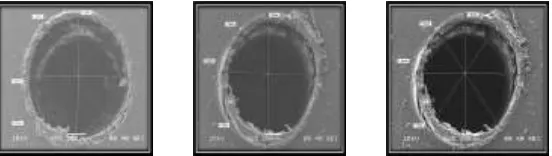
estimated with the utilization of Scanning Electron Microscope. The smaller scale penetrate gaps are appeared in the
Fig. 3.3 for various blends of boring food and axle speed. Trial information has been given in table 3.3. Every one of
this information has been utilized to assess the ideal parameter mix to accomplish wanted small scale boring
procedure
speed
Run
Feed (A)
Speed(B)
1.
2
3
2.
2
2
3.
1
3
4.
3
1
5.
2
1
6.
1
1
7.
3
2
8.
1
2
Impact Factor- 4.015
INTERNATIONAL JOURNAL OF ENGINEERING SCIENCES & MANAGEMENT
204-212
Fig. 3.3: Magnified view of micro drill holes under SEM
€
i(k)
Where
=
=Difference between absolute Values of
and
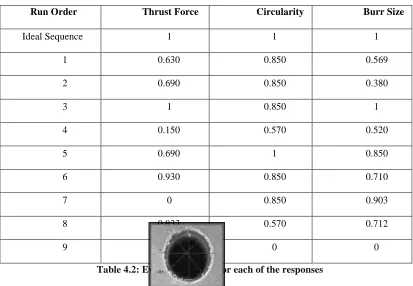
This approach changes over a numerous reaction advancement circumstance with the target work in general dark social review (table 4.4). The general dark social review can be figured by utilizing the connection as:
Consequently multi reaction enhancement issue is currently changed over into single equivalent
target work advancement. Higher the estimation of dim social review, the comparing blends is
near the ideal one.
Table 4.1: Grey Relational Generation
Run Order Thrust Force Circularity Burr Size
Ideal Sequence 1 1 1
1 0.630 0.850 0.569
2 0.690 0.850 0.380
3 1 0.850 1
4 0.150 0.570 0.520
5 0.690 1 0.850
6 0.930 0.850 0.710
7 0 0.850 0.903
8 0.933 0.570 0.712
9 0.150 0 0
INTERNATIONAL JOURNAL OF ENGINEERING SCIENCES & MANAGEMENT
204-212
Ideal
1
1
1
Sequence
1
0.361
0.141
0.426
2
0.301
0.141
0.616
3
0
0.141
0
4
0.846
0.426
0.473
5
0.301
0
0.141
6
0.060
0.142
0.285
7
1
0.140
0.093
8
0.063
0.426
0.283
9
0.846
1
1
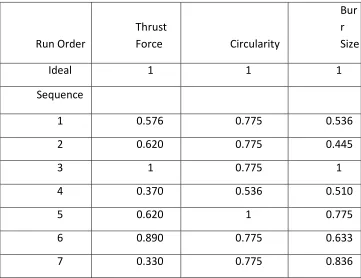
Table 4.3: Grey relational coefficient of each performance characteristics (with ψ=0.5)
Run Order
Thrust
Force
Circularity
Bur
r
Size
Ideal
1
1
1
Sequence
1
0.576
0.775
0.536
2
0.620
0.775
0.445
3
1
0.775
1
4
0.370
0.536
0.510
5
0.620
1
0.775
6
0.890
0.775
0.633
Impact Factor- 4.015
INTERNATIONAL JOURNAL OF ENGINEERING SCIENCES & MANAGEMENT
204-212
8
0.883
0.536
0.633
9
0.365
0.330
0.330
Table 4.4 Grey relational grades
Run Order
Grey relational grade
1
0.629
2
0.612
3
0.923
4
0.471
5
0.796
6
0.766
7
0.646
8
0.683
9
0.343
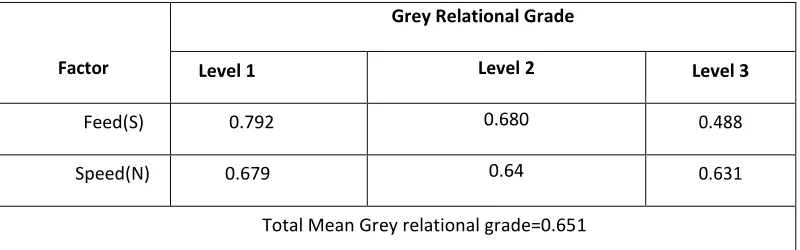
The mean reaction table is appeared in table 4.5 and graphically appeared in the fig. 3.3. The
ordinate of the figure demonstrates the S/N proportion of general dim social review and is
ascertained utilizing higher the better articulation specified in stage 5.
Table 4.5 Response table (mean) for overall Grey relational grade:
Factor
Grey Relational Grade
Level 1 Level 2 Level 3
Feed(S) 0.792 0.680 0.488
Speed(N) 0.679 0.64 0.631
Total Mean Grey relational grade=0.651
INTERNATIONAL JOURNAL OF ENGINEERING SCIENCES & MANAGEMENT
204-212
Fig.4 S/N ratio plot for overall Grey relational grade:Conclusion-
The target of this investigation was to discover the streamlined blend of Feed and Spindle speed with the goal that the push power, circularity and burr arrangement can be limited. The conclusions can be outlined as takes after: 1. In the 1mm smaller scale boring procedure, the trial work did by following the full factorial plan and after that receiving dim social investigation, Optimal Parametric mixes were discovered. Dark taguchi technique is one of the effective strategies for advancement of parameters where multi-reaction qualities are considered in the investigation. 2. Through the S/N proportion charts, it can be watched that S1 and N2 compare to the variables creating insignificant boring push, Minimizing circularity blunder and diminishing in burr estimate. In this way, the ideal conditions are nourish of 0.11mm/rev and axle speed of 140 rpm.
References:
1. Liu Dong et al, Study of Thrust Force and Torque in Drilling Carbon Fiber Reinforced Plastics (CFRP)
Using Twist Drill Brazed Diamond, 201O 2nd International Asia Conference on
In f ormatics in Control, Automation and Robotics.
2. Youtie J., Iacopetta M., Graham S.: Assessing the nature of nanotechnology: can we uncover an emerging
general purpose technology? The Journal of Technology Transfer, 33, 315–329 (2008).
3. R. Vimal Sam Singh, B.Latha, and V.S.Senthilkumar, Modelling and analysis of Thrust force and Torque
in drilling GFRP composites by multifaceted drill using fuzzy logic, International Journal of Recent Trends
in Engineering, Vol. 1, No. 5, May 2009.
4. Zhang, P.F., Churi, N.J., Pei, Z.J., and Treadwell C., 2008, “Mechanical drilling processes for titanium
alloys: a literature review,” Machining Science and Technology, Vol. 12, No. 4, pp. 417-444.
5. Azlan Abdul Rahman, Azuddin Mamat and Abdullah Wagiman, Effect of Machining Parameters on Hole
Quality of Micro Drilling for Brass, Modern Applied Science, vol 3, no. 5, May 2009
6. Dong-Woo Kim , Myeong-Woo Cho , Tae-Il Seo and Eung-Sug Lee, Application of Design of Experiment
Method for Thrust Force Minimization in Step-feed Micro Drilling, Sensors 2008, 8, 211-221.
7. Liu Dong et al, Study of Thrust Force and Torque in Drilling Carbon Fibre Reinforced Plastics (CFRP)
Using Twist Drill Brazed Diamond, 201O 2nd International Asia Conference on Informatics in Control,
Automation and Robotics.
8. Yu Teng Liang et al.,(2009),Investigation into Micro Machining Cutting Parameters of
Impact Factor- 4.015
INTERNATIONAL JOURNAL OF ENGINEERING SCIENCES & MANAGEMENT
204-212
9. M. K. A Mohd Ariffin, M. I. Mohd Ali, S. M. Sapuan and N. Ismail, An optimise drilling process for anaircraft composite structure using design of experiments, Scientific Research and Essay Vol.4 (10), pp.
1109-1116, October 2009.
10. Hyun-Ho Kim, Siyon Chung, Seung-Chul Kim, Condition monitoring of micro-drilling processes on glass
by using machine vision, Department of Mechanical Design and Production Engineering,Hanyang