Wireless Printer Fastener using Raspberry Pi
P. Mahitha P. Sreenivasulu
P.G. Scholar Assistant Professor
Department of Electronics & Communication Engineering Department of Electronics & Communication Engineering Audisankara College of Engineering & Technology
(Autonomous), Gudur, Nellore, Andhra Pradesh
Audisankara College of Engineering & Technology (Autonomous), Gudur, Nellore, Andhra Pradesh
Abstract
The common data printing procedure has to use notebook or desktop computer as a relay medium, first receiving the data from mobile and then sending it to printer using an appropriate printing Method. This is rather cumbersome. This paper proposes a design of a device which directly prints the data stored inside the Mobile without the assistance of a notebook or desktop computer. The design compromises Raspberry pi having Debian flavor of UNIX. The configured Bluetooth dongle accept file from Mobile and gives to RPi. The Printer driver is a program to control a printer that is connected to your system. The CUPs installed on RPi do the print job.
Keywords: Notebook computer, Desktop computer, Printer, USB Printer driver, Common UNIX Printing Method, Raspberry pi
_______________________________________________________________________________________________________
I. INTRODUCTION
Technology development should help people to do their work more easily and make them comfortable. Printing is useful stuff that helps people in day to day life. This paper proposes idea of using Mobile phone Bluetooth print the data. For printing purpose we need some mediator which mediates between a mobile device and a printer. The adapter which helps the printer to print by selecting either of the first operation modes in which data from the data supply device is received by wireless communication and before the completion of receiving the data; a print job is issued to the printer by wired communication. In second operation mode in which data from the supply device is received by wireless communication and after the completion of receiving the data, a print job is issued to the printer by wired communication.
embedded systems and the use of Linux to run applications on them. Hence an introduction to Embedded Systems and using Linux as an OS in them is provided.
II. LITERATURE SURVEY
With embedded systems fast expanding its reach, subject matter related to this field is available in abundance. While working on this project we have studied matter from various sources such as books, online articles and reference manuals. The knowledge gained from this activity has been of great help to us in understanding the basic concepts related to our project and has ignited further interest in this topic.
“Linux for Embedded and Real time Applications”, by Doug Abbott has been of great help in providing an introduction to the process of building embedded systems in Linux. It has helped us understand the process of configuring and building the Linux kernel and installing tool chains.
We understood the preponderance of the ARM processors in the field of embedded systems and the features of ARM processors from the document “The ARM Architecture” by Leonid Ryzhyk. The ARM architecture is a confluence of many useful features that makes it better than other peer processors. Being small in size and requiring less power, they prove useful in providing an efficient performance in embedded applications.
III. METHODOLOGY
Existing System:
The common data printing procedure has to use notebook or desktop computer as a relay medium, first receiving the data from mobile and then sending it to printer using an appropriate printing Method. This is rather cumbersome. This paper proposes a design of a device which directly prints the data stored inside the Mobile without the assistance of a notebook or desktop computer.
Proposed System:
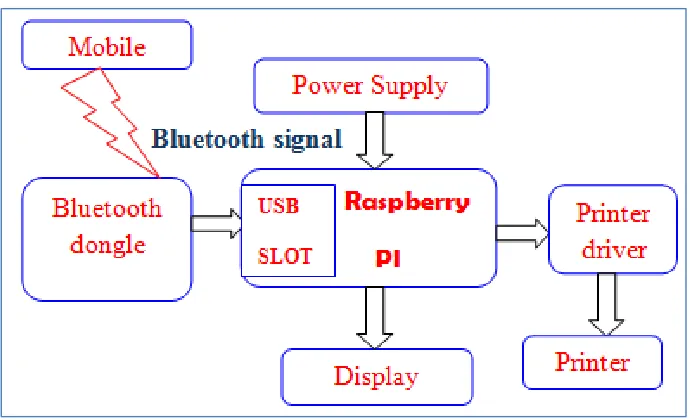
The design compromises Raspberry pi having Debian flavor of Unix. The configured Bluetooth dongle accept file from Mobile and gives to Raspberry Pi. The Printer driver is a program to control a printer that is connected to your system. The CUPs installed on Raspberry Pi do the print job. The disclosed Wi-Fi/USB printing converter can receive data transmitted from a Bluetooth dongle electronic product. The data can be directly sent to a printing device for printing without needing any computer device.
IV. BLOCK DIAGRAM
V. ALGORITHM FOR PROPOSED ARCHITCTURE
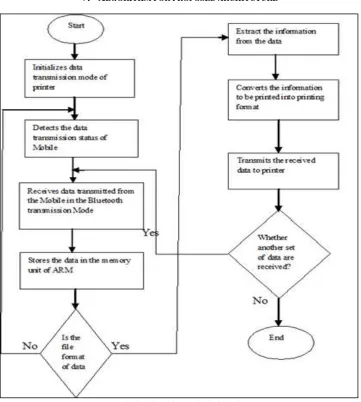
Fig. 2: Algorithm to be designed
The Algorithm shown in Fig. 2.consist of following steps - 1) Initialize the data transmission mode of printer. 2) Detect the data transmission mode of mobile. 3) Receives data transmitted from mobile. 4) Store the data in Memory unit.
5) Check the file format in the memory unit.
6) If the file format is correct then extract the information from the data, if file format is not correct then again detect the data transmission mode of Mobile phone.
7) Converts the information to be printed into printing data. 8) Transmits the received printing data to printer.
9) Stop.
VI. HARDWARE MODULES
Raspberry Pi Board:
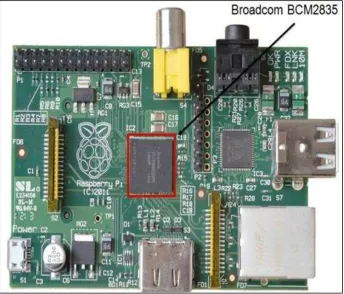
Fig. 3: Raspberry Pi Board
Bluetooth:
The Bluetooth is a specification (IEEE 802.15.1) for the use of low-power radio communications to link phones, computers and other network devices over short distances without wires. Bluetooth technology was designed primarily to support simple wireless networking of personal consumer devices and peripherals, including cell phones, PDAs, and wireless headsets. Wireless signals transmitted with Bluetooth cover short distances, typically up to 30 feet (10 meters). Bluetooth devices generally communicate at less than 1 Mbps.
Printer:
An external hardware device responsible for taking computer data and generating a hard copy of that data. Printers are one of the most commonly used peripherals and they print text and still images on the paper.
Bluetooth Dongle:
Bluetooth dongle transmission module is used to receive image data transmitted from Bluetooth electronic product such as mobile phones and PDA’s.
USB:
USB transmission module-It is connected to the microprocessor and in electrical communications With the USB of the printing device. It can transmit the printing data provided by the microprocessor to the printing device for printing.
VII. SOFTWARE MODULES
Linux Operating System:
Qt for Embedded Linux:
Qt for Embedded Linux is a C++ framework for GUI and application development for embedded devices.It runs on a variety of processors, usually with Embedded Linux. Qt for Embedded Linux provides the standard Qt API for embedded devices with a lightweight window system.
VIII. EXPERIMENTAL RESULTS
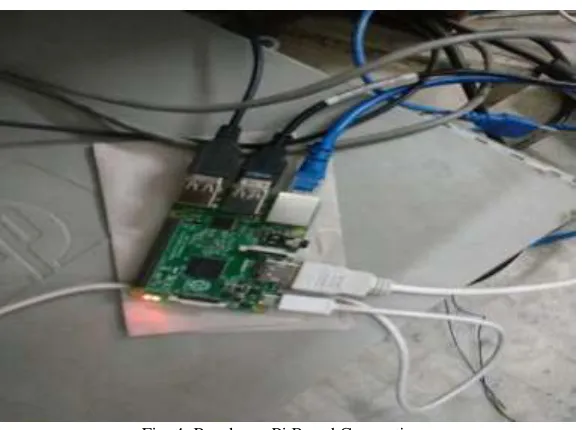
Fig. 4: Raspberry Pi Board Connections.
We can print data anytime, anywhere from your Mobile device. Now you can instantly print PDF files, text files and png , jpg format file more directly from your device to a printer. It requires an interfacing between the controller and Bluetooth dongle. The Bluetooth module accepts data and gives to controller for processing. The Printer is interfaced with Controller which receives data from Mobile and gives to the printer. The CUPs is installed in OS of Raspberry pi which converts normal data file into printing format and we get printed document.
Fig. 5: printer setup Fig. 6: output results
This paper proposed the design of a low cost Bluetooth to USB data converter, which is capable of receiving data and controlling Printer device via the Bluetooth port of Mobile. This approach can be used for time saving and it is simple and practical.
By using this approach we can more easily print data from mobile device. REFERENCES
[1] Stefan Nowak, Falk-Moritz Schaefer “Towards a Convergent Digital Home Network Infrastructure” IEEE Transactions on Consumer Electronics, pp.
1695-1703, 2011.
[2] Olawuyi J.O. Mgbole Friday, “Technological Convergence” Science Journal of Physics, pp.7237-7242, 2012.
[3] Amarnath M, “Home appliance control using mobile cloud technology” Proceedings of International Conference on Modeling Optimisation and
Computing, pp. 3587-3595, 2012.
[4] Wie-Chih Hsu, Shih-Tsung Liu “Design and Implementation of CAN-USB Converter Based on ARM7 Serial Protocol API ” IEEE International
Symposium on Computer, Consumer and Control pp. 333-336, 2012.
[5] T.K.Damodharan, V.Rhymend Uthariaraj “USB Printer Driver Development For Handheld Devices” IEEE Conference on Information Technology
Interfaces ITI, pp. 599-602, 2004.
[6] V. Vijaya, Rama Valupadasu, B. Ramrao Chunduri “FPGA Implementation of RS232 to USB Converter” IEEE symposium on Computers and Informatics,
pp. 237-242, 2011.
[7] Peng Daogang,Zhang Hao,Li Hui,Xia Fei “Development of the Communication Protocol Conversion Equipment based on Embedded Multi-MCU and
μC/OS-II” IEEE International Conference on Measuring technology and Mechatronics Automation , pp. 15-18, 2010.
[8] Ana Luiza de Almeida Pereira Zuquim, marcos Pego de Oliveira “An Embedded Converter from RS232 to Universal Serial bus” IEEE Transactions on
Consumer Electronics, pp. 91-96, 2001.
[9] Y.W. Lin and C.Y. Lee (2007), “Design of an FFT/IFFT processor for MIMO -OFDM Systems,” IEEE Trans. Circuits Syst. I, Reg. Papers, Vol. 54, no. 4,