Development and Realization of Real-time Data
Exchange between OPC Client and Multiple
Remote Servers
Da-hua Li
Tianjin Key Laboratory for Control Theory & Applications in Complicated Systems, School of Electrical Engineering, Tianjin University of Technology, Tianjin, China
Email: [email protected]
Hang Li, Kai-lin Zhang
Tianjin Key Laboratory for Control Theory & Applications in Complicated Systems, School of Electrical Engineering, Tianjin University of Technology, Tianjin, China
Email: [email protected], [email protected]
Abstract—The submitting of OPC (OLE for Process Control) has promoted the progress of the data collection in process control and industrial automation, and formulated the industry standard for the process real-time data exchange. Aiming at the key problem of ensuring the use of application program as OPC client to link multi-remote OPC server and real-time collect process data in control system, OPC technology and the connection and access technology of multi-remote OPC server were introduced and analyzed in detail. The multi-remote OPC server architecture is developed and analyzed based on the OPC technology and the automation interface. And the OPC client application is developed in order to connecting multi-remote OPC server. Multi-multi-remote OPC server communication case is achieved by the design of test software. Therefore the OPC client can calibrate and acquire progress data though calling the interface provided by the OPC server. Finally by establishing the suitable system architecture, configuring the corresponding environment variable and calling the corresponding test software program, the real-time data exchange between OPC client and multiple remote servers are achieved. This method has been successfully applied to develop the DCS I/O communication and control loop error test software, and provided better performance.
Index Terms—OPC, Multi-remote OPC server, OPC client, Data exchange
I. INTRODUCTION
Facing the increasingly development of industrial control technology, OPC technology has been recognized by more and more users. The full name of OPC is “Object Linking and Embedding (OLE) for Process Control”, which is put forward to promote the progress of data acquisition and built bridges for application and field process control applications. In the past, in order to store the data and information of the field devices, dedicated interface function was compiled by each application developers. However, because of the diverse types of
field devices, the product need to upgrades ceaselessly, which has brought huge workload to give users and software developers. Usually it cannot satisfy even the actual needs of the work. There is urgent need for a high efficiency, reliability, openness, interoperability of plug and play device driver to system integrators and developers. The OPC standard arises at this historic moment. OPC standard is based on Microsoft's OLE technology, and it is formulated by providing a set of standard OLE/COM interface. The OLE 2 technology is used in OPC technology. OLE standards allow document and graphic objects exchange between more microcomputers.
In the large-scale control network, different functional site will have OPC communications function. In many cases, users need to collect different process data from different control functional sites and do the corresponding processing. OPC communication technology is a very good technical means. Thus OPC server has been integrated into the configuration monitoring software in order to collect process data of control equipment efficiently. So, there is multi-remote OPC server existed in large-scale control network.
However, aiming at the problem how to collect process data of different sites of OPC server at the same time, the connection of multi-remote OPC server and read-write from multi-remote OPC server is important. On the work of OPC client development, how to use application program to create OPC server object for different OPC server to connect, OPC groups object for different function of reading and writing, OPC items object for collecting process data of different OPC server cache/device are worth to studying in-depth. Similar to the problem that how to ensure coordinating work between OPC server and OPC client avoid mistakes during data exchange in the same control network.
The key technology to develop multi-remote OPC server is the OPC technology and the automation interface. And multi-remote OPC server architecture is analyzed in detail in the later part.
A. OPC Technology
OPC is the abbreviated of Object Linking and Embedding (OLE) for Process Control. It is the application of object linking and embedding technology in process control in Microsoft. In the distributed system, OPC technology provides a complete solution to components exchange and data sharing. The data collection server program provided by the hardware equipment manufacturers can play all of the functions of hardware. The client can realize seamless connection through OPC interface and each manufacturer of OPC server.
OPC data access specification mainly includes real-time data access between server and client etc. OPCDA specification defines three objects as OPCServer (OPC server object), OPCGroup (OPC group objects) and OPCItem (OPC item object).
OPCServer is the primary object of the OPC client development. Under the premise of a good OPCServer having been established, we can one by one to create OPCGroup and OPCItem. Making connection of the clients through the defined OPC object and the object interface provided by OPC server, the data exchange function has been realized.
B. The Automation Interface
The automation interface provides an automated interface to configure and access data. It is the custom standard interface for descriptive programming language, which can be used by the application that using OLE automation server interface in VB program. When writing the OPC client, a dynamic link library called "automatic wrapper" provided by OPC Foundation can be used to implement the conversion between the automation interface and custom interface.
OPC server mainly do data exchange with equipment, which contains a large amount of communication program and data storage program, and provides a certain number of data interface for the use of OPC client application. This article provides the WinCC OPC server as the research object, whose OPC device name is “OPCServer. WinCC”.
C. Multi-remote OPC Server Architecture Analysis
In large-scale control network, different control stations have its own OPC server. Generally, the application program needs to be developed to achieve the real-time collection and storage of process data and realize the unified monitoring, operation, analysis and comparison of multi-site process data. A specific OPC client needs to be developed to achieve process data real-time acquisition from multi-remote OPC server in the
respectively develops OPC client application. Connecting and collecting data independently. The process data collected transmits to data processing procedures to be processed.
Figure 1. Multi-remote OPC server architcture1
Working in this way is complex and procedures are cumbersome. Experiments have show that the system is instability, the application load is larger, and the data transmission is blocked.
Figure 2. Multi-remote OPC server architcture2
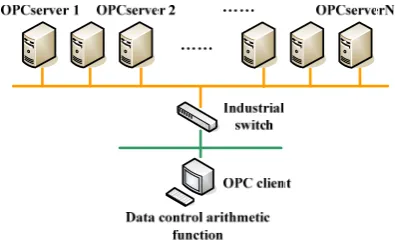
As shown in figure 2. OPC client use multi-point communication to connect each OPC server in local area network (LAN) through industrial switch.
This communication structure is simple. The process data stored in both OPC servers could be sent to the OPC client immediately through data real-time display, analysis and processing.
III. DEVELOPMENT OF OPC CLIENT
A. Structure Design of OPC Client.
The basic structure of the multiple OPC client is shown in figure 3. According to different requirement,
corresponding adjustments need to be made.
Figure 3. The basic structure of the multiple OPC client
B. Development of OPC Client.
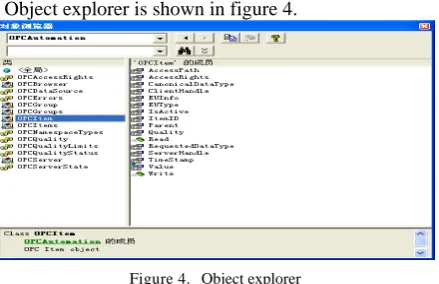
(1) The development of OPC client application based on VB language adopt the automation interface. VB gives great support in terms of OPC technology. The related attributes and methods of OPC can be used in VB by calling" OPCDA Automation Wrapper 2.02”.
Object explorer is shown in figure 4.
Figure 4. Object explorer
(2) Defining and building the OPCServer is the base of OPC client. Calling the statement of “Dim WithEventsServer1 As OPC Server” can realize the definition of OPCServer. The connection to remote OPC server needs to write ProgID and IP address into “connect” which is supported by OPCServer object. The statement is “Server1.Connect"ProgID", "IP"”. The order of OPC server name and IP address can't be reverse , or the OPC server connection will fail.
(3) The implement of data exchange needs to build OPCGroups object, OPCGroup object and OPCItems object. OPCServer object contains the properties of OPCGroups. OPCGroups can be established based on the created Server1 by calling the statement of “Set Groups1 = Server1.OPC Groups”. The establish ment of the OPCGgroup object is based on the
establish-ed OPCGroups. OPCGroups provide the method to add OPCGroup, the statement is “Add”, “Set Test Grp1 = Groups1.Add("WinCC _TestGrp")”. The same method to create OPCItems by calling the statement of “Set Items1 = TestGrp1.OPCItems”
(4) OPCItem is the smallest unit of data transmission, and variables are the carrier of data information. Understand the server name stored in OPC server is very significant. The correct server name must be written in OPC client. If the OPCItem of the OPC server is inconformity with the OPC client, the data exchange will not be realized. OPCItems provide the method to add OPCItem, the statement is “AddItem”.”Call fmMain. Items1.AddItems(8,strItemIDs,lClientHandles, Server Handles, lErrors)”.
(5) OPC client should have the function of reading and writing. OPCItem provides the method of reading and writing. The statement is “TestGrp1 .SyncWrite 1, lHandle(),vtItem Data, lErrors”, “TestGrp1.Sync Readn Source1,8,l Server Handles1, vtItem Values1, lErrors1”.
(6) In order to use DCOM resources reasonably, the DCOM environment should be set correctly and the function of disconnect OPC server should be included in OPC client application. OPCServer object provides the method of disconnect OPC server. Using the statement of “Server1.Disconnect”can realize the function of disconnection.
C. OPC Client Application.
Figure 5. OPC client
OPC client after developed can connect to multiple OPC server at the same time, there is no data loss and abnormal when transferring the process of data from the OPC server to the OPC client. Results of data display is shown in table 1.
TABLE I. THE RESULT FROM OPC CLIENT
OPCsever1 OPCsever2 OPC client
36.2 52.3 36.2/52.3
77 88 77/88
156.3 569.2 156.3/569.2
3.21 52.3 3.21/52.3
65 65 65/65
IV. MULTI-REMOTE OPC SERVER COMMUNICATION CASE.
In order to achieve the problem of multi-remote OPC server communication, the development of DCS communication test software is necessary. Besides defining the test software function meet the requirement of multi-remote OPC server communication.
A. Development of the Test Software
The DCS after upgrade need to do I/O communication test and control bus communication test. DCS and the hardware test platform work respectively as control station. Both of the control stations with OPC server provide data monitoring service. The development of DCS communication test software should solve the problem of multi-remote OPC server communication. Therefore, a set OPC client application should be developed to achieve data collection and control of DCS and hardware test platform.
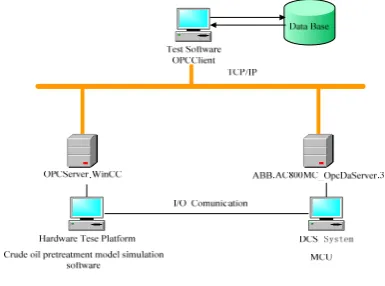
Take the case of one multi-remote OPC server architecurt, which is shown in figure 6, for example. The two multi-remote OPC server is connected through the industrial switch. By calling the DCS communication test software in main computer, data collection and control
Figure 6. Multi-remote OPC server architecture case
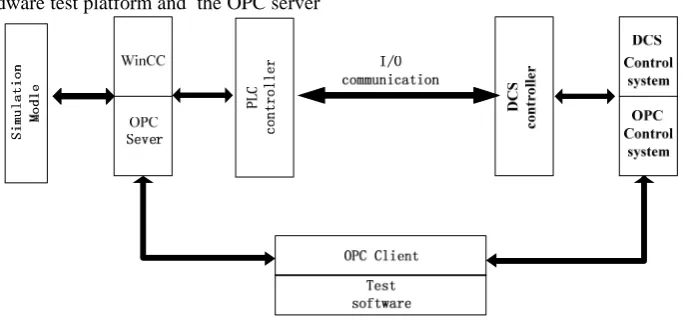
The research and development of the test software is for the used of testing ABB DCS based on the combination of Siemens S7-300 PLC and WinCC as the hardware control.
The system structure design is shown in figure 7.
Figure 7. System structure
B. Introduction of the Test Software Function
The function of the test software mainly contains three parts, such as equipment control, data acquisition and processing and data storage. Introduction in detail is as follows.
(1) Equipment control.
Main responsibility of equipment control is to control one or more of the I/O devices, in order to realize the data exchange between I/O devices and the computer. In this part, the direct control of the controller has been realized by sending control command to hardware control platform and remote OPC server provided by DCS using OPC.
(2) Data acquisition and processing.
Data collection, also known as data acquisition, is an interface, which collect the data from the external system input into the inner system, by the use of a device. Data processing is data collection, storage, retrieval, processing, transformation and transmission.
This part mainly to conduct the acquisition and processing of the digital and analog communication data
for the controller, make the output in certain data format, and provide accurate.
(3) Data storage:
Data storage is the temporary files or the information needed to be find in the process a data flow. In this system,data storage make data send by field devices collected and stored in the database, facilitate data call and inquiries work.
V. REALIZATION OF REAL-TIME DATA EXCHANGE BETWEEN OPC CLIENT AND MULTIPLE REMOTE SERVERS
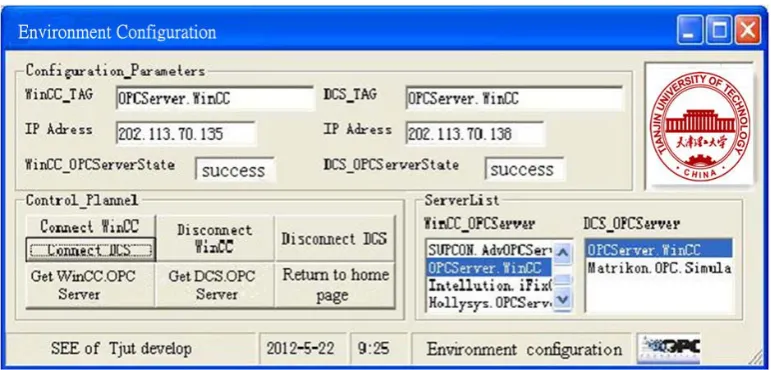
In order to connect to multiple remote OPC server structure by using the OPC client at the same time, the DCS test software is used in this system. DCS test software can search the current OPC server in the LAN, and connect to different remote OPC server respectively. Environment configuration is shown in figure 8. By select the suitable configuration parameters, the corresponding control channel and the corresponding OPC server, the environment have been configurated.
Figure 8. Environment configuration
DCS digital communication test of the test software is running in the way of connecting and reading more multiple remote OPC server at the same time accordance with the OPC client strictly in terms of data acquisition and control. In terms of DCS test, OPC client sends data to the hardware test platform, the hardware test platform send data to the DCS system through the way of bus.
At the same time, the OPC client real-time read stored data of OPC server in DCS. If the data sent by OPC
client is in accordance with the received data, the digital communication input is correct. Likewise in DCS digital output test system, OPC client sent data to DCS and acquire the data from hardware test platform at the same time. if the data is consistent, the DCS digital output test is correct.
Figure 9. Digital communication test
DCS analog test is similar to digital communication test. The OPC client need to connect both the hardware test platform and the DCS of the OPC server at the same
time, and own the function to guarantee the OPC server doing sending and collecting of the analog data .
Analog channel test is shown in figure 10.
Figure 10. Analog channel test
The control loop error test of the DCS test software require the OPC client to read the stored process data from both the hardware test platform and the OPC server
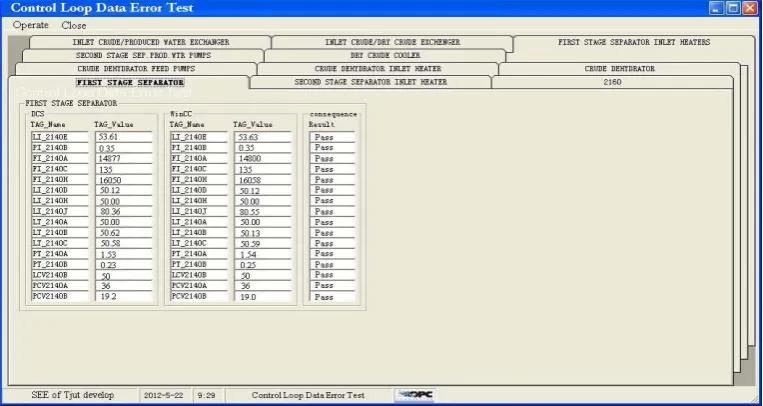
According to the process data collected by OPC server both from hardware test platform and DCS, the data transmission error test results of the control circuit can
be concluded. Control loop data error test is shown in figure 12.
Figure 12. Control loop data test
The application can connect the OPC server of DCS and hardware test platform at the same time, which has been verified in this project. Results have shown that the efficiency of data acquisition is improved and there is no jam. Thus simplify the repeated development work of OPC client.
VI. SUMMARY
Comparing with the architecture analysis of multi-remote OPC server, this way, that OPC client connect with multi-remote OPC server, could improve work efficiency of OPC client. The OPC client can multi-threaded parallel collect process data from different OPC servers. Study has shown that OPC client working in this way achieves the correct data transmission and high work efficiency. Besides, the study of OPC technology about the connection and access technology of multi-remote OPC server have been applied to the development of DCS I/O communication and control loop error test software successfully. And the system operation is normal, data collection is stable.
ACKNOWLEDGMENTS
This work is supported by Technology Project of CNOOC Energy Technology & Services under Grant YF10ZF1129.
REFERENCES
[1] Ming Cen, Qian Liu, Yi Yan. “OPC (OLE for Process Control) based Calibration System for Embedded Controller”. JOURNAL OF SOFTWARE, VOL. 7, NO. 12, pp.2866-2874, DECEMBER 2012.
[2] Vu Van Tan, Dae-Seung Yoo, and Myeong-Jae Yi, “A Novel Framework for Building Distributed Data Acquisition and Monitoring Systems”. JOURNAL OF
SOFTWARE, VOL. 2, NO. 4, pp.70-80, OCTOBER 2007.
[3] Benjun Guo, Jianhong Gan, Jingwen Su, Yuewen Hu, “A Pervasive Computing Model of Internet of Things based on Computing Area Network”, JOURNAL OF
COMPUTERS, VOL.7, NO.7, pp.1647-1655, JULY 2012.
[4] Wei Qiu, Li-Chen Zhang, “Research on Real-Time Software Development Approach”, JOURNAL OF
SOFTWARE, VOL.7, NO.7, pp.1593-1601,JULY 2012.
[5] Gao Qiang, Zhang Liang, Li Yuefeng. “Design of Virtual DCS Monitoring System based on the OPC Technology”,
Automation & Instrumentation, Vol.24, No.12, pp.30-32,
2009.
[6] Gao Qiang, An Kang, Dong Chao, Dong Haijie. “Realization of historical data communication system based on OPCHDA technology”. Control and Instruments
in Chemical Industry. Vol.34, No.5, pp.48-50, 2007.
[7] Sun Qingwen, Li Xiaojun, Sun Yongli. “Research and Application on Data Exchange between OPC Client and DCS based on C++”. China Instrumentation. No.5, pp.52-58, 2012.
[8] Ji Qiangjun. “Research and Application on OPC Client Development”, 2007.
[9] Zou Yuntao, Wu Chongguang. “Three Methods of Client Model Design Based on OPC Data Access Specification”.
Automation Panorama, No.1, pp.55-57, 2004.
[10]Wang Dekang, Su Hongye, Chu Jian. “Design and Reasearch of Advanced Control Software Based on OPC Technique”. Control and Instruments in Chemical
Industry. Vol.27, No.4, pp.27-30, 2000.
[11]Ma Longhua, Liu Jun, Qian Jixin. “Research and Application of OPC Data Access Specification”. Control
and Instruments in Chemical Industry.Vol.29, No.1,
pp.43-45, 2002.
[12]Yang Mingji, Guo Jianhong, Shen Qiang, Zhou Qiang. “Research of OPC Technology in the Field of Industrial Control”. JOURNAL HARBINUNIV .SCI. & TECH. Vol.13, No.4, pp.29-31, 2008.
[14]Renjie Huang and Feng Liu, “Research on OPC UA basedon electronic device description,” In IEEE Conf.
Ind.Electron. Appl., ICIEA, pp.2162-2166,2008.
[15]The OPC Data Access Specification, [Online]. Available:http://opcfoundation.org/, December 2004. [16]The OPC Historical Data Access Specification,
[Online].Available:http://www.opcfoundation.org/, December, 2003.
[17]The OPC Data Exchange Specification version 1.0. [Online].Available: http://www.opcfoundation.org/,March 2003.
[18]S. Chilingargyan and W. Eppler, “High Speed Data Exchange Protocol for Modern Distributed Data
Acquisition Systems based on OPC XML-DA,”
Proceedings of the Real-time Conference, 14th IEEENPSS,
pp. 352-356, June 2005.
[19]D. W. Holley, “Understanding and Using OPC for Maintenance and Reliability Applications,” Journal of the
IEE Computing and Control Engineering, pp. 28-31,
February-March 2004.