Page | 1
ENERGY EFFICIENT TARGET TRACKING PROTOCOL IN
WSN: A DESIGN
Mr. Ghule Shashikant M.
Dept. of Computer Engg, MIT Academy of Engineering, Alandi
Prof. Jain S. A.
Dept. of Computer Engg, MIT Academy of Engineering, Alandi
Prof. Ganjewar P. D.
Dept. of Computer Engg, MIT Academy of Engineering, Alandi
Abstract:
Wireless Sensor Network applications are pulling in more research, particularly in energy saving techniques that are the centre purpose of analysts here. One of the fascinating and helpful uses of Wireless Sensor Networks is the movable target tracking. Wireless Sensor Networks is utilized to track movable target in a monitored territory and to report its location to the base station. . Identification of exact position and path travelled by the movable target over an area is a noteworthy energy customer procedure inside of Wireless Sensor Networks. In this paper, we consider a best design requirements to outline energy efficient cluster based routing protocol for Target Tracking in Wireless Sensor Networks (WSNs), with the assistance of this convention expand network lifetime of each node and decrease communication cost between nodes. Specifically, we deliberately outline a energy efficient target tracking protocol with thought of couple of imperative parameters, such as, aggregate remaining energy. At last, we abridge and finish up the paper with some future headings.
Keywords: WSN; target tracking; cluster; cluster head; boundary nodes; energy efficiency; static cluster; nodes; communication cost, single target.
1. Introduction:
Target tracking is considered important in WSNs, as it is a base for many practical applications, such as battlefield surveillance, emergency rescue, disaster response, and patient monitoring. Generally speaking, target tracking aims to detect the presence of a target and compute reliable estimates of its
locations, while the target moves within an area of interest and forward these estimates to the base station in a timely manner.
Page | 2
Figure 1 Cluster Based Target tracking Model.
In above figure an internal member node detects the target. A member node reports its estimates to cluster head and cluster head again to the base station
2. RELATED WORK
Yang and Sikdar [7] proposed a distributed predictive tracking (DPT) protocol that predicts the next location of the target and informs the cluster head about the approaching target. The corresponding cluster head then wakes up the closet three sensors nodes around the predicted location before the arrival of the target.
Zhibo Wang et al.[8] proposed a hierarchical prediction strategy (HPS) that also relies on cluster structure for target tracking and implemented a real target tracking system in. Compared with dynamic clustering protocols, cluster based target tracking protocols take the advantages of underlying cluster structure, which is especially suitable for target tracking in large-scale networks.
Tanbeer et al. what's more, Boukerche and Samarah [5] [1] proposed brought together information mining models to discover relationship among the sensors nodes. They proposed tree based data structure that utilized used FP-growth approach to obtain the frequency of all events detecting sensor. Tanbeer et al. [5] utilized Sensor Pattern Tree (SP-Tree) to develop a prefix-tree and redesign the tree in a recurrence plummeting request. Through the revamping the SP-tree can keep up the habitually occasion distinguishing sensors' nodes at the upper piece of the tree, which gives high conservativeness in the tree structure. Once the SP-tree is built FP-development mining method is connected to locate the regular occasion identifying sensor sets.
Boukerche, and S. Samarah[3] utilized Positional Lexicographic Tree (PLT) structure for mining affiliation rules in which the occasion
identifying sensors are the principle objects of the standards paying little heed to their qualities. The mining starts with the sensor generating so as to have the greatest rank the regular examples from its PLT recursively.
K Romer, and Chonget a [3] [4], join the issue of mining sensor information to the affiliation rules' proposing so as to mine issue in-system models. Romer's[2] methodology thinks seriously about the appropriated way of remote senor systems to find successive examples of occasions with certain spatial and transient properties.
For missing qualities recognizable proof Halatchev and Gruenwald [3] proposed a centralized philosophy called Data Stream Association Rule Mining (DSARM) to distinguish the missing sensor's readings. It utilizes Association Rule Mining algorithm to distinguish sensors that report the same information for various times in a sliding window called related sensors and afterward gauges the using so as to miss information from a sensor the information reported by its related sensors.
Yoon and Shahabi, Beyens et al., Yeo et al.[6] proposed information relationship cluster structure planning for WSNs in which cluster heads spatiotemporally correspond.
3. ASSUMPTIONS:
Page | 3
3.1. HARDWARE RESOURCES REQUIRED1. Dual Core Pentium IV. 2. 40GB Hard Disk. 3. 1GB Ram.
4. Monitors at 800 x 600 minimum resolution. 5. One or two button mouse and standard
101keyboard.
3.2. SOFTWARE RESOURCES REQUIRED The software resources required for the project are as follows,
1. Windows 7/ Linux Operating System. 2. C Language
Following assumptions made for the simulation of proposed technique.
Table 1 Assumptions made for simulation
1 Network Field
2 Number Of nodes
3 Number Of sink
4 Transmission range
5 Packet size
7 Transmit power
8 Receive Power
9 Ideal Power
10 Sleep mode Power
11 Initial Battery Power
12 MAC layer
15 Simulation Time
4. PROPOSED WORK:
In this paper, I identify with the suitable energy efficient protocol for single movable target following and it is an upgraded type of LEACH, HEED, TEEN, AFTEEN and HCTT. With the help of proposed steering convention increase the framework lifetime of the every node and reduce correspondence overhead between two nodes.
4.1. ENERGY EFFICIENT TARGET TRACKING PROTOCOL (EETTP):
In this section we propose an energy efficient target tracking protocol for wireless sensor network tracking single movable target current location at a time. With the help of this technique we reduce energy usage using clustering algorithm and reduce communication cost. Work flow consists of a main
task called static cluster formation, internal node formation, target tracking task.
Figure 2 System Workflow
4.1.1. CLUSTER FORMATION:
In order to bolster get ready of data onto vitality proficient system, sensor nodes can be isolated into different little groups called cluster. The sensor nodes all out into gatherings are called cluster. Every group has a singular bunch head (CH). A cluster head is browsed the sensor nodes with most noteworthy remaining battery power and correspondence range. In cluster based frameworks, clusters are recognized using cluster heads. Grouping procedure can make stable WSN system topology at the level of sensor nodes network. The CH is similarly executing capable organization strategies to augment the battery life of the individual sensors and to open up the network lifetime. According suitable clustering algorithm such as HEED or LEACH, we separate deployed nodes in separate cluster.
4.1.2. INTERNAL NODE FORMATION: A requesting assignment issue is the means by which the framework finds the situation when the objective is drawing nearer the boundaries, particularly in a completely circulated way. We utilize boundary nodes to explain this issue in a completely disseminated way.
Definition 1:
Boundary node of a static cluster: A node Vi is defined as a boundary node of its stable cluster if there exists at least one of its neighbor nodes Vj, such that (Li ,Lj ) ≤RN and C(Vi )≠C(Vj ).
Definition 1:
Internal node of a static cluster: A node Vi is defined as a internal node of its stable cluster if there exists at least one of its neighbor nodes Vj, such that (Li ,Lj ) ≤RN and C(Vi )==C(Vj ).
4.1.3. TARGET TRACKING TASK:
Page | 4
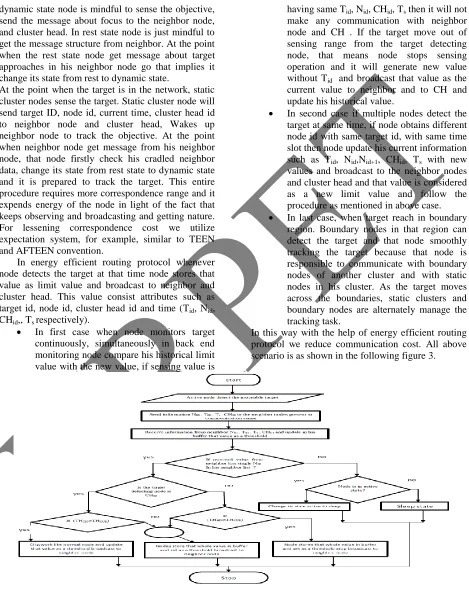
dynamic state node is mindful to sense the objective,send the message about focus to the neighbor node, and cluster head. In rest state node is just mindful to get the message structure from neighbor. At the point when the rest state node get message about target approaches in his neighbor node go that implies it change its state from rest to dynamic state.
At the point when the target is in the network, static cluster nodes sense the target. Static cluster node will send target ID, node id, current time, cluster head id to neighbor node and cluster head, Wakes up neighbor node to track the objective. At the point when neighbor node get message from his neighbor node, that node firstly check his cradled neighbor data, change its state from rest state to dynamic state and it is prepared to track the target. This entire procedure requires more correspondence range and it expends energy of the node in light of the fact that keeps observing and broadcasting and getting nature. For lessening correspondence cost we utilize expectation system, for example, similar to TEEN and AFTEEN convention.
In energy efficient routing protocol whenever node detects the target at that time node stores that value as limit value and broadcast to neighbor and cluster head. This value consist attributes such as target id, node id, cluster head id and time (Tid, Nid, CHid,, Ts respectively).
In first case when node monitors target continuously, simultaneously in back end monitoring node compare his historical limit value with the new value, if sensing value is
having same Tid, Nid, CHid, Ts then it will not make any communication with neighbor node and CH . If the target move out of sensing range from the target detecting node, that means node stops sensing operation and it will generate new value without Tid and broadcast that value as the current value to neighbor and to CH and update his historical value.
In second case if multiple nodes detect the target at same time, if node obtains different node id with same target id, with same time slot then node update his current information such as Tid, Nid,Nid+1, CHid, Ts with new values and broadcast to the neighbor nodes and cluster head and that value is considered as a new limit value and follow the procedure as mentioned in above case. In last case, when target reach in boundary
region. Boundary nodes in that region can detect the target and that node smoothly tracking the target because that node is responsible to communicate with boundary nodes of another cluster and with static nodes in his cluster. As the target moves across the boundaries, static clusters and boundary nodes are alternately manage the tracking task.
In this way with the help of energy efficient routing protocol we reduce communication cost. All above scenario is as shown in the following figure 3.
Page | 5
5. CONCLUSION:
Network lifetime is the most essential parameter in examination of dominant part of WSN's applications, for example, target following utilizing WSN. One of the primary restrictions of WSN is the limited power of sensor nodes. This restriction bears that saving energy and expanding system lifetime get to be two fundamental issues in WSN's applications. In this paper we design a cluster based Energy Efficient Target Tracking convention for diminishing energy consumption and communication cost for target tracking in WSNs separately. With the assistance of EETTP we take care of boundary issue when we utilize more than one cluster in a WSN. Our proposed convention considers both energy and communication range parameters for cluster. Later on, the techniques ought to be reached out to track different movable targets track in wireless sensor networks.As a future work, the proposed algorithms can be extended for multiple targets tracking and reporting to different central stations. Multiple targets tracking using cluster-based approach requires techniques to manage target tracking task, mostly in areas where targets are close to each other. Management of nodes which can participate in both multiple clusters and proper usage of their video information should be considered.
REFERENCES:
[1] A. Boukerche, and S. Samarah, “A novel algorithm for mining association rules in wireless ad hoc sensor networks,” IEEETransactions on Parallel and Distributed Systems, pp. 865-877, 2007.
[2] K. Romer, “Distributed mining of spatial-temporal event patterns in sensor networks,” Proc. of the 1st Euro-AmericanWkshp. on Middleware for Sensor Networks (EAWMS), 2006.
[3] M. Halatchev, and L. Gruenwald, “Estimating missing values in related sensor data streams,” in Proc. 11th Int’l Conf.Management of Data (COMAD ’05), 2005.
[4] S. K. Chong, S. Krishnaswamy, S. W. Loke et al., “Using association rules for energy conservation in wireless sensornetworks,” in Proceedings of the 2008 ACM symposium on Applied computing, 2008, pp. 971- 975.
[5]S. K. Tanbeer, C. F. Ahmed, B. S. Jeong et al.,“Efficient mining of association rules from wireless sensor networks,” in11th International Conference on Advanced Communication Technology (ICACT'09) 2009, pp. 719-724.
[6]S. Yoon, and C. Shahabi, “The Clustered Aggregation (CAG) technique leveraging spatial and temporal correlations in wireless sensor networks,” ACM Transactions on Sensor Networks (TOSN), vol. 3, no. 1, pp. 3, 2007.
[7] W. C. Yang, Z. Fu, J. H. Kim, and M. S. Park, “An adaptive dynamic cluster-based protocol for target tracking in wireless sensor networks,” in Advances in Data and Web Management, vol. 4505 of Lecture Notes in Computer Science, pp. 156–167, Springer, Berlin, Germany, 2007.
[8] Zhibo Wang, Wei Lou “A Hybrid Cluster-Based Target Tracking Protocol for Wireless Sensor networks” International Journal of Distributed Sensor Networks Volume 2013.
[9] W. B. Heinzelman, A. P. Chandrakasan, and H. Balakrishnan, “An application-specific protocol architecture for wireless micro sensor networks,”IEEE Transactions Wireless Communications,