ISSN (Online): 2320-9364, ISSN (Print): 2320-9356
www.ijres.org Volume 5 Issue 5 ǁ May. 2017 ǁ PP. 46-50
The Effect of Temperature on Aromatic Yield of Treated Heavy
Naphthene From Bonga Aromatic Crude
I. J. Otaraku
1,I. L. Egun
21Department of Chemical Engineering, University of Port Harcourt, Port Harcourt, Nigeria 2Department of Chemical Engineering, University of Port Harcourt, Port Harcourt, Nigeria
ABSTRACT:
The aim of this paper is to determine the effect of temperature on aromatic yield content ofheavy treated Naphtha from Nigerian crude during catalytic reforming. The catalytic reformer was simulated using Aspen Hysys catalytic reformer template configured as four beds while treated heavy Napthene from Bonga Crudewas used as feed stock. The outlet concentrations of paraffins, naphthenes and aromatics volume (Vol.% ) at different temperature of the reformer were recorded. It was observed that an increase in temperature leads to an increase in the concentration of aromatics as the volume of aromatic yield at 430oC was 23.46 % volume while at 540oC it was 51.38% volume showing a significant increase in the aromatic yield level.
Keywords:
Aromatic yield, Bonga Crude, Catalytic reforming, Naphthene, TemperatureI.
INTRODUCTION
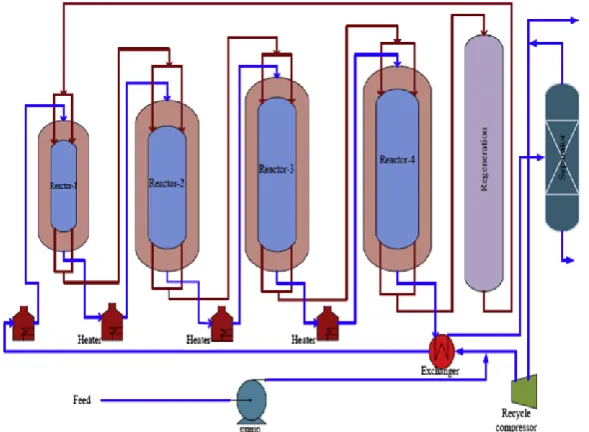
Catalytic reforming is a very important process for producing high octane gasoline as main products with hydrogen and liquefied petroleum gas as by-products [1].The catalytic reforming process is one that converts petroleum products with low boiling range low-octane hydrocarbons from paraffin to iso-paraffin and to naphthene, the naphthenes are changed to aromatics without changing carbon numbers in the molecule [2]. The yield (reformate), that is iso-paraffin and aromatics are high-octane gasoline components required to fuel automobiles. Catalytic reforming process is a vital process in the refinery, because it leads to the production of high-octane components, which is intensely demanded in our modern life [2]. The significance of this industrial process induced researchers to investigate different aspects of catalytic reforming process intensively [1]. Generally, naphtha reforming process is carried out in three or four fixed bed reactors which operate adiabatically at temperatures between 450 and 520 °C, total pressures between 10 and 35 bar, and molar hydrogen-to hydrocarbon ratios between 3 and 8 [3]. Usually, the feed to the first reactor is a hydrodesulfurized naphtha cut, composed of normal and branched paraffins, five and six-membered ring naphthenes, and single-ring aromatics [2]:
CH + NiO⇒C + H (1)
C + O ⇒ CO (2)
Catalytic reforming of heavy naphtha and isomerization of light naphtha constitute a very important source of products having high octane numbers which are key components in the production of gasoline [4].
Regeneration[4]
Bonga Aromatic crude is a medium gravity, low sulphur, naphthenic crude. It is similar in quality and yield pattern to Forcados, though slightly heavier [5].
1.2 The Simulation
1.2.1 Modeling Environment
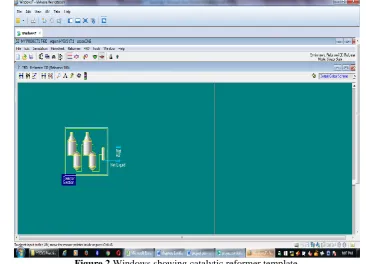
The catalytic reformer was modeled in a steady state mode using catalytic reformer template of ASPEN Hysys 7.2. In setting up the model, the fluid property package was chosen to be Peng-Robinson and the reactors configured as 4 beds.
Fig. 2 below is a representation of a typical process flow for the continuous catalytic reforming process.
Figure 2 Windows showing catalytic reformer template
1.2.2 Feed Conditions and Specifications
The feed and other input values used for modeling the catalytic reformer are given in Table 1 below
Table 1: Bonga Crude Assay
Crude Heavy Naptha
Density at 15OC: 879.5kg/m3 Density at 15OC: 761kg/m3
Nitrogen ppm 1219.9 Cut oC 80-160
Sulphur wt% 0.24863 Yield 13.97 Vol.%
API 29.4 Napthene 60.59 Vol.%
Paraffin 25.53 Vol.% Aromatics 13.88 Vol.% Source: ExxonMobil, 2016 [5]
1.2.3 Kinetic Model
The kinetic model used in the catalytic reformer template was that of Smith’s which considers the following reaction:
1. Dehydrogenation of naphthenes to aromatics 2. Dehydrocyclization of paraffins to naphthenes 3. Hydrocracking of naphthenes to light ends 4. Hydrocracking of paraffins to light ends
The simplified naphtha reforming kinetics, as described in [6], are written as:
N + 2H2 r3 2G (5)
P + H2 r4 2G (6)
Where N, A, G, H and P; are Naphthenes, Aromatics, Gases, Hydrogen and Paraffin respectively. The reaction rates are,
r1 = kf1pN − kr1pAp3H2 (7)
r2 = kf2pNpH2 − kr2pP (8)
r3 = kf3pN/p (9)
r4 = kf4pP /p (10)
where p is the partial pressure of the components and p is the overall reactor pressure, the forward and reverse rate constants, kf and kr. The Arrhenius type of rate expression is assumed:
kf= 𝑘0𝑓𝑒
−𝐸𝑓
𝑅𝑇 (11)
whereactivation energy E is dependent on the catalyst and k0f is dependent on the molarity of the reaction and R is the universal gas constant [6].
II.
RESULTS AND DISCUSSION
The results obtained from the simulation are discussed below:
2.1properties Of Treated Heavy Naphtha
The properties of the Treated Heavy Naphtha are recorded in Table 2.
Table 2: Properties of Treated Heavy Naphtha
Property Sample
Initial boiling point, °C 99
Final boiling point, °C 156
Paraffins, liquid volume % 25.53 Naphthenes, liquid volume % 60.59 Aromatics, liquid volume % 13.88
From Table 2 above, it is seen that sample initial and final boiling point temperatures were in a temperature range of 80 to 160 °C which corroborate with literature [3]. The sample had good distribution of Naphthenes, Paraffins and Aromatics liquid volume, this property makes it a good feedstock for the catalytic reformer.
2.2Aromatic Yield Result
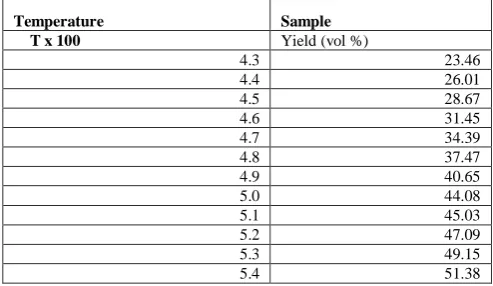
The volume of aromatic yield at various temperature change of the reactor is shown in Table 3 below.
Table 3: Aromatic yield of heavy treated Naphtha
Temperature Sample
T x 100 Yield (vol %)
4.3 23.46
4.4 26.01
4.5 28.67
4.6 31.45
4.7 34.39
4.8 37.47
4.9 40.65
5.0 44.08
5.1 45.03
5.2 47.09
5.3 49.15
5.4 51.38
Figure 3: Graph of Aromatic Yield against Temperature
From the figure above, it is seen that the curve is linear, showing that as the temperature increases the aromatic yield increases. All the samples were seen to be increasing in yield quantity as the temperature increased; this is due to the disappearance of paraffins [1].
1.3.3reformate Composition
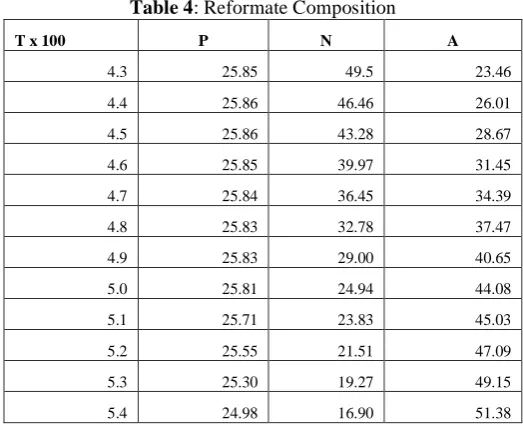
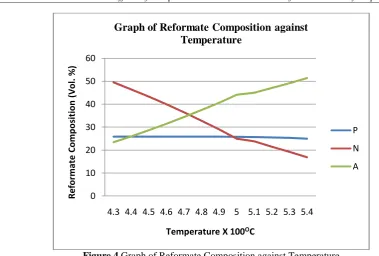
The reformate composition of the treated Heavy Naphthene at various temperature is shown in Table 4 below. It is seen that as temperature increases the reformate composition is changing (the naphthenic composition is reducing while that of the aromatic composition is increasing. The paraffin composition is relatively stable).
Table 4: Reformate Composition
T x 100 P N A
4.3 25.85 49.5 23.46
4.4 25.86 46.46 26.01
4.5 25.86 43.28 28.67
4.6 25.85 39.97 31.45
4.7 25.84 36.45 34.39
4.8 25.83 32.78 37.47
4.9 25.83 29.00 40.65
5.0 25.81 24.94 44.08
5.1 25.71 23.83 45.03
5.2 25.55 21.51 47.09
5.3 25.30 19.27 49.15
5.4 24.98 16.90 51.38
From Table 4 , an increase in temperature of reactor led to a change in the composition of reformate as the ratio of Paraffins vol % (P),Naphthenes vol% (N) and Aromatics vol% (A) were seen to be changing at any temperature change.It was observed that as the temperature for the reactor was increasing the Paraffins and the Naphthenes were decreasing as this was due to the dehydrogenation of the napthenic hydrocarbons thus promoting the production of Aromatics [1].
0 10 20 30 40 50 60
4.3 4.4 4.5 4.6 4.7 4.8 4.9 5 5.1 5.2 5.3 5.4
Aroma
ti
c Yi
e
ld
(V
o
l %)
Temperature X 100OC
Figure 4 Graph of Reformate Composition against Temperature
From the Fig. 4 above it is seen that composition of reformate is a function of temperature and it is of linear dependence. Due to the various reactions, the composition of reformate is constantly changing. At certain temperatures, the composition of reformate may be similar.
III.
CONCLUSION
It is seen that the operating temperature of reactor has a great effect on the volume of Aromatic yield. At higher temperature range, there will be high yield of aromatic reformate. The results showed that, it’s possible to increase the aromatic composition in reformate from treated heavy Naphtha by changing the design variables and operating conditions.
REFRENCES
[1]. Zaidoon M. S., Optimization of Al-Doura Catalytic Naphtha Reforming Process Using Genetic Algorithm, Eng. &Tech. Journal Vol. 31, 2013, Part A, No.7
[2]. Shuichi K., Analysis of catalytic reforming characteristics of various Hydrocarbons, JSAE Annual congress No. 43-04, 2004
[3]. Mohan L., Catalytic Reforming Process, Catalysts and Reactors 6th Summer School on Petroleum Refining & Petrochemicals Indian Institute of Petroleum Management Gurgaon, 2011, June 6-10. [4]. Mohammad, R. R., Mitra J. and Davood I., Progress in catalytic naphtha reforming process, Applied
Energy 109, 2013, 79–93
[5]. ExxonMobil (2016): www.exxonmobilng.com
[6]. Wordu, A. A., Dynamic Simulation of Industrial Reformer Reactors, International Journal of Engineering and Technology Volume 2 No. 7, July ISSN: 2049-3444 © 2012 – IJET Publications UK.
[7]. Raseev, S. Thermal and catalytic Processes in Petroleum Refining, Marcel, 2003,Dekker, Inc. New York. 0
10 20 30 40 50 60
4.3 4.4 4.5 4.6 4.7 4.8 4.9 5 5.1 5.2 5.3 5.4
Re
fo
rma
te
C
o
mp
o
si
ti
o
n
(V
o
l.
%)
Temperature X 100OC
Graph of Reformate Composition against
Temperature
P
N