The Optimization Study on Time Sequence of
Enhanced External Counter-Pulsation in
AEI-CPR
Lin Xu
Department of Math and Information Technology, Hanshan Normal University, Chaozhou, P. R. China School of Computer Science and Engineering, South China University of Technology, Guangzhou, P. R. China
Email: [email protected]
Xiaoming Wu, Yanru Zhang and Hengxin Yuan
School of Bioscience and Bioengineering, South China University of Technology, Guangzhou, P.R. China School of Computer Science and Engineering, South China University of Technology, Guangzhou, P. R. China
Institute of Biomedical Engineering Sun Yat-Sen University, Guangzhou, P.R. China Email: {[email protected], [email protected], [email protected]}
Abstract—To improve the aortic pressure and myocardial perfusion pressure during cardiac arrest, this study is de-signed to optimize sequence of Enhanced External Coun-ter-Pulsation (EECP) for a cardiopulmonary resuscitation (CPR) technique — Active Compression-Decompression CPR coupled with EECP and Inspiratory Impedance Threshold Valve (AEI-CPR). EECP is lower-limbs com-pression equipment for AEI-CPR that enhanced blood re-gurgitation during chest decompression. Different occa-sion for EECP performance would bring different hemo-dynamic effect. A mathematical model of human circula-tory system used to research AEI-CPR has been established. And then the AEI-CPR hemodynamic effect to the blood circulatory system is performed on the model. A genetic algorithm (GA) that used to find optimum sequence of the EECP is performed on the model when other parameters of external force for AEI-CPR are definite. At first, set the maximum strength of chest compression, chest decompres-sion and lower-limbs compresdecompres-sion at 400Nt, 160Nt and 300mmHg, respectively. Set the frequency of CPR at 100min-1 and the ratio of chest compression compared to LLCP at 1:1. Then, after genetic algorithm is performed on the established model, fifty groups of optimal results are obtained. The maximum coronary perfusion pressure (CPP) takes place when the EECP begin its compression at 0.2s and the interval among crural, femoral and iliac compres-sion is 0.05s. By applying the optimization algorithm on the CPR mathematical model, the optimum sequence of the EECP could be found. And the experiment results indicate that obvious hemodynamic effect is attained when the EECP began compression at the end of chest compression.
Index Terms—cardiopulmonary resuscitation,
mathemati-cal model, enhanced external counter-pulsation, genetic algorithm
I. INTRODUCTION
Heart disease is the primary cause of mortality. De-spite widespread use of cardiopulmonary resuscitation (CPR), which is an emergency medical procedure for a victim of cardiac arrest, the survival of patients recover-ing from cardiac arrest remains poor. One of the rea-sons for this situation is that the practical technique of CPR has changed little since the 1960’s [1]. Most re-searches focus on improving the CPR technique, such as active compression-decompression CPR (ACD-CPR) and interposed abdominal compression CPR (IAC-CPR), or on devices, such as an inspiratory impedance thre-shold valve (ITV) attached to the airway during standard CPR [2-4]. In the 1990’s, a CPR technique, which was ACD-CPR coupled with Enhanced External Coun-ter-Pulsation (EECP) and ITV, called as AEI-CPR, was proposed [5]. Researchers claimed that AEI-CPR could improve the aortic pressure and myocardial perfusion pressure. By compressing sequentially on the lower limbs, EECP could help to augment diastolic pressure and venous return flow. By impeding intermittently aspiratory gas exchange, ITV could help to increase in-trathoracic negative pressure [6]. Therefore, AEI-CPR can enhance coronary perfusion pressure (CPP) but not increase right atrial pressure during diastole. Recently, Demetris Yannopoulos et al. also investigate a CPR tech-nique like AEI-CPR [7].
However, most of current conclusions are derived from animal experiments or studies in humans after a prolonged cardiac arrest which has lost the effective time for CPR in preserving vital organ function. Moreover, it is impossible that built a reproducible model in patients because only the seconds to minutes after the onset of Manuscript received March 20, 2009; revised May 19, 2009;
ac-cepted June 15, 2009.
Corresponding author’s Email: [email protected] (Xiaoming Wu)
cardiac arrest is critical [8]. Therefore, a mathematical model of AEI-CPR is established by Simulink which could simulate the hemodynamic effect in cardiac arrest [9].
The AEI-CPR differs from current methods in that it adds a device, i.e. EECP, to the lower limbs. When the chest is active decompressed, EECP produce a lower limbs compression pressure (LLCP) acting on from crus to hip sequentially to help venous return. Likewise, the IAC-CPR is also a CPR technology that incorporates alternating chest and abdominal compressions to gener-ate enhanced artificial circulation during cardiac arrest [10]. Compared to abdomen, however, lower limbs can endure greater compression pressure, because there are many vital visceral organs in the abdomen while lower limbs are only wrapped by muscle. On the other hand, various sequence of compression acting on the lower limbs would generate various hemodynamic effects, es-pecially diastolic CPP. As well known, the quality of CPR affects the probability of immediate survival, 24h survival, and the rate of discharge. And a study of CPR results shows that the outcome is partially determined by the deliverance push and blow, confirming the belief of Peter Safar [11].
To improve the hemodynamic effect of AEI-CPR, a genetic algorithm (GA) is performed on the established AEI-CPR model to find optimum sequence of the EECP when other parameters for external force are definite. In accordance with animal experiment, parameters are set as follow: the maximum strength of chest compres-sion, chest decompression and lower-limbs compression is 400Nt, 160Nt and 300mmHg, respectively; the fre-quency of CPR is 100min-1 and ratio of chest compress to LLCP is 1:1. The duty-cycle of chest compression compared to chest de-compression is 50%. CPP is an important indicator to evaluate the quality of CPR tech-niques [12]. The experiment results show that the best effect of diastolic CPP occurs in LLCP applied at the end of chest compression. The optimum result of CPP is up to 50.99mmHg.
Ⅱ. MATHEMATICAL MODEL OF AEI-CPR
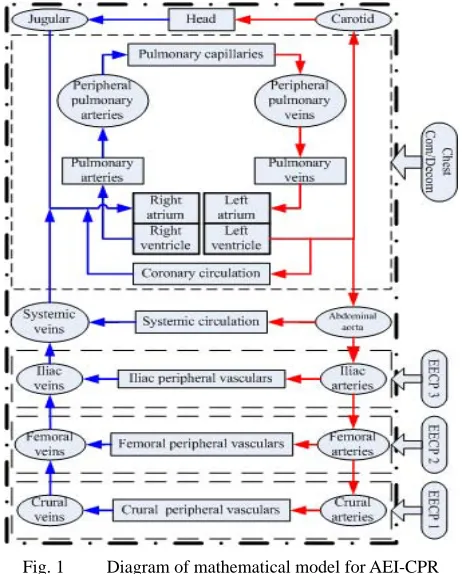
To research the hemodynamic effect of AEI-CPR one must not only model a human blood circulatory system but also consider the problem of mechanical coupling of the external force on the chest and lower limbs. A ma-thematical model for studying hemodynamic effect of AEI-CPR has been established by Simulink. It, as shown in the Fig. 1, based upon normal human anatomy and physiology, the definition of compliance (volume change/pressure change) and Ohm’s Law (flow= pres-sure/resistance) [9, 5]. The diagram of Fig. 1 includes two parts. The first part is the blood circulatory system model contained in dot-dashed rectangle. The second part is external force performed on the chest and lower limbs expressed by round corner rectangle at the right of the diagram. Four dashed rectangles indicate control range of external force. By applying various external pressures generated by GA on the model, optimal hemo-dynamic effect for AEI-CPR would be found.
Fig. 1 Diagram of mathematical model for AEI-CPR
A. Blood Circulatory System Model
Generally, blood circulatory system model is a lumped model. According to Navier-Stokes equation and Ohm’s Law, the relationship between blood pressure and blood flow is similar to the relationship between voltage and current in circuit [14]. Therefore, blood circulatory model could be simulated by an equivalent circuit. A resistance and a capacitance are used to represent blood resistance and compliance of a vascular compartment, respectively.
Fig. 2 shows the equivalent circuit of lower limbs. It consists of iliac, femoral and crural part. Every part could be divided into three vascular compartments, which are arteries, peripheral vasculature and veins.
C: Compliance; R: Resistance; I: Flow
ia: iliac arteries; iv: iliac veins; i: iliac peripheral vasculature; fa: femoral arteries; fv: femoral veins; f: femoral peripheral vasculature;
ca: crural arteries; cv: crural veins; cr: crural peripheral vascu-lature;
Dashed-box 1, 2 and 3 were relative to crural arteries, veins and crural peripheral vasculature, respectively
A vascular compartment could be simulated to a re-sistor paralleled with a capacitor, such as dashed rectan-gle 1 and 3 in the Fig. 2. Some great vessels, such as thoracic aorta, pulmonary arteries, have more com-pliance than their resistance, so they are simulated by capacitors. Similarly, some vascular compartments, such as capillary net, have more resistance than their compliance, so they are simulated by resistance, like dashed rectangle 2 in the Fig. 2 as shown.
In the Fig. 2, as an example, the circuits in the dashed rectangle 1, 2 and 3 corresponding to crural arteries, crural peripheral vascular and crural veins, respectively. Variable names in the Fig. 2 are defined in TABLE I. Standard values of these parameters are provided in T A-BLE II [9]. Other relative information of parameters of the model could be found in [13] and [15].
B. Numerical Methods of Circulatory Pressures
To model the influence of external force upon the chest in CPR, the researchers adopt a simplified scheme illustrated in the Fig. 3, in which the opposition of the chest to external compression is represented as a simple pair of spring (spring constant is k) and damper (damp-ing constant is µ) [13]. F(t) is a time-vary(damp-ing external force on the chest, and it leads to the depression of ster-num denoted as x1cm. At the same time, the cardiac
chamber is expanded x2cm because of the blood filling.
According to Ohm’s Law, motion of the sternum in re-sponse to force F(t) is given by the differential equation
TABLE I. NOMENCLATURE
Symbol Definition
ia iliac arteries
iv iliac veins
i iliac peripheral vasculature
fa femoral arteries
fv femoral veins
f femoral peripheral vasculature
ca crural arteries
cv crural veins
cr crural peripheral vasculature
TABLE II. MODEL PARAMETERS
Resistances(mmHg/L/s) Compliances(L/mmHg)
Variable Value Variable Value
Ria 360 Cia 0.00035
Riv 180 Civ 0.0078
Ri 9120 Cfa 0.0003
Rfa 400 Cfv 0.0063
Rfv 200 Cca 0.00028
Rf 9510 Ccv 0.00568
Rca 426
Rcv 213
Rcr 9812
Fig. 3 Model of chest wall, mediastinal tissues, and a
repre-sentative cardiac chamber
0 )
(t −kx1− x1=
F µ& (1)
for sternal displacement, x1, and velocity of displacement 1
x& (Here the “dot” over x1 indicates the first time
deriv-ative). Then, instantaneous pressure versus time wave-forms in each compartment of the model could be de-scribed by some difference equations [13].
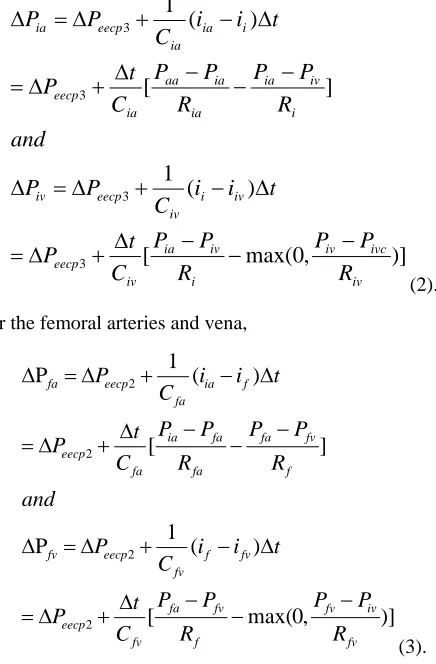
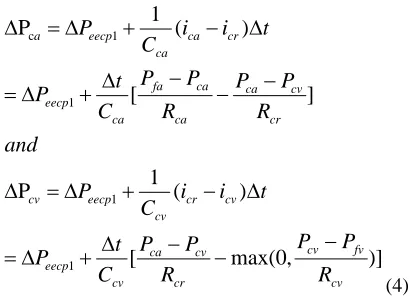
When the LLCP (expressed by Peecp) is performed in
AEI-CPR, Peecp acts as a direct pressure source. The
changed pressures of lower limbs are given by equation (2)-(4), as follows.
For the iliac arteries and vena,
)]
,
0
max(
[
)
(
1
]
[
)
(
1
3 3 3 3 iv ivc iv i iv a i iv eecp iv i iv eecp iv i iv ia ia ia aa ia eecp i ia ia eecp iaR
P
P
R
P
P
C
t
P
t
i
i
C
P
P
and
R
P
P
R
P
P
C
t
P
t
i
i
C
P
P
−
−
−
∆
+
∆
=
∆
−
+
∆
=
∆
−
−
−
∆
+
∆
=
∆
−
+
∆
=
∆
(2).For the femoral arteries and vena,
)] , 0 max( [ ) ( 1 P ] [ ) ( 1 P 2 2 2 2 fv iv fv f fv fa fv eecp fv f fv eecp fv f fv fa fa fa ia fa eecp f ia fa eecp fa R P P R P P C t P t i i C P and R P P R P P C t P t i i C P − − − ∆ + ∆ = ∆ − + ∆ = ∆ − − − ∆ + ∆ = ∆ − + ∆ = ∆ (3).
)] , 0 max( [ ) ( 1 P ] [ ) ( 1 P 1 1 1 1 c cv fv cv cr cv ca cv eecp cv cr cv eecp cv cr cv ca ca ca fa ca eecp cr ca ca eecp a R P P R P P C t P t i i C P and R P P R P P C t P t i i C P − − − ∆ + ∆ = ∆ − + ∆ = ∆ − − − ∆ + ∆ = ∆ − + ∆ = ∆ (4).
In the (2)-(4), the max() function is used to represent the action of venous valves in the iliac, femoral and crur-al veins that prevented retrograde flow.
Ⅲ. GENETIC ALGORITHM
Genetic Algorithms is a self-adaptive algorithm for global optimization searching, which coming into being by simulating evolution procedure of biology in the en-vironments [16]. Optimization process of GA imitates biological evolution. Biological evolution depends on chromosome selection, crossover and mutation. At first, some genes of parents P(t) would be changed or mutated with some probability to generate the next generation P(t+1). Secondly, according to individual fitness, se-lected individual would be the next parent. According to preferred rules, a higher adaptive genetic would sur-vive, through genetic and evolutionary constantly, to the next generation. Finally, a good individual X would reach or close to the optimal solution X*.
A. Control Parameters
External force for AEI-CPR includes eight parameters: frequency of compression, maximum strength of chest compression, maximum strength of chest de-compression, maximum pressure of LLCP, three se-quences of LLCP (leg, thigh and rump) and ratio of chest compress compared to LLCP. Applying GA to the es-tablished model, three optimum sequences of LLCP would be found when other parameters are definite. Set frequency of compress at 100/min, maximum strength of chest compression at 400Nt, maximum strength of chest de-compression at 160Nt, maximum pressure of LLCP at 300mmHg, and ratio of chest compress to LLCP at 1:1. The duty-cycle of chest compression compared to chest de-compression is 50%. Sine waveform is used to ex-press external force for AEI-CPR on the chest and lower limbs. Time sequence of LLCP influences the changed pressure of lower limbs directly, which are △Peecp1, △
Peecp2, △Peecp3.
B. Algorithm Description
The fitness of the organism for survival is the maxi-mum CPP in the diastole. CPP is an important indicator to evaluate the quality of CPR techniques, because it illustrates the blood flow perfuse into coronary artery to ensure the heart’s blood supply. The non-random
selec-tion is done to maximize diastolic CPP. Before per-forming GA on the established model, some constraints must be set. At first, set T=(t1, t2, t3) at optimized
se-quence, where is the time that EECP performs compres-sion on the leg, thigh and rump, respectively, in a CPR period. Secondly, according to compressing frequency which is 100/min, the range of t1, t2 and t3 is 0.1s ~ 0.45s.
Thirdly, it must be t1≤t2≤t3. Finally, set the objective
function at
) max(
)
(T CPPdiastolic
f = (5).
The steps of GA of the sequence are as follows: (1) According to constraints above, generate a random initial sequence T, and set counter n=1;
(2) Run the AEI-CPR model and compute f(T); (3) Randomly select three factors of T, and according to constraints to mutate them, and then get a mutant or modified sequence, T’;
(4) Run the AEI-CPR model and compute f(T’); (5) If f(T’) < f(T’), then set T=T’, n=1; otherwise, re-serve T, and n=n+1;
(6) If n>50, then stop optimizing and the optimal se-quence is T; otherwise, go to step 3.
That is, when a time sequence T is not displaced by other new time sequence T’ for 50 times, an optimal re-sult would be obtained.
Ⅳ. RESULTS
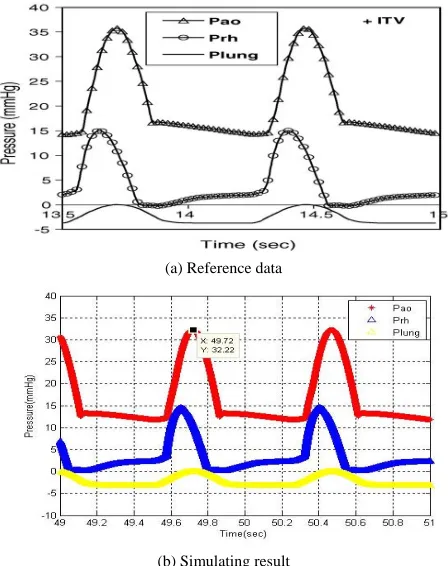
The blood circulatory system model has been estab-lished using MATLAB/Simulink. Its fixed-step size is 0.0001s, and the initial pressure of all organs’ compart-ments is 5mmHg. The simulation time is 70s. Fig. 4 shows that the simulating result is in accordance with the reference data. Fig. 4 (a) is the reference data, and Fig. 4 (b) is the simulating result. In the Fig. 4, Pao represents the pressure of thoracic aorta, Prh represents the right atrial pressure, and Plung represents the pressure in the lung.
Genetic algorithm is performed on the mathematical model, and 50 groups of result are obtained. TABLE III lists five groups of results which generates the best ef-fects of diastolic CPP.
In the TABLE III, the third sequence of LLCP generats the maximum diastolic CPP. Fig. 5 shows the experi-mental result when time sequence of LLCP is 0.2s, 0.25s, 0.30s on the leg, thigh and rump, respectively.
TABLE Ⅲ.
RESULTS OF GENETIC ALGORITHM
No. Time of leg
Time of thigh
Time of
rump CPP
1 0.384 0.391 0.393 50.49
2 0.487 0.493 0.492 45.17
3 0.200 0.250 0.300 50.99
4 0.486 0.490 0.494 45.20
(a) Reference data
(b) Simulating result
Fig. 4 Reference data and simulating results
Fig. 5 includes five charts. The first chart expresses external force waveform of AEI-CPR performed on the chest and lower limbs. The broad-brush waveform ex-presses the external force on the chest, which positive value is chest compression and negative value is chest decompression. Its unit is Newton (Nt). The other
three waveforms in the first charts are compression pressure on the leg, thigh and rump. Their units are mmHg. All external force waveforms are expressed by trapeziform waveform for in accordance with animal experiments and clinic. The second chart expresses the thoracic aortic pressure. The third chart expresses right atria pressure. The fourth chart expresses CPP, which is the difference of aortic pressure and right atria pressure. These three units are mmHg. The fifth chart expresses blood flow of aorta. Its unit is Liter (L). According to Fig. 5, diastolic CPP can be enhanced and arrive at maximum during middle of chest decompression. Moreover, when EECP starts compression on the crus at the end of chest decompression, the aortic blood flow can increase about 0.06L. It ensures that plenitudinous blood flow can be send to brain.
Ⅴ. CONCLUSION
The present results suggest that it might be better to begin with LLCP at the end of chest decompression, and the interval of time of LLCP is about 0.05s. These re-sults are in accordance with the parallel animal experi-ments and the data published before.
CPR is very important to a patient who endures car-diac arrest. Applying the mathematical model for CPR, several of experiments could be executed on the model repeated, and could guide clinical operations better.
ACKNOWLEDGEMENT
This paper was supported by projects National Natural Science Foundation of China (30670538).
REFERENCES
[1] S. Lenharta, V. Protopopescu, E. Jung, C. Babbs. Optimal Control for a Standard CPR Model. Nonlinear Analysis, 2005, vol. 63: pp1391-1397.
[2] M.W. Chang, P. Coffeen, K.G. Lurie, J. Shultz, R.J. Bache, C.W. White. Active Compression-Decompression CPR Improves Vital Organ Perfusion in a Dog Model of Ven-tricular Fibrillation. Chest, 1994, vol. 106: 1250-1259. [3] X.Y. Jin, Z.P. Zhang, D.H. Zhang, M.L. Wang, C.M.
Zhang. A Controlled Study of Interposed Abdominal Compression CPR and Standard CPR in Patients with Cardiac Arrest. Journal of Henan University (Medical Science), 2002, vol. 21, no. 4: pp.6-8. (in Chinese) [4] P. Plaisance, C. Soleil, K.G. Lurie, E. Vicaut, L. Ducros,
D. Payen. Use of an Inspiratory Impedance Threshold Device on a Facemask and Endotracheal Tube to Reduce Intrathoracic Pressures during the Decompression Phase of Active Compression-decompression Cardiopulmonary Resuscitation. Crit Care Med, 2005, vol. 33, no. 5: pp.990-994.
[5] H.X. Yuan, Z.S. Zheng, S.S. Jiang, H.F. Zhong, X.X. Liao, Z.M. Du, et al, The Hemodynamic Study of the Chest Compression Assisted with Enhanced External Coun-ter-pulsation, Emergency Medicine, 1995, vol. 4, no. 3: pp.140-144. (in Chinese)
[6] K.G. Lurie, K.A. Mulligan, S. McKnite, B. Detloff, P. Lindstrom, K.H. Lindner. Optimizing Standard Cardi-opulmonary Resuscitation with an Inspiratory Impedance Threshold Valve. Chest, 1998, vol. 113: pp.1084-1090. [7] D. Yannopoulos, H.R. Halperin, J. Hopkins, K. G Lurie.
Abstract 2230: Lower Extremity Counterpulsation Dur-ing the Decompression Phase of CPR Improves Hemo-dynamics and Provides Continuous Forward Carotid Blood Flow. Circulation, 2007, vol. 116: pp.II_485. [8] J.J. Shultz, P. Coffeen, M. Sweeney, B. Detloff, C. Kehler,
E. Pineda, et al. Evaluation of Standard and Active
Com-pression-Decompression CPR in an Acute Human Model of Ventricular Fibrillation. Circulation, 1994, vol. 89: pp.684-693.
[9] X.M. Wu, Y.R. Zhang, L. Xu, H.X. Yuan. The Computer Model in View of Hemodynamic Effects of Electro Venti-lation Double Pump CPR. APCMBE 2008, pp. 562-566. [10] C. F. Babbs. Relative Effectiveness of Interposed
Abdo-minal Compression CPR: Sensitivity Analysis and Rec-ommended Compression Rates. Resuscitation, 2005, vol. 66, pp.347-355.
[11] C.F. Babbs. Design of Near-Optimal Waveforms for Chest and Abdominal Compression and Decompression in CPR Using Computer-Simulated Evolution. Resuscitation, 2006, vol. 68, pp.277-293.
[12] E. Jung, S. Lenhart, V. Protopopescu, C.F. Babbs. Optim-al Control Theory Applied to a Difference Equation Mod-el for Cardiopulmonary Resuscitation. Mathematical Models and Methods in Applied Sciences, 2005, vol. 15, no. 10: pp.1519-1531.
[13] C.F. Babbs. Effects of an Impedance Threshold Valve upon Hemodynamics in Standard CPR: Studies in a Re-fined Computational Model. Resuscitation, 2005, vol. 66: pp. 335-345.
[14] X.X. Zheng, P.Z. Dai, J. Bai, and H.T. Ren. Physiological System Simulating and Modeling, Beijing Institute of Technology Press, Beijing, 2003. (in Chinese)
[15] Y.R. Zhang, L. Xu, X.M. Wu, HX Yuan. The Hemody-namic Effects Analysis of the New CPR Tech-nique-Electro Ventilation Double Pump CPR: Studies in the Computer Model. The 2nd International Conference on Bioinformatics and Biomedical Engineering, Shanghai, China, ICBBE 2008: pp. 1761-1764.
[16] M. Zhou, S.D. Sun. Genetic Algorithm: theory and ap-plication,Guofang Industry Press, Beijing, 1999.