A Survey on Movement Detection based on
Various Methods
R. Sindhiya B. Buvaneswari
PG Student Assistant Professor
Department of Computer Science & Engineering Department of Computer Science & Engineering KLN College of Engineering KLN College of Engineering
Abstract
Movement detection is a technology for detecting change in the surroundings relative to an object, Security systems which are being used now a days are not smart enough to provide real time notification after sensing the problem. To overcome this problem sensor based application can be used to view the activity and get notifications when the movement is detected, it saves the time and cost. This paper surveys various currently available techniques for movement detection based on different previously proposed system for motion detection.
Keywords: Behaviour understanding, Motion detection, Provide security, Alert notification
________________________________________________________________________________________________________
I. INTRODUCTION
Motion detection is a process of detecting a change in various objects relative to its surroundings, Using electrical and mechanical techniques there are many method to obtain motion detection, Motion detection has become a central topic of discussion in field of computer vision because of its extensive variety of uses like monitoring of security at airport, video surveillance, law enforcement, video compression, automatic target identification, marine surveillance and human activity recognition. Here we evaluate some popular motion detection methods and their features required for the purpose of motion detection.
II. RELATED WORK
Study of Motion Detection Method for Smart Home System
In this paper, we propose a system as a part of smart home security, here, interested to build CCTV camera with their own feedback system which sense the motion by themself to alert using alarm. This system also use in such area where the suspicious motions are occurs. The system captures images only when the motions exceed a certain threshold that is present in the system. It thus reduces the volume of data that needs to be reviewed and it is the more convenient way of monitoring the environment, especially with the increasing demand for multi-camera. Also, it helps to save data space by not capturing static images which do not contain the object of interest.
Methodology used in this approach (1) GM filter
There are many smoothing filter are used for remove the noise in the image. Generally, there are seven basic filter are mainly used which are convolution filter, Gaussian filter, first derivative GF, second derivative GF etc. Here we used a Gaussian filter; Gaussian filter removes high frequency components in the image. In 2D GM filter can derive as,
G(x, y) = e x2+y2
2σ2
Where, G is the operand, x and y are two axes value, and σ constant variable, larger the value of σ removes more details. In our application more detail is not essential. By using this filter we remove noise and more data, which also save the storage space.
(2) 2D Correlation Coefficient Method
This method used for check the similarity between two images. This method works pixel based comparison. The value of coefficient is between (0 1). If the coefficient value is 0 its show both images are different in the each pixel value at same location. If the coefficient value is 1 then its show both the images are same in each pixel value at same location. Then the formula used for the 2D correlation coefficient is shown below,
r= ∑m∑ (An mn−A̅)(Bmn−B)̅̅̅ √(∑m∑ (An mn−A̅)2)(∑m∑ (Bn mn−B̅)2)
Smartphone Enabled Intelligent Surveillance System
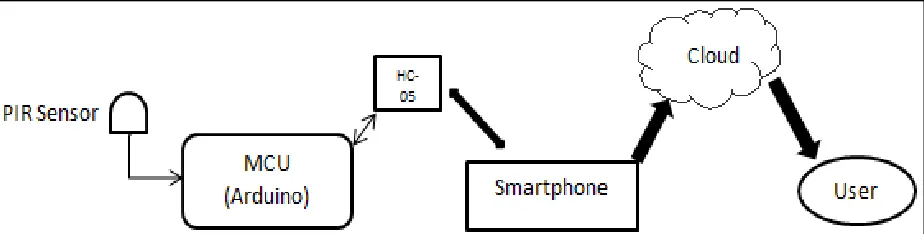
Surveillance plays a major role in our day-to-day life. In this paper, we propose a design for surveillance using smart phone along with the microcontroller unit (MCU) and the passive infrared (PIR) sensor. To detect the motion PIR sensor is attached to the smartphone through the MCU. The video is captured only when the motion is detected and the short message services (sms) alert is also sent to the user in the straight away.
Methodologies used in this approach (1) Sensor Input Locking Method
PIR motion sensor senses the change in Infra-red radiation in its vicinity. The input pin of PIR is HIGH on motion detection and it changes to LOW when the motion subsides. A continuous stream of HIGH value is sent to the MCU when there is a motion and a continuous stream of LOW value is sent to the MCU when the motion is stopped. To get an exact time slot of the motion a simple input locking mechanism is implemented using a lock variable. If motion is detected the output state of the sensor changes from LOW to HIGH and the lock variable is made TRUE. When the motion subsides the state changes from HIGH to LOW and the lock variable is changed to FALSE. The slot can be determined as the time the lock variables became FALSE from TRUE to TRUE from FALSE.
Fig shows the graph of the detected timeslot using the lock variable. The lock variable helps in starting and stopping of recording. The smartphone captures the video when “MOTIONSTARTS” command is received from the MCU and stops recording on receiving “MOTIONEND” command from the MCU. Along with the recording the smartphone simultaneously take necessary steps to notify the user. So it is very important to get the exact time slot. The MCU sends “MOTIONSTARTS” command when the lock variable changes to TRUE from FALSE and sends “MOTIONEND” command when lock changes to FALSE from TRUE. The locking mechanism helps to get the exact time slot of the motion.
(2) Architecture of the proposed system
The PIR sensor senses the movement in its vicinity and activates the MCU. The MCU sends notification to the smartphone through the Bluetooth module. When motion is detected by the PIR, the smartphone starts recording it and upload the same in cloud when the motion ends. The link of the uploaded video is sent to user through email.
Development of IoT based Smart Security and Monitoring Devices for Agriculture
Agriculture is being the backbone of the Indian economy deserves security. Security not in terms of resources only but also the agricultural products needs security and the protection at very initial stage, like protection from attacks of rodents or insects, in fields or grain stores. To overcome this issue we design an iot based device, through this we are analyzing the sensed information and transmitting it to the user. we are able to control and monitor the developed device from remote location, it is mostly implemented in agricultural fields, to solve the problem like identification of rodents and it delivering a real time notification based on the analysis and processing without human intervention.
Problems justification
1) Researchers have been developing various IOT based security devices but a little work is done in agricultural area. 2) Agricultural products such as rice, corn etc., are affected by the rodents. These rodent impacts are also associated with
the debilitating rodent borne diseases
4) In Asian and Pacific countries death rate due to rodent borne diseases is higher in comparison with some illness such as HIV-AIDS.
5) Comparison Between HIV-AIDS And Leptospirosis Based On Deaths And Cases Found.
DISEASE 2008 Jan-Oct 2009
Cases Deaths Cases Deaths
HIV-AIDS 528 4 629 1
Leptospirosis 832 41 2777 161
Device architecture
Device uses 3 interfaces for data collection, analysis and transmission. IoT architecture is categorized in 3 level architecture and five level architecture. Figure shows the working phenomena of device based upon 3 level architecture.
These layers, categorised as
Perception layer: Layer which is used to differentiate the different type of sensors used in device. Network layer: Layer used for process and transmit the information over network.
Application layer: This layer is responsible for various practical application based on users’ need.
Extra key level mentioned between application layer and network layer is known as middle-ware layer which consists of data analyzing system to take automated actions based upon information. This layer provides dedicated services among connected devices.
Data analysis
After installing and activating the device, scripts which was written in python language is used to identify motion of rodents using heat sensor which provides discrete values. Considering these discrete values as flag signal, URD sensor was activated to calculate the distance of rodent and simultaneously webcam daemon is activated to capture a snap of area.
Conclusion
A survey of several approaches used for movement detection is presented and each approach has been discussed in detail. Thus this work provides required information on movement detection.
An Indoor Location-Aware System for an IoT-Based Smart Museum
In this paper, we design and validate an indoor location-aware architecture are able to enhance the user experience in a museum. In particular, this system relies on the wearable device that combines image recognition and the localization capabilities to automatically provide the users with the cultural contents related to the observed artworks. These type of localization information is obtained by the Bluetooth low energy (BLE) infrastructure installed in the museum. Finally, several location-aware services, running in the system, control the environment status also according to users’ movements.
Methodologies used in this approach
This paper enables wearable devices, interacting with an IoT-based smart environment,to act as museum guides, providing a real interactive cultural experience.
(1) Bluetooth low energy
The service running on the processing center that receives the location of the user and provides it to the other services. More specifically, the network of wireless landmarks consists of some embedded devices equipped with BLE interface and placed individually in the different rooms of the building. The choice of BLE is mainly due to its low energy consumption in front of a communication range comparable with that of the traditional Bluetooth. In this way, the wireless landmarks can be battery powered, making the localization mechanism more flexible and less invasive. Each device of the BLE infrastructure sends its location identification (ID) together with the transmission(TX) power value. The service running on the user’s wearable device collects location data from all the landmarks within its listening range and then determines the room in which it is located. (2) The RANSAC algorithm
Temporal and spatial reasoning to obtain a robust detection.
It continuously tracks the user by leveraging a Bluetooth low energy (BLE) infrastructure.
And it recognizes the artwork in front of the user through both its processing capabilities and localization information.
III. RESULT
Proposed method is based on two different thresholding steps, the results concerning detection and recognition are shown separately.
θS is responsible to filter bad matches. In fact, setting it to a low value yields a high precision, but achieves very low recall and low accuracy, these leads to discarding most of the correct matches. On the other hand, if its value is too high, it cannot filter bad matches and therefore the overall accuracy decreases .
θD controls the detection performance: increasing its value the precision improves but, at some point, recall sharply drops (θD > 0.1). This is due to the fact that the method starts discarding too many frames.
IV. LIMITATIONS
It suffer from potential maintenance issues caused by hardware damages due to intensive use.
V. CONCLUSION
In this survey,we presented the different method for motion detection. During this survey we identified the major issues which decreases the accuracy of the result. Many works can be done to solve these issues and it provides better result related to conventional approaches, but need more computational time and need additional algorithm to deal with complex environment.
REFERENCES
[1] Stefano Alletto, Rita Cucchiara, Giuseppe Del Fiore, Luca Mainetti, Vincenzo Mighali, Luigi Patrono, and Giuseppe Serra, ‘‘An Indoor Location-Aware System for an IoT- Based Smart Museum”, IEEE INTERNET OF THINGS JOURNAL, VOLUME. 3, NO. 2, APRIL 2016.
[2] A.H.Sanoob, J.Roselin and P.Latha, “Smartphone Enabled Intelligent Surveillance System”, IEEE Sensors Journal, Vol. 16, No. 5, pp. 1361-1367, March 2016.
[3] Baranwal, Nitika,Pushpendra Kumar Pateriya, ‘‘ Development of IOT based Smart Security and Monitoring Devices for Agriculture”,2016 6th International Conference -Cloud System and Big Data Engineering , 978-1-4673-8203- 8/16/IEEE 2016.
[4] Mayur J. Charadva, Ramesh V. Sejpal, Dr. Nisha P. Sarwade, ‘‘A Study of Motion Detection Method for Smart Home System”, International Journal of Innovative Research in Advanced Engineering (IJIRAE), Volume 1, Issue 5, June 2014.
[5] ProsantaGope and TzonelihHwang., ‘‘BSN-Care: A Secure IoT-Based Modern HealthcareSystem Using Body Sensor Network”, IEEE Sensors Journal,Volume16,No.5,March2016.
[6] Juan Liao, Rong Dong, Bo Li, and Qimei Chen, ‘‘A Non-Parametric Motion Model for Foreground Detection in Camera Jitter Scenes”, IEEE Signal Processing Letters, Volume.21, No.6, June 2014.
[7] Daqiang Zhang, Laurence Tianruo Yang, Min Chen, Shengjie Zhao,MinyiGuo and Yin Zhang, ‘‘Real-Time Locating Systems Using Active RFID for Internet of Things”, IEEE Systems Journal, Volume.10, No. 3, September 2016.
[8] PauloCarreira,SílviaResendes,AndréC.Santos,‘‘Towards automatic conflict detection in home and building automation systems”,pervasive and mobile computing,Volume.12,Pages.37–57,June2014.
[9] RuiCamacho,PauloCarreira,InesLynce, Silvia Resendes, ‘‘An ontology-based approach to conflict resolution in Home and Building Automation Systems”, Expert Systems with Applications, Volume.41,no.14, Pages 6161–6173,October2014.
[10] SungwookKim,‘‘Cognitive hierarchy thinking based behavioral game model for IoT power control algorithm”, Computer Networks,Volume.110,Pages 79–90,December 2016.