Insight of Value-oriented Human Relationship
Benjamin Penyang Liao
Department of Information Management, Overseas Chinese University, No: 100, Chiao Kwang Rd., Taichung 407, Taiwan, R.O.C.
Email: [email protected]
Abstract-- Human relationship is important for everyone. The relationship connection is generally constructed by the value production. The insight of value system is firstly described with the discussions of value definition, framework of value system, value evaluation with positive and negative measures, and value characteristics. Then a framework of value-oriented human relationship is analyzed with the emphasis of the two value lines discussions. Finally, the insight of human relationship influence spectrum is discussed. The influence spectrum includes seven phases, which are uninfluenced phase, solvability phase, affect phase, confirmation phase, registration phase, exaggeration phase, and extreme phase.
Index Terms-- value system, value measures, value-oriented human relationship framework, human relationship influence spectrum
I. INTRODUCTION
We all live in societies and build some relationships with society members. These relationships will affect each society member's life everyday in many circumstances including working and living cases. In working case, customer relationship management (CRM) for example is an important task for an organization to continuously attaining benefit from customers by maintaining health relationships with their customers. In living case, marriage relationship management, for example, is an important task for couples to persistently obtaine loves and something else from each other by maintaining robust relationships between each other. We all know personal interrelationship is very important. Analyzing human relationships from value perspective is a good way to intrinsically digging out the coherent relationship components and features. In this paper, value-orientation is the intrinsic basis for inspecting the insight of human relationships.
The term of value in current time seems to get into ambiguous usage and interpretation in current days for most of people. Value, most of time, implies the price. For example, that apple 's value is worthing $2, which is considered in cost perspective from seller's viewpoint. However, the insight of value should contains more meanings. A value should be considered both from buyer viewpoints and seller viewpoints, especially for the buyer's viewpoints. For example, the apple's buyer can
Manuscript received June 10, 2010; revised August 28, 2010.
Project number:NSC 98-2410-H-240-002.
eat the bought apple to satisfy some buyer's needs, such as, hungry. In fact, needs satisfaction is the kernel of the term of value. In order to reveal the insight of human relationship from value perspective, this paper first inspects the insight of value system.
In most of time, an individual has to obtain something from outside to satisfy his/her needs. In such, in most cases, the exchange or transaction is invoked. When an exchange is occurred, at least two participants involve to interact with each other. In the simplest case, a buyer and a seller come together to take the exchange. The basic reason which causes the exchange is that each participant can get values from this exchange. That is, each participant tries to satisfy each one's needs from this exchange. Therefore, obtaining values from exchange is the kernel of exchange for each participants. In addition, it is obvious that there are two value lines to be produced, where each value line is operated exclusively for each participant. In order to get values from each exchange participant, a connection line has to be constructed, which will finally construct a relationship between participants. In addition, managing the relationship can in fact be considered maintaining these two value lines. This means that maintaining these two value lines are the kernel of human relationships. Therefore, the insight of human relationships from the value line perspective will be emphasized.
When the human relationship is going on progress, the relationship intensity will be changed. Different relationship intensity will affect the will and way to exchange for both two participants. Systematically to analyze the relationship intensity shown by a human relationship influence spectrum then is necessary. Anyone can apply this spectrum to realize the relationship with the others. In order to see the insight of human relationship, the analysis of the relationship influence spectrum is important. Therefore, This paper then inspects the human relationship influence spectrum with some new complements.
Remaining sections are arranged as follows. Section II discusses the insight of value system. Section III creates the models of humans relationship with the emphasis of value line concept. Section IV analyzes the insight of human relationship influence spectrum. Finally, Section V gives some concluding remarks.
II. ISIGHT OF VALUE SYSTEM
general value system framework is analyzed. After that, value evaluation for positive value and negative value is discussed. Finally, value characteristics are discussed.
A. Value definition
Axiology is a field of study for value in academy and can be divided into three perspectives: subjective, objective, and gestalt perspectives. No matter which perspective, subject (people) and object are discussed implicitly or explicitly.
From subjective perspective, the value is the worth attached to an object judged by a person when s/he evaluates the object as pleasure, desired or interested. Values are not some kinds of quality that exist inside the object, but are determined by the subject’s valuation on the object.
From objective perspective, the value represents the criterion to make the valuation. Values are independent of the subject or even the object. The subjectivists claimed that, if values exist outside the domain of our valuation, how can we know the existence of such kind of values? However, the objectivists argued that we must distinguish between valuation and value. The key point is that value is prior to valuation. If there were no values, what would people evaluate [2]? That is, it is meaningful only when there is something (value) that can be found when someone is searching for or evaluating for.
As a gestaltist, Frondizi [2] pointed out that the psychological experience of pleasure, desire, and interested is the necessary condition but not the sufficient condition for values. On the other hand, that the psychological experience does not exclude the objective aspects of values, but instead confirming their existence. Therefore, values have both objective and subjective aspects; they reside in the relationship between the subject of valuation and the object of values, and do not exist apart from them. Therefore, the value is gestalt, which is not only the combination of each component, but it also the uniqueness of the totality composed from these separated parts.
Chen and Chen [1] then defined the value with a similar gestalt perspective as follows.
A value is of that a behaving subjective entity attains the subjective confirmation of needs satisfaction by the interaction with objective entities.
In such, there are four key value factors which are subject needs, subject intention, object competence, and subject satisfaction. That is, a subject should arouse her/his needs and intend to be satisfied by capable objects with results of subject satisfaction.
B. Value system
There are many value classifications from many perspectives and can be found in [3][6]. Liao [4][5] proposed a framework of value system based on above value definition, as shown in Fig. 1. A value system comprises three components which are subject, object, and values. The subject component contains needs and valuation measures. The object component contains its attributes, where each attribute value represents the
object's competence that can potentially satisfy some subject needs. The value component is the results of match or interactions between subject needs and object competences.
The subject needs are categorized into physical needs, spiritual needs, and resources needs. The physical needs include sensory needs such as needs of eye, ear, nose, tongue and skin (or body), and safety needs which represent the needs without suffering hurts for physical body. The spiritual needs include affection needs, knowledge needs, and completeness needs. The affection needs represent, for example, the needs for attaining good emotion and belongingness. Pleasure and happiness are two instances of affection needs. Love need is an example of belongingness. The knowledge needs represent the needs for satisfying curiosity and knowing facts or rules that can be applied to solve some problems. The completeness needs represent the needs to attain the wholly states for her/him-self. The resources needs include the needs of tangible resources such as human, material and financial resources, and the needs of intangible resources such as time, brand equity, human relationships, and so on. The resources initially represent the role of object, which can satisfy subject needs. The resources needs imply that a subject can store these resources into warehouse for conveniently satisfying subject needs in the future.
Figure 1. A framework of value system [4][5].
The object competences are classified into static attributes and dynamic (or behavior/ operation) attributes. The static attributes include relation attributes and fundamental attributes. The relation attributes basically depict the relations for external objects and internal components, which further include dependency, generalization, association, and realization attributes. The
Subject
Subject Type . An object inherently
---Needs . Physical Needs .. Sensory Needs .. Safety Needs . Spiritual Needs .. Affection Needs .. Knowledge Needs .. Completeness Needs . Resources Needs .. Tangible .. Intangible
---Satisfaction Measures . Effectiveness
. Efficiency
Object
Object Type . Singular Object .. Natural Object .. Artificial Object . Compound Object .. Natural .. Artificial
---Competency . Static Attributes .. Relation Attributes .. Basic Attributes . Dynamic Attributes .. Behavior Attributes
association attributes can further be classified into composition and aggregation association attributes. The basic attributes show the object’s unique characteristics and are not the characteristics of relation attributes. For example, flying attribute is an airplane’s basic attribute which is synthesized by many parts, such as engine, wings, and so on. However, each part can not fly itself. The dynamic attributes show the object’s behaving characteristics.
Finally, all object attributes can potentially satisfy some subject needs. The values are produced by the match or interactions between subject needs and object competency. In addition, the values are classified into physical values, spiritual values, and instrumental values. Therefore, the match of physical needs and object competency results in physical needs, and the match of the spiritual needs and object competency results in spiritual needs. However, the instrumental value results from the instrumental role of objects applied by subjects. An instrument means that it can be applied to find terminal objects or other instrumental objects for subject. For example, a fishing net is an instrument which can help a subject to catch a fish (terminal object) to satisfy a subject’s physical needs.
C. Value structure
To analyze a value, we also can analyze its structure and characteristics. Here the value structure is discussed first.
A value structure includes its constructed components and the relationships among the components. The value components include subject need and capable object. The relationships among the value components include component connection and interactions between the components.
For component connection, there are one connection between the subject and the object. In this connection, the subject plays the need role which some needs are intended to be satisfied, or from the other viewpoint, the demand role that the subject demands something (ie., objects) to satisfy the needs. On the other side, the object plays the function role that it is capable to satisfy the subject's need.
For interactions between the components, the subject applies or uses the object to satisfy the subject's need by filling the need attributes until reaching the balance state. The object can help the subject to recover the balance state. Generally, the subject is actively to invoke the interactions to the object. In addition, the way of applying object may be confined by the object's features such as the usage guidelines set up by the manufacture, or followed by the subject's preferences.
D. Value characteristics
Value characteristics show the other states, viewpoints, and derived descriptions that the value structure does not address. The value characteristics are then discussed as follows.
1. Gestalt. Gestalt means that the discussed target is composed by its components and can not be described only from any component's viewpoint.
That is, the discussed target should be described by considering all its components in the same time. Discarding any component will destroy the discussed target. In such, a value is consists of its components, which are both the subject need and object capability. There is no value occurred while lacking one of the value components. 2. Subject's intention of need satisfaction. If a
subject does not have the intention to satisfy its needs, no values will produced.
3. Object replaceability. The object currently been applied by the subject can be replaced by any other object that is capable to satisfy the subject need.
4. Need variety. This means that a subject has many needs.
5. Need dynamic. This means that the objective of need is always changing. The objective of need can be considered as the balance state of some attributes. A need means that some attributes are under unbalance state and the subject intends to recover from the unbalance state. However, the balance state of an attribute sometimes is defined by the subject with preference. The subject preference may be changed affected by some factors. In such, the balance state of an attribute may be changed under some circumstances. 6. Need grouping. Need grouping means that some
subject's attributes are related and then grouped. In addition, the related attributes will affect each other under some ways. Therefore, it is possible that to invoke an attribute's unbalance state will also cause the unbalance state of the other related attributes.
E. Value evaluation
Values are produced by the match of subject needs and object competency. There are two types of measures for valuation: effectiveness measures and efficiency measures. The effectiveness measures show the degree of subject needs satisfaction by object competency, which include sub-measures of value depth, value width, and value quality. The value depth measure can be implemented by absolute values and relative values, eg., ratios. The value width measure includes its sub-measure of individual value width with multiple needs satisfaction, and sub-measure of group value width which many individuals can be satisfied by a single object competency. The value quality measure includes its sub-measures of consistency and longevity (or duration).
measures.
In general, the value is a positive term for most people , since that it shows an object can satisfy some subject needs. However, in some cases, when a subject tries to acquire and apply an object to satisfy its own needs, it might not obtain positive results but negative ones. The negative results can mean that a subject has paid some cost to acquire and apply an object but it still can not satisfy one's own needs and even hurt oneself. The negative result can be regarded as a loss or a negative value for subjects. The papers in [4][5] did not consider the situation of negative value. Therefore, this paper complements this negative value concept to the original contents of value system.
If we regard the value as a variable, it might contain positive contents and negative contents. In positive value perspective, as the same as the propositions of previous papers, there are three positive value types, which are positive physical value, positive spiritual value and positive instrumental value. On the other hand, there is the corollary of three negative value types, which are negative physical value, negative spiritual value, and negative instrumental value. The negative physical value therefore implies the suffering of physical loss. The negative spiritual value then implies the suffering of spiritual pain or discomfort. The negative instrumental value here means that the object can not play well the role of instrument to help the subject to find out suitable terminal objects. This object may even hinder a subject to find out the suitable terminal object.
In sum, the term of value generally contains the types of positive value and negative value, although most people regard the term of value as the type of positive value.
In such, the value measures can be divided into positive value measures and negative value measures by dimensions of performance type and value sign type. This can be shown in TABLE I. The performance type can be effectiveness or efficiency with the contents as described above. The value sign type can be positive or negative. Therefore, there are four types of value measures, which are positive value effectiveness measures, positive value efficiency measures, negative value effectiveness measures, and negative value efficiency measures.
TABLE I. VALUE MEASURES
Value Sign Type Positive Value Negative Value Performance
Type
Effectiveness Positive value effectiveness measures
Negative value effectiveness measures Efficiency Positive value
efficiency measures
Negative value efficiency measures
Generally, a subject gets terminal object by interchanging resources with the other subject. That is, each subject contains some resources (objects) for that can satisfy each other subject needs. Therefore, in the
process of value generation, exchange process creates a connected relationship between exchangers. In the meanwhile, value generation has to be considered when discussing the subject relationships.
III. MODELING HUMAN RELATIONSHIP
A. Definition of human relationship
Basically, a relation can be defined as a connection between entities, such as people. However, this definition is too general to depict its contents. There are some features of this connected relation. Connection influence is the key point to describe the relation connection in this paper. Therefore, this paper defines a human relationship as follows.
A human relationship is a reciprocal influence connection between two connected human entities.
In such, there are some features of human relationship. 1. Connectivity. There are two human entities
connected by some ways and may be under different circumstances. Without this connection, there is no human relationship created.
2. Interaction. When two human entities are connected each other, this connection line just like a road which can transmit something from one side to the other side. That is , this connection line provides an interaction or exchange channel. Reversely, each entity intends to interact each other and in such that creates this connection line.
3. Influence. Each connection line will help entities interact each other. Each interact will cause some changes of each entity. For example, each entity will both pay something in order to get the other things from the other exchangers. This exchange then will result in an influence between these exchangers.
4. Dynamic. The relationship can be changed. That is, this connection line can be cut off. Conversely, this connection line may be promoted. Therefore, the relationship influence can also be promoted.
In order to get more understanding of relationship, there are some important relationship attributes should be analyzed, which are connection hook, constructed material, and intensity.
There are two connection hooks in an connection line. Each connection hook link to an entity. The major constructed material of a relation connection line is value. The intensity can be measured from dimensions of thickness, flexibility, and loyalty.
B. Framework of value-oriented human relationship
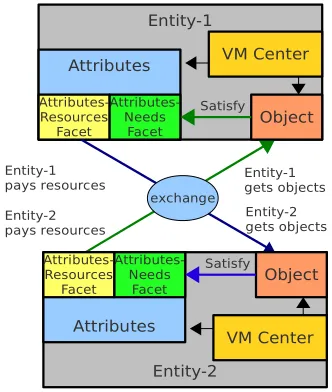
exchange their own resources each other in order to satisfy each one's needs. Fig. 2 shows a framework of value-oriented human relationship.
Figure 2. A framework of value-oriented human relationship.
Each human entity contains many attributes. Each entity can be described by two different perspectives, which are subject perspective and object perspective. That is, each entity can concurrently play two roles, which are the subject role and the object role under the same entity attributes. When an entity is analyzed from subject perspective, the discussion focus is on the subject need and all entity's attributes are regarded as the needs attributes. When an entity is analyzed from object perspective, the discussion focus is on the object competence and all entity's attributes are regarded as the resources attributes. An exchange will only occur when each exchanger has some needs intending to be satisfied from acquiring the objects owned by the other exchanger. Therefore, if an entity does not intend to satisfy its needs, the exchange will not occur. As described in the definition of human relationship, the exchange will produce influence for each participants. The features of connection influence in fact can show the types and intensity of human relationship.
Figure 3. Insight of the framework of value-oriented human relationship.
A relation connection line in fact contains two sub-connection lines. Each sub-sub-connection line can be viewed
from the entity's need facet. That is, how an entity's needs are satisfied by the other entity's resources. Since there are two entities, it then creates two value lines, as the two crossed lines between two entities in Fig. 3. Each value line can show a need-satisfying process. Fig. 3 also points out there is a VM Center which is a value management center. Fig. 4 shows the contents of the VM center. A VM center will search targets and coordinate with the target's holder and then decide whether to exchange with the target's holder. If the decision is willing to have an exchange, then it goes to the attain and pay stages. After attaining the targets, an entity can make the rebalance for needs. After that, evaluation for this whole process will be analyzed and reviewed. The evaluation results will affect the relationship intensity between the entity and the target holders.
A VM center will manage the targets. First the VM center will determine whether some resources play the role of objects. After that, the VM center applies the objects to satisfy entity's needs. After that, a VM center will evaluate the object's performance.
Figure 4. An entity's value management center.
IV. INSIGHT OF HUMAN RELATIONSHIP INFLUENCE SPECTRUM
A. Human relationship influence spectrum
A relationship connection line is mainly constructed by values in an accumulated way. The essential value types are physical values and spiritual values. Physical values are those that physical needs are satisfied. Spiritual values are those that spiritual needs are satisfied. The value content in fact implies the allowed transmitting stuff in a connection line. These constructing material of value for relationship will affect a connection's thickness, fragility, growth rate, etc. This construction features of human relationship can give us more pictures of human relations. However, it still neglects some insights of human relationships. What we want to know is the connection influence. That is, a relation connection just likes a communication channel which can cause some exchanges between the connected participants. Each exchange will cause some changes and this means that this connection line can influence these exchanging activities.
As analyzed above, the obtaining value is the essential constructing material of relation connection. Logically, more value obtaining will cause more relation influence
Entity-1
Attributes
Attributes-Needs
Facet Attributes-Resources
Facet
Entity-1
pays resources Entity-1gets objects exchange
Object
Satisfy
Entity-2 pays resources
Entity-2 gets objects
VM Center
Entity-2 Attributes
Attributes-Needs
Facet Attributes-Resources
Facet Object
Satisfy
VM Center
Entity
Targets
VM(Value Management) Center
Needs
Resources Objects
Search, Coordinate,
Decide Attain Pay Rebalance Evaluate
Performance
Satisfy
Role
Determine Evaluate
Manage Entity-1
Exchange with Influence
Needs of Entity-1
Resources of Entity-1 Attributes of
Entity-1
Entity-2
Needs of Entity-2
Resources of Entity-2 Attributes of
and less value attaining will cause less relation influence. But this still can not depict a clear picture of influence degree.
Generally, a human is a compound entity of physical body and spiritual soul. And most of us believe that the soul dominates the physical body even though the soul are often affected by the physical body with continuously changing states. Since the spiritual soul is the master of physical body, we can inference that when a value is more related to soul satisfaction, it will cause more influence to the entity. Therefore, the influence of spiritual values is bigger than the influence of physical values.
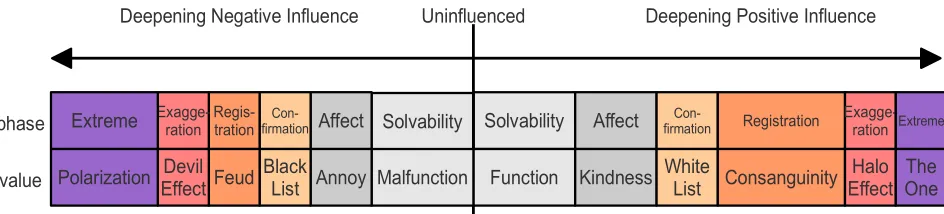
In addition, there are many spiritual features or needs attributes with different layers, such as Maslow's needs hierarchy, which are physical layer, security layer, belongingness layer, esteem layer, and self achievement layer. This means that a need satisfaction can be analyzed by the degree or process of relation carving. Therefore, the influence degrees can be described by seven influence phases. This seven influence phases or degrees are the uninfluenced phase, solvability phase, affect phase, confirmation phase, registration phase, exaggeration phase, and extreme phase, as shown in Fig. 5. Since the
influence direction can be positive and negative, the above phases can simultaneously be applied to these influence direction. This results in a human relationship influence spectrum, as shown in Fig. 6. Each influence phase with the influence spectrum is discussed as follows.
1. Uninfluenced phase. In this phase, there is no any exchange occurred between entities. Therefore, there is no any influence between entities.
2. Solvability phase. In this phase, each entity has some problems to be solved. That is, each entity wants some needs to be satisfied or recovered from unbalanced state. In this phase, each entity has little understanding of other entity. Therefore, the focus is only on specific physical resources and the focus scope is narrow. Therefore, the main interchange is of physical material exchange. In this phase, each entity does not put or project their emotion to the other entity. Sometimes, we can regard the human relationship in this phase is functional. That is, the considering focus is whether this relationship is of function or of malfunction.
Figure 5. Seven general deepening phases of human relationship influence intensity
Figure 6. Human relationship influence spectrum.
3. Affect phase. In this phase, some feelings are exchanged. Each entity recognizes the other guy's gentleness or rudeness in the process of major needs satisfaction. But this feeling of gentleness or rudeness is only surface. This feeling is likely to be emotional or temporal. That is, in this affect phase, each entity only obtained shallow kindness or annoy.
4. Confirmation phase. In this phase, each entity writes down the other entity's name on her/his
white list or black list. For the entity in the black or white list, an entity would like to pay more energy to deal with the relationship with the other one. In this time, each entity will frequently and autonomously scan the other guy's current information and take some responses by then. Enrolling a guy on a white list or black list depends on confirmed benefits or harms for each other. However, in this phase, the affect intensity is still shallow but is stronger Uninfluenced (Function vs.Solvability
Malfunction)
Affect (Kindness vs.
Annoy)
Confirmation (White List vs.
Black List)
Registration (Consanguinity
vs. Feud)
Exaggeration (Halo Effect vs.
Devil Effect)
Extreme (The One vs.
Polarization) Deepening Influence
Surface Influence
Uninfluenced Carving Influence
Solvability Uninfluenced
Affect firmationCon- Registration Exagge-ration Extreme
Solvability Affect
Con-firmation
Regis-tration
Exagge-ration
Extreme
Deepening Negative Influence Deepening Positive Influence
Function Kindness WhiteList Consanguinity EffectHalo OneThe Malfunction
Annoy Black
List Feud Devil Effect Polarization phase
then that in affect phase.
5. Registration phase. In this phase, the affect intensity is increased for the entities on the white list and black list. Registration means that some specific guys on the list are deliberately picked out. From value perspective, this means that this relationship will cause significant benefits or harms each other. Under this big significance perception, the registered guys will be written on a VIP list or criminal wanted list. This will produce the relationships which are similar to consanguinity or feud. In the consanguinity relationship, connected entities are family members, just like each member has the kinship or with blood-relations. On the other hand, in the feud relationship, connected entities are inherited enemies. In this case, each entity's emotion will easily be invoked or provoked. Therefore, responses will be quickly emitted. In this feud case, each connected entity will trap into the prejudice fighting with quick and strong responding for each other.
6. Exaggeration phase. In this phase, perceived values for each connected entity will spread out. This will cause the state of halo effect or devil effect. Basically, the halo effect describes the situation of one guy will amplify the other one's other capability after confirmed the other guy's specific competence. Reversely, the devil effect describes the situation of one guy will also amplify the other one's other drawbacks after confirmed the other guy's specific inability. Therefore, within exaggeration relation, each connected entity will amplify perceived values from each other.
7. Extreme phase. In this phase, connection entities will go through two differently extreme routes. One route with positive direction is that an entity is to be an incarnated agent for each other. Then these two entities can be regarded as the one. That is, what one thinks is the same as what the other one thinks. On the other route with negative direction, perceived recognitions are totally reverse each other within the connected entities. That is, what one thinks is totally the reverse as what the other one thinks.
In addition, these seven phases, can be grouped into three general phases, which are uninfluenced phase, surface influence phase and carving influence phase. The surface influence phase includes the solvability phase and the affect phase. The carving influence phase includes the confirmation phase, registration phase, exaggeration phase, and extreme phase. In the surface influence phase, the relationship intensity is shallow. In the carving influence phase, the relationship intensity will be more and more stronger.
B. Phase transition
The human relationship influence spectrum describes the deepening influences by seven phases. This study
proposes that there are two factors will affect the phase transition, which are realization and belief.
Realization means that each connected entity can really get the correct and necessary information about the other guy. More understanding will help an entity to make correct value judgment. More correct value judgment will intensify the connected relationships.
However, the value judgment in fact will be affected by each entity's belief. A belief is that something an entity thinks right or wrong. A belief will cause an entity to likely obtain something perceived correct to satisfy one's needs. On the other hand, a belief will cause an entity to likely discard something perceived wrong to prevent one's attribute from unbalanced state. A belief sometimes can be regarded as an entity's value viewpoint. However, each entity's beliefs for something is perceived different. In addition, each entity's beliefs are generally in persistent state. That is, a belief is not easy to be changed. Changing one's belief will take times. Therefore, the belief will affect the speed of phase transition.
C. Influence scope
The influence scope can be discussed in degree of width and depth.
The influence width implies the number of needs attributes that are to be satisfied. With the connection relationship with higher influence width, it will cause more resources exchange to make more needs satisfaction. In addition, this study proposes that higher phases will show higher influence width.
On the other hand, the influence depth means how much a need is satisfied. A more influence depth implies that it will get more satisfaction for that need. In addition, this study proposes that higher phases will increase higher influence depth.
D. Why relationship is changed?
Basically, when the performance of two value lines in the relationship line is changed, the relationship will be changed. The reasons that makes the relationship changed include the resource quality and the resource shortage.
E. Characteristics of human relationship influence spectrum
The characteristics of human relationship influence spectrum are discussed as follows.
1. Bi-direction. This means that there are two different influence direction of human relationship. One is positive influence direction and the the other one is negative influence direction.
2. Changeability. This means that the influence direction can be changed. The preliminary description of influence changing feature can be reviewed in the sub-section of phase transition. The changeability also shows the features of dynamic. The dynamic means that the influence intensity is not fixed all the time.
an entity already has deepening belief of worst impression or image of the other entity. It is hard to change one's deepening belief. Therefore, when the the influence intensity is stronger, this intensity is not easier to be changed.
V. CONCLUDING REMARKS
We all live in a society and will naturally interact with the other people. These interactions will build some relationship connections among connected people. The essential purpose of interaction among people is to get values. Therefore, it is important to discuss what is a value first while talking about the human relationships. This paper then first discuss the contents of value system. By above value discussions, a value can simply be regarded as a need satisfaction by applying object competences. Therefore, the kernel of human relationship is showing that each connected people makes exchanges with their own resources (objects) in order to satisfy each one's needs. A framework of value-oriented human relationship is built and discussed under the combination of value perspective and interchange perspective, especially the emphasis of two value lines in the relationship connection line.
In addition, this study analyses the human relationship starting from the constructing material for the connection line. Meanwhile, based on above discussions, a human relationship influence spectrum with seven phases is discussed. This spectrum could provide a good insight of human relationships. Finally, the influence phase transition, influence scope, and characteristics of human relationship influence spectrum are discussed.
The human relationship influence spectrum can be applied to the case of agent interaction, such as resonance
or interaction among entities. This spectrum can provide an interaction basis and guidelines for everyone.
ACKNOWLEDGEMENT
This work was supported in part by a grant from National Science Council, Taiwan, with granted project number: NSC 98-2410-H-240 -002.
REFERENCES
[1] B. -C. Chen and X.-M. Chen, Value Sociology, Laureate, Taipei.1990. (in Chinese)
[2] R. Frondizi, What is Value? An Introduction to Axiology, La Salle, Ill: Open Court, 1971.
[3] P. -Y. Lee, The Nature of Values and Valuations: Theory,
Measurement, and Application, PhD. Dissertation,
University College London, University of London, 1996. [4] B. P. Liao, “A Framework of Value Management,” The
First Conference of Innovation & Management, Taipei,
paper no. 457, 2004.
[5] B. P. Liao, “A framework of value-oriented innovation system,” paper no. P0134, 2007.
[6] M. Rokeach, The Nature of Human Values, New York: Free Press, 1973.
Benjamin Penyang Liao was earned his PhD of Information Management from National Central University, Taiwan, at 2006. His mainly research fields are value management and herd behavior by applying the information technology.
![Figure 1. A framework of value system [4][5].](https://thumb-us.123doks.com/thumbv2/123dok_us/7831901.1667267/2.595.309.537.407.678/figure-framework-value.webp)