Design and Implementation of Secure Network
Layer for Wireless Sensor Networks under
Contiki Operating System
Poonam R.Gaikwad
Usha Mittal Institute of Technology S.N.D.T Women's University, Mumbai-400049, Maharashtra, India
Abstract
We are implementing a a secure network layer for wireless sensor networks, designed for the Contiki Operating System. This layer will be a configurable design, providing three security modes starting from confidentiality and integrity, and expanding to integrity. It is designed to balance low energy consumption and security while conforming to a small memory foot print. We are evaluating it on COOJA Simulator for Tmote Sky Mote under Contiki Os. Contiki is an open source, highlyportable operating system for wireless sensor networks (WSN) that is widely used in WSNs domain. As it is open source, we can try out various secure technologies so that we can convert this in to secure operating system and secure for wireless environment.
Keywords: WSN, Contiki, Security, COOJA, Tmote Sky
________________________________________________________________________________________________________
I. INTRODUCTION
Wireless Sensor Networks are nowadays becoming a regular component in our daily life for ease of many operations. It can be seen that they are now deployed in nearly every field of computer science research. Many areas in science and technology are adapting to use wireless sensor networks for analysis of data. This includes its usage in large areas as well in small vicinities for a real time gathering of data. Due to these advancements in the use of WSN, more and more critical and sensitive operations of industry and military are becoming part of sensor networks. With such high dependency of large WSN for a complete picture of any sort of operation, security becomes a major concern. If some intruder can access the data and/or tamper with it, then it can result in any undesirable results.
Security has been a major concern in all modern communications. Now with the increasing use of wireless sensor networks in many real time applications for data gathering, security has become a vital ingredient and its continual need in this technology is emerging as a big concern. Embedded Systems like WSN need specially designed & written operating systems due to their limited resources. There are some famous OS specially written with WSN in perspective, these include TinyOS [1], Contiki [2] and MANTIS . Contiki is a new operating system as compared to most of the others operating systems in this field. During its years of development it has become the second major operating system by the contribution of large community of developers. Due to the use of C language for its development, many advanced and light components are now becoming part of it such as uIPv4 [4] & uIPv6 [5] network stacks. Although the speed of development in Contiki is very rapid and up-to-date, but it still lacks the use of security primitives for secure communication between sensor nodes.
Contiki does not offer any confidentiality or authenticity services for the communication between nodes. The current version provides only cyclic redundancy checks (CRC-16) to achieve integrity. In this paper we present ContikiSec, a secure network layer for wireless sensor network architecture for Contiki. ContikiSec has a configurable design, providing three security modes. ContikiSec offers confidentiality, authentication, and integrity in communications under the Contiki operating system. We base our design on existing security primitives that have been proven to provide security properties. We designed a complete solution after careful performance characterization and analysis of the existing security primitives that we selected.
II. BACKGROUND
Security Principles for WSN:
The basic security primitives required for wireless sensor networks are listed below:
Confidentiality:
Semantic Security:
Semantic security guarantees that a passive adversary could not extract partial information about the plaintext by observing the ciphertext [3]. Block ciphers do not hide data patterns since identical plaintext blocks are encrypted into identical ciphertext blocks. Thus, a special mode of operation and an initialization vector (IV) are often used and are needed to provide some randomization. IVs have the same length as the block and are typically added in clear to the ciphertext.
Integrity:
Integrity guarantees that the packet has not been modified during the transmission. It is typically achieved by including a message integrity code (MIC) or a checksum in each packet. The MIC is computed by calling a cryptographic hash function that detects malicious altering or accidental transmission errors. Checksums are designed to detect only accidental transmission errors.
Authenticity:
Data authenticity guarantees that legitimate parties should be able to detect messages from unauthorized parties and reject them. The common way to achieve authenticity is by including a message authentication code (MAC) in each packet. The MAC of a packet is computed using a shared secret key, which could be the same key used to encrypt the plaintext. In addition to authenticity, MACs also provide integrity.
Existing Security Architectures for WSN:
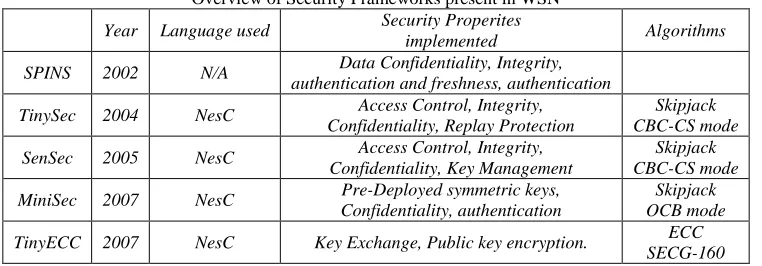
In recent years, the increased need of security in WSNs has prompted research efforts to develop and provide security modules for these platforms. These efforts go from simple stream ciphers to public key cryptography architectures. SPINS [7] is the first security architecture designed for WSNs. It was optimized for resource-constrained environments and it is composed of two secure building blocks: SNEP and μTesla. SPINS offers data confidentiality, two-party data authentication, and data freshness. However, SNEP was unfortunately neither fully specified nor fully implemented [2]. In 2004, TinySec [2] was presented as the first fully implemented link layer security suite for WSNs. It is written in the nesC language and is incorporated in the official TinyOS release. TinySec provides confidentiality, message authentication, integrity, and semantic security. The default block cipher in TinySec is Skipjack, and the selected mode of operation is CBC–CS. Skipjack has an 80-bit key length, which is expected to make the cipher unsecure in the near future [8]. In order to generate a MAC, it uses Cipher Block Chaining Message Authentication Code (CBC–MAC), 4 Lander Casado and Philippas Tsigas which has security deficiencies [9]. It provides semantic security with an 8-byte initialization vector, but adds only a 2-byte counter overhead per packet. t. TinySec adds less than 10% energy, latency, and bandwidth overhead.
SenSec [1] is another cryptographic layer for WSNs, presented in 2005. It is inspired by TinySec, and also provides confidentiality, access control, integrity, and semantic security. It uses a variant of Skipjack as the block cipher, called Skipjack-X. It has been conjectured that Skipjack-X is more secure than Skipjack, because it is not vulnerable to brute force attacks. In addition, SenSec provides a resilient keying mechanism.
MiniSec [3] is a secure sensor network communication architecture designed to run under TinyOS. It offers confidentiality, authentication, and replay protection. MiniSec has two operating modes, one tailored for single-source communications, and the other tailored for multi-source broadcast communication. The authors of MiniSec chose Skipjack as the block cipher, but they do not evaluate other block ciphers as part of their design. The mode of operation selected in MiniSec is the OCB shared key encryption mechanism, which simultaneously provides authenticity and confidentiality.
TinyECC [4] is a configurable library for elliptical curve cryptography operations in WSNs. It was released in 2008 and targets TinyOS. Compared with the other attempts to implement public key cryptography in WSNs, TinyECC provides a set of optimization switches that allow it to be configured with different resource consumption levels. In TinyECC, the energy consumption of the cryptographic operations is on the order of millijoules, whereas using symmetric key cryptography is on the order of microjoules .
Table – 1
Overview of Security Frameworks present in WSN Year Language used Security Properites
implemented Algorithms
SPINS 2002 N/A Data Confidentiality, Integrity, authentication and freshness, authentication
TinySec 2004 NesC Access Control, Integrity, Confidentiality, Replay Protection
Skipjack CBC-CS mode
SenSec 2005 NesC Access Control, Integrity, Confidentiality, Key Management
Skipjack CBC-CS mode
MiniSec 2007 NesC Pre-Deployed symmetric keys, Confidentiality, authentication
Skipjack OCB mode
Contiki:
Contiki is developed by Swedish Institute of computer science and it is a lightweight, open source, highly portable and multitasking operating system used for embedded systems which are highly memory efficient. The memory usage for contiki is about 2kb of RAM and 40Kb of ROM [2].
The first version of contiki was released in 2004 and the latest version 2.4 is released in feb 2010. Contiki is developed in C and is currently used in many microcontrollers like MSP430, AVR, HC 12 and Z80. The biggest advantage of Contiki is that it provides dynamic loading and unloading of applications and services which enhances many resource utilization in sensor networks and the kernel is event driven. Contiki also provides multithreading and is implemented in a separate library, which can be used by an application when needed. By combining multi-threading and event driven kernel contiki is the best operating system for sensor networks to implement asymmetric cryptography.
Contiki Libraries:
The kernel provides basic CPU multiplexing and event handling features, the rest of the systems is implemented as system libraries linked with programs either by linking libraries that are part of the core (although core libraries are always included, and need not to be included in the loadable program binaries) , libraries that are part of the loadable program, and libraries that allow calling specific services.
Tmote Sky:
Tmote Sky is an ultra-low power IEEE 802.15.4 compliant wireless module for use in sensor networks used in monitoring based applications, and rapid application prototyping. Tmote Sky gets its power by AA batteries but it has a usb port which can be connected to usb port of a computer to utilize power from the computer. The low power usage is of Tmote Sky is possible due to MSP430 F1611 microcontroller which consists of 10Kilobytes RAM and 48Kilobytes flash ROM. This mote also includes the ability of fast wake up from sleep which takes less than 6μs. Its 16 bit RSIC processor enables it to use less power while active and in sleep mode enabling the node to run for years on single pair of AA batteries [24].
Tmote Sky is equipped with Integrated onboard antenna with 50m range indoor / 125m range outdoors, the radio is Chipcon CC2420 which provides reliable wireless communication. There are three types of integrated sensors in Tmote Sky including Humidity, Temperature, and Light sensors. It also provides hardware link-layer encryption and authentication for better security. For external code and data storage Tmote Sky provides ST M25P80 40MHz serial code flash that can hold 1024 kilobytes of data. The flash is decomposed into 16 segments, each 64kB in size.
COOJA:
Cooja Simulator is a network simulator specifically designed for Wireless Sensor Networks.
A simulated Contiki Mote in COOJA is an actual compiled and executing Contiki system. The system is controlled and analyzed by COOJA. This is performed by compiling Contiki for the native platform as a shared library, and loading the librar y into Java using Java Native Interfaces (JNI). Several different Contiki libraries can be compiled and loaded in the same COOJA simulation, representing different kinds of sensor nodes (heterogeneous networks). COOJA controls and analyzes a Contiki system via a few functions. For instance, the simulator informs the Contiki system to handle an event, or fetches the entire Contiki system memory for analysis. This approach gives the simulator full control of simulated systems. Unfortunately, using JNI also has some annoying side-effects. The most significant is the dependency on external tools such as compilers and linkers and their run-time arguments. COOJA was originally developed for Cygwin/Windows and Linux platform, but has later been ported to MacOS.
Cooja is a network simulator that is able to emulate Tmote Sky (and other) nodes. The code executed by the node is the exact same firmware you may upload to physical nodes.
III. PERFORMANCE AND MEASUREMENT METHODOLOGY
Wireless Sensor networks have very limited resources, due to these constraints many important factors need to be analysed before deploying in a field. In this section software based methods, used to measure different performance merits of the implementation phase are presented.
Execution Time:
There are two techniques used to measure the time consumed by software to perform various operations. The most accurate method is to use high precision oscilloscope to check the data output pin. This method seems to be more complex and many external factors need like margin error of measuring tool needed to be considered. The second method is to use real-time timers present in Contiki. By using these real-time timers higher accuracy in execution time is visible.
Real-time timer in Contiki is hardware dependent. This gives a choice to select any of two clocks present in the sensor node. Main Clock (MCLK) provides a maximum resolution of 0.4069 microseconds if the processor cycle is executed at 2.4576 MHz. This is very accurate but it cannot be used as this clock is disabled in low power modes, while Contiki runs in low power mode 1out of 5 low power modes available. The second clock option is to use auxillary clock ACLK which runs by use of a crystal oscillator with frequency rate of 32768 Hz. This configuration was preferred and selected for all the measurements in the project.
ROM:
ROM is a very limited resource in WSN and hence a very important parameter that needs to be fulfilled for any application to be able to reside on the node. Most of the freely available cryptographic libraries have not taken this constraint into consideration. Additionally there are only few free libraries present that are designed to be used in embedded devices. Once the library is chosen then it cannot be ported as a whole package into Contiki so it needs to be reduced and create a minimal application that can reside in the node with a code range of around 15 to 30 bytes. Public Key cryptography use very large numbers for computation, such computations cannot be done with the simple mathematical operations. Due to this reason all public key cryptographic libraries include or support some big number libraries. So this makes an additional load on the code size, but it is mandatory and cannot be skipped.
RAM:
RAM is the most important constraint that needs the most attention. WSNs are equipped with only a few kilobytes of RAM. MSB430 is equipped with only 5 KB of RAM while Tmote Sky has 10KB of RAM. As the stack has variable size during the process execution hence it was not easy to measure ram. A mixed approach was chosen for Ram estimations. Initially msp430-ram-usage [9] program is used to see the memory footprint of Contiki on the sensor node. Cooja simulator provides a Stack viewer which can show the stack usage during all the process execution. Therefore Cooja is used to view the stack usage during all of the operations to see their stack utilization.
Energy:
As WSN are equipped with a limited power source hence energy is a very scarce resource. Normal applications consume use energy in the range of micro-joules but as in public key cryptography complex and long mathematical equations are solved so the consumption increases from micro-joules to mill-joules as is shown in the case of TinyECC [25]. In addition, the cost of a hardware-based mechanism for energy measurement is too high; the cost per-hardware-unit is similar to the price of the sensor node [42].Contiki provides a built in tool ENERGEST for energy estimations. “Energest is a software-based on-line energy estimation mechanism that estimates the energy consumption of a sensor node” [43].
Energest: It is a mechanism provided inside Contiki to be used by sensor node to provide energy estimations of all components such as radio transceiver and CPU. The core of this process is to use timers. When a component is turned on, a counter starts to measure the estimated energy consumption. When the component is turned off then the current value is added to the entry table of the component.
IV. PERFORMANCE CHARACTERIZATION OF SECURITY PRIMITIVES UNDER CONTIKI
Studied block ciphers Evaluaton
1) AES: The Advanced Encryption Standard (AES) algorithm, also known as Rijndael, is a block cipher adopted as an encryption standard by the U.S. government. AES is a substitution-permutation network and is one of the most popular symmetric-key cryptography algorithms. AES is fast in both software and hardware and is relatively easy to implement. It operates on a 4x4 array of bytes and has a fixed block size of 128 bits and a key size of 128, 192, or 256 bits with 10, 12, and 14 numbers of rounds, respectively.
2) RC5: An advantage of RC5 is its flexibility. Unlike other encryption algorithms, RC5 has a variable block size (32, 64, or 128 bits), number of rounds (0...255), and key size (0...255 bits). The values of those parameters determine the level ofsecurity of the algorithm.
3) Skipjack: Skipjack is a block cipher developed by the U.S. National Security Agency (NSA). The algorithm is an unbalanced Feistel network with 32 rounds. Skipjack uses an 80-bit key for encryption and decryption and the size of the data blocks is 64 bits. Since all of its parameters are constants, Skipjack is not as flexible as AES or RC5.
4) XXTEA: XXTEA, also called Corrected Block TEA, is the successor of XTEA and was designed to correct flaws in the original Block TEA (Tiny Encryption Algorithm). XXTEA has a small memory requirement which makes it suitable for use in resource constraint environments such as embedded systems. XXTEA has a key size of 128 bits. The length of the input plaintext is equal to the length of the output cipher text which means that XXTEA does not require using operation modes.
The best public cryptanalysis for AES is a related-key attack for a 256-bit key while using 9 rounds. A chosen-plaintext attack can break up to 8 rounds of 192-bit and 256-bit AES and 7 rounds of 128-bit AES [26]. Currently AES-128, AES- 192, and AES-256 (the number in the name of the algorithm corresponds to the size of the key in bits) are running on 10, 12, and 14 rounds respectively. Thus, none of them are breakable yet.
The best known cryptanalysis for Skipjack is an attack against 31 of its 32 rounds using differential cryptanalysis [26]. Therefore, Skipjack is currently considered to be unbreakable. According to RSA Labs, however, this will soon change since 80-bit keys would be breakable by 2010 [27]. The best reported attack on XXTEA has used 6 rounds [28]. Therefore, XXTEA with more than 6 rounds can be considered secure.
We focused on C language implementations of these ciphers since our objective is to integrate them into the Contiki operating system, which is designed in C. Due to the computational and memory limitations of sensor nodes, we used the most optimized, publicly available versions of each cipher
Fig. 1 Encryption, decryption, and key expansion time
In Figure 1 , we show the time needed for encrypting and decrypting a single block of plaintext. Additionally, we show the time needed to carry out the key expansion process. For the context of these measurements it is important to emphasize the block size with which each cipher operates: XTEA, Skipjack, and Triple-DES operate with 64-bit blocks; in contrast, AES and Twofish operate with 128-bit blocks.
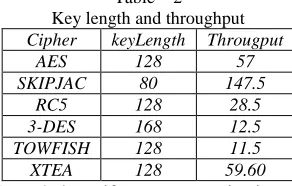
In orderto simplify the analysis while taking into account the block size, we show the encryption throughput and the key length of each cipher in Table 2.
Table – 2 Key length and throughput Cipher keyLength Througput
AES 128 57
SKIPJAC 80 147.5
RC5 128 28.5
3-DES 168 12.5
TOWFISH 128 11.5
XTEA 128 59.60
Skipjack has by far the best throughput. Nevertheless, if greater security is needed, we should choose a 128-bit key length cipher. In that case, AES and XTEA are the most suitable ciphers; both have similar encryption throughput.
Their respective throughput is nearly three times smaller than the throughput of Skipjack.
In Figure 2 we show the memory requirements for the ciphers under consideration.
We observe that Skipjack uses only 21 bytes of RAM, which is not a typical value. As we mentioned, the obtained RAM usage is an approximation. When analyzing the ROM usage, we see that XTEA uses the least ROM, followed by RC5 and Skipjack.
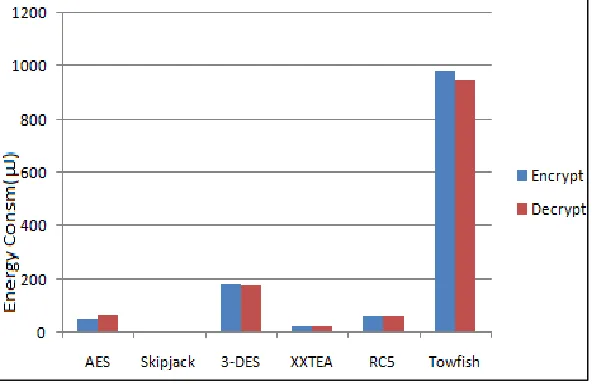
Energy is an extremely scarce resource in sensor nodes. Energy consumption of the cryptographic primitives must be taken into account when designing a security layer for WSNs. As expected, faster ciphers consume less energy. In Figure 3 we illustrate the estimated energy consumption of each block cipher.
Fig. 3: Energy consumption for encrypting and decrypting one data block.
Currently, brute force is the only cryptanalysis that can be applied against AES, Skipjack, and XXTEA when they are used with their correct number of rounds and key-length.
Because of that, we can directly compare the security strength of AES, Skipjack, and XXTEA based on the length of the key they use.
The experimental results also show that XTEA is also a very efficient block cipher for WSNs. It achieves an acceptable throughput and it needs less ROM than any other cipher. Although it has a 128-bit key, a related-key differential attack can break 27 out of 64 rounds of XXTEA.
After Skipjack and XTEA, AES achieves the best results in our experiments. It obtains a data throughput greater than radio rate, and reasonable memory usage and energy consumption. Additionally, at present time AES is the block cipher approved as a standard and recommended by NIST.
Based on the results described above and taking into account the trade-off between security and resource consumption, we selected AES as the most appropriate block cipher for the WSNs under consideration.
CBC-CS Evaluation
Cipher Block Chaining–Ciphertext Stealing (CBC–CS) is a mode of operation proposed by NIST [30]. A mode of operation is an algorithm that features the use of a symmetric block cipher. A mode of operation requires an initialization vector (IV), which is a random block of data, to achieve the semantic security property.
From our observations, the overhead produced by padding the plaintext to the cipher block size is very important. Consequently, we should try to avoid encrypting very short packets. In contrast, we observed that the power consumption for encrypting messages larger than the block size is nearly zero. In addition, sending an IV in each packet produces a significant increase in the energy consumption. The length of the IV should be defined depending on the security level required. In our opinion, a 2-byte IV makes a good balance between security and power consumption.
In typical WSN scenarios, few packets per minute are sent, and thus the time to exhaust all the possible 216 IVs is quite long .
CMAC Evaluation
Cipher-based Message Authentication Code (CMAC) is a cryptographic algorithm that provides assurance of the authenticity and, hence, the integrity of binary data [9]. In order to evaluate the impact of including a MAC in each message we have to define the length of the tag. Our experiments show that sending one byte has nearly the same power consumption as calling the AES encryption function six times. Thus, we have to limit the length of the MAC as much as possible.
Table – 3
Energy consumption of sending packets with a MAC Payload Mode Energy (µJ) Increase
10 Default 48.5 ---
10 CMAC 48.5 14.3
20 Default 80.48 ----
20 CMAC 91 10.7
40 Default 180 ---
40 CMAC 197 8.5
We observe that the energy cost of computing the MAC is negligible compared with the energy needed to send the MAC.
OCB Evaluation
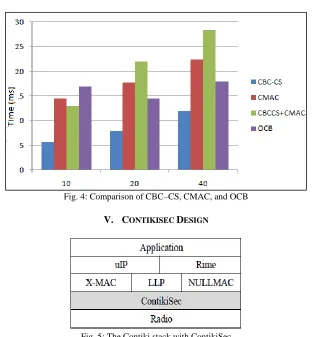
Offset Codebook Mode (OCB) is a mode of operation that simultaneously provides confidentiality and authenticity [31]. When the application under consideration demands confidentiality and authenticity, OCB is claimed to be the most appropriate mode for WSNs. To evaluate the efficiency of OCB in our platform, we implemented this authenticated-encryption algorithm and compared it with the CBC–CS and CMAC modes As can be seen in Figure 4, OCB is faster than CBC–CS encryption combined with the CMAC. The results suggest that OCB is even more efficient with larger data lengths. Therefore, our analysis indicates that OCB is the best choice to select from when confidentiality and authenticity are required in the WSNs under consideration.
Fig. 4: Comparison of CBC–CS, CMAC, and OCB
V. CONTIKISEC DESIGN
Fig. 5: The Contiki stack with ContikiSec
The Contiki protocol stack is divided in four layers: the physical layer, the data link layer, the communication layer, and the application layer. In WSNs, the typical traffic pattern is the many-to-one communication pattern. Because of that, in order to avoid routing packets injected by an adversary to waste energy and bandwidth, ContikiSec: A Secure Network Layer for Wireless Sensor Networks under the Contiki Operating System security should be implemented at the link layer [16]. Contiki provides three media access control protocols for our platform: X-MAC, LLP, and NULLMAC. Currently, we have implemented ContikiSec under NULLMAC, but it could be ported to run under the other two protocols.
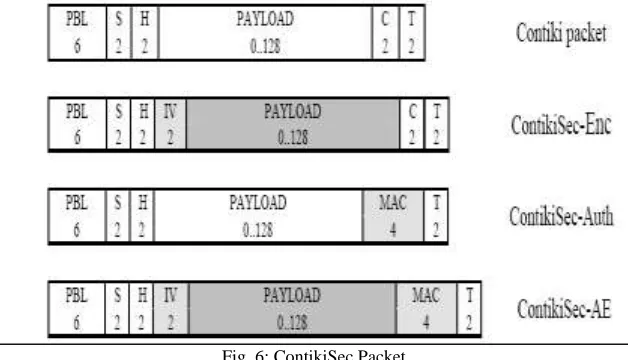
As we can observe, ContikiSec-Enc includes a 2-byte initialization vector (IV) in each packet, producing a 2-byte overhead. The length of the IV has a great impact for security and energy consumption. Longer IVs are more secure, but the energy cost of sending them is too high for WSNs.
initializes the random generator differently. The payload is encrypted using the CBC–CS mode of operation with AES as the underlying block cipher. Moreover, we assume that all the nodes in the network are provided with a single 128-bit key. The key-expansion process is performed when the node is initialized and then stored in the RAM. In addition, the CC2442 radio driver adds a 2-byte checksum field to each packet. Consequently, Enc supports confidentiality and integrity. ContikiSec-Auth is designed for applications where confidentiality is not critical, but where it is crucial to know the originator of each message. Contiki provides a 16- bit cyclic redundancy check (CRC) function to calculate a 2-byte checksum and achieve integrity. However, the checksum is designed to detect only accidental modifications of the data, whereas a MAC also detects intentional unauthorized modifications of the data. Hence, ContikiSec-Auth provides authentication and integrity by removing the checksum field from the packet and instead including a MAC. To generate a MAC, ContikiSec-Auth uses the CMAC algorithm benchmarked .
ContikiSec supports three security modes: confidentiality-only (ContikiSec-Enc), authentication-only (ContikiSec-Auth), and authentication with encryption (ContikiSec-AE). We believe that a configurable design is especially desirable for WSNs, as WSNs are expected to support many different application scenarios with different security requirements. ContikiSec offers the programmer the choice to select between three security levels depending on the needs of the application on hand.
Fig. 6: ContikiSec Packet
As we can observe, ContikiSec-Enc includes a 2-byte initialization vector (IV) in each packet, producing a 2-byte overhead. The length of the IV has a great impact for security and energy consumption. Longer IVs are more secure, but the energy cost of sending them is too high for WSNs.
2-byte IV makes the best balance between security and energy consumption. The IV is created using the Contiki library that generates random numbers. For the seed value to initialize the random generator, we used the node identifier. Hence each node initializes the random generator differently. The payload is encrypted using the CBC–CS mode of operation with AES as the underlying block cipher. Moreover, we assume that all the nodes in the network are provided with a single 128-bit key. The key-expansion process is performed when the node is initialized and then stored in the RAM. In addition, the CC2442 radio driver adds a 2-byte checksum field to each packet. Consequently, Enc supports confidentiality and integrity. ContikiSec-Auth is designed for applications where confidentiality is not critical, but where it is crucial to know the originator of each message. Contiki provides a 16- bit cyclic redundancy check (CRC) function to calculate a 2-byte checksum and achieve integrity. However, the checksum is designed to detect only accidental modifications of the data, whereas a MAC also detects intentional unauthorized modifications of the data. Hence, ContikiSec-Auth provides authentication and integrity by removing the checksum field from the packet and instead including a MAC. To generate a MAC, ContikiSec-Auth uses the CMAC algorithm benchmarked.
Finally, ContikiSec-AE provides the highest level of security, achieving confidentiality, authentication, and integrity. As we demonstrate , the OCB mode is the most efficient algorithm when those properties are required.
VI. CONCLUSION AND FUTURE SCOPE
We present ContikiSec, which is a secure network layer for wireless sensor networks under the Contiki operating system. We have designed ContikiSec as a complete and configurable solution, providing three security modes, starting from confidentiality and integrity, and increasing to confidentiality, authentication, and integrity. Our design was governed by a careful selection and performance analysis of existing security primitives. Our design tries to achieve low energy consumption without compromising security. Our evaluation was carried on Contiki Cooja Simulator for Tmote Sky Mote.
REFERENCES
[1] TinyOS Community Forum. [Online] http://www.tinyos.net [2] The Contiki Operating System. [Online] http://www.contiki.org.in
[3] SHAH BHATTI, JAMES CARLSON, HUI DAI. s.l. Springer Science, 2005. ISSN: 1383-469X. Poster Abstract: "Making Sensor Networks IPv6 Ready." [4] Mathilde Durvy, Julien Abeillé, Patrick Wetterwald , Colin O'Flynn, Blake Leverett, Eric Gnoske, Michael Vidales, Geoff Mulligan, Nicolas Tsiftes, Niclas
Finne, Adam Dunkels. s.l. : Proceedings of the 6th ACM conference on Embedded network sensor systems, 2008. ISBN:978-1-59593-990-6. [5] ScatterWeb. ScatterWeb - MSB430. [Online] http://www.scatterweb.com/content/products/researchline/msb430.en.html
[6] mspgcc- GCC toolchain for MSP430 http://mspgcc.sourceforge.ne/ Mspsim - an extensible simulator for msp430-equipped sensor boards. [7] Joakim Eriksson, Adam Dunkels, Niclas Finne, Fredrik Osterlind. Netherlands : European Conference on Wireless Sensor Networks, 2007. [8] Moteiv Hardware Product Transition Notices.[online] http://www.sentilla.com/moteiv-transition.html
[9] Fredrik Osterlind. [Online http://www.sics.se/~fros/cooja.php.
[10] Jennifer Yick, Biswanath Mukherjee, DipakGhosal ”Wireless sensor network survey”
[11] IElsevier Computer Networks 52 (2008) 2292-2330 Lalit Saraswat, Pankaj Singh Yadav, “A comparative analysis of wireless sensor network operating systems,” Int J Engg Techsci Vol 1(1) 2010, 41-47.
[12] Thang Vu Chien, Hung Nguyen Chan, and Thanh Nguyen Huu “A Comparative Study on Operating System for Wireless Sensor Networks,” ICACSIS 2011
[13] Tarek M.Salem, Sherine M. Abd El-kader,“Mapping “Wireless Sensor Network Applications Requirements to Existing Operating Systems,” IJCSI International Journal of Computer Science Issues, Vol. 10, Issue 5, No 1, September 2013 ,ISSN (Print): 1694-0814 |ISSN (Online): 1694-0784
[14] Dunkels, B. Gronvall, and T. Voigt Contiki - a lightweight and exible operating system for tiny networked sensors.
[15] In LCN '04: Proceedings of the 29th Annual IEEE International Conference on Local Computer Networks (LCN'04), pages 455-462, Washington, DC, USA, 2004. IEEE Computer Society.
[16] Perrig A., Szewczyk R., Wen V., Culler D., Tygar J. D.: SPINS: Security Protocols for Sensor Networks. In: Proceedings of the 7th annual international conference on Mobile computing and networking, pp. 189--199. ACM, New York (2001)
[17] Karlof C., Sastry N., Wagner D.: TinySec: a Link Layer Security Architecture for Wireless Sensor Networks. In: Proceedings of the 2nd International Conference on Embedded Networked Sensor Systems (SenSys 2004), pp. 162--175. Baltimore (2004)
[18] Luk, M., Mezzour, G., Perrig, A., Gligor, V.: MiniSec: a Secure Sensor Network Communication Architecture. In: Proceedings of the 6th International Conference on Information Processing in Sensor Networks (IPSN 2007), pp. 479-488. ACM, New York (2007)
[19] Liu A., Ning P.: TinyECC: A Configurable Library for Elliptic Curve Cryptography in Wireless Sensor Networks. In: Proceedings of the 7th International Conference on Information Processing in Sensor Networks (IPSN 2008), SPOTS Track, pp. 245--256, (2008)
[20] Jinwala D., Patel D., Dasgupta, K. S.: Optimizing the Block Cipher and Modes of Operations Overhead at the Link Layer Security Framework in the Wireless Sensor Networks. In: Proceedings of the 4th International Conference on Information Systems Security. LNCS, vol. 5352, pp. 252--272. Springer (2008)
[21] National Institute of Standards and Technology, Computer Security Division. Recommendation for Block Cipher Modes of Operation: The CMAC Mode for Authentication, Special Publication 800-38B (2005)
[22] Toledo, Sivan. Exercise in Embedded Computing: Contiki Basics. [pdf] s.l. : Tel-Aviv University.
[23] Micro power meter for energy monitoring of wireless sensor networks at scale. Xiaofan Jiang, Prabal Dutta, David Culler, Ion Stocia. Cambridge, Massachusetts, USA : Proceedings of the 6th international conference on Information processing in sensor networks, 2007. ISBN:978-1-59593-638-X. [24] Software-based on-line energy estimation for sensor nodes. Adam Dunkels, Fedrik Osterlind, Nicolas Tsifes, Zhitao He. Ireland : ACM, Proceedings of the
4th workshop on Embedded networked sensors, 2007. ISBN:978-1-59593-694-3.
[25] ScatterWeb. ScatterWeb - MSB430.Online http://www.eecs.harvard.edu/konrad/projects/shimmer/references/researchlinetmote-sky- Datasheet.pdf [26] COOJA/MSPSim: interoperability testing for wireless sensor networks.Joakim Eriksson, Fredrik Osterlind, Niclas Finne, Nicolas Tsiftes, Adam Dunkels,
Thiemo Viogt, Robert SAuter, Pedro Jose Marron.Rome, Italy : International Conference On Simulation Tools And Techniques For Communications, Networks And Systems and Workshops, 2009. ISBN:978-963-9799-45-5.
[27] N. Ferguson, R. Schroeppel, and D. Whiting. A simple algebraic representation of Rijndael. Selected Areas in Cryptography, LNCS, pages 103–111, 2001. [28] E. Biham, A. Biryukov, and A. Shamir. Cryptanalysis of Skipjack reduced to 31 rounds using impossible differentials. Journal of Cryptology, 18(4):291–
311, September 2005.
[29] RSA Laboratories. http://www.rsa.com/rsalabs. Tinyness: An overview of TEA and related ciphers. [30] http://web.archive.org/web/20070812222155/http://wwwusers.
[31] National Institute of Standards and Technology, Computer Security Division, AES standard, http://csrc.nist.gov/archive/aes/index.html