CHARACTERIZING CONSTITUTIONAL
INPUTS
MICHAEL COENEN†
ABSTRACT
Constitutional doctrine frequently employs tests that operate on abstract conceptual inputs rather than objectively identifiable facts. Consider some examples: substantive due process doctrine directs attention to whether a violated “right” qualifies as fundamental or nonfundamental; Commerce Clause doctrine directs attention to whether a regulated “activity” qualifies as economic or noneconomic; the strict scrutiny test directs attention to whether a relevant “government interest” qualifies as compelling or noncompelling; and so forth. These sorts of decision rules call for an evaluation of variables whose scope, content, and character are frequently up for debate, thereby requiring courts to characterize constitutional inputs as a precondition to reaching constitutional results. To determine whether the government has violated a “fundamental right,” courts must first characterize the relevant right whose fundamentality is at issue. To determine whether a congressional enactment regulates an “economic activity,” courts must first characterize the relevant activity whose economic nature must be scrutinized. To determine whether a challenged law pursues a “compelling government interest,” courts must first characterize the relevant government interest whose importance is to be assessed. Tests of this sort thus implicate not just the familiar judicial challenge of evaluating a given variable by reference to an established doctrinal criterion, but also the less familiar (and often unnoticed) challenge of extracting from a fact pattern an operative characterization of the variable to be evaluated.
This Article examines these input-characterization problems as a general challenge of constitutional decisionmaking. The Article makes three contributions. First, the Article demonstrates the widespread presence of characterization problems within constitutional law,
Copyright © 2018 Michael Coenen.
highlighting both the broad range of contexts in which these problems arise and the limited amount of attention they have thus far generated. Second, the Article explores the possibility of avoiding input-characterization problems through the reformulation of constitutional decision rules, considering in particular the tradeoffs implicated by the replacement of “characterization-dependent” decision rules with “characterization-resistant” alternatives. Finally, the Article works through the various methods by which courts might confront characterization problems on their own terms, asking whether there exist reliable and predictable means of selecting an authoritative input characterization from the many possibilities that the facts might afford. In sum, this analysis reveals that input-characterization problems are neither easily avoidable nor easily solvable, thus raising critical questions regarding the determinacy and coherence of the doctrine writ large.
TABLE OF CONTENTS
Introduction ... 745
I. The Characterization Process ... 753
A. Basic Model of Constitutional Adjudication ... 753
B. Adding Input Characterization Into the Mix ... 757
C. Characterization Versus Evaluation ... 759
II. Characterization Problems in Constitutional Doctrine ... 763
A. Characterizing Rights ... 764
B. Characterizing Rules ... 768
C. Characterizing Government Interests ... 771
D. Characterizing Activities ... 774
E. Characterizing Injuries ... 779
F. Characterizing Fields ... 782
G. And on and on ... 784
III. Characterization-Resistant Doctrine? ... 786
A. Targeted Inputs ... 787
B. Holistic Inputs ... 792
C. Neutralized Inputs ... 798
IV. Constraining Characterization Choices ... 804
A. Controlling Generality Levels ... 804
B. Results-Based Characterization ... 810
C. Precedent-Driven Characterization ... 814
V. Characterizing Constitutional Outputs? ... 820
INTRODUCTION
Suppose that you have given me a collection of photographs and invited me to take from that collection any and all pictures of things that make me happy. I accept your invitation and start looking for photos to claim. Adhering strictly to your instructions, I ask with respect to each photo, “Does the subject of this picture make me happy?,” and I select only those photos for which the answer to this question is “yes.” Some photos are easy to deal with: I eagerly grab the photo of the dog, and I fervently reject the photo of smog. Others present a more complex calculus: I’m initially flummoxed by the photograph of a computer—sometimes computers make me happy, other times they do not—but I ultimately decide that my overall feelings toward computers are more positive than negative and thus add the photo to my pile. And I continue to make similar such judgments on a photo-by-photo basis, generally satisfied in my ability to distinguish between things that do and do not make me happy.
Suddenly, however, I hit a roadblock1 :
My problem is this: I know that the earth makes me happy and I know that the moon does not, but I cannot figure out whether this is a picture of the earth or of the moon. Worse still, I worry that the picture might depict something other than “the earth” or “the moon”: perhaps it depicts “outer space,” “sunlight,” “celestial orbs,” “Earth as seen
from the moon,” “Earthrise over the moon,” or even “what the Apollo 8 astronauts saw on December 24, 1968.”
And then I start to wonder about other choices that I previously made. Was that photo of a dog really a photo of “a dog,” or was it a photo of “a snarling guard dog”? Was that photo of smog really a photo of “smog,” or was it a photo of “a somewhat obscured urban center”? Was that photo of a computer really a photo of “a computer,” or was it a photo of “an Apple IIC computer,” or was it a photo of “plastic”? I am identifying more and more potential subjects of each photograph, some more happy-seeming than others, but all of which strike me as equally valid characterizations of the images with which they are associated. And yet, I somehow must choose only one characterization out of each multitude in order to decide what to do with the picture it describes.
Suppose now that I am a judge tasked with deciding the following case.
Patient is suffering from a terminal illness and anticipates death within the year. Patient very much wishes to die on her own terms, rather than drag herself and her family through the painful ordeal of a slow medical decline. Patient asks Doctor to administer life-ending treatment, but Doctor refuses, citing to a state-law prohibition on “causing the death of a person.” Patient claims that the law violates the substantive component of the Fourteenth Amendment’s Due Process Clause.2
Having recently studied up on substantive due process doctrine, I know that my disposition of this claim will depend on whether the “right” being asserted by the plaintiff qualifies as “fundamental” or “nonfundamental,”3 and I know how I should go about assessing a right’s fundamentality. Here too, however, I encounter a problem: I am not sure how to characterize the right whose fundamentality I should assess. Is Patient asserting a “right to commit suicide,” a “right to demand physician-assisted suicide,” a “right to die with dignity,” a “right to refuse to continue living,” a “right to spare one’s family members of emotional pain,” a “right to make decisions about one’s
own body,” or some other “right” altogether?4 Some of these rights seem more fundamental than others, but before I can even get to the question of fundamentality, I have to extract from the fact pattern a claim of right to be assessed. And this is no easy task. All of the rights I have considered strike me as descriptively accurate characterizations of the facts I am confronting, and yet I must select one and only one such characterization as the basis for my disposition of the substantive due process claim.
These two hypotheticals—the first, a figment of my imagination, the second, an adaptation of Washington v. Glucksberg5—highlight what I call the challenge of input characterization (or, the challenge of characterization, for short). This challenge arises whenever we must characterize factual information (for example, a photographic image or the fact pattern of a case) in terms of an abstract concept (the subject of the photograph or the right implicated by the case), which we then proceed to evaluate by reference to an operative criterion (is the subject of the photograph a “thing that makes me happy”?; is the right “fundamental” or “nonfundamental”?). The task is challenging because facts are often susceptible to large numbers of competing characterizations, and we have no obvious means of choosing a particular characterization to serve as the input for our evaluative inquiry. And the task is important because the characterization choices that we make will often influence, if not wholly dictate, the result of that inquiry itself.
These challenges are by no means unfamiliar to constitutional scholars, many of whom have commented on the importance and difficulty of defining the proper level of generality with which to frame the subject of a given doctrinal inquiry.6
As I understand it, however,
4. Many of these formulations were proposed and considered throughout the litigation of
Glucksberg itself. See, e.g., Glucksberg, 521 U.S. at 724 (referring to the “right to commit suicide with another’s assistance”); id. at 722 (referring to the “right to choose a humane, dignified death”); id. at 755 (Souter, J., concurring) (referring to the “right to physician assistance”).
5. Washington v. Glucksberg, 521 U.S. 702 (1997).
the challenge of characterization implicates more than just the well-known levels-of-generality problem. Characterization choices, in other words, implicate not just questions about generality, but also questions about what descriptive features of a fact pattern to include in—and exclude from—the doctrinal inputs that judges end up evaluating.7 We might all agree, for instance, that I should characterize the NASA photograph at a low level of generality, but that fact alone does not tell us whether the characterization should be “the Earth on December 24, 1968,” or “the Earth as seen by the crew of Apollo 8.” Similarly, we might all agree that the right at issue in Glucksberg merited a high-generality characterization, but that fact alone does not tell us whether the characterization should have been a “right to die with dignity,” a “right to die with a physician’s assistance,” or a “right to die at a time of one’s own choosing.”8
I will elaborate on this point further in the
WM.MITCHELL L.REV.80, 91–100 (2015) (evaluating how levels of generality affect judicial decisions). See generally John F. Basiak, Jr., Inconsistent Levels of Generality in the Characterization of Unenumerated Fundamental Rights, 16U.FLA.J.L.&PUB.POL’Y 401 (2005) (analyzing how courts characterize fundamental rights). Some commentators, though, have noted the existence of similar problems within and across other domains as well. See, e.g., Alan K. Chen,
Shadow Law: Reasonable Unreasonableness, Habeas Theory, and the Nature of Legal Rules, 2 BUFF.CRIM.L.REV. 535, 585 n.167 (1999) (noting that “levels of generality problems pervade qualified immunity, Teague, and [other habeas questions],” while analogizing to levels of generality problems that arise in the context of substantive due process doctrine); David L. Faigman, Measuring Constitutionality Transactionally, 45HASTINGS L.J. 753, 778–83 (1994) (discussing the importance of characterization choices in connection with inquiries that require a balancing of “liberty interests” against “government interests”); Richard H. Fallon, Jr., Strict Judicial Scrutiny, 54UCLAL.REV. 1267, 1271 (2007) (“Although it is widely recognized that courts must determine the ‘level of generality’ at which constitutional rights should be defined . . . the Court has largely ignored parallel questions involving the generality with which government interests should be specified.”); Dov Fox, Interest Creep, 82GEO.WASH.L.REV. 273, 275 (2014) (noting “the central place of state interest definition in constitutional adjudication,” while noting the Court’s “‘astonishingly casual approach’ to articulating or evaluating those sources of government concern that ambiguous interests comprise” (quoting Fallon, supra, at 1321)); Mark V. Tushnet, Following the Rules Laid Down: A Critique of Interpretivism and Neutral Principles, 96HARV.L.REV.781, 791 (1983) (“Frequently an analysis turns completely on the level of generality at which some feature of the issue under analysis is described.”).
7. See Tribe & Dorf, supra note 6, at 1091 (highlighting this difficulty).
discussion below,9 but for now it suffices to say that the levels-of-generality problem represents only one aspect of the problem that I am considering here. With that broader understanding of the problem in place, we are more likely to notice its occurrence across many different areas of constitutional law.
Indeed, a central claim of this Article is that the challenge of input characterization presents a pervasive problem for judges tasked with deciding constitutional cases.10 In case after constitutional case, involving clause after constitutional clause, courts must characterize complex bodies of factual details in terms of a single abstract concept that a decision rule demands. Glucksberg illustrates this point with respect to substantive due process doctrine: the case law distinguishes between claims involving fundamental and nonfundamental rights, and it thus requires courts to extract from each case’s fact pattern a characterization of the relevant right whose fundamentality can then be gauged.11 But characterization problems arise with equal frequency in many other domains. To determine whether a federal court plaintiff has Article III standing, one must first characterize the plaintiff’s various burdens, grievances, indignities, and other harms in terms of a single “injury” whose concreteness, traceability, and redressability can then be evaluated.12
To determine whether a law survives strict scrutiny, one must characterize the complex cluster of problems, policies, objectives, and effects of the law in terms of a “government interest” whose overall importance and closeness of fit can then be evaluated.13
To determine whether a federal law preempts a state law, one must characterize various facts about each law as a description of each law’s regulatory “field” before then proceeding to address whether those fields problematically overlap.14 This list could go on, but the key point is simply that constitutional decision rules frequently operate on abstract characterizations of the facts rather than directly on the facts themselves. And where that is so, courts must characterize
law, that is, “a legal-sounding argument can be made only after a situation is characterized nonrationally, so that the advocate seems able to deduce a single result on principle.” Id. at 592. This Article attempts to show that a similar phenomenon is at work within various areas of constitutional doctrine as well.
9. For a criticism of different approaches to characterization problems that focus exclusively on calibrating generality levels, see infra Part IV.A.
constitutional inputs as a precondition to generating constitutional results.
This fact is not problematic in and of itself, but it becomes problematic when another fact comes to light. And that fact, which I will also endeavor to demonstrate in the pages below, is that the Supreme Court does not often pause to defend, let alone acknowledge, the characterization choices that it makes. All too often, contestable characterizations of the facts are simply adopted without explanation, buried within elaborate and involved discussions as to why one decision rule or another should be adopted or why a characterized input does or does not satisfy the terms of the decision rule being applied. The Court has told us much about how it evaluates the fundamentality of an unenumerated right, but it has told us relatively little about how it goes about characterizing the particular right that a given case implicates. Similarly, the Court has told us much about what distinguishes a mere “generalized grievance” from a cognizable injury-in-fact, but it has told us relatively little about how it goes about characterizing the particular injury that a plaintiff claims to have suffered. The Court has told us much about what sorts of government interests qualify as “compelling,” but it has told us relatively little about how it goes about identifying the relevant interest that a given law pursues. To be sure, not all of the Court’s characterization choices have been rendered so casually; some choices have been conducted out in the open, although even here the justifications for those choices have been largely unilluminating. But given the frequency with which the Court characterizes its constitutional inputs, it is both surprising and concerning that the Justices have had so little to say about how courts should go about performing this important task.
making it all the more important for us to analyze the structure of the problem it presents.
The remainder of this Article takes up that task. Part III looks at the challenge of characterization through the lens of decision rule design. This Part considers the possibility of crafting constitutional doctrine in such a way as to minimize the decisional influence of characterization choices—in effect, responding to the challenge of characterization by rendering difficult characterization choices irrelevant to the application of a given legal norm. This strategy might be pursued in one of three ways. First, the Court might prescribe decision rules that operate on specifically described and easily identifiable features of a fact pattern, calling for the assessment of targeted inputs drawn directly from the facts.15
Second, and at the opposite extreme, the Court might prescribe decision rules that operate on the entirety of a given fact pattern, calling for a holistic and all-things-considered assessment of all aspects of a transaction giving rise to a case.16
Finally, even where a decision rule operates on a characterized input, courts might attempt to neutralize the influence of the characterization choice by installing equilibrating or self-corrective mechanisms into the decision rule itself.17 These three strategies, I argue, can and sometimes do succeed at producing various forms of characterization-resistant constitutional doctrine. But they will not always be available for courts to use. And when that is so, courts have no choice but to confront the challenge of characterization head on.
15. Consider, for instance, rules that accord differing levels of First Amendment protection based on whether a defamation plaintiff qualifies as a public or nonpublic figure. See, e.g., Curtis Publ’g Co. v. Butts, 388 U.S. 130, 134 (1967); N.Y. Times v. Sullivan, 376 U.S. 254, 264 (1964); see also Stephen J. Mattingly, Drawing a Dangerous Line: Why the Public-Concern Test in the Constitutional Law of Defamation Is Harmful to the First Amendment, and What Courts Should Do About It, 47U.LOUISVILLE L.REV.739, 742 (2009) (noting that New York Times and Butts
“established that the status of a defamation plaintiff determined the contours of the protection afforded to the speech in question”).
16. Consider, for instance, the Court’s suggestion that the “reasonableness” of a given search be assessed by reference to the “totality of circumstances” accompanying the search. See, e.g., Grady v. North Carolina, 135 S. Ct. 1368, 1371 (2015) (per curiam) (“The reasonableness of a search depends on the totality of the circumstances . . . .”).
Part IV thus considers how courts should go about characterizing constitutional inputs. More specifically, it considers three different strategies for constraining characterization choices, asking how and according to what guideposts courts should select a particular characterization of the facts. The first strategy attempts to constrain characterization choices by prescribing the requisite level of generality
with which a relevant input should be characterized. (If, for instance, I had been instructed to characterize the subject of each photograph at a “high” level of generality, I would have had some basis for concluding that a photo depicted a “dog” rather than a “snarling guard-dog.”) But this strategy can only achieve so much, encountering limitations that result both from the difficulty of communicating and measuring desired generality levels and from the reality that multiple competing characterizations will often exist at the same overall level of abstraction. The second strategy employs what I call results-based
characterization; utilizing this strategy, the Court would simply instruct its subordinates to characterize inputs in whatever manner is most likely to produce the correct-seeming outcome under the decision rule being applied. (As applied to the example of the photographs, this strategy would instruct me to ask first whether a picture makes me feel happy and then to characterize the photograph in terms of a “subject” that accords with this feeling.) In contrast to the generality-based strategy, this strategy is at least sometimes capable of generating determinate and predictable characterization choices, but it will also have the effect of rendering the operative decision rule largely irrelevant to the decision it purports to guide. Finally, the Court might call for precedent-driven characterization choices, instructing courts to characterize constitutional inputs in a manner that coheres with characterization choices made in previous, similar cases. (If, for instance, I had previously characterized a picture with a dog in it as a “picture of a dog,” that strategy would instruct me to do the same thing in connection with similarly canine-focused pictures.) This strategy likewise carries only limited promise: among other things, the precedent-driven approach may impose undue cognitive burdens on the decisionmaker and may be impossible to pursue without once again converting the process into a doctrinally irrelevant sideshow.
the resolution of constitutional cases. The suggestion here is that characterization choices, along with the decision rules to which they attach, might make more sense when understood as an output-focused rather than input-focused phenomenon—concerned less with dictating results ex ante than they are with communicating a set of judgments that would otherwise resist easy description. That observation, in turn, might prompt a broader reexamination of the purposes and benefits of constitutional decision rules. In particular, the suggestion is that, to the extent that characterization-dependent decision rules afford benefits to the doctrine as a whole, those benefits may have more to do with the appearance of continuity across cases rather than with the actuality of the same. The suggestions here are largely tentative, but they do, I hope, at least demonstrate the importance of thinking carefully about the challenge of characterization and its relationship to the broader challenge of deciding constitutional cases over time.
I. THE CHARACTERIZATION PROCESS
A. Basic Model of Constitutional Adjudication
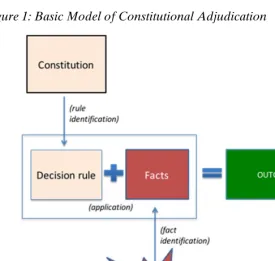
To understand the challenge of characterization, it may help to begin with an idealized account of how constitutional decisionmaking works. Constitutional litigation, like any other area of litigation, requires attention to both the law and the facts. To decide a constitutional case, a court must identify the applicable rule, identify the relevant facts, and then apply the rule to those facts.
With this picture in view, we can identify three tasks of importance to the enterprise. The first is that of fact identification—the development of a factual record against which to resolve the constitutional question before the court.18 Fact identification can occur in a number of different ways, depending on the issues or procedural posture of a case: the parties might stipulate certain facts, some facts might be assumed, other facts might be found by a judge or jury, and so-called legislative facts might find their way into the case via amicus briefs or independent judicial research. These processes in turn generate different types of information: they might tell us, for instance,
18. For useful investigations into the various challenges to which this process gives rise, see DAVID L.FAIGMAN,CONSTITUTIONAL FICTIONS:AUNIFIED THEORY OF CONSTITUTIONAL
what was said during a traffic stop; they might tell us about the content of a television broadcast that triggered FCC penalties; or they might tell us about a state’s history of enforcing a challenged law. The process can sometimes be arduous, and it can at other times proceed quickly. But however the fact-finding process takes place, its underlying purpose is the same: generating information about a legal dispute and the broader environment in which it operates.19
Second, courts must identify the applicable law. Call this the task of rule identification. In one sense, rule identification in constitutional cases is easy to do: if a litigant asserts a constitutional claim, the applicable rule is the Constitution itself. But rarely does the abstract language of the Constitution provide much in the way of concrete guidance. More frequently, that guidance comes from the various decision rules of Supreme Court doctrine that specify how to go about resolving a given constitutional claim. Equal protection doctrine, for instance, instructs courts to apply strict scrutiny when reviewing laws that employ race-based classifications;20
Spending Clause doctrine calls for courts to apply a multifactor test when reviewing a conditional spending program;21
procedural due process doctrine requires courts to apply the three-part balancing test from Mathews v. Eldridge22 when evaluating the adequacy of procedural safeguards;23
and so forth. For frequently litigated issues, one identifies the applicable rule simply by looking up the relevant judicial precedents and reciting the standards they set forth. Where the precedents are sparser, rule identification
19. I should note that—perhaps unconventionally—I will sometimes understand the relevant facts of a constitutional case to include materials of a formally legal character. For example, in a Commerce Clause challenge to a newly enacted piece of federal legislation, my conceptual framework would treat the legislation itself as a fact rather than as a rule that is of relevance to the constitutional decision. In such a case, after all, the challenged legislation would be operating as an object of, rather than source of, the legal analysis that the court conducts, becoming, in effect, one of several data points feeding into the question of whether a claimant’s Commerce Clause argument should fail or succeed. This is not to say that the challenged legislation could not function as a rule in another case; we would understand it to be the governing rule, for instance, in a criminal prosecution presenting the question whether a defendant acted in violation of the legislation itself. But where the legislation is itself the object of a constitutional inquiry, it is more accurately characterized as a fact on which the relevant decision rule operates.
20. See, e.g., Adarand Constructors, Inc. v. Peña, 515 U.S. 200, 227 (1995) (“Accordingly, we hold today that all racial classifications, imposed by whatever federal, state, or local governmental actor, must be analyzed by a reviewing court under strict scrutiny.”).
21. See, e.g., South Dakota v. Dole, 483 U.S. 203, 207–08 (1987) (listing four factors for evaluating a conditional spending program).
might involve the formulation of a new decision rule informed by judgments about text, history, structure, policy, and so forth.24
Rule identification, in short, begins with the various sources of constitutional law and ends with some combination of tests, presumptions, formulations, exceptions, and other directives that courts have developed to facilitate the implementation of an abstract constitutional norm.
With the law and the facts on the table, a decisionmaker can then proceed to apply the former to the latter, thus carrying out the final, outcome-determinative task of rule application.25 Is a particular government interest “compelling” enough to survive strict scrutiny? If so, is a particular race-based classification “narrowly tailored” to serve that interest? Is a particular conditional spending program unduly “coercive”? Does a given set of procedures satisfy the Mathews v.
24. More specifically, I understand the rule identification enterprise to encompass two different sorts of determinations that courts routinely make. First, the rule identification process will sometimes involve the resolution of interpretive questions about the meaning of the constitutional text, with courts identifying an operative proposition of constitutional law by selecting one out of several plausible readings of a given textual provision. See, e.g., NLRB v. Noel Canning, 134 S. Ct. 2550, 2561–67 (2014) (reading the phrase “the recess” in the Recess Appointments Clause to refer both to intra-session and inter-session recesses of Congress). Second, the rule identification process will sometimes involve the creation of judge-made decision rules to facilitate the implementation of whatever the operative proposition is identified to be.
See, e.g., Miranda v. Arizona, 384 U.S. 436, 444–45 (1966) (setting forth a particularized warning requirement as a means of enforcing the Fifth Amendment’s prohibition on compelled confessions); see also Mitchell N. Berman, Constitutional Decision Rules, 90VA.L.REV.1, 51 (2004) (distinguishing between “constitutional operative propositions (essentially, judge-interpreted constitutional meaning) and constitutional decision rules (rules that direct courts how to decide whether a given operative proposition has been, or will be, complied with)”); Richard H. Fallon, Jr., Foreword: Implementing the Constitution, 111HARV.L.REV. 54, 57 (1997) (contending that the task of “[i]dentifying the ‘meaning’ of the Constitution is not the Court’s only function” and that the Court must also “craft doctrine that is driven by the Constitution, but does not reflect the Constitution’s meaning precisely”); Lawrence B. Solum, The Interpretation-Construction Distinction, 27 CONST. COMMENT. 95, 96 (2010) (distinguishing between “interpretation,” which is “the process (or activity) that recognizes or discovers the linguistic meaning or semantic content of the legal text,” and “construction,” which is “the process that gives a text legal effect”); David A. Strauss, The Ubiquity of Prophylactic Rules, 55U.CHI.L. REV.190, 207 (1988) (noting that “courts create constitutional doctrine by taking into account both the principles and values reflected in the relevant constitutional provisions and institutional realities”). For ease of exposition, I will generally refer to the output of the rule identification process as a “decision rule” of constitutional doctrine; but I should emphasize that I do not intend to suggest that the process is wholly unrelated to the interpretive challenge of extracting meaning from the constitutional text.
Eldridge balancing test? To answer these questions, judges must assess a case’s factual particularities in light of the various evaluative criteria that the applicable decision rule has set forth. And once these assessments have been made, a court can cite to the applicable decision rule as justifying the outcome it has reached: if the government interest is not compelling or the classification is insufficiently tailored, the law must be struck down. If the conditional spending program is impermissibly coercive, the spending program cannot stand. If the government interests outweigh the liberty interests, and if the risk of an erroneous deprivation is minimal, a court should uphold the procedural rules under review. Rule application marks the stage of the inquiry where law and fact come together—the identified decision rule takes the identified fact pattern as its input and yields a legal disposition as its output.
Figure 1: Basic Model of Constitutional Adjudication
All of this is diagrammed above. Every constitutional case starts with two fixed points: (1) the Constitution,26 and (2) the world as we
know it. The rule identification process takes us from the Constitution to an operative decision rule, whereas the fact identification process extracts from the world a fact pattern to be evaluated under the decision rule. The law application process then combines the decision rule with the fact pattern to produce the ultimate outcome of the case.
B. Adding Input Characterization Into the Mix
Thus far, our model has omitted reference to the characterization of constitutional inputs. We can now bring that process into the picture by noting that many decision rules require an assessment of something other than unvarnished facts about the real world. When, for instance, qualified immunity doctrine instructs the courts to evaluate whether a violated rule qualifies as “clearly established,”27
the relevant facts will not yield a single agreed-upon description of what that relevant rule is. Similarly, when substantive due process doctrine instructs the courts to determine whether the plaintiff’s liberty interest is fundamental, knowing what happened between the plaintiff and the government is not the same as knowing what particular liberty interest the plaintiff seeks to protect. The fact identification process gives us a detailed snapshot of a particular dispute, but the snapshot is not always the input that we need. This is where the challenge of characterization comes in—courts must organize a case’s fact pattern into terms and concepts that the operative decision rule can understand.28
A further analogy may help to illustrate the idea. Suppose that a
identification inquiry, nothing of much significance for our purposes turns on the question of whether the Constitution itself exhausts the content of U.S. constitutional law. See, e.g., Ernest A. Young, The Constitution Outside the Constitution, 117YALE L.J.408, 410 (2007) (“[T]he American ‘constitution’ consists of a much wider range of legal materials than the document ratified in 1789 and its subsequent amendments.”). The central assumption of the model, rather, is that there exists some set of sources of constitutional law—including but not necessarily limited to the constitutional text—and that the rule identification process involves the translation of those the sources into rules of decision that courts can apply.
27. See, e.g., Harlow v. Fitzgerald, 457 U.S. 800, 818 (1982) (holding that “government officials performing discretionary functions . . . generally are shielded from liability for civil damages insofar as their conduct does not violate clearly established statutory or constitutional rights of which a reasonable person would have known”).
friend asks me whether the opening chord to “A Hard Day’s Night” is major or minor in character. Suppose further that I have managed to identify all of the individual notes sounding from all of the individual instruments at the beginning of the song.29
I have, in other words, identified an applicable rule (namely, evaluate whether the chord is major or minor) and I have gathered all the relevant facts (the notes being played at the beginning of the song). But I am not yet able to answer my friend’s question, because the decision rule operates on the singular, abstract input of a “chord.” Consequently, before I can discern the major or minor nature of the opening chord of “A Hard Day’s Night,” I first must restate that collection of notes in the conceptual language of a chord. Do the notes comprise a “G-seven chord with a suspended fourth”? A “D-minor-11 chord”? An “F-major-seven-add-9 chord”? Or some other chord altogether? As it turns out, these—and many other—labels all offer plausible harmonic descriptions of the collection of notes that I hear at the beginning of the song,30 and no additional fact finding will shed light on the question of which particular description I should employ. I must therefore make a characterization choice, tagging one of these descriptions as the relevant “chord” to serve as the basis for the answer to my friend’s question.
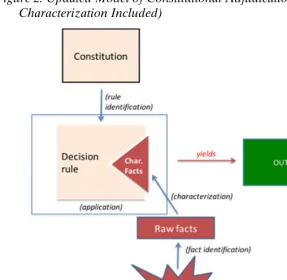
We can thus visualize the characterization process as a sometimes-necessary intermediate step between the fact identification and law application stages of the decisionmaking process.31 In our example
29. As it happens, this information only recently became available. See Damian Fanelli,
Beatles Multitracks Reveal True “A Hard Day’s Night” Opening Chord, GUITAR WORLD (Nov. 6, 2015), http://www.guitarworld.com/beatles-multitracks-reveal-true-hard-days-night-chord-video [https://perma.cc/KD8K-SUEE].
30. Compare, e.g., TONY BACON,FUZZ AND FEEDBACK:CLASSICAL GUITAR MUSIC OF THE 60’S, at 5 (2000) (characterizing the chord as a Dm7sus4), with DOMINIC PEDLER,THE
SONGWRITING SECRETS OF THE BEATLES 478–79 (2003) (quoting George Harrison’s characterization of the chord as an Fadd9). Whether Harrison’s own characterization of the chord should carry special weight is an interesting question, but it is one, alas, that lies outside the scope of this Article.
31. I should note here that I understand the challenge of input characterization to be materially different from what David Faigman has elsewhere called problem of defining the “proper frame of reference for deciding constitutional cases.” See FAIGMAN, supra note 18, at 78.
above, it was a process that took us from a collection of notes to a description of a chord. In law, it is the process that takes us from the text and legislative history of a congressional statute to a description of the “activity” that the statute regulates; from a transcript of statements made by a protester to a description of the “matter” that the protester discussed; from data about the history and effects of a regulation to a description of the liberty interests and/or government interests that it implicates. It takes as its input what we might call a raw fact pattern— a timeline of events, the text of a challenged law, the testimony of a government official—and it generates as its output a characterized factual input—a label, concept, or descriptive statement that can be plugged into the decision rule we are applying.
C. Characterization Versus Evaluation
As the foregoing discussion suggests, what we call the application of law to fact often involves—or at least purports to involve—two distinct tasks: a characterization of facts into the language of the requisite doctrinal input, followed by an evaluation of that input by reference to criteria the test sets forth. For instance, when courts apply substantive due process doctrine, they must characterize the facts in terms of a “right” being asserted, and they must then evaluate the right by reference to its overall “fundamentality” or “nonfundamentality.” When courts apply qualified immunity doctrine, they must characterize the facts in terms of a “violated rule,” and they must then evaluate the rule by reference to its “clearly established” or not “clearly established” nature. When courts apply the Article III standing test, they must characterize the facts in terms of an asserted “injury” of the plaintiff, and then evaluate that injury in terms of its concreteness, traceability, and redressability. Questions of characterization in this sense precede questions of evaluation. To know whether some input satisfies the relevant doctrinal criteria, we must first identify, and hence characterize, the descriptive contours of the input itself.
to the issue of how to characterize a factual input that the doctrine demands, but rather to the antecedent question of what sort of factual inputs the doctrine should demand in the first place.
Figure 2: Updated Model of Constitutional Adjudication (with Characterization Included)
This posited distinction between characterization and evaluation should invite an important point of skepticism: perhaps our attempt to differentiate characterization-based questions from evaluation-based questions will tend to obscure more than it illuminates, for the simple reason that both types of questions ultimately implicate the same big-picture task of applying law to fact.32 It may be formally correct to
describe the determination that “X is or is not Y” as involving both a characterization of the facts in terms of X followed by an evaluation of
X in terms of Y. But if the first and second steps of the inquiry turn out to overlap with one another, then we might as well jettison the distinction as unhelpful to the goal of better understanding the challenge of constitutional decisionmaking. If, in other words, the various difficulties associated with questions of characterization end up mirroring the various difficulties associated with questions of evaluation, then we should examine those difficulties directly and on their own terms, without indulging any surface-level distinctions between the contexts in which they arise.
So, before proceeding further, I want to point out two important ways in which questions of characterization differ from questions of evaluation, and to suggest that these differences are significant enough to warrant the distinction I have drawn. First, unlike questions of evaluation, questions of characterization can be both posed and answered in purely descriptive terms: they are, on their face, value-neutral questions of “what,” rather than value-laden questions of “whether.” Characterizing the relevant government interest implicated by a law does not appear to involve an assessment of the strength of the government’s justifications for that law, whereas evaluating the importance of that interest does. Characterizing the relevant injury suffered by a plaintiff does not require a court to express a judgment of the Article III bona fides of the plaintiff’s complaint, whereas evaluating the injury’s concreteness and redressability undoubtedly does. Obviously, and as we will explore in further detail, this feature of characterization questions does not shield them from normative influence,33 but it does mean that such choices can mask or obscure value-based judgments in a way that their evaluation-based
protects), and I certainly do not intend for this Article’s substantive domain to signify anything to the contrary. This Article’s choice of focus derives instead from expositional considerations. A comprehensive treatment of characterization problems within all different areas of law strikes me as too big a task for a single law review article to take on, and I have thus decided to narrow the paper’s focus to a body of cases with which I am already well familiar. Constitutional law, in other words, strikes me as as good an area as any other within which to explore the problem of characterization, and I do not think much is lost by limiting this Article’s focus in this way. To the extent, moreover, that the insights I offer here turn out to be of interest and use to scholars within other disciplines, I would regard that outcome as all to the good.
counterparts cannot. In other words, even if questions of characterization turn out to be irreducibly normative, they still can be framed and disposed of in such a way as to make their motivating value judgments more difficult for the characterizing court to notice and for the observing reader to detect. With evaluation-based questions, by contrast, the value-based cards are more likely to be out on the table for everyone to see.
Second, questions of characterization—unlike questions of evaluation—accommodate a huge range of seemingly plausible answers. Evaluation-based questions are typically posed as binary “yes or no” questions: “Is the right fundamental?,” “Is the government interest compelling?,” “Is the injury concrete?,” etc.34 Characterization-based questions, by contrast, are typically posed as open-ended interpretive inquiries: “What right does this case implicate?,” “What government interest does this law serve?,” “What injury has plaintiff suffered?,” and so forth. In answering an evaluative question, we at least have the luxury of knowing that the answer must come out one way or the other: either the characterized input will satisfy the relevant criterion or it will not, and there is no other option to choose. But to answer a characterization-based question, we must begin from the vast universe of descriptively accurate labels that we might affix onto a given body of facts. Worse yet, whereas the two possible answers to an evaluative question are mutually exclusive of one another—a right cannot be both fundamental and nonfundamental at the same time— the much higher number of possible answers to characterization questions are less obviously so. Descriptively speaking, for instance, a substantive due process case can simultaneously implicate a “right to same-sex marriage” and a “right to marriage,” just as a qualified immunity case can simultaneously implicate the “prohibition on abridgments of free speech” and the “prohibition on abridgments of employee speech on matters of public concern.” That is not to say that questions of evaluation are always easier to answer than their characterization-based counterparts. But it is to say that, all else equal, evaluation-based questions at least enjoy a clarity of framing that their characterization-based counterparts do not.
To be sure, distinguishing between characterization-based
questions and evaluation-based questions may not always prove to be a useful or easy exercise.35
Even so, and as I hope the ensuing discussion will reveal, the distinction will often provide helpful means of thinking about a range of different problems in a range of different doctrinal contexts.
II. CHARACTERIZATION PROBLEMS IN CONSTITUTIONAL DOCTRINE
This Part offers a representative but by no means exhaustive catalogue of characterization choices implicated by constitutional decision rules. Specifically, it highlights decisions in which the Supreme Court has relied on a contestable characterization of the facts on the way to determining the outcome of a given doctrinal test. Some of the Court’s characterization choices, as we will see, are easier to spot than others, but all of the examples below illustrate both the widespread existence of characterization-based questions in constitutional doctrine and the absence of a clear and systematic approach to resolving these questions.36
35. In particular, it will sometimes be debatable whether a decision rule does in fact operate on characterized inputs. Consider, for example, the much-debated question of whether the so-called “individual mandate” of the Affordable Care Act regulated “inactivity” or “activity”—a question that five Justices ultimately found relevant to their disposition of the Commerce Clause claim presented in NFIB v. Sebelius, 567 U.S. 519, 522 (2013). Assuming for the moment the validity of a rule that withholds from Congress the power to regulate “inactivity” under the Commerce Clause, we might well disagree as to whether the application of that rule requires a characterization of the facts. As this Article argues below, one might answer this question in the affirmative, interpreting the rule the require the reviewing court to characterize out of the facts a particular “behavior” regulated by the law, and then to evaluate the active or inactive nature of the “behavior” so characterized. For a description of the question in these terms, see infra Part II.D. But one might alternatively understand the determination in characterization-free terms; perhaps, for instance, the operative decision rule simply instructs the court to ask whether a challenged statute is or is not behavior-forcing, in which case a characterization of the regulated behavior might not in fact be warranted. The ambiguity, in short, stems from the Court’s failure to specify what exactly it understood the input of the operative decision rule to be: either the input is the statute itself, or the input is the behavior regulated by the statute (which does require a characterization choice). In this way can the seemingly straightforward distinction between decision rules that do and do not require characterization choices tend to break down at the margins.
A. Characterizing Rights
Characterization problems frequently arise when litigants allege infringements of unenumerated rights under the Fourteenth Amendment’s Due Process Clause. The Clause has long been understood to contain a substantive component,37 according to which courts must apply heightened scrutiny to government action that deprives individuals of a fundamental right. The fundamentality or nonfundamentality of the right asserted thus carries major implications for the success or failure of a substantive due process claim, and courts must, and often do, devote substantial analysis to the question of whether the asserted right does or does not qualify as fundamental. But a Court cannot render this assessment until it has rendered a characterization of the relevant “right” to be assessed. Substantive due process analysis therefore must begin, as the Court itself has acknowledged, with a “‘careful description’ of the asserted fundamental liberty interest.”38
This is no easy task. A well-known illustration of its difficulties comes from Michael H. v. Gerald D.39 Michael H. believed, on the basis of strong DNA evidence, that he was the father of a child born to a woman married to another man.40 A California court had denied his request for visitation rights, citing to a state evidentiary presumption
they have evaluated.
To the extent this is so, it might provide reason to question the descriptive validity of an adjudicatory model that conceptualizes “characterization” and “evaluation” as independent, sequential steps. Certainly, it is important not to take the model as an airtight description of how courts actually apply law to fact. Even so, the model still accords with descriptive reality insofar as it describes what the operative decision rules themselves purport to require. When we are told to evaluate the Y-ness of X, we cannot perform that task without first determining what X is, and that fact is in and of itself descriptively significant. There can be a difference, in other words, between what a decision rule instructs courts to do and what courts say they are doing when applying that rule, but misalignments between these two things do not in any way falsify our claims we might make about the rules themselves. To be sure, those misalignments may themselves be significant. They might suggest, for instance, that courts are making the required characterization choices internally, implicitly, or altogether subconsciously. They might also suggest that a nominally operative decision rule is in fact inoperative, failing to guide or constrain judicial decisionmaking as it purports to do. But those conclusions cast no doubt on the more basic descriptive suggestion that I wish to offer here—namely, that many existing rules of constitutional doctrine on their own terms require courts to engage in the difficult business of characterizing inputs out of the facts.
37. Obergefell v. Hodges, 135 S. Ct. 2584, 2597 (2015).
38. Washington v. Glucksberg, 521 U.S. 702, 721 (1997) (quoting Reno v. Flores, 507 U.S. 292, 302 (1993)).
that “the issue of a wife cohabitating with her husband . . . is conclusively presumed to be a child of the marriage.”41
In response, Michael H. sought judicial invalidation of the presumption on substantive due process grounds, claiming an unjustified government infringement of a fundamental right.42 A fractured Court denied his claim, with the Justices disagreeing about, among other things, how to characterize the liberty interest Michael H. sought to vindicate.43 According to Justice Scalia’s plurality opinion, Michael H. had invoked an interest in “assert[ing] parental rights over a child born into a woman’s existing marriage with another man”44
—an interest that was not “so deeply embedded within our traditions as to be a fundamental right.”45
Justice Brennan and the other dissenters disagreed, arguing that Michael H. was seeking recognition of the “parent-child relationship”—an interest that “was among the first that this Court acknowledged in its cases defining the ‘liberty’ protected by the Constitution.”46
One group of Justices, in other words, saw the case as concerning the rights of “adulterous natural father[s],”47 whereas another group of Justices saw the case as concerning the right of “parenthood,” full stop.48 With these differing characterizations adopted, the Justices reached differing conclusions as to whether Michael H. should win.
Characterization choices also played a significant role in shaping the Court’s evaluation of state antisodomy laws under the Fourteenth Amendment. The Court originally upheld one such law, reasoning in
Bowers v. Hardwick49
that the “right to engage in homosexual sodomy” did not qualify as sufficiently fundamental to implicate heightened due process protections.50
But some twenty years later, the Court reversed
41. Id. at 115 (citing CAL.EVID.CODE § 621(a) (West 1989)). 42. Id. at 116.
43. Id. at 121–31 (plurality opinion); see id. at 132 (O’Connor, J., concurring in part); id. at 133 (Stevens, J., concurring in the judgment); id. at 142 (Brennan, J., dissenting).
44. Id. at 125 (plurality opinion). 45. Id.
46. Id. at 142 (Brennan, J., dissenting); see also id. at 157 (White, J., dissenting) (“Prior cases here have recognized the liberty interest of a father in his relationship with his child.”). 47. Id. at 127 n.6 (plurality opinion).
48. Id. at 139 (Brennan, J., dissenting). 49. Bowers v. Hardwick, 478 U.S. 186 (1986).
course in Lawrence v. Texas,51 finding in Bowers a “failure to appreciate the extent of the liberty at stake.”52
Rather than implicate the “right to engage in consensual sodomy,” the Court instead characterized the right as involving “the most private human conduct, sexual behavior, and in the most private of places, the home.”53 Put differently, the plaintiffs in Lawrence sought not just to engage in a particular form of sexual activity, but rather to develop a “personal bond that is more enduring.”54
The Court in Lawrence concluded that its earlier decision in Bowers had thus “misapprehended the claim of liberty there presented to it.”55
Consider also the Court’s decision in Washington v. Glucksberg— described in this Article’s Introduction. A group of doctors and patients sought facial invalidation of a Washington law prohibiting physician-assisted suicide of terminally ill patients.56 Among the first issues the Court confronted was the nature of the liberty interest at stake: was it a “right to die,”57 a “liberty to choose how to die,”58 a right to “control of one’s final days,”59
a “right to choose a humane, dignified death,”60 or something else entirely? Confronting this question, and emphasizing the Court’s “tradition of carefully formulating the interest at stake in substantive due-process cases,”61 the Court ultimately settled upon a formulation based on the “right to commit suicide which itself includes a right to assistance in doing so.”62 Having framed the right in these terms, the Court then proceeded to note that “[t]he
51. Lawrence v. Texas, 539 U.S 558 (2003).
52. Id. at 567. To be sure, the Court in Lawrence was not altogether clear as to whether the (recharacterized) “liberty interest” did in fact qualify as fundamental. See id. at 586 (Scalia, J., dissenting) (noting the absence of an explicit declaration as to the asserted right’s fundamentality). But even though the Court never expressly declared that the plaintiff’s liberty interests were fundamental, it left strong signals that suggested as much. See Laurence H. Tribe, Lawrence v. Texas: The “Fundamental Right” That Dare Not Speak Its Name, 117HARV.L.REV. 1893, 1935 (2004) (“The Court left no doubt about its understanding of the fundamental claim to ‘liberty’ being advanced in Lawrence . . . .”).
53. Lawrence, 539 U.S. at 567. 54. Id.
55. Id.
56. Washington v. Glucksberg, 521 U.S. 702, 707–08 (1997).
57. Id. at 709 (quoting Compassion in Dying v. Washington, 79 F.3d 790, 816 (9th Cir. 1996) (en banc)).
58. Id. at 722 (quoting Brief for Respondents at 7, Washington, 521 U.S. 702 (No. 96-110)). 59. Id. (quoting Brief for Respondents at 7, Washington, 521 U.S. 702 (No. 96-110)). 60. Id. (quoting Brief for Respondents at 15, Washington, 521 U.S. 702 (No. 96-110)). 61. Id.
history of the law’s treatment of assisted suicide in this country has been and continues to be one of the rejection of nearly all efforts to permit it.”63 And that fact in turn led to the conclusion “that the asserted ‘right’ to assistance in committing suicide is not a fundamental liberty interest protected by the Due Process Clause.”64
Contested characterizations of rights recently took center stage in litigation concerning the constitutionality of same-sex marriage bans.65 Faced with the question whether the Due Process Clause prohibited states from denying marriage licenses to same-sex couples, lower court judges had reached different results predicated on differing characterizations of the right that same-sex marriage bans abridged. Some judges in particular had characterized the relevant right as a “right to same-sex marriage,” and they had further concluded that this was not a right whose “fundamentality” could be demonstrated.66 Other judges, by contrast, characterized the right as a “right to marry,”67 whose fundamentality was made manifest by prior Supreme Court decisions such as Loving v. Virginia,68
Turner v. Safley,69 and
Zablocki v. Redhail.70 When the issue reached the Supreme Court, a majority of the Justices opted for the broader of the two characterizations, explaining the choice as follows:
[The respondents] assert the petitioners do not seek to exercise the right to marry but rather a new and nonexistent “right to same-sex marriage.” Glucksberg did insist that liberty under the Due Process Clause must be defined in a most circumscribed manner, with central reference to specific historical practices. Yet while that approach may have been appropriate for the asserted right there involved (physician-assisted suicide), it is inconsistent with the approach this Court has used in discussing other fundamental rights, including marriage and intimacy. Loving did not ask about a “right to
63. Id. at 728. 64. Id.
65. See Obergefell v. Hodges, 135 S. Ct. 2584, 2602 (2015) (discussing competing characterizations of the right to same-sex marriage).
66. See, e.g., DeBoer v. Snyder, 772 F.3d 388, 411 (6th Cir. 2014) (“Loving addressed, and rightly corrected, an unconstitutional eligibility requirement for marriage; it did not create a new definition of marriage.”).
67. See, e.g., Bostic v. Schaefer, 760 F.3d 352, 376 (4th Cir. 2014) (“Because we conclude that the fundamental right to marry encompasses the right to same-sex marriage, Glucksberg’s analysis is inapplicable here.”).
interracial marriage”; Turner did not ask about a “right of inmates to marry”; and Zablocki did not ask about a “right of fathers with unpaid child support duties to marry.” Rather, each case inquired about the right to marry in its comprehensive sense, asking if there was a sufficient justification for excluding the relevant class from the right.
That principle applies here.71
The Obergefell dissenters, by contrast, saw things differently. In their view, the “‘right to marry’ cases stand for the important but limited proposition that particular restrictions on access to marriage as traditionally defined violate due process.”72
The relevant case law, in other words, “sa[id] nothing at all about a right to make a State change its definition of marriage, which is the right that petitioners actually seek here.”73 That being so, the right the plaintiffs sought—namely, a right “to make a State change its definition of marriage”—could not be shown to be fundamental within the meaning of the Due Process Clause.74
In one sense, this dispute went to the import of prior precedents: the Justices in the Obergefell majority saw the Court’s past “right to marriage” cases as enshrining a broader set of constitutional protections than did their colleagues in dissent. In another important sense, however, the Justices’ dispute stemmed from differing characterizations of the facts before them in terms of the right the plaintiffs had invoked. Both camps in Obergefell could agree, and in fact did agree, that Loving, Turner, and Zablocki established a fundamental right to marry, but they could not agree on whether that was the right at issue in Obergefell itself. Each side, looking at the same set of facts, characterized out of those facts substantially different descriptions of the liberty interest being asserted. And with these divergent characterizations of the liberty interest on the table, divergent conclusions as to its fundamentality naturally followed suit.
B. Characterizing Rules
Characterization problems can also arise within the law of qualified immunity, which generally shields public officials from
71. Obergefell v. Hodges, 135 S. Ct. 2584, 2602 (2015) (first citing Glucksberg, 521 U.S. 702, 752–73 (1997) (Souter, J., concurring in judgment); then citing Glucksberg, 521 U.S. at 789–92 (Breyer, J., concurring in the judgment)).
72. Id. at 2619 (Roberts, J., dissenting). 73. Id.
liability for actions that, though unlawful, did not at the time of their occurrence violate “clearly established statutory or constitutional rights of which a reasonable person would have known.”75 The standard exists to measure the “objective legal reasonableness” of official conduct, which is to be “assessed in light of the legal rules that were clearly established at the time it was taken.”76
This rule’s applicability, as the Court has noted, “depends substantially upon the level of generality at which the relevant ‘legal rule’ is to be identified.”77 The broader the characterization of the violated rule, the easier it is to demonstrate a violation of clearly established law; the narrower the characterization, the more difficult it becomes to do the same.78 Consequently, characterization choices regarding the identity of the rule that an official is alleged to have violated can play a major role in shaping courts’ dispositions of qualified immunity cases.
Consider Mullenix v. Luna.79
During the course of a car chase, a Texas state trooper fatally shot the driver of a car.80 The district court denied summary judgment to the trooper, and the Fifth Circuit affirmed, with both courts finding that material issues of fact existed as to the question whether the officer’s actions violated clearly established Fourth Amendment law.81 Operative Fourth Amendment doctrine, the Fifth Circuit explained, held in no uncertain terms that “the use of deadly force, absent a sufficiently substantial and immediate threat, violated the Fourth Amendment.”82
The plaintiffs had adduced facts suggesting that the victim’s conduct had not given rise to a “substantial and immediate” threat, the court reasoned,
75. Harlow v. Fitzgerald, 457 U.S. 800, 818 (1982). It bears noting that the qualified immunity rule is not a “constitutional” rule, as it does not derive directly from the Constitution itself. See
Scheuer v. Rhodes, 416 U.S. 232, 241 (1974) (describing qualified immunity as a “creature of the common law”). But because the rule remains relevant to a wide variety of different constitutional cases, I have chosen to include it within the scope of my analysis here.
76. Pearson v. Callahan, 555 U.S. 223, 244 (2009) (quoting Wilson v. Layne, 526 U.S. 603, 614 (1999)).
77. Anderson v. Creighton, 483 U.S. 635, 639 (1987).
78. See Karen M. Blum, Qualified Immunity: A User’s Manual, 26IND.L.REV. 187, 200 (1993) (“In most cases, the answer to the question of whether the right was clearly established will be a function of how narrowly the ‘contours’ of the particular right are drawn when framing the inquiry.”).
79. Mullenix v. Luna, 136 S. Ct. 305 (2015) (per curiam). 80. Id. at 306−07.
81. See id. at 307 (“[T]here are genuine issues of fact as to whether Trooper Mullenix acted recklessly, or acted as a reasonable, trained peace officer would have acted in the same or similar circumstances.” (quoting Luna v. Mullenix, 773 F.3d 712, 725 (5th Cir. 2014))).
meaning that the officer violated the clearly established Fourth Amendment rule that “it is unreasonable for a police officer to use deadly force against a fleeing felon who does not pose a sufficient threat of harm.”83
The Supreme Court reversed. It did not necessarily disagree with the Fifth Circuit’s conclusion that the Fourth Amendment clearly prohibited the use of deadly force in the absence of a “substantial and immediate threat,” nor did it necessarily disagree with the Fifth Circuit’s conclusion that the officer had in fact exercised deadly force in the absence of a substantial threat.84 But it did disagree with the lower courts’ conclusion that the relevant rule implicated by the facts was a general Fourth Amendment prohibition on the use of deadly force in nonthreatening situations.85
Instead, the Court held that the relevant rule should have been characterized with greater particularity, incorporating into its content the specific circumstances faced by the defendant when choosing to fire his weapon.86 With the rule so characterized, its clearly established nature could hardly be shown, given that past case law had “not clearly established that deadly force is inappropriate in response to conduct like [the victim’s].”87
In other words, it may have been true that Fourth Amendment doctrine plainly prohibited the exercise of deadly force in the absence of a substantial threat, but Fourth Amendment doctrine did not plainly prohibit the exercise of deadly force under the circumstances the defendant faced. Thus, the differing conclusions of the Fifth Circuit and the Supreme Court in Mullenix derived largely from differing characterizations of the relevant rule whose clearly established nature was at issue in the case.88
83. Id. (quoting Lytle v. Bexar Cty., 560 F.3d 404, 417 (5th Cir. 2009)). 84. Mullenix, 136 S. Ct. at 308.
85. Id.
86. Id. at 309 (“The relevant inquiry is whether existing precedent placed the conclusion that Mullenix acted unreasonably in these circumstances ‘beyond debate.’ The general principle that deadly force requires a sufficient threat hardly settles this matter.” (citation omitted) (quoting Ashcroft v. al-Kidd, 563 U.S. 731, 741 (2011))).
87. Id. at 311.
C. Characterizing Government Interests
Equal protection doctrine, substantive due process doctrine, free speech doctrine, and various other areas of law often call upon courts to employ some form of means/ends analysis in assessing the validity of challenged government action.89 The requisite doctrinal standards vary—the strict scrutiny test requires that the government interest be “compelling” and that the challenged action be “narrowly tailored” to that interest; the intermediate scrutiny test requires that the interest be “important” and that the challenged action be “substantially tailored” to that interest; the rational basis test requires that the interest be merely “legitimate” and that the challenged action be “rationally related” to that interest—but the overarching structure of the inquiry is largely the same. In particular, all forms of means/ends analysis require at their outset a characterization of the relevant government interest whose importance and relatedness to the challenged law may
like you are the one . . . pulling the switch.” Id. at 231. The jury imposed the death sentence, and the sentence was upheld on direct appeal. Id. at 232.
The retroactivity issue in Sawyer centered on a case called Caldwell v. Mississippi, 472 U.S. 320 (1985), decided approximately one year after Sawyer’s conviction had become final. Caldwell, according to the Court in Sawyer, had held that “the Eighth Amendment prohibits the imposition of a death sentence by a sentencer that has been led to the false belief that the responsibility for determining the appropriateness of the defendant’s capital sentence rests elsewhere,” Sawyer, 497 U.S. at 233 (citing Caldwell, 472 U.S. at 328−29); Caldwell, 472 U.S. at 342 (O’Connor, J., concurring in part and concurring in the judgment), and its holding therefore cast doubt on the validity of Sawyer’s capital sentence. Sawyer, 497 U.S. at 233−34. But because Caldwell postdated Sawyer’s conviction, Sawyer could not receive the benefit of Caldwell itself; rather, he needed to show that Caldwell’s holding (and thus the unconstitutionality of his sentence) had been “dictated by” prior precedents in existence at the time of his conviction. Id. at 234 (quoting Teague v. Lane, 498 U.S. 288, 301 (1989) (O’Connor, J., concurring)). Whether that was so, however, depended largely on how one chose to characterize the relevant rule that the prosecutor allegedly violated in Sawyer’s case. Sawyer (and, ultimately, the dissenting Justices) sought to characterize the prosecutor’s conduct as subverting the “principle of reliability in capital sentencing,” a principle that long predated the decision in Caldwell itself. Id. at 247 (Marshall, J., dissenting). But a majority of Justices rejected that characterization, believing it to be cast at too high a “level of generality.” Id. at 236 (majority opinion). To these Justices, the relevant rule that the prosecutor had violated was the holding of Caldwell itself—a prohibition on forms of “prosecutorial comment” that diminished the jury’s sense of responsibility for imposing a sentence of death. Id.
And with the relevant characterization thus adopted, the majority could easily conclude that Sawyer’s claim for relief was Teague-barred. Cases prior to Caldwell may have emphasized the importance of reliability in capital sentencing, but “no case prior to Caldwell invalidated a
prosecutorial argument as impermissible under the Eighth Amendment.” Id. (emphasis added). Thus, Sawyer’s claim for relief depended squarely on Caldwell and not its predecessor cases, which in turn meant that Sawyer’s habeas petition relied on a rule that was “new.”