ISSN (e): 2250-3021, ISSN (p): 2278-8719
Vol. 06, Issue 11 (Nov. 2016), ||V2|| PP 01-05
Comparative Study of Removal of Cu and Pb from Aqueous
Solution by using modified Rice Husk Ash
as an Adsorbent
1
RAVI KUMAR
2Dinesh Kumar Arya and
3Nouratan Singh,
4
Hirdayesh Kumar Vats
1,4Department of Chemistry, OPJS University, Churu, Rajasthan, India.
2Acharya Narendra Dev College Govind Puri, Kalkaji New Delhi-110019
3
Scientific and Applied Research Center [SARC], Meerut, Uttar Pradesh, India.
Abstract: Rice husk ash consist of silica , alumina , magnesium oxide , calcium oxide etc A batch experiment were apply and different quantity of adsorbent were use in experiment at different concentrations (5, 10, 15, 45,100 mg/L) of copper and lead. And five different concentrations (5, 10, 15, 45,100 mg/L) of copper and lead in mixed combination. It has been found that by using 0.5 to 1.5 g adsorbent for solution having concentration of 5 and 10 mg/L of Cu 92.8 % to 100% Cu was remove. .it was clear from the experiment that the adsorption efficiency depends on the amount of adsorbent. The adsorption efficiency of Pb was increased from 80% to 100% in the same solution (5mg/L).it was also found that adsorption efficiency decreased about 2.8 % and 5.8% of Cu and Pb to mixed metal solution, it is examine that the adsorption efficiency of mixed metals were decreased.
Key words: Rice husk Ash , Adsorption, Contact time, Heavy metals, Industrial wastewater.
I.
INTRODUCTION
The industrial waste water which poured into the river water contains many heavy metals. Due to this reason river water made toxic and have an adverse effect on human body. Water is an essential part for plant and human body. It is a resource for agriculture, manufacturing and other human activities. In developed country the careless disposal of heavy metal effluents flow in the river may contribute greatly to the poor
quality of river water [1-4].It has been found that the Heavy metals are dangerous for environmental due to their
toxicity and strong tendency to concentrate in environment and in food chains[6-7]. It has been studied that
environment polluted with heavy metals is contributed by different industry, i.e. metallurgical, electroplating
,paper, mine drainage and battery manufacturing [8]. It has been found that different research studied on the
protection against plant and animal life degradation. Developed countries also contribute to increase this problem, as they are sources of industrial effluents. It clear that different agencies and research centre also worked for reduce the environmental pollution, a number of studies has been done for minimize the problems
that caused by the commonly employed for treatment of heavy metal effluents [9-10]. It has been found that heavy
metals removal from wastewater achieved principally by the application of several processes adsorption
technique [6], sedimentation process [11], electrochemical processes[12], ion exchange[13] ,cementation[14],
coagulation and flocculation[15] , filtration and membrane processes[16] Chemical precipitation and solvent
extraction techniques[17-18] . Adsorption technique is the one of the important procedure for the removal of heavy
metals from the environment due to it strong affinity and high loading capacity. Moradabad district is also known as a Brass City of India situated at a distance of 167 km from the national capital, New Delhi (NH 24), on the bank of Ramganga river and located at 28.830 N 780 E. The elevation of Moradabad city is 186 meters (610 feet) above sea level. The city has seen more progress in industrialization during last few decades. This city is full of brass and steel industries. It has been found that Most of these industries are situated in unorganized manufacturing sector and thus have unplanned growth leaving to high degree of air, water and soil
pollution[19-20] . The most of the manufacturing units are dumping their effluents in Ram Ganga River pass from
the heart of the city. Many small-scale manufacturing units of brass has been also situated in the heart of the city. As Copper, Zinc & Lead and its compounds used in brass industries, the continued intake of copper and lead by humans leads to severe diseases like mucosal irritation, depression and most dangerous lung cancer. Therefore,there is need for treatment of industrial effluents before pouring in riwer water for the protection of human life. . The metal needs to be removed from industrial effluents before discharge into the environment to minimize any impact on plant, animal and human beings. In the present study, adsorption potential of low cost adsorbent (Rice husk ash) towards Cu and Pb has been examined.
Adsorbents
The RHA was take from Amrit Vanaspati Company Ltd Punjab, India.It was washed with distilled water until the pH of solution was constant, dried it in an oven at 105°C for 24 hour . It was cooled in incubator and determined its size distribution measured with help of USA Standard Sieve (≤125, 125-250, 250-500μm). Thus, studied particle size was 250-500 μm.
III.
PREPARATION OF MODIFIED RICE HUSK ASH (MRHA):
The modification of rice husk ash done by, the rice husk ash was mixed with 0.1 M NaOH for 50 min, after treatment with 0.1 M NaOH, Rice Husk Ash (MRHA) was remove by washing it with distilled water until the pH was same and adsorbent were dried in an oven at 105°C for 24 h.
IV.
ADSORBATE SOLUTION:
Analytical grades of Pb(NO3)2, HCl and NoaH were purchased from Merck, India. The solutions of
Lead ions were prepared by made a solutions of its corresponding Nitrate salt in distilled water. Stock solution
of Cu(II) was prepared by using CuSO4.5H2O. All chemicals were used of analytical grade and distilled water
was used to prepare solutions.
V.
ADSORPTION STUDIES:
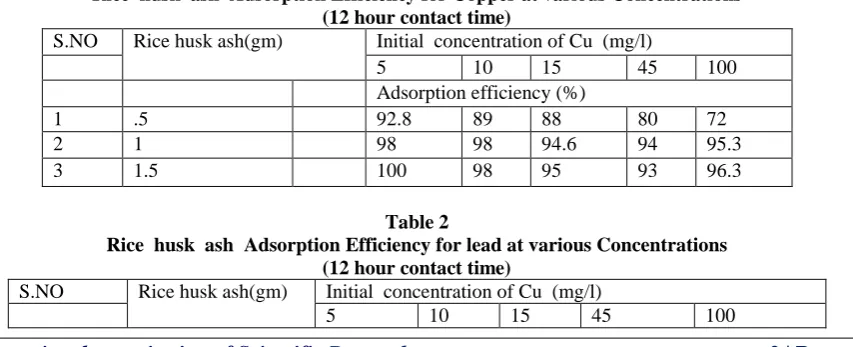
Individual and mixed solutions of Pb and Cu with different concentrations of 5, 10, 15, 45, 100 mg/L were prepared. in this study we were performed by using three different amount of adsorbent 0.5, 1, 1.5, in single solution. Firstly we take 0.5gm adsorbent in a conical flask in which 100 ml of solution of Pb was added and the mixture was shaken in shaker. After this the mixture was filtered after 12 hours contact time and final concentration of metal ion was determined by atomic adsorption spectrophotometer (GBC 902).
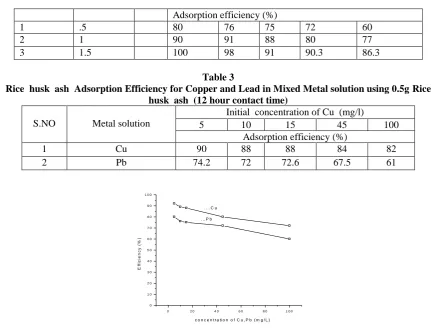
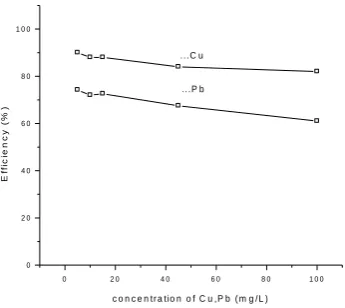
The experiments were studied in three times and the mean concentration calculated by taking of average them. The experimental procedure were repeat by varying the adsorbent dose and concentration of Pb and Cu solution both individual and in mixed solution. Based on residual concentrations, the adsorption efficiency of Rice Husk Ash is calculated and summarized in Table 1-3. Results and Discussion The above analysis indicates that the adsorption efficiency of Rice Husk Ash is high for Cu (Table-1and 2).it has been found that the adsorption efficiency for various concentrations of Cu by taking adsorbent dose from 0.5 gto 1.5 gm Rice husk ash shows in Table 1.studied that Rice Husk Ash is a good adsorbent for removal of heavy metal Cu from industrial waste water . The adsorption rate is depend on adsorbent amount and initial concentration of heavy metal in synthetic solution. 92.8% removal of Cu from 5 mg/L solution was possible by applying 0.5 g Rice Husk Ash. whereas at the .5gm adsorbent was not enough for the remove 100mg/L Cu solution to above 72%. However, by increasing the amount of Rice husk ash powder to 1.5g the efficiency of adsorption was 96.3% for the same solution (100mg/L Cu). Studied that at higher quantity of adsorbent dose removal hevvy metal ions efficiency were higher. From Table- 2 it has been found that the adsorption efficiency is dependent on the type of metal, as for Pb the efficiency of lead removal was 80 % at 0.5 gm adsorbent dose in solutions 5mg/L). From the Table-3 the results of adsorption experiments conducted on the mixture of metal solution as citation before, the maximum and minimum removal efficiency in the first stage experiments with 0.5g of adsorbent was 92.8% and 80% for Cu and Pb. However, for the mixture of these metals a decrease of 2.8% has observed for Cu whereas Pb adsorption has decreased about 5.8%. The efficiency of Cu and Pb adsorption by various amounts of Rice Husk Ash mention in fig.1 to fig 3 for distinct solution and for mixed solution of Cu and Pb (fig.4).
Adsorption efficiency (%)
1 .5 80 76 75 72 60
2 1 90 91 88 80 77
3 1.5 100 98 91 90.3 86.3
Table 3
Rice husk ash Adsorption Efficiency for Copper and Lead in Mixed Metal solution using 0.5g Rice husk ash (12 hour contact time)
S.NO Metal solution
Initial concentration of Cu (mg/l)
5 10 15 45 100
Adsorption efficiency (%)
1 Cu 90 88 88 84 82
2 Pb 74.2 72 72.6 67.5 61
0 2 0 4 0 6 0 8 0 1 0 0
0 1 0 2 0 3 0 4 0 5 0 6 0 7 0 8 0 9 0 1 0 0
. . . P b . . . . C u
E
ff
ic
ie
n
c
y
(
%
)
c o n c e n t r a t io n o f C u , P b ( m g / L )
Figure 1 % Adsorption of Copper and Lead by .5g Rice husk Ash
0 2 0 4 0 6 0 8 0 1 0 0
0 1 0 2 0 3 0 4 0 5 0 6 0 7 0 8 0 9 0 1 0 0
. . . P b . . . C u
E
ff
ic
ie
n
c
y
(
%
)
c o n c e n t r a t io n o f C u , P b ( m g / L )
0 2 0 4 0 6 0 8 0 1 0 0 0
1 0 2 0 3 0 4 0 5 0 6 0 7 0 8 0 9 0 1 0 0 1 1 0
...P b ...C u
E
ff
ic
ie
n
c
y
(
%
)
c o n c e n tr a tio n o f C u ,P b ( m g /L )
Figure 3 % Adsorption of Copper and Lead by 1.5g Rice husk Ash
0 2 0 4 0 6 0 8 0 1 0 0 0
2 0 4 0 6 0 8 0 1 0 0
...P b ...C u
E
ff
ic
ie
n
c
y
(
%
)
c o n c e n tr a tio n o f C u ,P b ( m g /L )
Figure 4 % Adsorption of Copper and Lead in mixed metal solution by using by .5g Rice husk Ash
VI.
CONCLUSION
[6] Sari A, Tuzen M and Soylak M, Adsorption of Pb(II) and Cr(III) from aqueous solution on Celtic clay, J. Hazard. Mater, 144, 41- 46 (2007)
[7] Bulut Y and Baysal Z, Removal of Pb(II) from wastewater using wheat Bran, J. Environ. Manage,
78,107-113 (2006)
[8] Matheickal J T and Yu Q, Biosorption of Pb(II) from aqueous solutions by Phellinus badius, Miner
Eng.,10, 947-957 (1997)
[9] Carvalho de R P, Freitas J R, de Sousa M G, Moreira R L, Pinheiro M V B, Krambrock K, Biosorption of
copper ions by dried leaves: chemical bonds and site Symmetry, Hydrometallurgy , 71, 277-283 (2003) 10. Valdman E, Leite S G F, Biosorption of Cd, Zn and Cu by Sargassum sp. waste biomass, Bioprocess Engineering, 22, 171-173 (2000)
[10] Song Z, Williams C J, Edyvean RG J, Treatment of tannery wastewater by chemical coagulation,
Desalination,, 164, 249-259 (2004)
[11] Fahim N F, Barsoum B N and Eid A E, Removal of Chromium (III) from tannery wastewater using
activated carbon from sugar industrial waste, J. Hazard. Mat., 136, 303-337 (2006)
[12] Tiravanti G, Petruzzelli D and Passino R, Pretreatment of tannery wastewaters by an ion exchange
process for Cr(III) removal and recovery, Water Sci. Technol., 36, 197-207 (1997)
[13] Filibeli A, Buyukkamaci N and Senol H, Solidification of tannery wastes, Resour.Conserv.Recy, 29,
251-261 (2000)
[14] Song Z, Williams C J and Edyvean R G J, Sedimentation of tannery wastewater, Water Res., 34,
2171-2176 (2000)
[15] Fabianil C, Rusciol F, Spadonil M and Pizzichini M, Chromium(III) salts recovery process from tannery
wastewaters, Desalination, , 108,183 (1996)
[16] Fabianil C, Rusciol F, Spadonil M and Pizzichini M, Chromium(III) salts recovery process from tannery
wastewaters, Desalination, , 108,183 (1996)
[17] Brooks C. S., Metal recovery from industrial waste, Lewis Publisher, USA, (1991)
[18] Agarwal A and Saxena M, Assessment of toxic effect of Brass and Steel industries waste on labeo Rohita
in nearby river , International Journal of Environmental Engineering and Management, , 2(1),107-110 (2011)
[19] Agarwal A. and Saxena M., Correlation between physicochemical water parameters using regression