Experimental Study of Hydrograph Model of
Catchment Area Based on Regional Characteristic
Ratna Musa, Muhammad Saleh Pallu, Lawalenna Samang, Mukhsan Putra
Abstract-- This research intends to know regional physic characteristic such as rainfall, land use, soil type and regional topography in the frame work for development of hydrograph model experimental based on regional characteristic; hydrograph pattern for various regional factor; synthetic unit hydrograph model applies catchment area parameter; Information of model validity when it is applied in others catchment area.
This research in the form of experimental study implemented in the laboratory by using rainfall simulator as a simulation rain. Modelling process is prepared by statistic with regression method. The research is implemented toward a physic factor of the catchment area like rainfall, land use, soil type, large of catchment area (A), the length of the main river (L) river mean slope (S) believed that has effect to hydrograph shape. The result of this study shows that result of the test for cover land, stone, earth, grass, and the average (combination of stone, earth, grass) characterize shape of catchment area tendeng to stretch a long a length, having rising characteristic is faster than recession
line (hydrograph rising line < hydrograph recession line). The result of adjustment produces hydrograph parameter value
(α*) = 1 - 2,5 whereas for value tg is modified from the orginal formulation tg = 0,21 becomes tg* = (
√ ) * tg .
After model constant adjustment be done, the result is more accurate than their measurement unit hydrograph, indicated by value of coefficient of efficiency (CE) more than 0,90 shows that adjustment of model HSS has a good approximation accurateness level, and it is supported by the test parameter value of EV, AEQp, EQp and ETp which have approached or equals to 0 (zero). The result of model validity with measurement data of sub catchment area of Bantimurung has produces good performance. Value of CE for other tested model = 1 (one), likewise for other test parameter so that result in the most satisfication unit hydrograph shape estimation. From this condition indicates that hydrograph of empiric synthetic unit (HSE) have the same shape with the measurement unit hydrograph.
Index Term-- Characteristic of Catchment area, synthetic unit hydrograph physic model.
Ratna Musa is serving in
Doctoral Student Department of Civil Engineering, Hasanuddin University, Makassar. South Sulawesi, Indonesia [email protected]
Lawalenna Samang is serving in
Civil Engineering Department, Hasanuddin University, Makassar. South Sulawesi, Indonesia [email protected]
Muh. Saleh Pallu is serving in
Civil Engineering Department, Hasanuddin University, Makassar. South Sulawesi, Indonesia [email protected]
Mukhsan Putra is serving in
Civil Engineering Department, Hasanuddin University, Makassar.
I. INTRODUCTION
A. Problem Background
The transformation process of rain into discharge is a complex phenomenon, so it becomes serious problem for hydrologist. Basically, this problem can be overcome if discharge data exists in the long distance at any outlet in the river, therefore, determining design flood is not necessary done transformation analysis of rain becomes discharge. However, discharge data is often unavailable or the data is available with very restricted data distance. Therefore, transformation analysis of rain becomes discharge must be done as a consequences of data restriction.
Actually, many models have been introduced to analyze transformation of rain becomes discharge as an anticipation of that problem. However, many cases that model not give a satisfication result and tends to results in big deviation. This means that the method application tend to be restrected in the catchment area applied as a composer of the model parameter. As consequences of that problem, this research tries to prepare any model in the form of small scale as a key parameter of the unit hydrograph with the title “Experimental Study of Hydrograph model in catchment area Based on Regional characteristic.
B. The Objective of This Study
The purpose of this study is to implement experimental study to investigate the role or contribution of regional factor to justify a pattern of hydrograph unit for catchment area based on regional factor and finds a practical implementation prespective within hydrograph unit development for specifically catchment area.
The aim of this study is to:
1. Know regional physical characteristic such as rainfall, land use, soil type and regional topography in the frame work of development of hydrograph model experimental based on the regional characteristic.
2. Know hydrograph pattern for various regional factor 3. Know synthetic unit hydrograph model using parameter
of the catchment area
4. Know model validity information when it is applied in other catchment area.
C. Benefit of The Study
1. As a simple instrument for unit hydrograph estimation for catchment areas which are not measured yet (catchment area having not flow data either water level or discharge measurement data ) in particular in the activity of water structure design.
II. LITERATURE REVIEW
A. Catchment Area
The catchment area interpreted as a landscape bordered by topography divide catching, collecting and flowing rain water to outlet has been extendly accepted as a water resources management existing in the catchment area (IPB Team). The catchment area as the smallest planning unit has specific character which is extremely influenced by type soil, topography, geology, geomorphology, vegetation and land use.
B. Factor and Parameter of Catchment Area Flow
In the catchment area there are several factors having special characteristic means that every catchment area will provide a different catchment area to the same rainfall input. Several factors influencing are rainfall and catchment area characteristic namely : (a) Rainfall intensity, (b) rainfall duration, (c) rainfall distribution, (d) distribution of rainfall spreading, (e) Rain movement direction, (f) previous rainfall index, (g) catchment area, (h). Large of catchment area, (i).land use, (j). Topography, and (k) and Soil type.
C. Concept and Mechanism of Hydrograph Process Flow.
1. Catchment Area Concept
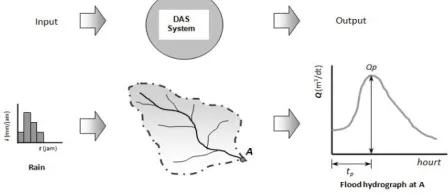
The symplification of hydrology cycle elements conceptuals is a basic principle that will be developed as a volume calculation or water flow from the all flow components that maybe occur in one area or given zone. In hydrology contex can be stated that transformation process from one input set becomes one output set in a hydrology system, namely watershed system. Input in this interpretation is rainfall, whereas output is flow. This concept is schematically shown in Figure 1.
Fig 1. Scheme of Catchment Area System
2. Unit Hydrograph
The unit hydrograph is defined as a direct runoff hydrograph recorded at the end of catchment area in downstream emerged by effective rainfall in the amounth of one unit (1 mm, 1 cm, or 1 inch) that has occured spread throughout in all catchment areas with intensity is constant in the one time unit (example 1 hour) given.
3. Synthetic Unit Hydrograph
Seyhan said that several patameters of catchment area physic in determining shape of unit hydrpgraph besides rain
characteristic. The parameter of the catchment area physic is large of catchment area, slope, drainage pattern and so on. The parameters of catchment area physic will be used in determination amounth of unit hydrograph from the related catchment area with synthetic hydrograph method.
III. STUDY METHODOLOGY
A. Time and Study Object
This study is implemented in laboratory of soil mechanic and hydroulic of Civil Technic Department, Technic Faculty of Hasanuddin for six months from May to October 2013. The object of study is carried out in sub catchment area of Bantimurung in Maros Regency of South Sulawesi. Geographycally, Bantimurung catchment area is located in position 05°01´14,55“ of south latitude and 119°40´32,3“ of east longitude with area of 20,26 km2 with elevation between 100 to 500 m above sea mean level given in Figure 2.
Fig. 2. Location of study object (sub Catchment Area of Bantimurung)
B. Study Procedure
This study has been conducted by the following steps : 1. Data collection
In this step is carried out of preparation, collection of data, material and instrument for model preparation.
a. Data collection consists of secondary and primary data.The collection of secondary data comparises rainfall intensity data, procentage of land use application, land slope, river slope, large of catchment area, shape of the catchment area and soil type and the primary data such as infiltration measurement, discharge data, water level data, and run off volume.
b. Scale model of catchment area
The catchment area model in laboratory such as shown in figure 3, with lenght of 3,11 meters and the wide of 1,63 meters.The depts of soil layer in upstream is taken 50 cm and in down stream 10 cm.
c. Material and Tool
2. The tool used is rainfall simulator, measurement glass, stopwatch, digital camera, rain water reservoir, roll meter, laptop, software Microsoft Excel, and the other supporting instrument.
2. Preparing model parameter design. 3. Preparation of physic model 4. Laboratory test
5. Data analysist
The data analyst comprises :
a. Determination of regional rainfall is done by mean method.
b. Analysis of inflitration capacity is done by using Ø index.
c. Preparation of model was established by mathematic equals deseribing run off process occuring in the catchment area,started from process of rain, inflatration percolation up to have formed lag flow at the end forms base flow. Accumulation from all the run off typies are a hydrograph of river in the catchment area. d. Model calibration was conducted as return test
based on data of infiltration calculation result by using data of hours or daily rainfall up to be obtained estimation hydrograph which its value approaches/same with measurement data with determination coefficient value toward real data. e. Model validity test is conducted by hydrograph
estimation simulation with applying model that had been calibrated using other rainfall data. Standard of model validity test based on presentation hydrograph and graphycally actual hydrograph and determination coeficient value (R2).
The completion study step can be shown in Figure 3 as following :
Fig 3.Test model prespective
IV. RESULT AND DISCUSSION
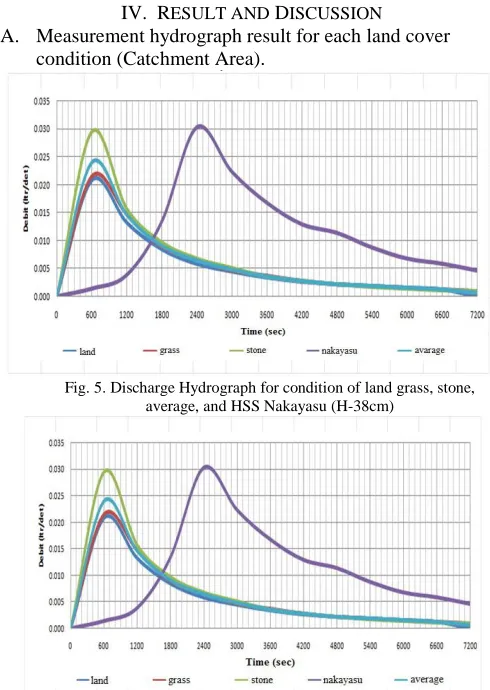
A. Measurement hydrograph result for each land cover condition (Catchment Area).
Fig. 5. Discharge Hydrograph for condition of land grass, stone, average, and HSS Nakayasu (H-38cm)
Fig. 6.Discharge hydrograph for condition of grass land, stone, average, and HSS Nakayasu (H-58cm)
B. Result of measurement unit hydrograph component for each land cover condition (Catchment Area)
Table I
Component of syntetic unit hydrograph (HSS) Nakayasu and measurement unit hydrograph (before adjustment).
Table II
Table III
Value of quantitative test parameter of HSS Nakayasu toward measurement unit hydrograph (before model constant adjusment) H-58 cm.
C. Model Adjustment of experimental hydrograph and synthetic unit hydrograph (HSS) Nakayasu.
The adjusment of empirical to be done by way to minimaize the different of modelling result value with measurement value. Equation of model constant
adjusment result for every principal variable of synthetic unit hydrograph (HSS) Nakayasu, with the following result :
1.
Equation of tg, namely time lag of begining to flood peak, lenght of the river (L) < 15 km be suggested tg = 0,21 L 0,7, after model constant adjusment becarried out = (
√ ) *β*tg .
2.
Equation of peak discharge (Qp) of synthetic unit hydrograph (HSS) be suggested Qp =
,after model constant adjusment is done : Qp* = ( )
(
)
3.
Coefficient β is needed in calibration process of value Tp. The value of Tp of coefficient standard β is 3, if calculation of Tp is smaller than Tp of observation, value β is taken > 3 in order that value Tp increases. If the Tp of calculation is bigger than Tp calculation, value β is taken < 3 in order that value of Tp will reduce. This process is repeated in order that Tp of calculation approa Tp of calculation.4.
Coefficient α* is needed in calibration process of peak discharge value (Qp). Value of Qp of coefficient standard α* is 3, if the value of calculation peak discharge value is smaller than observation peak discharge, value α* is taken < 3 in order that peak discharge value increases . If the calculation peak discharge is bigger than observation peak discharge, the value of α* is taken > 3 in order that peak discharge value will reduce. This process is repeated in order to calculation peak discharge approaeches observation peak discharge (Qp).5.
Hydrograph parameter (α) is needed in process of calibration in the form of hydrograph. The value of α coefficient standard is 3 for time hydrograph shope rises is faster than their recession.6.
Base time (Tb) for catchment area has measurement medium and in the amount of teority value Tb mayhave unlimitation value (equal to Nakayasu method), however, in their practical Tb can be limited until recession curve approaches zero.
From the result of analysis, coordinat of measurement unit hydrograph and synthetic unit hydrograph (HSS) Nakayasu with adjusment indicates small deviation (<10%). This indicates that model of synthetic unit hydrograph (HSS) is good enough to predict discharge in this study.
Table IV
The result of parameter value change of model quantitative test for shynthetic hydrolograph (HSS) Nakayasu (after model constant adjusment)-H-38cm.
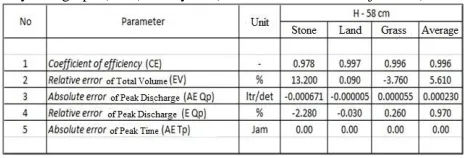
Table V
The result of parameter value change of model quantitative test for shynthetic hydrolograph (HSS) Nakayasu (after model constant adjusment)-H-58cm.
The table IV and table V, shows that after adjusment be done toward model constant measurement unit hydrograph shape estimation accurateness is more improve where the shape of synthetic unit hydrograph (HSS) of adjusment result is the more approaches shape of their measurement unit hydrograph shown by a mounth value of coefficient of efficient (CE) approaching value1.The value of coefficient of efficient (CE) more then 0,90 indicates taht model of synthetic unit hydrograph adjusment has good estimation accurateness level,and it is supported by test parameter value of EV, ΔEQp, EQp, and ETP in which approaches or equal to value 0 (zero). Adjustment of synthetic unit hydrograph applied to estimate unit hydrograph shape of other catchment area is an adjusment synthetic unit hydrograph with average measurement unit hydrograph.The application of average measurement unit hydrograph is intended in order to model can be valid to all conditions of land cover, not only for any condition of just land cover .
D. Model Validation of catchment area of empirical unit hydrograph and synthetic unit hydrograph Nakayasu.
The model validation is done on sub Bantimurung catchment area with the following parameter :Large of catchment area (A) = 20,26 km2,the main length of the chanel(L)= 6,22 km from outlet (AWLR Bantimurung) with average river slope = 0,,523, the depth average = 7,0 meters and wide average= 14 meter. The shape of Bantimurung Catchment area is more like shape of bird fur (stretch a long of lenght) with measurement outlet in station of automatic water level recorder of Bantimurung.
Table VI
Component of empirical unit hydrograph and synthetic unit hydrograph Nakayasu of sub Bantimurung Catchment Area (not validated yet)
Fig. 8. Empirical unit hydrograph and synthetic unit hydrograph Nakayasu sub Catchment Area of Bantimurung (not validated yet).
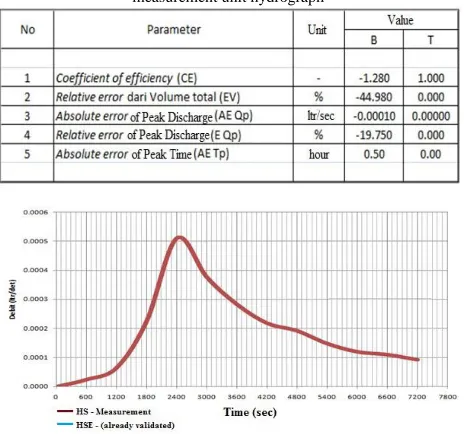
Table VII
Value of test parameter of synthetic unit hydrograph quantitative towards measurement unit hydrograph
Fig. 9. Hydrograph of units measurements and synthetic unit Nakaysu after being validated.
In Figure 9 and Table 7 , show that application of synthetic unit hydrograph Nakayasu in
estimating unit hydrograph of sub catchment area of Bantimurung has indicated a good result. The value of C for testing model = 1 (one), this means that simulation result hydrograph has the same shape with measurement unit hydrograph. Likewise for other test parameter if it is seen from the value improvement of relative error volume total (EV) that before is 44,98% becomes 0,00%. This Indicates that there is no volume different between unit hydrograph of measurement result with synthetic unit hydrograph Nakayasu.
The adjusment of model constant also improves the accurateness in estimating the amounth of peak discharge namely there is a change of value EQP from 19,75% to 0,00%.This means that there is no different between model of synthetic unit hydrograph Nakayasu with measurement unit hydrograph The Adjustment of model constant also improves the accurated value of ETp from 0,5 hour to 0 (zero) hour, this means that there is no different between peak time of synthetic unit hydrograph Nakayasu and peak time of measurement unit hydrograph after adjusment of model constant.
V. CONCLUTION AND SUGGESTION
A. Conclution
From the obtained result can be concluded as following :
1. The application of synthetic unit hydrograph for a catchment area having different morphometry characteristic with catchment area where the model to be developed should be adjusted in order to get accurate estimation
2. Model of synthetic unit hydrograph Nakayasu adjusted with the model is able to estimate a shape of
measurement unit hydrograph with high
accurateness.
3. Model of empirical unit hydrograph which has been adjusted their model constant with unit hydrograph measurement data of sub catchment area are able to estimate the well unit hydrograph shape.
4. Characteristic observation hydrograph (for all land cover conditions) characterize the shape of catchment area tending to scetche a long of length, namely has rising line characteristic is faster than recession line (hydrograph rising line time < hydrograph recession line time).
5. Coordinat of empirical hydrograph unit hydrograph with its model constant adjustment indicates small deviation (<10%) to measurement unit hydrograph. 6. From the calculation of the deviation to find the
characteristics of the river where the value of the parameter α is found
7. From the results before calibration measurements with HS HSS Nakayasu via parameters α, β, α * obtained value α = 3, β = 4, and α * = 2.5 the deviation of the peak discharge = 77.942%, whereas after calibration parameters α, β, α *, and tg through measurement unit hydrograph obtained value α = 2.3, β = 4, α * = 1, and g t = 0.7 hours with irregularities in the discharge peak at = -1.880%
8. Based on these results, the parameter values are generated unit hydrograph peak time (Tp) = 0.7 hours, peak discharge (Qp) 2, 5, and 10 years respectively m3/sec beturut = 91.848, 119.021 m3 / sec, 137.493 m3/sec, and time base (Tb) = 3.588 hours
B. Suggestion
Based on study result related with a verification result is suggested us the following :
1. The usefulness of measurement unit hydrograph having shorten time period to minimize the different between peak time of synthetic unit hydrograph model with the peak time of measurement with unit hydrograph.
2. In accordance with study result that has been implemented, the length of river and large of catchment area is the most dominant in the preparation of synthetic unit hydrograph Nakayasu. The two factors are predicted as deviation causal. Likewise for roughness coefficient of catchment area (n), is suggested to re-examine the methode of roughness coefficient determination of catchment area (n).
3. Considering to make several accurate synthetic unit hydrograph models with each relative small error (<10%) is difficult, then public works department for long range is suggested to complete each catchment area with automatic water lever recorder and automatic rain recorder.
ACKNOWLEDGMENT
We would like to thank all whom involved directly and indirectly in completing this paper. Special thanks to the Civil Engeneering Laboratory APTISI Kopertis Wil. IX for supporting, and provided opportunity to the writer to conduct research
REFERENCES
[1] Asdak, Chay., 2001, Hidrologi dan Pengolahan Daerah Aliran Sungai, Yogyakarta, Gadjah Mada University Press.
[2] Bambang, T, 2008, Hidrologi Terapan, Beta Offset, Yogyakarta [3] Budi S, Kridasantosa I, 2007, “ Kajian Keragaman Unit Hidrograf
Sintetik Untuk DAS Citarum dan Pentingnya Validasi Metoda Unit
Hidrograf Sintetik “ PIT HATHI XXIV, Makassar
[4] Chow, V.T., Maidment, M.R., and Mays,L.W., 1998, Applied
Hydrology, McGraw-Hill, New York..
[5] Lily Montarclh L, 2007, Hidrograf Satuan Sintetik Limantara (Studi
Kasus Di Sebagian DAS Di Indonesia), PIT HATHI XXIV, Makassar.
[6] Muhammad Y, “ Studi Pengembangan Model Hidrograf Satuan Sintetik
Snyder Untuk Sungai– Sungai di Sulawesi Selatan”, ITS Surabaya
[7] Noerwanto, Pantjahjo. 2009. Analisis Hidrograf Satuan Sintetis Terhadap Hidrograf Banjir Pengamatan (Studi Kasus Sub DAS
Bokong-Takari, Kabupaten TTS-Propinsi NTT), Universitas Brawijaya, Malang
[8] Olivera,F,2001, Extracting Hydrologic Information from Spatial Data
for HMS Modeling, Journal of Hydrologic Engineering.
Vol.6,No.6,pp.524-530, American Society of Civil Engineers
[9] Seyhan EF, 1977, Dasar-Dasar Hidrologi, Subagyo S, Penerjemah : Prawirohatmodjo S, Editor, Yogyakarta : Gadjah Mada University. Terjemahan dari : Fundamentals of Hydrology
[10] Sosrodarsono, Suyono. Dan Kensaku Takeda, 1999. Hidrologi Untuk
Pengairan, PT. Pradnya Paramita, Bandung
[11] Sri Harto Br, 2000, Hidrologi (Teori, Masalah, dan Penyelesaian), Yogyakarta, Nafiri Offset.
[12] Sujono,J., 1998, Penurunan Hidrograf Satuan dengan Data Hujan
Harian, Media Teknik, Fakultas Teknik, Universitas Gadjah Mada,
Yogyakarta.
Ratna Musa, She is a Doctoral Student, Departement of Civil Engineering, Hasanuddin University, Makassar, South Sulawesi, Indonesia, Post Code : 90245, Telp: +62 411 583646, Email : [email protected] Now, She is a Doctor Candidate in Civil Engineering, School of Engineering, Hasanuddin University, Jalan Perintis Kemerdekaan Km 10 Makassar 90245, South Sulawesi, Indonesia. Telp : +62 411 583646. She was born in Barru, South Sulawesi, Indonesia on 27th December 1958. Her education level at elementary school and junior / middle high school were experienced in Barru, South Sulawesi, senior high school were experienced in Makassar, South Sulawesi. She graduated from Civil Engineering (Ir) at Hasanuddin University, Makassar, South Sulawesi, Indonesia in 1984. She recieved her Master Of Engineering (MT) in Water Resources Department from Yogyakarta University Gadjah Mada (UGM), Yogyakarta, Indonesia from September 1992 until March 1995. She is lecture in University Muslim Indonesia, Makassar, South Sulawesi, Indonesia since October 1985 until now.
H.Muh.Saleh Pallu,Prof.Dr.Ir.M.Eng.; His current address is in Civil Engineering Department, School of Engineering, Hasanuddin University, Jalan Perintis Kemerdekaan Km. 10 Makassar 90245 , South Sulawesi, Indonesia. Telp. +62 411 584639, Fax: +62 411 586015. Email : [email protected]
His academic experience is :
• Doctor of Civil Engineering , University of Kyushu , Japan, 1994. • Master of Civil Engineering , University of Kyushu, Japan,1991.
• Bachelor of Science,Civil Engineering, Hasanuddin University , Makassar, Indonesia 1981.
H.Lawalenna Samang, Prof.Dr.Ir.M.S,M.Eng.; His current address is in Civil Engineering Department, School of Engineering, Hasanuddin University, Jalan Perintis Kemerdekaan Km. 10 Makassar 90245, South Sulawesi, Indonesia. Telp, +62 411 587636, Fax: +62 411 580505. Email: [email protected]
His academic experience is :
• Doctor of Civil Engineering, University of Saga, Japan,1997. • Master of Civil Engineering, University of Saga, Japan,1994.
• Master of Civil Engineering, Hasanuddin University, Makassar, Indonesia,1988.
• Bachelor of Science, Civil Engineering, Hasanuddin University, Makassar,Indonesia 1984.