Restricted Nussbaum Gain Control Method and
Its Application in One Order System
Jinyong YuA
A Department of Control Engineering, Naval Aeronautical and Astronautical University, Yantai, China
Email: [email protected]
Junwei LeiB
B Department of Control Engineering, Naval Aeronautical and Astronautical University, Yantai, China
Email: [email protected]
Yuqiang JinC and Hongchao ZhaoD
C Department of Trainning, Naval Aeronautical and Astronautical University, Yantai, China
D Department of Static Engineering, Naval Aeronautical and Astronautical University, Yantai, China
Email: {jinyuqiang1024 C, zhaohongchao1024D}@126.com
Abstract—The unknown control direction is one of the most open difficult question in nonlinear control theory. A new kind of restricted Nussbaum method is proposed to solve the unknown control direction problem without using high gain feedback. Although High gain has some advantages for improving the dynamic performance of a control system such as it can improve the quickness of the system and it can make the steady state error as small as possible. But now experienced engineers also realized that it causes many problems such as make the system unstable for big signal or high frequency noise. A kind of restricted Nussbaum gain method is firstly proposed to solve the problem. And simulation results show that it has better control effect compared with the traditional Nussbaum gain method. What is worthy pointing out is that the robustness of the Nussbaum gain strategy is improved obviously.
Index Terms—Nussbaum gain; Unknown control direction; Stability; Uncertainty; Adaptive
I. INTRODUCTION
Since there are typical results for linear system control, more and more researchers are interesting in control of nonlinear system [1-3]. The main difficulties for nonlinear control lie to the uncertainties and nonlinearity. Also there are some special method is proposed to solve special nonlinear systems; such as special controller [4, 5] designed for a kind of strict feedback nonlinear systems. Or the controller is designed based on differential geometric approach theory[6], Neural-network method [7], Robust control theory[8,9,10], linear feedback[11], sliding mode method[12,13,14,15]. But the unknown control direction is one of the most open difficult questions in nonlinear control theory.
Since Nussbaum first proposed the Nussbaum gain method [16, 17], the unknown control direction problem has arouse many researchers’ interests. And Nussbaum gain method was applied in first order system and achieved obvious effect. Adaptive methods used by
DING Z[18] to solve unknown control direction problem, and this problem can also be called without a priori knowledge of control direction[19,20] or with unknown virtual control coefficients. Xuedong Ye [21] considered the over parameterization problem during coping unknown control directions. NN method is applied to solve this problem and simultaneously the input constraint is considered by Weisheng Cheng [22]. And T.P.Zhang [23] also use adaptive neural method to solve this problem with dead-zones.
Also unknown control direction with discrete time, time varying , time-delay and output feedback problems are studied by Yang C[24] and Ge, S. S[25,26] and Liu Yunguang [27]. There are some similar problems such as unknown high frequency gains or unmodeled dynamics are research by KE Hai-sen [28] and M. Krstic[29]. Since there is no clear line among those problems so methods for unknown high frequency and unmodeled dynamics can also be used in solve unknown control direction problem.
The Nussbaum gain method can deal with the unknown control direction problem, which is discussed in many papers recently. But it is also has some problems when this method is applied in real engineering control object. The first problem is how to design a proper gain for the system.
So it is always important to choose a proper gain for every system with any control method. Nussbaum gain control is a kind of complex nonlinear adaptive method. It should also obey the above principle. In fact, some Nussbaum gain algorithms can be unstable in some situation and the main reason is that the Nussbaum gain is not proper, or in most situations it is too big. In this paper, a new kind of restricted Nussbaum method is proposed to solve the above problem.
II. PROBLEM DESCRIPTION
Considering a typical one order system with unknown control direction
( )
x= f x +bu . (1) Where x is the state of system and uis the controller or input, f x( )is the known nonlinear function and bis the unknown control direction or it can be called control coefficient.
The control objective of restricted Nussbaum gain method is to design a control u=q x k( , ) and k ≤ksat, where ksatis the restriction of the system gain condition, such that system state xcan track desired value d
x even if the sign of control b is changed from positive to negative or from negative positive.
The solution of restricted gain problem is based on the traditional Nussbaum gain method since it is effective for the unknown control direction problem. But to make the gain is bounded; a bounded gain function is introduced. With a design of double bounded gain layer, the restriction of the gain is realized; also the whole system signals can be guaranteed to be bounded.
III. ASSUMPTION
For above systems, five assumptions are proposed to make the following design easier.
Assumption 1: The given gain ksat is big enough and it
satisfies the energy need of the physical system.
Assumption 2: Without loss of generality, assume the desired value to be constant soxd=0.
Assumption 3: The control direction
b
is bounded and its value is in an unknown field I [ , ]l l1 1− +
= where0∉I, so the sign of bis unknown.
Assumption 4: The bound of bis known, so there exists a known constant bmaxsuch thatb ≤bmax.
Assumption 5: The number of the sign change of bis not infinite.
IV. DESIGN OF RESTRICTED NUSSBAUM GAIN
Design a new error variable as d
z= −x x , the error of the system can be written as
( )
z= f x +bu. (2) Use the poles placement method to design the virtual control as
1 2
( )
d
u = −f x −k z k−
∫
zdt . (3)Considering the unknown control direction problem, design the Nussbaum gain control as:
( )
du
= −
N k u
. (4) Then1 2 ( )
d d
z= −k z k−
∫
zdt bN k u− −u . (5) Design the turning law of Nussbaum gain asd l
l
=
k zu
. (6) Design a bounded gain function as( )
sk
=
f l
. (7)Wheref ls( ) can be chosen as triangular functions. The error function can be written as:
2
1 2
1
( ( ) 1)
l
zz k z k z zdt bN k dl
k
= − −
∫
− +. (8)
Construct a type of integral Lyapunov function as follows:
2 1 2 2 2
1
( )
2 2 2
k k
V = z +
∫
z dt+∫
zdt . (9) Solve the derivative of Lyapunov function as( ( ) 1)
l
k V = − bN k + dl . (10) With integration in both sides of the equation, it holds:
( )
(0)
( ) (0) ( ( ) 1)
( ) (0) ( )
l l
l t
l
k V t k V bN k dl
bN k dl l l t
− = − +
= − + −
∫
∫
. (11)To make it simple, choose the restricted Nussbaum gain as k=10 sin( )l , Nussbaum, and choose the Nussbaum gain function as N k( )=k2sink
.
It is obvious that the system gain satisfies below restrictions with the above design:
2
( ) cos 100
N k =k k< . (12) Also different restriction can be chosen to meet the different demand of real systems.
With the proof below, the system can be proved to be stable and the control law can adapted to the disturbance of control direction change.
First, assume the gain lis unbounded. Without loss of generality, consider the situationl→ +∞ , divide by l
on both side of the equation it holds: ( )
(0)
( ) (0) (0) 1
( ) 1
l t
l l
l
k V t k V l
bN k dl
l l
− + = − −
∫
. (13)Since −bN k( )is bounded, there exist positive constants
1
ε
andε
2such that ( )1 2
(0) 1
( ) 1
l t
l
bN k dl l
ε ε
− ≤
∫
− − ≤ . (14)It is obvious that if kl >0, it holds:
1 ( ) 2
l l
l l
V t
k ε k ε
− ≤ ≤ . (15)
2 ( ) 1
l l
l l
V t
k ε ≤ ≤ −k ε . (16) Assume that the limit of above integration exists:
( )
(0) 1
lim ( ) 1
l t
l l
bN k dl
l ε
→∞
∫
− = + . (17)So it always has
( ) l
V t =εk l . (18) It is obvious that contradiction will appear if kl >0 or
0 l
k < because it will makeV t( )≤0.
Also if the integration does not exist, so there exists a
t such that
( )
3 (0)
1
lim ( )
l t
l l
bN k dl
l ε
→∞
∫
− = . (19)where
1 3 2
ε ε ε
− ≤ ≤ . (20) So whetherε3 is positive or negative, there exists
0
l
k > or kl<0such thatV t( )≤0 , then contradiction appears.
Now, it is easy to prove that ( )l t is bounded. Also ( )V t is bounded and ( )z t is bounded. Finally, d
u is proved to be bounded. Because of the construction of integral type Lyapunov function, it is easy to prove that ( )z t →0.
V. NUMERICAL SIMULATION
Take a simple one order system with unknown control direction as an example, the model can be written as
3 sin
x= x x bu+ . (21) Where the unknown control direction bis designed as:
1 0 3
2 3 6
2 6
t
b t
t < <
⎧ ⎫
⎪ ⎪
= −⎨ < < ⎬
⎪ > ⎪
⎩ ⎭
. (22)
Choose the initial value of Nussbaum gain as (0) 1
l = ,the initial condition as (0)x =0, set the desired value of state as xd =2 , set the simulation step as 0.001s and do the simulation with Eular method , the simulation result can be show as below figures.
Figure 1 shows the state of x1 and at time 3s and 6s, the state x is disturbed by the change of control direction. But it can be stabled by Nussbaum gain law successfully.
Figure 2 shows the restricted Nussbaum Gain L and it is clear that the Nussbaum gain can adapt to a proper gain after the disturbance of control direction.
Figure 3 shows the real Nussbaum Gain K and it is obvious that the Nussbaum gain can adapt to the unknown change of control direction.
0 1 2 3 4 5 6 7 8 9 -10
-9.5 -9 -8.5 -8 -7.5 -7 -6.5 -6 -5.5 -5
t/s
K
Figure 3. Curve of Gain K.
0 1 2 3 4 5 6 7 8 9 10
10.2 10.4 10.6 10.8 11 11.2 11.4 11.6
t/s
L
Figure 2. Curve of Gain L
0 1 2 3 4 5 6 7 8 9 0
2 4 6 8 10 12
t/s
x
Figure 4 shows the real gain of control and it can follow the change of control direction very quickly.
Figure 5 shows the ideal control and the overshoot is obvious at the time when control direction is changed.
Figure 6 shows the real control and it shows that at the time the control direction changes the control law need enough energy to make the system stable.
In order to test the robustness of this limit Nussbaum gain method under different initial gain value, we done a
simulation assume that the initial gain is
l
(0) 10
=
, and simulation result is show as below.Figure 7 shows the state of x1 and at time 3s and 6s, the state x is disturbed by the change of control direction.
Figure 8 shows the restricted Nussbaum Gain L and the initial value is set to 10.
Figure 10 shows the real Nussbaum Gain K and it is begin from -5.5 and adapt to the unknown change of control direction and finally stop at about -9.5.
0 1 2 3 4 5 6 7 8 9 -10
-9.5 -9 -8.5 -8 -7.5 -7 -6.5 -6 -5.5 -5
t/s
K
Figure 9. Curve of Gain K
0 1 2 3 4 5 6 7 8 9 10
10.2 10.4 10.6 10.8 11 11.2 11.4 11.6
t/s
L
Figure 8. Curve of Gain L
0 1 2 3 4 5 6 7 8 9 0
2 4 6 8 10 12
t/s
x
Figure 7. Curve of state x.
0 1 2 3 4 5 6 7 8 9 -400
-300 -200 -100 0 100 200 300 400
t/s
u
Figure6. Curve of Control U
0 1 2 3 4 5 6 7 8 9 -70
-60 -50 -40 -30 -20 -10 0 10 20
t/s
ud
Figure 5. Ideal control Ud.
0 1 2 3 4 5 6 7 8 9 -8
-6 -4 -2 0 2 4 6
t/s
Nk
Figure 11 shows the ideal gain of control and it can follow the change of control direction very quickly.
Figure 12 shows the ideal control and the overshoot. We can make a conclusion from above simulation results that the restricted Nussbaum gain method is effective and robust under different initial gain value.
To test the robustness of the restricted Nussbaum method under different initial value of system state, we done a simulation and assume that the initial value the
first order system is
x
(0)
=
5
. And the simulation result is shown as below.Figure 13 shows the state of x1 and at time 3s and 6s, the state x is disturbed by the change of control direction, and the initial state is 5.
Figure 14 shows the restricted Nussbaum Gain L and the initial value is set to 10.
0 1 2 3 4 5 6 7 8 9 0
2 4 6 8 10 12
t/s
K
Figure 15. Curve of Gain K
0 1 2 3 4 5 6 7 8 9 0
0.1 0.2 0.3 0.4 0.5 0.6 0.7 0.8 0.9
t/s
L
Figure 14. Curve of Gain L
0 1 2 3 4 5 6 7 8 9 -2
0 2 4 6 8 10 12 14
t/s
x
Figure 13. Curve of state x.
0 1 2 3 4 5 6 7 8 9 -70
-60 -50 -40 -30 -20 -10 0 10 20
t/s
ud
Figure 12. Curve of real control U
0 1 2 3 4 5 6 7 8 9 -70
-60 -50 -40 -30 -20 -10 0 10 20
t/s
ud
Figure 11. Ideal control Ud
0 1 2 3 4 5 6 7 8 9 -8
-6 -4 -2 0 2 4 6
t/s
Nk
Figure 15 shows the real Nussbaum Gain K and it is begin from 0 and adapt to the unknown change of control direction and finally stop at about 10.8.
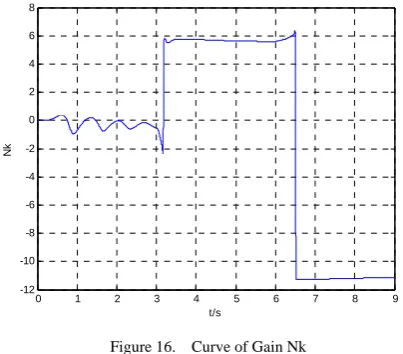
Figure 16 shows the ideal gain of control and it can follow the change of control direction very quickly.
Figure 17 shows the ideal control and the overshoot and Figure 18 shows the real control of the Nussbaum gain method. We can make a conclusion from above simulation results that the restricted Nussbaum gain method is effective and robust under different initial system state.
Also choose another initial value as
x
(0)
=
6.6
, it is the biggest initial value the proposed restricted method can cope. And compared with common Nussbaum gain method, this value is improved. And the simulation result is shown as below.Figure 19 shows the state of x1 and at time 3s and 6s, the state x is disturbed by the change of control direction. It is obvious that the system is unstable since the initial value of the system state is too big.
0 1 2 3 4 5 6 7 8 9 0
2000 4000 6000 8000 10000 12000 14000
t/s
L
Figure 20. Curve of Gain L
0 1 2 3 4 5 6 7 8 9 -400
-200 0 200 400 600 800 1000 1200 1400 1600
t/s
x
Figure 19. Curve of state x
0 1 2 3 4 5 6 7 8 9 -800
-600 -400 -200 0 200 400
t/s
u
Figure 18. Curve of real control U
0 1 2 3 4 5 6 7 8 9 -100
-80 -60 -40 -20 0 20
t/s
ud
Figure 17. Ideal control Ud
0 1 2 3 4 5 6 7 8 9 -12
-10 -8 -6 -4 -2 0 2 4 6 8
t/s
Nk
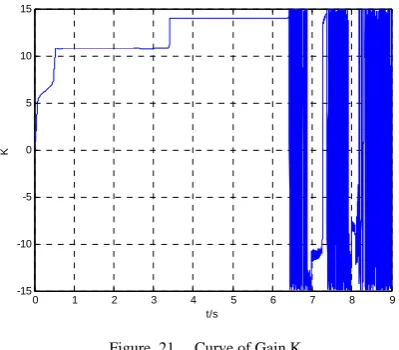
Figure 20 shows the restricted Nussbaum Gain L and the initial value is set to 0, and figure 21 shows the Nussbaum gain K and it is restricted from -15 to 15. Both gain K and L is unstable as time increase.
So we can make a conclusion that the restricted Nussbaum can improve the system stability compared with common Nussbaum gain method. But it is still can not guarantee the system is always stable if the initial value is too big. That is mainly because the Nussbaum gain is a nonlinear control law and the stability is not global. And also because the simulation step is not small enough on some point the gain of the system is too big.
VI. CONCLUSIONS
A kind of restricted Nussbaum gain method is proposed in this paper. It can be used to solve the complex unknown control direction problem. The advantage of this method is that the gain of controller is limited. It can also improve the traditional Nussbaum gain design that it makes the Nussbaum gain strategy more stable since the gain is restricted. Also the stability is proved in this paper that it is not affected by the limit gain.
ACKNOWLEDGMENT
The author wish to thank his friend Heidi in Angels (a town of Canada) for her help , and thank his classmate Amado in for his many helpful suggestions. This paper is supported by Youth Foundation of Naval Aeronautical and Astronautical University of China, National Nature Science Foundation of Shandong Province of China ZR2012FQ010, National Nature Science Foundations of China 61174031, 61004002, 61102167, Aviation Science Foundation of China 20110184 and China Postdoctoral Foundation 20110490266.
REFERENCES
[1] RYAN E P.A universal adaptive stabilizer for a class of nonlinear systems. Systems & Control Letters, 1991, 16(3): 209-218.
[2] Qian, C., & Lin, W. (2002). Output feedback control of a class of nonlinear systems: A nonseparation principle paradigm. IEEE Transactions on Automatic Control, 47, 1710-1715
[3] RYAN E P.A nonlinear universal servomechanism. IEEE
Trans on Automatic Control, 1994, 39(4): 753-761.
[4] GE Shuzhi Sam, WANG J. Robust adaptive neural control
for a class of perturbed strict feedback nonlinear systems. IEEE Trans on Neural Networks, 2002, 13(11): 1409- 1419.
[5] Charalampos P. Bechlioulis, George A. Rovithakis,
adaptive control with guaranteed transient and steady state tracking error bounds for strict feedback systems , Automatica 45(2009)532-538
[6] C. C. Fuh and P. C. Tung, “Controlling Chaos Using
Differential Geometric Approach,” Physical Review Letters, vol. 75, no. 16, pp. 2952-2955, 1995.
[7] Jagannathan S, He P. Neural-network-based state-feedback control of a nonlinear discrete-time system in nonstrict feedback form. IEEE Transactions on Neural Networks 2008; 19(12):2073-87.
[8] Polycarpou, M. M., Ioannou, P. A. A robust adaptive
nonlinear control design. Automatica, Vol. 32. No. 3 (1996) 423-427
[9] Seung-Hwan Kim, Yoon-Sik Kim, Chanho Song, A robust
adaptive nonlinear control approach to missile autopilot design, Control engineering practice, 12(2004) pp. 149-154 [10]Sahjendra N. Singh, Marc Steinberg, Robert D. Digirolamo,
Variable Structure Robust Flight Control System for the F-I4, IEEE transactions on aerospace and electronic systems vol. 33, No. 1 , 1997
[11]Tsinias, J. (1991). A theorem on global stabilization of nonlinear systems by linear feedback. System and Control Letters, 17, 357-362
[12]Xu H J and Mirmirani M.Robust adaptive sliding control for a class of MIMO nonlinear systems [A].In: AIAA Guidance,Navigation,and Control Conference and Exhibit. Montreal, Canada, AIAA 2001-4168.
[13]Yuqiang Jin, Junwei Lei, Yong Liang, Tracking of super chaotic system with static uncertain functions and unknown parameters, Journal of Computers, 2012:7(12),2853-2860
[14]Jingjing Du, Chunyue Song, Multi-PI control for block-structured nonlinear systems, Journal of Computers,2012:7(12),3052-3059
[15]Guoqiang Liang, Junwei Lei, Yong Liang, Research on the robustness of PISS integral sliding mode control of supersonic missiles, Journal of Computers, 2012:7(8),1943-1950
[16]Nussbaum, R. D. (1983). Some remarks on the conjecture in parameter adaptive control. Systems and Control Letters, 3(3), 243-246
[17]MARTENSSON B. Remarks on adaptive stabilization of
first order nonlinear systems. Systems & Control Letters, 1990, 14(1): 1-7
[18]DING Z. Adaptive control of nonlinear systems with
unknown virtual control coefficients. Int J of Control Signal Processing, 2000, 14(4): 505 - 517.
[19]YE X, JIANG J. Adaptive nonlinear design without a
priori knowledge of control directions. IEEE Trans on Automatic Control, 1998, 43(11): 1617 -1621.
[20]YE X D. Asymptotic regulation of time-varying uncertain nonlinear systems with unknown control directions. Automatica, 1999, 35(5): 929 - 935.
[21]Xuedong Ye, Global adaptive control of nonlinear systems with unknown control directions nonover-parameterization
0 1 2 3 4 5 6 7 8 9 -15
-10 -5 0 5 10 15
t/s
K
design, Journal of China Jiliang University, Jan, 2005 Vol.14,No,1
[22]Weisheng Chen, Adaptive NN control for discrete-time
pure-feedback systems with unknown control direction under amplitude and rate actuator constraints, ISA Transactions 48 (2009) 304-311
[23]T.P.Zhang , S.S.Ge Adaptive neural control of MIMO
nonlinear state time-varying delay systems with unknown dead-zones and gain signs, Automatica 43(2007) 1021-1033
[24]Yang C, Ge SS, Xiang C, Chai TY, Lee TH. Output
feedback NN control for two classes of discrete-time systems with unknown control directions in a unified approach. IEEE Transactions on Neural Networks 2008; 19(11):1873-86.
[25]Ge, S. S., & Wang, J. (2003). Robust adaptive tracking for time-varying uncertain nonlinear systems with unknown control coefficients. IEEE Tran-sactions on Automatic Control, 48(8), 1463-1469.
[26]Ge, S. S., Hong, F., & Lee, T. H. (2004). Adaptive neural control of nonlinear time-delay system with unknown virtual control coefficients. IEEE Transactions on Systems, Man, and Cybernetics-PartB: Cybernetics, 34(1), 499-516.
[27]Liu Yunguang, Output-feedback Adaptive Control for a
Class of Nonlinear Systems with Unknown Control Directions, ACTA AUTOMATICA SINICA, Vol. 33, No. 12, 1306-1312
[28]KE Hai-sen, YE Xu-dong, Robust adaptive controller
design for a class of nonlinear systems with unknown high frequency gains, Univ SCIENCE A 2006 7(3):315-320
[29]M. Krstic, J. Sun, and P. V. Kokotovic, “Control of
Feedback Linearizable Systems with Input Unmodeled Dynamics,” Proc. of the 33rd Conference on Decision and Control, Lake Buena Vista, FL, pp. 1633-1638, 1994
Jinyong Yu (1977-) was born in Haiyang city of Shandong province of China and received his Doctor degree in Guidance, Navigation and Control in 2006 from Naval Aeronautical and Astronautical University, Yantai of China.
He became a vice professor of this school in 2008 and now he is the director of drone teaching team of control engineering department. Now his current interest is aircraft control and navigation.
Junwei Lei (1981- ) was born in Chibi of Hubei province of China and received his Doctor degree in Guidance, Navigation and Control in 2010 from Naval Aeronautical and Astronautical University, Yantai of China. Her present interests are control theory, chaotic system control, aircraft control and adaptive control.