www.ijraset.com Volume 5 Issue V, May 2017 IC Value: 45.98 ISSN: 2321-9653
International Journal for Research in Applied Science & Engineering
Technology (IJRASET)
©IJRASET: All Rights are Reserved
195
Driver Alert System using Eye Pupil Detection
D. Ashok1, Shreekesh Sreekumar2, Vineet Kumar3, Ankesh Raj4 1,2, 3,4
Computer Science Engineering, SRM University
Abstract: every year several people lose their lives due to fatal road accidents around the world. There are many reasons leading to such incidents of which drink and drive, drowsiness and distraction is the prominent. Due to irregular sleeping habits, working stress or personal problems, the person driving the vehicle may feel sleepy or drowsy. In many real life scenarios, this has been a prominent reason. The driver loses his/her control when he /she gets distracted by turning sideways which leads to accidents. Such distractions may occur. This project can generate a model which can prevent such accidents by alerting the person driving vehicle.
Keywords:open cv, dlib, haar cascade classifiers, distraction, pupil detection, face detection
I. INTRODUCTION
The major cause of car accidents according to survey is not , overspeed or ran a red light. Distracted drivers are the top cause of car accidents in the India today. A distracted driver is someone that diverts his/her attention, usually to talk on a cell phone, send a text message or eat food or get distracted by different circumstances. Driver drowsiness detection is a car safety technology which helps prevent accidents caused by the driver getting drowsy. Various studies have suggested that around 20% of all road accidents are fatigue related, up to 50% on certain roads. For the detecting stage, eye blink sensor always monitor the eye blink moment. It continuously monitor eye blink. If the monitoring is over, the collected data is send to feedback system. When it is triggered, the microcontroller makes a decision which alert needs to be activated.
II. LITERATURE SURVEY
A. Various Techniques for Detecting Distracted and Drowsy Driver
There are numerous different methods that are used these days for the detection of the Drivers drowsiness and detection. These techniques are divided into following categories, Physiological characteristics, monitoring Drivers tendency and response, different sensors.
B. Sensors
Many sensors are placed in front of the driver and on the steering wheels, the eye lid movement is tracked in real time and if any change is not shown in a period of time and calculating the values from the sensors on the steering the driver is alerted.
1) Temperature Sensor: Thermal sensitive sensor such as thermistor is used whose main function is to show a large, predictable and precise change in the body temperature. Negative temperature Coefficient(NTC) thermistor exhibit a decrease in electrical resistance when subjected to an increase in body temperature.
2) Eye Blink Sensor: The eye is illuminated by an IR led, which is powered by the +5v power supply and the reflected light is recorded by an IR photo diode. This eye blink sensor is IR based; the variation across the eye will vary as per eye blink. The exact functionality greatly depends on the positioning and aiming emitter and detector with respect of eye. If the eye is closed then the output is high otherwise output is low. This is to know if the eye is open or closed. This output is given to logic circuit to indicate the alarm. This model can be used to make project for alerting driver while sleeping.
C. Psycho-Physiological Characteristics
The best method is to monitor the physiological characteristics of the human body, this gives more accuracy and precise output. This technique is done by measuring the changes in the body such as sagging posture, leaning of the driver’s head and open/close state of eyes.
III. ARCHITECTURE AND APPROACH
Technology (IJRASET)
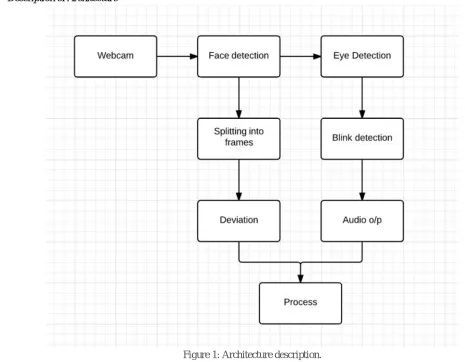
from small camera or webcam, then the eye’s region is determined by background extraction. It also alerts the driver if he/she is feeling drowsy or sleepy by detecting their frequency of eye blinks. The camera module detects the face haar cascade is used to detect the face and using the filters and classifiers the eye pupil is detected. The overall solution intends to convert recognized sequence of movements of eye lid and pupil to produce the output. The aim of the system is to alert the drivers if they are drowsy or distracted. The camera module captures the video and detects face using haar cascade classifier. The detected face is then split into frames. The system then calculates the deviation and generates a beep sound to alert. For drowsiness, the detected face is used as reference to detect eyes. We use Eye Aspect ratio (EAR) to detect the eyes.
[image:3.612.54.519.185.547.2]A. Description of Architecture
Figure 1: Architecture description.
The webcam captures the image and using the haar cascade the face is detected, the haar cascade classifiers finds the best threshold which will classify the faces to positive and negative of the image. The cascade classifiers divides the captured image into various groups, hence the no of features in a window screen reduces, if first few features is failed neglect the group and move forward to new group. The window which passes all stages is a face region. Now the face is detected the same process is used to detect the eyes or pupil. After detecting eyes the program will track the position of eyes in real time using the webcam and if both the pupil or one pupil or one pupil is visible and other is partial, in such cases there will be prompt message and an audio output to look forward. [1] To build our blink detector, we’ll be computing a metric called the eye aspect ratio (EAR). In terms of blink detection, we areonly interested in two sets of facial structures — the eyes.
Each eye is represented by 6 (x, y)-coordinates, starting at the left-corner of the eye There is a relation between the width and the height of these coordinates.
[1] we can then derive an equation that reflects this relation called the eye aspect ratio (EAR):
www.ijraset.com Volume 5 Issue V, May 2017 IC Value: 45.98 ISSN: 2321-9653
International Journal for Research in Applied Science & Engineering
Technology (IJRASET)
©IJRASET: All Rights are Reserved
197
Where p1, …, p6 are 2D facial landmark locations.
The numerator of this equation computes the distance between the vertical eye landmarks while the denominator computes the distance between horizontal eye landmarks, weighting the denominator appropriately since there is only one set of horizontal points but two sets of vertical points.
IV. ALGORITHM
A. Haar-based Object Detection
Detecting Objects by the use of Haar cascade classifiers is speediest and reliable object detection method. The following method was proposed by Paul Viola and Michael Jones in their paper, "Rapid Object Detection using a Boosted Cascade of Simple Features" in 2001. In the following paper, a cascade function is trained from a number of positive as well as negative images. The same is used in other images.
Viola–Jones object detection framework has the following characteristics:- 1. High detection rate and low false-positive rate
2. It is designed for real time applications
3. It is only for object detection and not recognition
In order to detect the desired object, we need lots of positive images (images of the required object) as well as negative images (images, other than the required object). These sets of images are used to train the classifier.
V. CONCLUSION
In this paper, we propose an approach for reducing the no. of accidents due to the distracted drivers and drowsiness of drivers. Our main aim is to overcome the existing problems which uses physiological factors, which is not accurate. Hence our model uses the camera module and using of Open cv library, Haar cascade and dlib the face and eyes and eye blink is detected.
REFERENCES
[1] Soukupová and Čech in their 2016 paper,Real-Time Eye Blink Detection Using Facial Landmarks.
[2] A. R. Beukman, G. P. Hancke and B. J. Silva, "A multi-sensor system for detection of driver fatigue," 2016 IEEE 14th International Conference on Industrial
Informatics (INDIN), Poitiers, 2016, pp. 870-873.
[3] I. R. Tayibnapis, D. Y. Koo, M. K. Choi and S. Kwon, "A novel driver fatigue monitoring using optical imaging of face on safe driving system, " 2016 International Conference on Control, Electronics, Renewable Energy and Communications (ICCEREC), Bandung, 2016 pp. 115-120.
[4] L. M. King, H. T. Nguyen and S. K. L. Lal, "Early Driver Fatigue Detection from Electroencephalography Signals using Artificial Neural Networks," 2006