5
II
February 2017
Technology (IJRASET)
Formulation and in Vitro Characterisation of Self
Emulsifying Drug Delivery System of Diclofenac
for the Enhancement of Dissolution and Solubility
K. A. Chowdary1 , V. Phanendra Babu2, Srinivasa Rao. B3
1,2,3Department of Pharmaceutical Technology, St.Ann’s College of Pharmacy,Cantonment, Vizianagaram, A.P, India
.
Abstract: Diclofenac , non-steroidal anti-inflammatory drug (NSAID) belongs to BCS Class II drug with low dissolution and poor aqueous solubility. The main aim of the present study was to improve the solubility and dissolution rate of diclofenac using self-emulsifying drug delivery technique. Micro emulsion region was formed by preparing the ternary phase diagram. Ratio 0.15:0.85 , 0.5:0.5 and 0.3:0.7 was selected as the self-emulsification region for the development of formulation . Drug – excipient studies were performed by FT-IR .Parameters were evaluated include time of emulsification , freezing and thawing and dissolution. The present research work describes SEDDS of Diclofenac using olive oil, Tween 20 and PEG200 prepared by simple vortex in the mixture at 40 °c and packed in hard gelatine capsule shell of 00 size. In vitro dissolution was carried out using USPII by 6.8 pH buffer at 75 RPM and samples were measured at 276 nm using UV-Visible spectroscopy. From the studies the optimized SEDDS was composed of 30% oil, 45% Surfactant and 25% Co surfactant. The optimized formulation was found to be showing significant improvement in drug release and had 24 seconds self-emulsification time , having drug content 101.16% and complete 99.01% drug release in 60 minutes.
Keywords: Diclofenac , SEDDS, Tween 20, PEG 200 and Olive oil.
I. INTRODUCTION
Oral route has been the most preferable route of drug delivery due to the ease of administration and good patient compliance. The most common problem faced by drugs given through this route is due to the undesirable physicochemical properties of drug molecules namely high lipophilicity, low solubility etc 1-2. Lipid-based formulations are highly water insoluble with low dissolution
rate and low bioavailability has always been a challenge to the pharmaceutical technologist. Most of these highly water insoluble drugs, is not formulated properly, may lead to poor oral bioavailability on oral administration. Hence, it is a challenging task to formulate a suitable drug delivery system of highly poor water soluble drugs3, oral bioavailability of water insoluble drugs is now
come under BCS (Biopharmaceutical system classification) class II (High Permeability, Low Solubility & class IV (Low Permeability, Low Solubility4.These problems can be overcome by various drug delivery strategies which include size reduction,
formation of salt, β-cyclodextrins, Nano particulate systems and solid dispersions. Further, these approaches utilize surfactants, lipids, permeation enhancers5-7. SEDDS are homogenous dispersion consisting of solid or liquid surfactants, synthetic or natural oils
alternatively either co-solvents/surfactants and one or more hydrophilic solvents. These systems can prepare fine oil-in-water (o/w) emulsions or micro emulsions upon mild agitation subsequent dilution in aqueous media, i.e., gastrointestinal (GI) fluids7-8.
Diclofenac (Benzene acetic acid, 2- [(2,6-dichlorophenyl)amino] . [o-(2,6-dichloroanilino) phenyl]acetate). Diclofenac Sodium is phenyl acetic acid derivative. It is non-steroidal anti-inflammatory drug (NSAID) that exhibits anti-inflammatory, analgesic and anti-pyretic activities in both animals and human beings 9.The apparent volume of distribution is 1.4L/Kg. It is 99% bound to human
serum proteins 10-11.
II. MATERIALS AND METHODS
Diclofenac was purchased from Yarrow Chem Products Ltd, Mumbai. Polyethylene glycol 400 was obtained from Ozone Intenational, Mumbai, Ahmedabad. Tween 20 was obtained from Loba Chemie Pvt Ltd, Mumbai. Olive oil was received from Burgoyne Burbidges Ltd, Mumbai.
A. Solubility Studies
Technology (IJRASET)
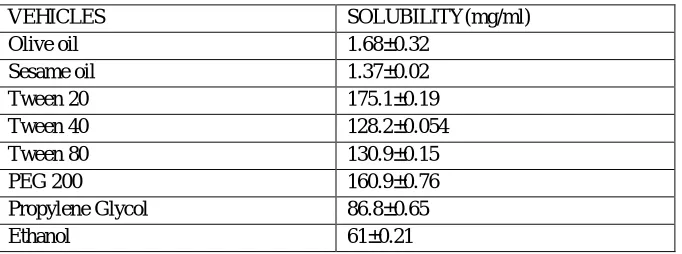
finally kept at ambient room temperature (25°C) under continuous shaking for 24 hours to attain equilibrium. After reaching equilibrium, each vial was centrifuged at 3000 rpm for 5 min and excess insoluble Diclofenac was discarded by filtration using a membrane filter (0.45 μm, 13 mm, Whatman, India). The concentration of Diclofenac was then quantified by UV spectrophotometer at 276 nm. Solubility study was performed at three times and standard deviation was calculated12. Solubility of Diclofenac in
[image:3.612.138.479.173.300.2]different systems was shown in the following
Table 1.
Table 1: Solubility of Diclofenac in various vehicles at 25°C (Mean± SD; n=3)
Construction of ternary phase diagram Self-emulsifying performance of self-emulsion (SE) mixture was assessed from their ternary phase diagrams. Only the specific combinations of oil, surfactant and a co surfactant in the specific composition range were observed to produce a fine micro emulsion upon aqueous dilution. To check emulsification efficiency of SE mixtures, test for emulsification was performed on all combinations and the resultant dispersions were visually assessed. The dispersions either formed a clear micro emulsion, a slightly turbid emulsion or a milky emulsion which immediately was phase separated. A series of formulations were prepared\with the drug using varying concentrations of oil, surfactant and co-solvent in the glass test tube and mixed by vortexing until a clear solution was obtained. The mixture was stored at room temperature until used 13.
1) Fourier Transform-Infrared Spectroscopy: FT-IR spectroscopy was performed using FT-IR model Shimadzu 8400, Japan attached to an attenuated total reflectance (ATR) accessory. ATR was fitted with a single bounce diamond at 45˚ internally reflected incident light providing a sampling area of 1 mm in diameter with a sampling depth of several microns. Diclofenac and mixture of ingredient was analyzed. A small amount of the sample was directly placed on the diamond disk and liquid sample kept in liquid sample holder. Sample was scanned for absorbance over the range from 4000 to 400 wave numbers (cm-1) at a resolution of 1 cm-1.
2) Self-Emulsification Time: The self-emulsification time is determined by using USP dissolution apparatus II at 50 rpm, where 0.5 g of SEDDs formulations is introduced into 250 mL of 0.1N HCI or 0.5% SLS solution. The time for emulsification at room temperature is indicated as self-emulsification14.
B. Drug Content
All the batches were assayed spectrophotometrically for the drug content at the wavelength 276 nm with proper dilution of formulations taking phosphate buffer (PH 6.8) as blank15. Dissolution study of SEDDS formulations were determined using rotating
paddle dissolution apparatus (USP type II Lab India DS 8000 ) used at 37°C ± 0.5°C and a rotating speed of 75 rpm in 900 mL of phosphate buffer (pH 6.8). The SEDDS formulation was placed in a hard time for the formulation. gelatine capsule held to the bottom of the vessel using copper sinkers. During the release studies, samples were withdrawn and subjected to UV Spectrophotometric analysis. The sample volume was replaced each time with equal quantity of fresh medium16.
C. Robustness to Dilution
These systems when diluted with excess of water, standard phosphate buffer (pH 6.8) and 0.1N HCl (500-900 mL) and were stored for 12 hours give no precipitation or phase separation and are thus said robust to dilution17.
D. Freeze Thaw Cycle
Three freeze thaw cycles between -4°C and +40°C with storage at each temperature for not less than 48 hours was done for the
VEHICLES SOLUBILITY(mg/ml)
Olive oil 1.68±0.32
Sesame oil 1.37±0.02
Tween 20 175.1±0.19
Tween 40 128.2±0.054
Tween 80 130.9±0.15
PEG 200 160.9±0.76
Propylene Glycol 86.8±0.65
Technology (IJRASET)
formulations18.
E. Drug-Excipients Compatibility Study
This was carried out by FT-IR analysis of pure drug, oils and surfactants (Polyethylene glycol 400, Olive oil and Tween20) and their formulations to study the possible interaction between drug and polymers19.
III. RESULTS AND DISCUSSION
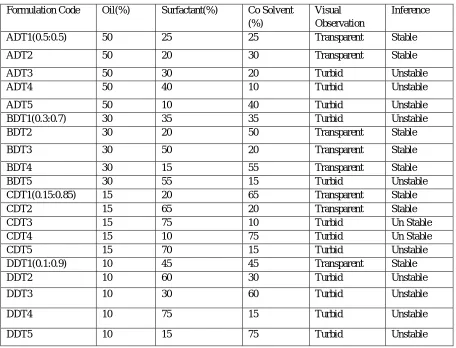
Construction of Ternary phase and visual observations From the above chosen oils, surfactant and co-solvents were taken in different ratios (Table 2 and Figure 1) for the construction of ternary phase diagrams to know the emulsion and micro-emulsion domains such that at particular concentration of oil, surfactant and co-solvent ratios, a stable self-emulsifying formulation is formed. The Self emulsification process is affected on the concentration of Tween 20 and Polyethylene glycol 200 and their ratio. self-emulsion single phase region was appeared at surfactant concentration (15-65%) of W/W, co-solvent concentration at (20- 65%). So the concentration of oil, surfactant and co-solvent was selected in these domains for the study. On the basis of ternary phase diagrams readings, it was observed that region of emulsification in case of tween 20, PEG 200 ratio at 0.5:0.5 is 20-25 % and 25-30% , in case of tween 20, PEG 200 at 0.3:0.7 is 15-50 % and 20-55%, in case of tween 20 , PEG 200 at 0.15:0.85 is 20- 65% and 15-60% , it was therefore, decided to use tween 20 and PEG 200 ratio 0.15: 0.85 , 0.5:0.5and 0.15: 0.85 for further development of self-emulsifying system of Diclofenac13 .
[image:4.612.79.535.335.683.2]Table 2: Composition of combinations containing olive oil , Tween 20 and polyethylene glycol 200 (oil, surfactant, co-solvent)
Figure 1: Ternary Phase Diagrams of Different Formulations of ADT,BDT and CDT.
Formulation Code Oil(%) Surfactant(%) Co Solvent
(%)
Visual Observation
Inference
ADT1(0.5:0.5) 50 25 25 Transparent Stable
ADT2 50 20 30 Transparent Stable
ADT3 50 30 20 Turbid Unstable
ADT4 50 40 10 Turbid Unstable
ADT5 50 10 40 Turbid Unstable
BDT1(0.3:0.7) 30 35 35 Turbid Unstable
BDT2 30 20 50 Transparent Stable
BDT3 30 50 20 Transparent Stable
BDT4 30 15 55 Transparent Stable
BDT5 30 55 15 Turbid Unstable
CDT1(0.15:0.85) 15 20 65 Transparent Stable
CDT2 15 65 20 Transparent Stable
CDT3 15 75 10 Turbid Un Stable
CDT4 15 10 75 Turbid Un Stable
CDT5 15 70 15 Turbid Unstable
DDT1(0.1:0.9) 10 45 45 Transparent Stable
DDT2 10 60 30 Turbid Unstable
DDT3 10 30 60 Turbid Unstable
DDT4 10 75 15 Turbid Unstable
Technology (IJRASET)
[image:5.612.125.513.41.347.2]Preparation of Diclofenac SEDDS using hard gelatine capsule The liquid SEDDS formulations were prepared by standard ad mixture method. Required quantity of drug was dissolved in the olive oil, Tween 20 (surfactant) and PEG 200 (co solvent) were mixed separately and then surfactant/co solvent mixture was added to oil drug mixture, while stirring at high speed using magnetic stirrer at optimum temperature. On the basis of region of emulsification in pseudo ternary phase diagram, Olive oil, Tween 20, PEG 200 were taken in different concentrations to prepare the formulations and shown in table 3 Based on the composition of oil , surfactant and co solvent ,the total formulations were prepared for 2 ml.
Table 3: Composition of combinations containing olive oil , Tween 20 and polyethylene glycol 200 with Diclofenac in hard gelatine capsule (oil, surfactant, co-solvent)
A. Content Uniformity
The formulations which contain 50 mg of Diclofenac equivalent weights were tested for amount of drug present in each capsule. The contents present inside the capsules were emptied into 100ml volumetric flask. 20ml methanol was added and mixed it for 20min to dissolve the drug. The volume was made to 100ml with methanol. The dispersion was filtered using Whatmann filter paper. Dilutions are made in 6.8 Phosphate buffer and absorbance of sample solution was determined at 276 nm .So that the drug present in the single capsule can be known.
Formulation Code Drug Oil (%) Surfactant (%) Co solvent (%)
DF1 200mg 50 20 30
DF2 200mg 50 25 25
DF3 200mg 50 35 15
DF4 200mg 30 15 55
DF5 200mg 30 35 35
DF6 200mg 30 45 25
Technology (IJRASET)
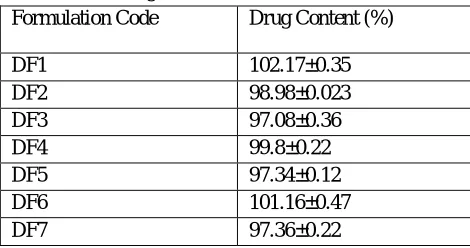
Table 4: Drug content of SEDDS of Diclofenac.
Formulation Code Drug Content (%)
DF1 102.17±0.35
DF2 98.98±0.023
DF3 97.08±0.36
DF4 99.8±0.22
DF5 97.34±0.12
DF6 101.16±0.47
DF7 97.36±0.22
B. Determination of Time of Emulsification
The rate of emulsification is an important index for the assessment of the efficiency of emulsification. Since the free energy required to form an emulsion is very low, the formation is thermodynamically spontaneous. The SEDDS should disperse completely and quickly when subjected to aqueous media under mild agitation. The Evaluation of emulsification time for the prepared formulations was conducted in 0.1N HCl. Table shows that, as the concentration of surfactant increases, the spontaneity of emulsification process increased and emulsification time decreases. This may be due to capacity of Tween 20 in reducing the interfacial tension and that the co-solvent further lower the interfacial tension between o/w interface and also influenced interfacial film curvature, may show impact on spontaneous emulsification process. Time of emulsification for different formulation were shown in the following table 5 .
Table 5 : Emulsification time for various formulations
Formulation Code Self emulsification
time(Sec)
DF1 167
DF2 121
DF3 86
DF4 61
DF5 26
DF6 24
DF7 22
C. Robustness to Dilution
[image:6.612.188.423.87.211.2]Robustness to dilution was performed diluted with excess of water, standard phosphate buffer pH 6.8 and 0.1N HCl (500-900 ml) and was stored for 12 hrs gives no precipitation or phase separation was found and result were shown in Table 6. High inter-subject variation exists in the volume of GI fluid particularly in case of fed and fasted states. The success of prepared SEDDS depends on the infinite dilutability and formation of micro droplets, as the process of dilution by the GI fluids lead to gradual desorption of surfactant located at the globule interface. The process is thermodynamically driven by the requirement of the surfactant to maintain an aqueous phase concentration equivalent to its critical micelle concentration. The optimized oil and S mix concentrations are robust to all dilutions with various dissolution media. Robustness to dilution, with excess of water, 0.1M HCl, standard pH 1.2 and pH 6.8 phosphate buffers, show no precipitation or phase separation. No significant effect of pH on the optimized formulations DF2 to DF7 was observed. It confirms the preparations were robust to high dilution and variations in pH.
Table 6 : Robustness to dilution of various formulations in different solvents
Formulation Code
Technology (IJRASET)
DF1 Precipitation Precipitation Precipitation
DF2 No Precipitation No Precipitation No Precipitation
DF3 No Precipitation No Precipitation No Precipitation
DF4 No Precipitation No Precipitation No Precipitation
DF5 No Precipitation No Precipitation No Precipitation
DF6 No Precipitation No Precipitation No Precipitation
DF7 No Precipitation No Precipitation No Precipitation
D. Freezing and Thawing
[image:7.612.64.548.382.524.2]The objective of thermodynamic stability is to evaluate the phase separation and effect of temperature variation on SEDDS formulations. Diclofenac SEDDS were diluted with aqueous medium and centrifuged at 5,000 rpm for 15 minutes and formulation were observed visually for phase separation. Formulations were subjected to freeze cycle (-4°c for 24hrs followed by +40°c for 2 days).
Table 7 : Freezing and thawing of various formulations at different temperatures
Formulation code Centrifugation Freezing and Thawing method
-°4 C for 2 days °40 C for 2 days
DF1 Phase Separation Phase Separation Phase Separation
DF2 No Phase Separation No Phase Separation No Phase Separation
DF3 No Phase Separation No Phase Separation No Phase Separation
DF4 Phase Separation Phase Separation Phase Separation
DF5 No Phase Separation No Phase Separation No Phase Separation
DF6 No Phase Separation No Phase Separation No Phase Separation
DF7 No Phase Separation No Phase Separation No Phase Separation
From the seven formulations shown in above Table without DF1 and DF4 remaining all are neither phase separation nor precipitation of drug in micro emulsions after 24 hr. It representing that these formulations are resulting in stable micro emulsion upon dilution. Hence the formulations which were stable for precipitation after study were selected for further investigation. In vitro dissolution studies
Procedure
The quantitative in-vitro release test was performed in 900 ml of buffer pH 6.8 using US Pharmacopeia XXIV dissolution apparatus 2. The paddles were rotated at 75 rpm. The SEDDS formulations were put into hard gelatin capsules (00 size) and used for drug release studies; results were compared with those of plain Diclofenac . Puredrug. During the release studies, a 5-ml sample of medium was taken out and subjected to drug analysis using UV Visible spectrophotometer at 276 nm. The removed volume was replaced each time with 5 ml of fresh medium at different interval 0, 5, 10 ,20, 30,40,50 and 60 min.
Result from the SEDDS formulations
Technology (IJRASET)
[image:8.612.45.566.190.346.2]SEDDS formulations are given in the below figure 10 , 11 and 12 . Based on the drug release comparison studies, it was observed that maximum drug release from the SEDDS from all formulations are higher when compared with that of the pure drug. The order of drug release in decreased order DF6 >DF7 >DF5 >DF3 >DF2. DF6 and DF7 shows maximum release and have more than 90% release within 40 min. From all the formulations, DF6 was selected for the optimum formulation due to the maximum release with less self-emulsification time. Drug release kinetics were calculated for all formulations. From the regression value of all formulations, all formulations follow first order release mechanism.
[image:8.612.133.480.378.465.2]Table 8: Dissolution profile of Diclofenac . (Mean± SD; n=3)
Table 22 : Drug release kinetics of SEDDS showing ´r` value.
Formulation Code First order Zero order
DF2 0.970 0.897
DF3 0.960 0.906
DF5 0.971 0.849
DF6 0.964 0.865
[image:8.612.142.475.500.695.2]DF7 0.975 0.841
Figure 2: Dissolution profile of Various SEDDS of Diclofenac and Pure drug.
-20 0 20 40 60 80 100 120
0 20 40 60 80
%
D
is
so
lv
e
d
TIme ( Min)
Dissolution of Diclofenac Sodium
DF2
DF3
DF6
DF5
Time ( Min)
DF2 DF3 DF5 DF6 DF7 Pure drug
0 0 0 0 0 0 0
5 8.12±0.22 5.57±0.32 8.09±0.43 4.98±0.23 5.907±0.33 10.54±0.26
10 36.18±0.45 37.65±0.13 41.04±0.32 45.08±0.16 51.64±0.66 48.97±0.64
20 59.37±0.02 55.54±0.53 67.96±0.43 68.08±0.64 67.46±0.22 64.67±0.25
30 67.98±0.32 68.97±0.44 78.32±0.12 76.35±0.73 76.65±0.43 74.97±0.74
40 75.35±0.46 79.06±0.11 81.09±0.43 91.98±0.24 89.5±0.22 75.35±0.21
50 85.3±0.12 87.64±0.64 91.45±0.32 95.08±0.23 94.57±0.34 74.33±0.86
Technology (IJRASET)
Figure 4: Dissolution profiles of Pure drug and DF6
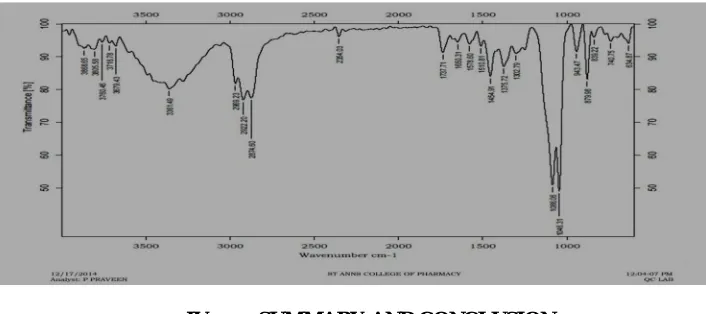
[image:9.612.67.539.552.716.2]FT-IR studies for Diclofenac and its Optimized SEDDS. An FT-IR spectrophotometer equipped with attenuated total reflectance accessory was used to obtain the infrared spectra of drug in the isotropic mixtures of excipients. Analysis of pure drug, olive oil , PEG 200 and Tween 20, physical admixtures of the drug with the excipients (in 1 :2 ratio) were carried out using FT-IR with KBr disc. All the samples were dried under vacuum prior to obtaining any spectra in order to remove the influence of residual moisture. For each of the spectrum were obtained at a resolution of 4 cm−1 from a frequency range of 4000–600cm−1 as shown in Figure 13 and 14. From the results of the spectra , it was found that there was no interaction between the drug and excipients used in the SEDDS of Diclofenac .
Table 23. FT-IR Studies for Diclofenac and SEDDS of optimized formula
Diclofenac sodium interpretation Showing peaks at different functional groups
Optimized sedds interpretation Showing peaks at different functional groups
NH-3612.72 3679.43
COOH-3282.92 3361.49
OH-1746.98 1737.71
Cl-750.12 740.75
0 1 2 3
0 20 40 60 80
Lo g % d is so lv ed
Time ( Min ) First order release
DF2 DF3 DF6 DF5 DF7 -20 0 20 40 60 80 100 120
0 20 40 60 80
% D is so lv e d
Time ( min)
Dissolution of DF6 and Pure drug
DF6
Technology (IJRASET)
[image:10.612.130.483.273.430.2]Figure 5 : FT-IR graph of diclofenac
Figure 6: FT-IR graph of optimized sedds of diclofenac
IV. SUMMARY AND CONCLUSION
In this study, self-emulsifying (SE) mixtures containing surfactant, co surfactant and a medium chain triglyceride were prepared and their tendency to efficiently emulsify was evaluated. Upon aqueous dilution, such mixtures spontaneously emulsified forming an oil-in-water emulsion. This property was dependent on the composition of the excipients as well as their individual concentration in the mixture. Excipients evaluated for self- emulsification were Tween 20 as surfactants, PEG 200 as co surfactants and olive oil and as an oil for Diclofenac. Five different formulations of different ratios of all vehicles are prepared for Diclofenac. Among this five prepared formulations of Liquid SEDDS, formulation DF6 containing 30% oil, 45 % surfactant and 25 % co-surfactant was selected as optimized formulation was successfully developed with an increased solubility and dissolution rate. Optimized formulation had 24 seconds self-emulsification time, having drug content 101.16% and complete 99.01 % drug release in 60 minutes. Self-emulsifying drug delivery system (SEDDS) is known to improve dissolution characteristics of a poorly water soluble drug since they maintain the drug in a solubilized state in the GI tract. Using the optimized SE mixture, Diclofenac loaded Liquid were prepared, evaluated for their self-emulsification tendency and characterized. In vitro drug release studies showed a 90% drug release within 50 minutes of dissolution time from the optimum formulations. Our studies indicated that SEDDS can be potentially used for delivering a poorly water soluble drug. Thus, our study confirmed that the SEDDS formulation can be used as a possible alternative to traditional oral formulations of Diclofenac to improve its dissolution rate leading to enhanced bioavailability.
REFERENCES
[1] Hauss D.J., Ed. Oral lipid based Formulations Enhancing the Bioavailability of Poorly water soluble drugs,1st Edn, Informa Health care, CRCpress:New Jersey,07-128, (2007).
[2] Pouton, C.W., Formulation of self-emulsifying drug delivery systems. Advanced Drug Delivery Reviews, 25 (1), 47–48, (1997) [3] Lipinski, C.A. Poor aqueous solubility—an industry wide problem in drug discovery. Am. Pharm. Rev. 2002; 5: 82–8
Technology (IJRASET)
bioavailability assessment. Int J Pharm 2001;212:233-46.[6] Chowdary KPR, Prakasarao KS. “Factorial Studies on the Effects of β- Cyclodextrin and Poloxamer 407 on the Solubility and Dissolution Rate of BCS Class II Drugs” Int. J. Pharmaceutical Research and Development, Vol. 3(3), 125-130, 2011.
[7] Katteboina S, Chandrasekhar VS, Balaji S. Approaches for the development of solid self-emulsifying drug delivery systems and dosage forms. Asian J Pharm Sci 2009;4:240-53.
[8] Gursoy RN, Benita S. Self-emulsifying drug delivery systems (SEDDS) for improved oral delivery of lipophilic drugs. Biomed Pharmacother 2004;58:173-82. [9] Todd, P.A. And Sorkin, E.M.(1988). Diclofenac sodium, A reappraisal of its Pharmacodynamic and Pharmacokinetocs properties, and therapeutic efficacy.
Drugs, 35(3), 244-285.
[10] Brogden, R.N., Heel, R.C., Pakes G.E., Speiight, T.M and Avery, G.S.(1980). Diclofenac sodium, A review of its Pharmacological properties and therapeutic use in rheumatic diseases and pain of varying origin. Drugs, 20(1), 24-48.
[11] Sheng, F.S., Chen, H.C., Chao, F.K. And Jin, G.H.(2003). In vitro and in vivo comparison of two diclofenac sodium sustained release oral formulations. International Journal of pharmaceutics. 260(1), 39-46.
[12] B. Srinivasa Rao, Ch. Ramanamma and K. A. Chowdary. Development of self emulsifying drug delivery system of nebivolol for the improvement of solubility and dissolution. World Journal of Pharmaceutical Research. Vol 5, Issue 10, 2016. Volume 5,
[13] Bhikshapathi D. Formulation and characterization of pioglitazone HClself-emulsifying drugdelivery system. Scholars Research Library, 2013; 5(2): 292-305.Issue 10, 674-
[14] Kavita S, Ashu S, Singh SK, Saloni K. Self-emulsifying drug delivery system: A tool in solubility enhancement of poorly soluble drugs. Indoglobal journal of pharm. Sci., 2012; 2(3): 313-332.
[15] Mallikarjun V, Babu RV. Recent trends in development of solid self-emulsifying drug delivery (SSEDDS) systems: an overview. Int Res J. of Pharm., 2011; 2(6): 18-22.
[16] Patil P, Joshi P, Paradkar A. AAPS Pharm Sci Tech., 2004; 5(3): 1-8.
[17] \Date AA, Nagarsenker MS. Design and evaluation of self- nanoemulsifying drug delivery systems (SNEDDS) for cefpodoximeproxetil. Int J Pharm., 2007; 166–172
[18] Sheikh S., Shakeel F, Talegaonkar S, Ahmad FJ, Khar RK, Ali M. Development an bioavailability assessment of ramiprilnanoemulsion formulation. Eur J Pharm Biopharm., 2007; 66: 227–243.