Sentimental Analysis of Tweets using Principle
Component Analysis Technique
Dr. Mohd. Abdul Raffey1, Mr. Pankaj N. Patil2, Dr. Sunil Kawale3
1, 2, 3
Dr. Babasaheb Ambedkar Marathwada University, Aurangabad, India
Abstract: The much commonly famous and well-known micro-blogger web platform is twitter where registered user over the world can share their opinions by twitting. Users sharing the reviews on products which they are using and sometimes they exaggerate tweets about the same product. Sentiment Analysis is the technique of identifying the validity of such tweets by analyzing hidden emotions in their tweets Sentiment Analysis is widely used to analyze emotions in Text, News, Figures and Pictures etc…
Keywords: Sentiment Analysis, feature selection methods, machine learning, twitter, reviews, PCA
I. INTRODUCTION
Opinion Mining is currently the ongoing field of study. Many researchers are working on it for analyzing emotions, sentiments or views. Another challenging field attracting to researchers is that sentiment analysis, It is a process of decides the statement or a piece of statement is positive, negative or neutral. Nowadays this technique is widely used to discover what people feel about the particular product. Various industries are working on Sentiment Analysis to improve their sales by analyzing the emotions of users by text, news, figures and pictures.
A. The process of sentiment analysis is performed at different levels such as
1) Document Level: Documents expressed opinions like web reviews or open-ended questions in the market survey; the main task is to find whether the whole document is positive, Negative or Neutral.
2) Sentence Level: This level the sentences are checked for its Positive, Negative or Neural biased.
3) Aspect Level: At this level aspect driven sentiment analysis identifies the aspect of a given target entity and estimate the sentiment polarity for each mentioned aspect.
The most researchers work with Sentiment Analysis technique carried on news and text. The sentiment analysis on Twitter is a challenging work. Twitter is the very famous micro-blog website using by many people around the world. Twitter is founded in 2006 by Jack Dorsey, Noah Glass, Biz Stone and Evan William at SanFrancisco, California USA.
Principle Component Analysis (PCA) is a dimensionality reduction technique that is commonly used to transform a high-dimensional sample to small dimension by finding a new set of variables, smaller than the original variable without changing the meaning of sample.
B. The PCA used before running on Machine Learning Algorithms on the data because
1) It reduces the size of space on which K-nearest-neighbors (KNN) must calculate the distance it helps to performance improvement.
2) It also reduces the number of degree of freedom of hypothesis which reduces the risk of overfitting. 3) If the data/sample is in less amount most algorithms are faster.
4) When you reduce using PCA it simplifies the data set.
II. LITERATURE REVIEW
1602
©IJRASET (UGC Approved Journal): All Rights are Reserved
(BOW and BON) and SVM classifier used to prove much accuracy. G. Vinodhini, R.M. Chandrasekaran (2015) has done the hybrid combination of PNN and PCA for reducing the training time and increases the classification performance, ANN is better in the training time. Vikram Kumar (2016) evaluated Naïve Byes of Linear Vector Quantization (LVQ) of the reducing data set by PCA. Bholane Savita (2016) used two methods senti-strength and SVM to find the accuracy of interpretation and proven that SVM is better. Neha Upadhyay, Prof. Angad Singh (2016) used Naïve Byes, SVM, Maximum Entropy and Ensemble Classifier to estimate the probability for better result taken electronic items for Positive, Negative and neutral classification to help peoples for selecting the best item. G. Vinodini (2017) has taken a review of the work on PNN and PCA.
A. Proposed Model
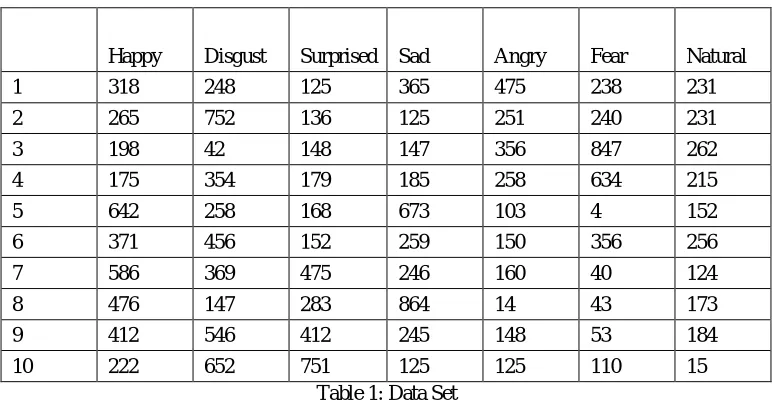
In this model, we have taken 2000 tweets regarding 10 features of iPhone 7. These tweets have been selected randomly which are recorded on twitter microblogger website and categorized into 6 different types of emotions proposed by Ekman’s which are given in table no. 1.
Happy Disgust Surprised Sad Angry Fear Natural
1 318 248 125 365 475 238 231
2 265 752 136 125 251 240 231
3 198 42 148 147 356 847 262
4 175 354 179 185 258 634 215
5 642 258 168 673 103 4 152
6 371 456 152 259 150 356 256
7 586 369 475 246 160 40 124
8 476 147 283 864 14 43 173
9 412 546 412 245 148 53 184
10 222 652 751 125 125 110 15
Table 1: Data Set
In general, this information is vague to decide the real approach of users about iPhone 7. Hence here we want to find real reviews about products of users for that we proposed Principle Component Analysis (PCA) to find the association of different emotions, to decide which motions are closely associated. PCA has been performed through SPSS.
Correlation matrix (Table No. 2) shows the association between emotions. Here the showing negative relation found in “Happy” & “Disgust” also “Happy” & “Sad”
Happy Disgust Surprised Sad Angry Fear Neutral
Happy 1.000 .028 .045 .052 -.192 -.720 -.226
Disgust .028 1.000 -.401 -.510 -.181 -.346 -.330
Surprised .045 -.401 1.000 -.193 -.443 -.448 -.005
Sad .052 -.510 -.193 1.000 -.475 -.475 -.054
Angry -.192 -.181 -.443 -.475 1.000 .578 .510
Fear -.720 -.346 -.448 -.475 .578 1.000 .587
[image:3.612.113.499.239.439.2]Neutral -.226 -.330 -.005 -.054 .510 .587 1.000
Table 2: Correlation Matrix
Initial Extraction
Happy 1.000 .802
Liked 1.000 .626
Surprised 1.000 .831
Sad 1.000 .886
Angry 1.000 .670
Loves 1.000 .807
Natural 1.000 .818
[image:4.612.193.419.71.253.2]Extraction Method: Principal Component Analysis.
Table 3: Communalities
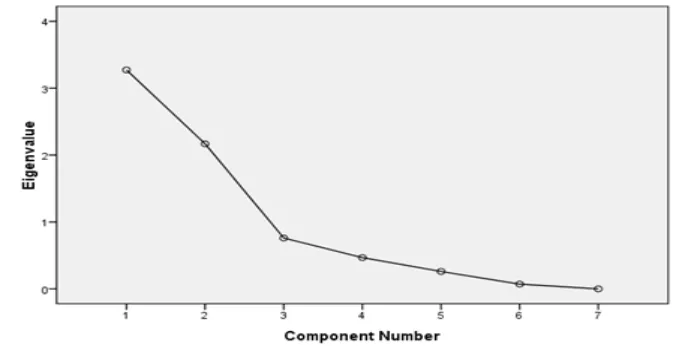
In Table No. 4 shows that the extraction sums of square loadings contain only that Eigenvalue which is greater than 1, percentage of the variance of factors shown in the same table which is 46.75% and 30.97% respectively.
Component
Initial Eigen values Extraction Sums of Squared Loadings Rotation Sums of Squared Loadings
Total % of Variance Cumulative % Total % of Variance Cumulative % Total % of Variance Cumulative %
1 3.273 46.755 46.755 3.273 46.755 46.755 2.773 39.621 39.621
2 2.168 30.976 77.731 2.168 30.976 77.731 2.668 38.110 77.731
3 .760 10.859 88.590
4 .468 6.679 95.269
5 .260 3.712 98.981
6 .071 1.019 100.000
7 9.194E-17 1.313E-15 100.000
[image:4.612.44.573.298.472.2]Extraction Method: Principal Component Analysis.
Table 4: Total Variance Explained
Factors determined through PCA are also checked by Scree Plot which shows the two components are considered in a determination of PCA. Hence the PCA used in this analysis is very much correct and PCA is used to reduce the big data to the small groups of factors.
[image:4.612.138.480.543.716.2]1604
©IJRASET (UGC Approved Journal): All Rights are Reserved
III. CONCLUSION
PCA is the very useful technique for data reduction in Sentimental Analysis in view to deciding the real approach of reviews PCA is applied on 2000 tweets related to iPhone 7 to find the reliability of tweets. In this paper we applied PCA technique to find out sentiments in tweets the eigenvalue shown in table 4 is help us to take decision about the positive, negative or neutral tweets of iPhone reviews so that new buyer can take decision with the help of table 4 and can decide whether he has to buy iPhone or not. The accuracy is 77% of reviews over 2000 tweet that means many people gives their feedback through tweets in the real sense.
REFERENCES
[1] Bholane Savita D., Prof. Deipali Gore , “Sentiment Analysis on Twitter Data Using Support Vector Machine” in I JCST 2016.
[2] G. Vinodhini, R.M. Chandrasekaran “A comparative performance evaluation of neural network based approach for sentiment classification of online reviews” in JKSU–C&IS, pp. 2–12 2016.
[3] Bo Pang and Lillian Lee, Shivakumar Vaithyanathan, “Thumbs up? Sentiment Classification using Machine Learning Techniques” in EMNLP, pp. 79-86 July 2002.
[4] Yi, J., Nasukawa, T., Niblack,W., & Bunescu, R., “Sentiment analyzer: extracting sentiments about a given topic using natural language processing techniques”, in ICDM, pp. 427–434, 2003.
[5] Kirutika M., sanjana woonna, Priyanka Giri, “Sentiment analysis on twitter data” in IJIET 2016, pp. .
[6] Walaa Medhat, Ahmed Hassan, Hoda Korashy, “Sentiment analysis algorithms and applications: A survey” in ASEJ 5, 1093–1113, 2014 [7] Akshi Kumar and Teeja Mary Sebastian, “Sentiment Analysis on Twitter” in IJCSI pp. 372-378, 2012.
[8] Neha Upadhyay, Prof. Angad Singh, “Sentiment Analysis on Twitter by using Machine Learning Technique” in IJRASET [9] Ekman, P.: An Argument for Basic Emotions. Cognition and Emotion. 6, 169–200 (1992)
[10] A Abbasi, HC Chen and A Salem. Sentiment analysis in multiple languages: Feature selection for opinion classification in web forums. ACM Transactions On Information Systems, Volume 26, Number 3, 2008.
[11] Tan, S. B., & Zhang, J. (2008). An Empirical study of opini on analysis for Chinese documents. Expert Systems with Application, 34(4), 2622–2629. [12] Hu, M. & Lui, B. (2004), “Mining and Summarizing Customer Reviews”. In Proceedings of ACM SIGKDD Conference on Knowledge Discovery and Data
Mining 2004 (KDD-2004), p. 168–177.
[13] Haseena Rahmath P, “Opinion Mining and Sentiment Analysis -Challenges and Applications” in IJAIEM pp. 401-403, 2014.
[14] https://georgemdallas.wordpress.com/2013/10/30/principal-component-analysis-4-dummies-eigenvectors-eigenvalues-and-dimension-reduction/ [15] https://klevas.mif.vu.lt/~tomukas/Knygos/principal_components.pdf
[16] https://www.cs.cmu.edu/~elaw/papers/pca.pdf
[17] http://support.sas.com/publishing/pubcat/chaps/55129.pdf