Accident Prevention Using VANET
Priyanka L. Ikhar1, Ms. Apurva N. Ganar2, Mr. Abhishek Narkhede3
Lecturer1,2, Astt. Professor3
1,2,3
Department Of Electronics Engineering, 1,2Rajiv Gandhi College of Engineering & Research, Nagpur, India,
3
Siddhivinayak Technical Campus School of Engineering & Research Technology, Amravati, India
Abstract- A Vehicular Ad-Hoc Network (VANET) may be a sort of Mobile ad-hoc network, to supply communication among close vehicles. Driver’s tiredness cause maximum number of automobile accidents. To deal with the matter we tend to propose a vision-based driver fatigue detection System in VANET using clustering. A clustered network structure is usually recommended owing to its a lot of utilization of network resource associated higher communication quality within which the motive force and different vehicles area unit then alerted by operational an in-vehicle alarm and causation alert messages containing corrective actions via wireless technology provided by VANET. The system includes driver fatigue detection and additionally observance of varied vehicle parameters in vehicle-to-vehicle communication in intelligent transportation to fulfill safety and luxury needs of the motive force.
Keywords – VANET, Driver’s fatigue, Bluetooth, V2V, Eye Tracking.
I. INTRODUCTION
The increasing number of transportation accidents has become a serious problem for society. The traffic accidents will be largely decreased if finding a judging rule to determine whether drivers stay awake or not, and make a warning to the drivers when they begin to fall asleep, so it is meaningful to research fatigue detection algorithm which is also a key technology in smart vehicles driving. The driver fatigue problem has become an important factor for causing traffic accidents. Driver fatigue may be a major reason for automobile accidents, since asleep drivers are unable to form fast choices, and that they could have slower reaction times. As a result, several governments have education program to alert people to the risks of driving whereas tired, and drivers are inspired to avoid conditions which can result in driver fatigue. Therefore, the way to supervise and avoid fatigue driving expeditiously is one among the numerous issues.
In this paper, it is important to use new technologies to design and build systems that are able to monitor vehicle health as well as driver’s level of attention during the entire process of driving.
Technology (IJRASET)
System for online Monitoring of Driver
II. PROPOSED DESIGN
A. Proposed Drowsiness (Driver Fatigue) Detection System
The system proposed in this paper is able to perform real-time processing of capturing an image in order to infer the driver level of fatigue by determining the number of frames in which driver’s eyes are blink. Successively, processing system output is sent to an alarm system that will activate an alarm when an index, computed by mean of PERCLOS parameter.
The system consists of 4 parts (a) Dividing in to frames (b) Face Detection (c) Eye Detection (d) Drowsiness Detection. In addition there is 1 external hardware components namely Camera. The external hardware required for capturing the image After Capturing the image from an external device. The next procedure is to divide in to frames/image .once the frame is capture the face is detected from each and every frame. This is achieving by harrcascade file for face detection. Harrcascade contain the various feature of the face such as vascular, width, etc. After detecting the face the next procedure is to detect the eyes by using the same technique which we use for face detection. To reduces the amount of process for eye detection. We mark the region of interest before detecting the eyes from face gabber. Once the eye is detected the next step is to check the states of eyes whether it is closed or open. This is check according to the percentage of eyes of the vehicle driver. As the percentage of eyes is closed higher than the normal state of eyes then it should be clear that the driver is in drowsy state .the last step is to generate an in vehicle alarm to alert the vehicle driver.
B. V2V Communication
Vehicle-to-vehicle (V2V) communications comprises a wireless network where vehicle send messages to each other with information about what they’re doing. This data would include speed, location, braking, and loss of stability and also the driver is in a sleepy state or not. V2V would be a mesh network, meaning every node (car, smart traffic signal, etc.) could send, capture and retransmit signals.
On below of the situation is of V2V communication wherever the road has been style and on it street road the nodes can create that represent a vehicle. Wherever some general nodes are created that represent a bunch of car to create a cluster. This vehicle node then communicates with one another to send and alert messages.
III. HARDWARE MODULE
max232 IC Convert ASCII value in to Binary form (0, 1) and send it to Rs-232 connector which communicates to System. Let’s see the block diagram of Hardware to System Connection.
Fig2: Block diagram of Hardware to System Connection
1) Microcontroller: A microcontroller is a small chip computer on a single integrated circuit containing a processor core, memory, and programmable input/output peripherals.
2) MAX232: The MAX232 from Maxim was the primary IC that in one package contains the mandatory drivers (two) and receivers (also two), to adapt the RS-232 signal voltage levels to TTL logic. It became popular, as a result of it simply wants one voltage (+5V) and generates the mandatory RS-232 voltage levels (approx. -10V and +10V) internally. This greatly simplified the look of electronic equipment. Electronic equipment stealers now not have to be compelled to design and build an influence offer with 3 voltages (e.g. -12V, +5V, and +12V), however might simply give one +5V power offer, e.g. with the assistance of an easy 78x05 voltage convertor.
3) RS-232 Connector: RS232 is a standard for a serial communication interface which allows sending and receiving knowledge via a minimum of 3 wires. With the RS232 interface it is possible to setup a connection between a microcontroller and a System. A very famous RS232 level converter is the MAX232 chip.
4) IR Sensors: The IR diode keeps sending IR infrared rays up to some vary. Once some object (The object her is that the vehicle) comes within the IR infrared vary, the IR waves hits the article and comes back at some angle, picture diode detects that IR rays and hence works as an IR sensor device.
Fig3: Vehicular hardware Module
IV. IMPLEMENTATION RESULT
Technology (IJRASET)
[image:5.612.200.408.105.260.2]Fig4: Snapshot of hardware vehicle connected to system.
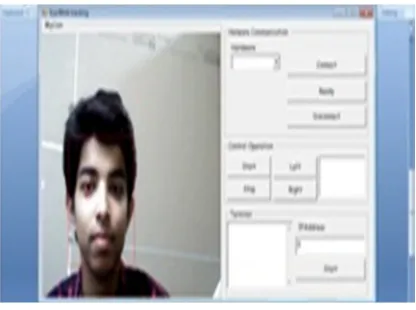
Fig 5: Real time eye tracking.
The Above result shows that the driver eye is in drowsy state .as the drive eye is detected the alert signal is given to that driver and the message is pass to the nearby vehicle. The below fig shows the result of displaying of drowsiness message this alert information is floated to other vehicles to provide safety to other vehicles on the roads.
V. CONCLUSION
This paper proposes an approach for Real time drowsiness detection system based on eye tracking in Vehicular network model to avoid an accident for road safety. The system is to perform real-time processing of capturing an image by using a hardware vehicular module in order to infer the driver level of fatigue by determining the number of frames in which driver’s eyes are blink Successively, processing system output is sent to an alarm system that will activate an LEDS when an index computed by mean of PERCLOS parameter. It will even be useful for alternative vehicles as they will be alerted bymessages regarding the vehicles there in a network. It will produce higher opportunities for the drivers on a main road in future.
REFERENCES
[1] Woong Cho, Kyeong-Soo Han, Hyun Kyun Choi and Hyun Seo, Oh, “Realization of Anti-collision Warning Application using V2V Communication”, 2009 IEEE.
[2] Carl Bergenhem, Erik Hedin, Daniel Skarin, “Vehicle-to-Vehicle Communication for a Platooning System”, 2011 Elsevier.
[3] C D.RajiniGirinath ,S.Selvan, ”A Novel Cluster based Routing Algorithm for Hybrid Mobility Model in VANET.” 2010 International Journal of Computer Applications (0975 - 8887).
[4] Liling Li, Mei Xie, HuazhiDong,“A Method of Driving Fatigue Detection Based on Eye Location.”, 2011, IEEE.