International Journal of Emerging Technology and Advanced Engineering
Website: www.ijetae.com (ISSN 2250-2459, ISO 9001:2008 Certified Journal, Volume 7, Issue 7, July 2017)
344
A Survey on Leach Based Protocols in Wireless Sensor
Network
Anshuman Prakash Singh
1, Prof. (Dr.) S. Hasan Saeed
21Research Scholar, 2Professor, Electronics and Communication Engineering Department, Integral University, Lucknow, India
Abstract— Wireless sensor networks (WSNs) consist of
various homogeneous or heterogeneous sensor nodes deployed over an area. The most challenging issue in wireless sensor network research is its routing protocols as the sensors have limited power so protocols should be like it consumes less energy during active mode. To increase lifetime of a sensor network is to design protocols in such a way that it makes less use of battery, hence increment the lifetime of network. LEACH is the most commonly used energy efficient cluster based protocol. In this survey paper we represent LEACH based routing protocols with phases, operation and detailed algorithm used by LEACH. In this paper we also represent how to manage issues and on WSN. This paper also surveys advancements done in LEACH to improve its performance.
Keywords— LEACH, Cluster Head (CH), Base Station
(BS), Wireless Sensor Network (WSN).
I. INTRODUCTION
A wireless sensor network (WSNs) is of various homogeneous or heterogeneous sensor nodes which is deployed over an area. Sensor network are capable of observing, monitoring and controlling the physical ambient conditions. Each node of WSN wirelessly communicates to one or more sensors for process the data and balancing the environmental factors. This type of networking is known as Wireless sensor networking. Wireless sensor networks were inspired by military applications such as battlefield surveillance [18]; but presently sensor networks also find their applications in many industrial and consumer field.
Figure I Wireless Sensor Network
The main attributes of a WSN include: Ability to handle node failures Nodes mobility
Nodes heterogeneity
Scalable to large scale of deployment Ability to withstand all ambient conditions Easy to use
Optimize nodes power
In wireless sensor network one of the major factor is energy because every node is operated by battery. To have large network life time all nodes need to optimize their energy consumption. Node is composed of small battery so that the energy associated with this node is very less so the charging and replacing of battery is impossible because it is very expensive. To overcome this problem, a routing protocol was proposed known as Low-Energy Adaptive Clustering Hierarchy (LEACH).
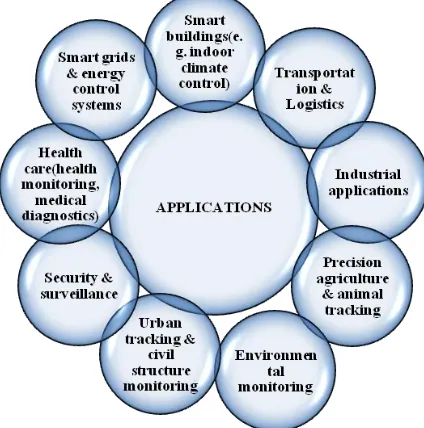
[image:1.612.337.549.478.692.2]II. APPLICATION OF SENSOR NETWORK
[image:1.612.52.296.566.675.2]International Journal of Emerging Technology and Advanced Engineering
Website: www.ijetae.com (ISSN 2250-2459, ISO 9001:2008 Certified Journal, Volume 7, Issue 7, July 2017)
345 III. LEACH PROTOCOL
LEACH Protocol is the first protocol of hierarchical Routings which suggests data fusion; it is of milestone importance in clustering routing protocols. Lots of hierarchical routing protocols are improved ones based on LEACH protocol [20]. So, when wireless sensor networks progressively go into our lives, it is essential to study LEACH.
LEACH is a hierarchy routing protocol used in WSN to increase the life time of a network, in LEACH protocol sensors organize themselves in a cluster and one of these nodes acts as cluster head, only a cluster head is allowed to send to base station, cluster head collects data from all nodes then aggregates and compress it and send it to base station. LEACH is a self-organizing, clustering, and adaptive protocol. Leach has the proposition according to Sensor features and Base Station [3].
In LEACH protocol sensors and base station has some characteristics such as [16]:
Sensors are sensing surroundings at fixed rate.
Sensors communicate among each other and to the base station.
All sensors are homogenous and have energy constraint. Nodes located close to each other have correlated data. While a Base Station:
Base station is fixed.
Base station is located far from sensors.
IV. PHASES OF LEACH
In LEACH protocol, a cluster head is not fixed, LEACH uses a concept of rounds and each round consists of two phases: setup phase, steady state phase and each phase consists of two phases [6].
Set-up Phase: cluster-head selection and cluster formation.
1)Advertisement Phase. 2)Cluster Set-up Phase.
Steady Phase: data collection, aggregation, delivery to the base station.
1)Schedule Creation 2)Data Transmission
V. LEACH OPERATION
Below shows the Pseudo code describing the operation of LEACH protocol [11].
Notation:
N: number of nodes. CH: cluster head.
Setup phase:
In this phase cluster are created ,cluster heads are chosen
forEach(node N)
N selects a random number r between 0 and 1
If (r <threshold value)
N become a CH
N broadcasts a message advertising its CH status
Else
N become a regular node
N listen to advertising message of CHs
N chooses the CH with strongest signal as its cluster head
N informs the selected CH and becomes a member of its cluster
EndIf
forEach(CH)
CH creats a TDMA schedule for each node to transmit data
CH communicates the TDMA schedule to each node in the cluster
Endfor
Steady State phase:
forEach(regular node N)
N collects sensed data
International Journal of Emerging Technology and Advanced Engineering
Website: www.ijetae.com (ISSN 2250-2459, ISO 9001:2008 Certified Journal, Volume 7, Issue 7, July 2017)
346 Endfor
forEach (CH)
CH receives data from the nodes of the cluster
CH aggregates the data
CH transmits the data to base station
Endfor
VI. LEACH ALGORITHM DETAIL
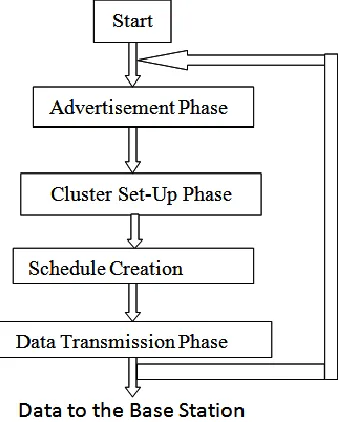
[image:3.612.84.253.376.587.2]The algorithm comprises of number of rounds. When the clusters are deployed, every round starts with a set-up phase, followed by the steady-state phase. To minimize load, the steady-state phase is kept longer than set-up phase. Flow chart of the LEACH protocol is shown in the figure III.
Figure III LEACH algorithm flow chart
A.Advertisement phase
Initially, every single node elects itself to become a cluster head by picking a random number between 0 and 1 and then compute threshold T (n) formula as shown below (1) [10]:
T(n) = (1)
Such that:
P: desired Percentage to become a Cluster head.
r: Current Round.[7]
G: Set of nodes that have not been selected as Cluster head in last 1/P rounds.
If a random number is less than T (n) ,the node becomes a cluster head and a node that become a cluster head in a round 0 will not become a cluster head in next 1/p [17] round and a T(n) will be 1 after 1/p-1 and all nodes will be qualified again to become a cluster head, and as the cluster head is selected the cluster head broadcast an advertisement message to the remaining nodes by using Carrier sense multiple access (CSMA MAC protocol), and each node decides to which cluster to belong according to received signal strength indicator (RSSI) of advertisement.
B.Cluster Set-up Phase
After a node selects a cluster head it transmits its selection using CSMA MAC protocol, during this all cluster head must keep receiver on.
C.Schedule Creation
In Steady Phase a cluster head creates Time Division Multiple Access (TDMA) schedule according to number of nodes in cluster after this a member node receives the schedule, it transmits data in its own time slots, and leftover in the sleep state in other slots.
D. Data Transmission
As TDMA schedule is fixed, transmission of data start. The data aggregation occurred before sending the data to the base station. In final step, the compressed data transfer to the base station by the cluster-head. This is operation of steady state of sensor network using LEACH protocol. After certain time these four phase would be repeated.
VII. ISSUES OF LEACH PROTOCOL
International Journal of Emerging Technology and Advanced Engineering
Website: www.ijetae.com (ISSN 2250-2459, ISO 9001:2008 Certified Journal, Volume 7, Issue 7, July 2017)
347 The CH is permanently transmits and gather data so its energy ends soon and when the CH die i.e no energy left , the cluster becomes useless because the data collected by cluster nodes will never reaches the base station [13, 5].
LEACH protocol takes into considerations number of assumptions which may create problems in real-time systems. Some of these assumptions are as follows:
A.More Energy Loss in Cluster Head Nodes:
Cluster head in LEACH protocol are randomly produced and energy dissipated can be evenly spread in the network; but, it avoids leftover energy of nodes, geographical area and other information in the selection of cluster head node, due to this it can easily lead to drain the energy quickly in cluster head nodes. It is necessary to design efficient energy communication strategies for data collecting process because considerable amount of communication in WSN involves data collecting.
B.Easy Failure of Cluster Head:
An assumption is taken by LEACH protocol that all the nodes can be directly connected with the cluster head node and the base station node, usually the sensing area is far from the deployed network of the base station, the cluster head which is away from the base station is easily fail. Therefore, it is difficult to expand the network, because the distribution of cluster head is completely dependent on the random number, so the number of the cluster-heads can be large at a regional, and at the other region there is few number of cluster heads.
C.Dynamic Clustering a Tough Approach:
The concept of dynamic clustering produces more overhead, which may decrease the energy. LEACH considers that all nodes starts with the same energy during each round, considering that the energy consumption of CH is approximately same amount for each node . The protocol should be scaled to account for non-uniform energy sensor nodes, i.e., use energy-based threshold.
D.No Guarantee of Real Load Balancing in Case of Sensor Nodes with Different Amount of Energy:
For achieving load balancing, CHs rotation has to be performed at each round; LEACH cannot guarantee real load balancing in the case of sensor nodes with different amounts of initial energy. Taking this issue into consideration a improved version should be created. Improved LEACH can be created whose energy efficiency must be greater than the actual version of LEACH.
E.Reliability in Terms of Data Transportation
In LEACH data reliability is an important feature. As more transmission energy are required to send aggregated data to sink, where the sink is found far from each cluster head. Data fatal ratio is calculated at sink itself, therefore Delay occurs. The ratio of loss of how many packets transmitted is known as fatal ratio.
VIII. LEACH IMPROVEMENT TECHNIQUES
The limitation of energy resources is the most challenging issue in developing (WSN) applications. Several network topologies have been introduced for estimating the power dissipation of this kind of application. These strategies can help to predict the WSN lifetime, give recommendations to application developers and may optimize the energy dissipated by the WSN applications.
Proposed clustering algorithm [10] for sensor networks, called Low Energy Adaptive Clustering Hierarchy (LEACH). LEACH organizes the network into clusters; cluster is the group of nodes deployed. In each cluster one of the node is created as CH. The operation of LEACH protocol is broken into rounds. Each round starts with set up phase where cluster formation and cluster heads selection is performed which is followed by steady state phase where data transfer is done, when data is transmitted from nodes to the CH and then to the BS.
LEACH-E (Energy Low Energy Adaptive Clustering Hierarchy) in this all a nodes have same energy and same probability to become a cluster head. After first round residual energy will change and the cluster head will be the node with highest residual energy thus the nodes themselves determine whether they become cluster-head [9].
LEACH-F (Fixed number of cluster Low Energy Adaptive Clustering Hierarchy) this protocol uses centralized approach for cluster formation. Once the cluster formation process is done, then there is no need to re-clustering phase in next round. The clusters are fixed and only CH rotates within its clusters [12].
Two level Low Energy Adaptive Clustering Hierarchy this protocol able to deliver more data packets than the Original LEACH protocol as TL-LEACH improves energy efficiency by using a cluster head node as relay node in between cluster head nodes [14].
International Journal of Emerging Technology and Advanced Engineering
Website: www.ijetae.com (ISSN 2250-2459, ISO 9001:2008 Certified Journal, Volume 7, Issue 7, July 2017)
348 By using the base station, each node sends its current location and energy level to the base station and the base station uses tracking methods to produce better clusters require less transmission of energy [15].
Vice Cluster Head Low Energy Adaptive Clustering Hierarchy which improves the drawback in LEACH protocol by having vice-cluster head in each cluster that takes the role of cluster head when cluster head dies [19].
DE-LEACH guarantee that nodes which are far away from base station will be cluster head only when they have enough energy for doing this task [4].
Advanced Low Energy Adaptive Clustering Hierarchy A-LEACH is an extension of the LEACH, which improves the stable area of the clustering hierarchy and reduces probability of failure nodes employing the particular parameters of heterogeneity in networks. In these networks some high energy nodes called CAG nodes become cluster head to collect the data of their cluster members and transfer it to the sink or Gateways to minimize the energy consumption of cluster head because it is employed to route information from cluster head to the sink, which permits to minimize the failure probability of clusters head and this increase the lifetime of the network [1] .
Multi-hop Routing with Low Energy Adaptive Clustering Hierarchy partitions the network into different layers of clusters and in each layer there are a cluster head and then cluster heads collaborates with adjacent layers to transmit sensor’s data to the base station. MH-LEACH adopts an optimal path between cluster head and base station [8].
K-LEACH, to prolong the lifetime of a sensor network by regular clustering through k-medoids algorithm and balancing the capacity of entire network among all active nodes. It guarantee regular clustering of nodes and gives suitable location of CH. It uses the combination of clustering, maximum residual energy criterion and a random chosen of CHs only after almost 50% of rounds of operations of the network gets over, whereas the LEACH protocol does totally random selection of CHs, which leads to very poor chosen of CHs and consequently leads to highly inefficient lifetime and energy retention by the network [2].
Distance Based Cluster Formation improves LEACH protocol to enhance network lifetime. The distance of the node from base station is significant in cluster formation which minimizes extra transmissions in existing LEACH protocol [11].
IX. CONCLUSION
LEACH is a hierarchical routing protocol, it contains many advantages like it does not need any control information, it saves energy, it is completely distributed and also contain many disadvantages like if cluster head dies then cluster become useless, clusters are divided randomly etc. various improvements are done on LEACH protocol and so there are various version of LEACH protocol.
REFERENCES
[1] Abdellah, E., hssane, A., (2010). Advanced Low Energy Adaptive Clustering Hierarchy. (IJCSE) International Journal on Computer Science and Engineering 2.07, Vol. 02, No. 07, 2491-2497. [2] Bakaraniya, P., and Mehta, S., (2013). K-LEACH: An improved
LEACH Protocol for Lifetime Improvement in WSN. International Journal of Engineering Trends and Technology (IJETT) – Volume 4 Issue 5, ISSN: 2231- 5381.
[3] Barai, L., and Gaikwad, M., (2014). Performance Evaluation of LEACH Protocol for Wireless Sensor Network. International Journal of Innovative Research in Advanced Engineering (IJIRAE) Volume 1 Issue, ISSN: 2349-2163.
[4] Boukerche, A.; Nakamura, E.F.; Loureiro, A.F (2009). Algorithms and Protocols for Wireless Sensor Networks. In: Azzedine Boukerche,Eduardo F.Nakamura and Antonio A.F.Loureiro, Algoritms for Wireless Sensor Networks.; zBoukerche, A., Ed.; John Wiley & Sons: Hoboken, NJ, USA.
[5] Braman, A., Umapathi, G., (2014). A Comparative Study on Advances in LEACH Routing Protocol for Wireless Sensor Networks: A survey, International Journal of Advanced Research in Computer and Communication Engineering Vol. 3, Issue 2 ,1271-7722.
[6] Dhawan, H., Waraich, S., (2014). A Comparative Study on LEACH Routing Protocol and its Variants in Wireless Sensor Networks: A Survey. International Journal of Computer Applications Volume 95– No.8, (0975 – 8887).
[7] EZZATIABDELLAH, SAIDBENALLA, Abderrahim
BENIHSSANE,MoulayLahcenHASNAOUI,‖Advanced Low Energy Adaptive Clustering Hierarchy‖ EzzatiAbdellah etal/ (IJCSE) International Journal on Computer Science and Engineering, Vol.02.No.07, 2010, 2491-2497.
[8] Farooq, M., Dogar, A., and Shah, G., (2010). MR-LEACH: Multi-hop Routing with Low Energy Adaptive Clustering Hierarchy. Fourth International Conference on Sensor Technologies and Applications, pages 262-268.
[9] Handy, M., Haase, and Timmermann, D., (2000). Low Energy Adaptive Clustering Hierarchy with Deterministic Cluster-Head Selection. Fourth IEEE Conference on Mobile and Wireless Communications Networks, Stockholm, erschienen in Proceedings, S. 368-372, ISBN 0-7803-7606-4.
International Journal of Emerging Technology and Advanced Engineering
Website: www.ijetae.com (ISSN 2250-2459, ISO 9001:2008 Certified Journal, Volume 7, Issue 7, July 2017)
349 [11] Kole, S., Vhatkar, K., and Bag, V., (2014). Distance Based Cluster
Formation Technique for LEACH Protocol in Wireless Sensor Network. International Journal of Application or Innovation in Engineering & Management (IJAIEM), Volume 3, Issue 3 ISSN 2319 - 4847.
[12] Kumar, V., Jain, S., and Tiwari, S., (2011). ―Energy Efficient Clustering Algorithms in Wireless Sensor Networks: A Survey,‖ International Journal of Computer Science Issues (IJCSI), Vol.8, Issue 4, No 2, pp.1694-0814.
[13] Liao, Q., Zhu, H., (2013). An Energy Balanced Clustering Algorithm Based on LEACH Protocol. Proceedings of the 2nd International Conference on Systems Engineering and Modeling (ICSEM-13), Vol.5, Issue.3, pp.90-95, 2.
[14] Loscrì, V., Morabito, G., and Marano, S., (2005). A Two-Level Hierarchy for Low-Energy Adaptive Clustering Hierarchy (TL-LEACH). Vehicular Technology Conference, 1988, IEEE 38TH (7803-9152).
[15] Muruganathan, S., and Fapojuwo, A., (2005). A Centralized Energy-Efficient Routing Protocol for Wireless Sensor Networks, IEEE Radio Communications 43.3 (2005): S8-13.
[16] Ramesh, K., and Somasundaram K., (2011). A Comparative Study of Cluster Head Selection Algorithms in Wireless Sensor Networks, International journal of computer science & engineering survey (IJCSES) vol.2, no.4 (1205.1673).
[17] Ravneet Kaur1, Deepika Sharma2, Navdeep Kaur3,―Comparative Analysis Of Leach and Its Descendant Protocols In Wireless Sensor Network‖ International Journal of P2P Network Trends and Technology-Vol. 3, Issue 1–2013
[18] S. ELkhediri, N. Nasri, A. Kachouri, Diverses‖Synchronization Issues in Wireless Sensors Networks‖, IEEE the 23 International Conference of Microelectronics. TUNISIA: ICM, 2011.
[19] Sindhwani, N., and Vaid R., (2013) .V Leach: An Energy Efficient Communication Protocol for WSN. Mechanica Confab 2.2, Vol. 2, No.2, ISSN: 2320-2491.