Host Mobility Protocol for Secure Group Communication in Wireless Mobile
Environments
Miss Laiha Mat Kiah and Keith M. Martin
Information Security Group, Department of Mathematics
Royal Holloway, University of London
United Kingdom
[email protected], [email protected]
Abstract
Secure group communication allows a set of nodes (or devices) to communicate securely amongst each other over unprotected and open networks. Provision of security for group communication is based on cryptographic services, which relies on careful management of cryptographic key-ing material. Securkey-ing group communication in wired net-works is fairly well understood, however wireless netnet-works introduce further challenges as group members may move from one place to another while still remaining in a group session. In this paper we propose a host mobility proto-col to govern group member movement in wireless mobile environments. We introduce the use of lists as part of our protocol design in order to facilitate host mobility.
1. Introduction
The advance in Internet technology, in particular multi-castfunctionality [8] (which efficiently enables group com-munication), has increased the demand and popularity of group-based applications such as multimedia conferencing, news or stock updates and virtual classrooms.
Both end-users and content (or service) providers have similar security expectations for multicast applications as in traditional point-to-point (unicast) applications. Thus a vital component of any security architecture for group com-munication is the design of agroup key management frame-work (GKMF), within which to govern the management keying material.
Previous GKMF proposals, such as those in [1][2][5][7][10][11][13][14][19][22][24] were not de-signed with wireless mobile environments explicitly in mind. While some efforts have been made to extend GKMFs to mobile environments, such as [4][6][8][20][21], most do not explicitly address host mobility issues.
Providing mechanisms to address this specific problem is fundamental if secure group communication is to be deployed in wireless mobile environments. In this paper we propose and analyse a host mobility protocol.
The rest of the paper is organised as follows. Section 2 describes the main components of a GKMF. Section 3 iden-tifies specific issues that need to be addressed in a GKMF for wireless mobile environments. In the following two sec-tions we present our proposal for supporting host mobility. Finally, we conclude in Section 6.
2. Group Key Management Frameworks
A GKMF is an infrastructure comprising the basic en-tities and functions necessary to provide common crypto-graphic keys to all communicating entities (group members) in a network supporting group (multicast) communication. The main objectives for group communications are similar to traditional unicast communications, namely the provision ofconfidentiality, integrityandauthenticationsecurity ser-vices. A GKMF provides all the management tasks to main-tain and protect the keys required to implement all of these services.
The main components of a GKMF can be divided into two parts, each of which is discussed in the following sub-sections.
2.1. GKMF architecture
The GKMF architecture specifies:
• the main entities within the GKMF, which typically consist of key managers, group managers and group members;
• the placement of these entities within the architecture;
• the (types of) cryptographic key used within the archi-tecture.
2.2. Key management processes
The essential processes identified within a GKMF for se-cure group communication are as follows:
• Formation of multicast group. This includesgroup cre-ationandinitial registration of group members. Group creation can consists of a host sending a request to the network via the Internet Group Management Protocol (IGMP)[7][23]. Registration of group members is typ-ically performed by a host sending a join request to a group manager (perhaps asking for a specific inter-net service). At this point all the information related to a group, such as group membership policy and the required cryptographic keys, is determined.
• Generation and distribution of cryptographic keys. Cryptographic keys can be symmetric, asymmetric or a combination of both, depending on the security ob-jectives or preferences of particular applications. Most GKMFs employ symmetric keys because symmetric algorithms have lower computational complexity and are faster than asymmetric algorithms [9][15]. Typical key types are:
– Individual keys. Also referred to as long-term keys, these keys are unique to every host (po-tential group member) and are typically gener-ated by, and shared with, a key or group manager. These keys are established prior to the group cre-ation.
– Group keys. Also referred to astraffic encryption keys(TEKs), group keys are generated by a key manager, and shared by all group members of a multicast group. Primarily used for securing the actual data communication, group keys are usu-ally distributed to every member of a multicast group under the protection of individual keys.
An auxiliary key may be needed for the secure and ef-ficient distribution of a group key to the group mem-bers [11][17][24]. Instead of having to send the group key separately under the protection of individual keys of group members, it can be sent once via a multicast message protected under the auxiliary key.
Where asymmetric cryptography is used, all entities involved in the group communication are assigned asymmetric key pairs [1][11][12].
• New member joins. Similarly to initial registration, any host who wishes to join a group will need to send ajoin
request message to a governing entity such as a group manager. If the member is granted permission to join the group then relevant keys need to be delivered to the newly joined member.
Provision of backward secrecy [11][19] may require re-keying of cryptographic keys whenever a new mem-ber joins a group in order to control access to the pre-vious group traffic from the new member. Re-keying will result in all group members including the newly joined member obtaining a new group key.
• Existing member leaves. This process is initiated by sending aleaverequest message to a governing entity such as a group manager. If provision offorward se-crecy[11][19] is required then re-keying will need to occur in order to update the group with a new set of group keys, and to control access of future group traf-fic from the leaving member.
Unlike member joins, member leaves can be voluntary or non-voluntary. While the former occurs at the re-quest of a group member, the latter can occur acci-dently (such as when a member is disconnected), or when a member is evicted from a group. An eviction of a group member usually requires re-keying to occur.
• Re-keying. This may occur due to group membership change (new joins for backward secrecy, and member leaves for forward secrecy), re-keying may also occur due to:
– Periodic re-keying. A pre-determined plan to re-key a multicast group after a certain interval (which is often dictated by a group policy, as well as security requirements of a particular applica-tion).
– Expiration of cryptographic keys. When a key has reached the end of its validity period.
– Compromised keys. When a key used is believed (or suspected) to have been compromised and is no longer considered safe to use.
Re-keying events are normally initiated by governing entities such as group or key managers.
3. GKMFs for Wireless Mobile Environments
(WMobEs)
into a generic GKMF model for wireless mobile environ-ments [18].
3.1. New reasons for
joinsand
leavesAs well as the reasons discussed in Section 2.2, group members may join and leave groups as they move between areas, while still remaining in a group session. The pro-cess of a member moving to another area can be treated as a leavefrom one area followed by ajointo another. Moving members member will need to notify a key manager, prior to moving. Such a move may require the provision of back-ward and/or forback-ward secrecy (since different areas may have their own security requirements). Thus a specific protocol is required to govern host mobility.
3.2. Additional key management to support
mobility
The generation of new keying material may be required in order to support host mobility. For example:
• Moving members may still hold cryptographic keys of the areas they visited even after they leave a group, which may lead to compromise.
• Host mobility may require group members to occa-sionally communicate via a foreign network (the vis-iting area) that may not be fully trusted. Thus, it is im-portant to ensure that group members that are moving from one area to another are protected (via different sets of keys).
• Group members that move between areas may gather the area’s local security information. It is imperative to ensure that the area is protected from members who are moving from one area to another in order to collect the security information (keys) of each area for malicious purposes.
4. A GKMF Supporting Host Mobility
In the next two section we propose a method of sup-porting host mobility gor group communication in wireless mobile environments. In this section we briefly outline the GKMF and in the next section we provide details of the host mobility protocol.
4.1. Scope of proposal
It is important to note the following:
• Infrastructure-based environment. The framework for the proposed protocol relies on an infrastructure based
environment with a basic underlying cellular architec-ture [3][16][20] as its networking platform.
• Key distributions and key updates. The aspects of key management that the protocol is primarily concerned with arekey distributionandkey updates (or, re-keying) which may occur during host mobility. Other aspects of key management such as generation, registration as well as deletion of keys are implicitly assumed to be available.
• Simplified protocol descriptions. Our protocol descrip-tions will be simplified in order to highlight how the keys in the GKMF are utilized to provide confidential-ity services. Provision of other securconfidential-ity services (such as data integrity and message authentication) are im-plicitly assumed.
4.2. Main architecture
We adopt the general cellular architecture based on the notion of domain(s) and areas as the basic framework [11][18]. The reason for adopting logically or physically defined domains and areas is to provide a means to have an administratively manageable environment for group com-munication to take place within.
• Main entities. The main entities involved are:
– Domain key manager (DKM): responsible for generating, distributing, storing and deleting all keying materials that may be required at the do-main level, as well as playing the role of group controller, which includes managing group poli-cies, group membership, re-keying events and se-curity policies.
– Area key manager (AKM): one per area, operat-ing under the DKM’s jurisdiction and responsible for key management within the area, including for group members residing within that area.
– Group member(s): senders and receivers, defined to reside within one area at any given time.
• Placement of entities. Figure 1 shows placement of entities in domainiand areaj, with DKM as the main key manager of domainiand AKM as the key manager of the areaj.
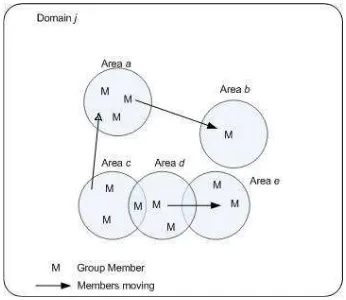
Figure 2 shows placement of group membersMacross a domain j, where distribution of members occurs throughout the areas a toe. The arrows denote the movement of group members between the areas.
Figure 1. Placement of entities in domain i
and areaj.
Figure 2. Placement of group members throughout areas.
group members trust these key managers. There are two levels of trust relationships:
– At the domain level. All AKMs trust the DKM as the primary key distributor, as well as the main group manager for various groups operating in that domain.
– At the area level. All group members (residing in that area) trust their AKM as the main ref-erence point for security parameters needed for group communication.
• Types of key. The symmetric keys used are:
– Domain-Area Key,DAi−Key. A unique long-term key shared between the DKM and AKMi of areai. Generated by the DKM, the function
of each Domain-Area key is restricted to unicast communication between the DKM and a particu-lar AKM.
– Area-Member Key, AiM−Key. A unique key shared between AKMi and group member M. Generated by the AKM, the function of each Area-Member key is restricted to unicast com-munication between AKM and the group mem-ber.
– Area Key, A−Key. A group key unique to an area. Generated by each AKM, the main purpose of having an area key is for managing host mo-bility and for efficient and scalable re-keying.
4.3. Host mobility protocol functionality
Since a moving member may accumulate information for each area it visits, provision of backward secrecy is neces-sary for controlling access to an area’s past security infor-mation (which could be used for malicious purposes). This requires re-keying to occur whenever host mobility occurs. Thus the main functional requirements of our host mobility protocol are to:
• transfer a group member from one area to another area;
• initiate a re-keying of an area key of a visiting area;
• deliver a new area key of a visited area to a moving member and to group members residing in that area.
The main security requirements of the protocol are to:
• ensure that only transfers from authorized group mem-bers are processed;
• secure communications between the group member and the area key manager;
• secure communications between the area key manager and the domain key manager;
• protect the distribution of area key of the visited area to the moving member.
4.4. List(s) management
In this section, we introduce an important concept that we will use as part of our protocol design. As group mem-bers may frequently move between a number of areas while still remaining in a group session, every time a member moves, re-keying of an area key may need to occur.
useful to avoid frequent re-keying of an area key. To facili-tate this, we propose the use of a list referred to as amobility list(MobList). This is securely maintained by key managers (DKM and AKMs) in a domain and contains information on group members that move from one area to another (and also indicates how many area keys the member possesses). Each time a member moves from one area to the next, the following information is logged inMobList:
• ID of the moving member,
• ID of the multicast group joined by the member,
• ID of the area that a member is moving from,
• ID of the visited area that a member is moving to.
MobListcan be used to keep track of host mobility and frequent re-keying can be avoided every time a member moves back into an area that it recently visited. This is be-cause when the same member moves back into that area, the AKM of the visited area can determine (by looking up its MobList) whether the member is a returning member who is just moving back into the area, in which case re-keying of the area’s key may not need to take place.
5. Host Mobility Protocol
We now specify our host mobility protocol.
5.1. Notation
We use the following notation:
• DKM. Domain key manager.
• IDD. Identity (ID) of DKM.
• AKM. Area key manager.
• AKMi. AKM of areai.
• IDAi. ID of AKMi.
• Mi. Group member of an areai.
• IDMi. ID ofMi.
• IDG. ID of a multicast group G.
• DAi−Key. Domain-Area key between DKM and AKMi.
• AiMi−Key. Area-Member key between AKMi and Mi.
• A−Keyi. Area key of areai.
• A−Keyinew. New area key of areai.
• Sm−Keyji. Session mobility key between AKMiand Mj.
• ||. Concatenation operator.
• {m}k. Encryption of message (or data)mwith a sym-metric algorithm using the keyk.
• text. A field in the message content which may contain optional information.
• a→b.Unicasttransmission from entityato entityb.
• M ov−T okenD. Amove tokenfrom DKM→AKM containing security parameters associated with a mul-ticast group duringhost mobility.
• M ov−T okenA. Amove tokenfrom AKM→M con-taining security parameters associated with a multicast group duringhost mobility.
5.2. Important assumptions
For ease of design, we make the following assumptions:
• Availability of secure encryption algorithms.
• Implicit use of secure entity and data origin authenti-cation mechanisms such as use of message authentica-tion codes (MACs).
• Symmetric keys specified in Section 4.2 are assumed to have been established securely prior to the com-mencement of the host mobility protocol.
• Use of some form oftime variant parameter such as a time stamp in thetextfield within protocol messages for freshness checking.
• The membership of all key managers (DKM and AKMs) in a domain is predetermined and fixed. Thus, each Domain-Area key and the Domain key are static and valid until the policy determines otherwise.
• Availability of secure storage of cryptographic keys for all group communication entities.
• Availability of secure mechanisms for managing the MobList.
5.3. The protocol
This protocol describes transfer of a group member from one area to another with consideration to secure access to previous keys and group data traffic (backward secrecy). The protocol also includes the delivery of a new area key A−Keyvnewto the moving member, as well as to the group members residing in that area.
• An established multicast group has already been cre-ated.
• Moving memberMi (currently in area i) and AKMv (in the visited area v) have securely established a shared short-term session mobility key Sm−Keyiv prior to moving.
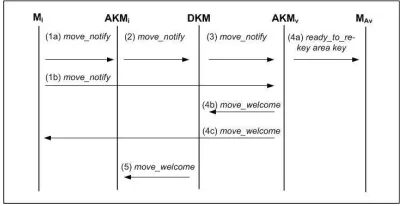
[image:6.612.76.277.201.304.2]The message flow of this protocol is depicted inFigure 3. The steps involved are described as follows:
Figure 3. Member Moving with Backward Se-crecy protocol message flow.
1. A group memberMithat wishes to move into another area sends amove−notif ymessage along with the ID of the area that he is moving into (IDAv) to:
(a) its current area key manager AKMiprotected un-der Area-Member keyAiMi−Key:
Mi→AKMi:IDMik{IDGkIDAikIDAvk
IDMiktext}AiMi−Key.
(b) the area key manager of the visited area AKMv protected under a session mobility key Sm−Keyiv:
Mi →AKMv:IDMik{IDGkIDAikIDAvk
IDMiktext}Sm−Keyiv.
2. Upon receiving themove−notif ymessage fromMi, AKMi checks the message by decrypting it with AiMi−Key and passes the message to DKM pro-tected under Domain-Area keyDAi−Key:
AKMi→DKM :IDAik{IDGkIDAikIDAvk
IDMiktext}DAi−Key.
3. Upon receiving the message from AKMi, DKM checks the message by decrypting it withDAi−Key, and sends themove−notif ymessage to AKMvalong with the ID ofMiin the form ofM ov−T oken, where M ov−T okenD ={IDGkIDAikIDMikIDAvktext}
protected under the Domain-Area keyDAv−Key it shares with AKMv:
DKM →AKMv:IDDk{M ov−T okenDk
text}DAv−Key.
4. Upon receiving the move−notif y message from DKM andMi, AKMvdoes the following:
(a) checks the message from DKM by decrypting it with the Domain-Area keyDAv−Keyit shares with the DKM;
(b) checks the message from Mi by decrypting it with the session mobility key Sm−Keyiv it shares withMi;
(c) assuming that the checking is valid, AKMvlooks up its MobListvand ifMiis not in the list (mean-ing that this isMi’s first time to enter the area), AKMvmust re-key its area keyA−Keyv. To do so, AKMvgenerates a new area key and sends it via theready−to−rekeymessage. This results in all group membersMAvin that particular area obtaining the new area keyA−Keyvnew. (d) AKMv sends the new area key A−Keyvnew
via a move−welcome message in the form of M ov−T oken, where M ov−T okenA =
{IDGkIDAikIDMikIDAvkA−Keyvnewktext},
to :
• Mi, protected under the session key Sm−Keyiv;
• DKM, protected under the Domain-Area keyDAv−Key.
(e) IfMi is already on MobListv, AKMvwill need to check whether there has been any re-keying of its area key sinceMi’s last visit to the area. If none, AKMv sends amove−welcomemessage toMi in the form of M ov−T oken, along with its current area keyA−Keyv(as inStep 4(d)). Otherwise, AKMv sends an updated area key A−KeyvnewtoMi.
5. Upon receiving the move−welcome message from AKMv, DKM informs AKMi of the successful move of memberMi via amove−welcomemessage, pro-tected under aDomain-Areakey.
Having the new information concerning member Mi, DKM and AKMs (AKMiand AKMv) will need to update theirMobListin order to keep track of memberMi’s mobil-ity, along with the number of area keys that may have been kept byMi.
In cases where provision of backward secrecy is not nec-essary, no update of keying material will need to occur dur-ing host mobility, and a movdur-ing member is given the same key(s) currently in use in the visited area.
5.4. Analysis of protocol
In this section, we provide a basic analysis of the pro-posed protocol.
• A memberMi who wishes to move into another area must first establish a short-term session mobility key with the AKM of the visited area, and we have as-sumed that this was done securely (see Section 5.3).
• After obtaining the session mobility key,Mi initiates the move protocol by sending amove−notif y mes-sage to its local area key manager AKMi, protected under the Area-Member key, and to the visited area key manager AKMv, protected under the session mo-bility key. If an adversary gets hold of the enciphered messages between the entities, he has no way of deci-phering the message as he has no access to either of the keys (Area-Member key or session mobility key).
• A member Mi uses the session mobility key to se-cure communications with the AKMv. If an adversary wants to masquerade as some moving member in order to get hold of the area key of the visited area, he will not be able to do so because he has no access to the session mobility key shared only between the moving member and the AKMv.
• We have implicitly assumed the provision of data ori-gin authentication (such as using MACs). Thus, we can conclude that if an adversary wants to masquer-ade as some moving member in order to get hold of A−Keyv orA−Keyvnew, the adversary will not able to do so because he has no access to the MAC key. Other entities (DKM, AKM andMi) can easily check the integrity of messages received via the same pro-cess.
• After receiving the move−notif y message from AKMi, DKM notifies AKMv of the move, protected under the Domain-Area key. Similarly, if an adversary gets hold of the enciphered message between DKM and AKMv, he has no way of deciphering the message as he has no access to the Domain-Area key.
• After receiving the move−notif y message from DKM andMi(and ifMiis not in theMobList), AKMv initiates the re-keying of its area keyA−Keyv. This results in all members residing in the visited area, in-cluding the moving member Mi, obtaining the new area key A−Keyvnew. AKMv can send this key to group members (excludingMi) in the area either via multicast, protected under the old area keyA−Keyv, or via unicast, protected under the Area-Member keys. AKMvsendsA−Keyvnew toMi, protected under the session mobility key. If an adversary wants to get hold ofA−Keyvnew, he will not be able to do so because he has no access to the keys (A−Keyv, Area-Member keys, or session mobility key).
• We have implicitly assumed the provision of data ori-gin authentication, so we can conclude that if an ad-versary wants to masquerade as some moving member in order to get hold ofA−Keyvnew, the adversary will not be able to do so as he has no access to the MAC keys.
• On a member’s first move into an area, the area needs to be re-keyed with a new area key, and information about the moving member is logged inMobList. If it is necessary to control the number of area keys that are kept by a group member (which corresponds to the number of areas that he visited), MobList may need to be reset for that particular member after a period of time, for example when the number of area keys collected by a member (as he moves from one area to another) has reached a threshold limit. In this case, re-keying of the area key may need to occur when the member moves into an area. This will be determined by the group security policy at the creation of a multi-cast group, prior to the commencement of group com-munication. This is useful to avoid a group member moving from one area to another with intent to collect all the area keys. If colluding members want to ex-change security information, such as area keys, to gain unauthorized access to different areas, this could also be prevented (periodically).
• All affected key managers (DKM, AKMiand AKMv) update theirMobList, and area(s) visited are logged. We assume that these lists are maintained and kept se-curely by the key managers.
6. Conclusion
residing), to another area managed by AKMv, while still re-maining in the group session. Themoveis managed by the DKM via AKMi. For provision of backward secrecy, when a member moves to a visited area, the area key of visited area needs to be re-keyed. This results in group members (including the moving member) residing in that particular area obtaining a new area key. All affected key managers during host mobility (such as DKM, AKMi and AKMv) need to update theirMobList, and new information regard-ing the movregard-ing member is logged into the lists.
The proposed protocol features a mechanism (MobList) that allows for efficient processing of members who are re-turning to recently visited areas during host mobility.
References
[1] M. Baugher, R. Canetti, L. Dondeti, and F. Lindholm.Group Key Management Architecture. Internet Draft IETF MSEC WG, 2003. http://www2.tools.ietf.org/html/draft-ietf-msec-gkmarch-04.
[2] M. Baugher, R. Canetti, L. Dondeti, and F. Lindholm. Multi-cast Security (MSEC) Group Key Management Architecture. RFC 4046, 2005.
[3] B. Bhargava, S. B. Kamisety, and S. K. Madria. Fault-tolerant authentication and group key management in mo-bile computing. Technical report, Center for Education and Research in Information Assurance and Security, and Department of Computer Science Purdue University, 2000. http://www.cs.purdue.edu/homes/bb/cs690b/report.ps. [4] D. Bruschi and E. Rosti. Secure multicast in wireless
net-works of mobile hosts: Protocols and issues. Mobile Net-works and Applications, 7(6):503–511, dec 2002.
[5] R. Canetti, J. Garay, G. Itkis, D. Micciancio, M. Naor, and B. Pinkas. Multicast security: A taxonomy and some efficient constructions. InProceeding of IEEE Eigh-teenth Annual Joint Conference of the IEEE Computer and Communications Societies (INFOCOMM)’99, 1999. http://citeseer.ist.psu.edu/canetti99multicast.html.
[6] B. Decleene, L. Dondeti, S. Griffin, T. Hardjono, D. Kiwior, J. Kurose, D. Towsley, S. Vasudevan, and C. Zhang. Secure group communications for wireless networks. In Proceed-ings of IEEE MILCOM’01, pages 66–73, 2001.
[7] S. Deering.Host extensions for IP multicasting. RFC 1112, 1989.
[8] L. Gong and N. Shacham. Multicast security and its exten-sion to a mobile environment.Wireless Networks, 1(3):281– 295, 1995.
[9] R. A. Gove. Fundamentals of cryptography and encryption. InInformation Security Management Handbook, 4th Edition by H. F. Tipton and M. Krause. Auerbach, 2000.
[10] T. Hardjono, B. Cain, and N. Doraswamy. A Framework for Group Key Management for Multicast Security. Internet Draft IETF, 2000. http://www3.ietf.org/proceedings/00jul/I-D/ipsec-gkmframework-02.txt.
[11] T. Hardjono, B. Cain, and I. Monga. Intra-Domain Group Key Management Protocol. Internet Draft IETF, 2000. http://www.securemulticast.org/draft-ietf-ipsec-intragkm-03.txt.
[12] T. Hardjono and L. R. Dondeti. Multicast and Group Secu-rity. Artech House, 2003.
[13] T. Hardjono and G. Tsudik. IP Multicast Security: Issues and Directions. Annales de Telecom, pages 324–340, 2000. http://citeseer.ist.psu.edu/hardjono99ip.html.
[14] H. Harney and C. Muckenhirn. Group Key Management Protocol (GKMP) specification. RFC 2093, 1997.
[15] J. Ikbal. An introduction to cryptography. InInformation Security Management Handbook, 4th Edition by H. F. Tipton and M. Krause. Auerbach, 2003.
[16] Y. Lin and I. Chlamtac. Wireless and Mobile Network Ar-chitectures. John Wiley & Sons, Inc, 2001.
[17] M. L. MatKiah and K. M. Martin. Group communication: Design challenges in the development of key management frameworks in wireless mobile environments. In Proceed-ings of International Conference on Security and Manage-ment SAM’05, pages 385–390. CSREA Press, 2005. [18] M. L. MatKiah and K. M. Martin. A generic group key
management framework for group communication in wire-less mobile environments. InProceedings of the Sixth In-ternational Network Conference INC2006, pages 347–354. University of Plymouth, 2006.
[19] S. Mittra. Iolus: A framework for scalable secure multicas-ting. InProceedings of ACM SIGCOMM, pages 277–288, Cannes, France, 1997.
[20] J. Park, Y. Suh, and S. Kang. Supporting mobile mul-ticast in mobile networks by considering host mobility. In IDMS/PROMS 2002: Proceedings of the Joint Inter-national Workshops on Interactive Distributed Multimedia Systems and Protocols for Multimedia Systems, pages 263– 273. Springer-Verlag, 2002.
[21] R. Shankaran, V. Varadharajan, and M. Hitchens. Secure multicast extensions for mobile networks. In LCN ’99: Proceedings of the 24th Annual IEEE Conference on Lo-cal Computer Networks, page 106. IEEE Computer Society, 1999.
[22] D. Wallner, E. Harder, and R. Agee. Key Management for Multicast: Issues and Architectures. RFC 2627, 1999. [23] B. Williamson. Developing IP Multicast Networks. Cisco
Press, 2000. Chapter 43.