~\ IST~l<AAN UNIVERSITI MALAYA
Developing Malay Children's Literary Resources
Chew Fong Peng, Ph.D Associate Prof. Mahzan Arshad, Ph.D
Zahari Ishak, M.Sc Loh Sau Cheong, Ph.D
Faculty of Education Teh Ying Wah, Ph.D
Faculty of Computer Science &Information Technology University of Malaya
MALAYSIA
Abstract
Introduction
Early childhood literature is the building agent in forming human emotion, thought or
language. According to Savage (2002) human development in early childhood literature
can be divided into three forms namely, self development and social, cognitive
development and language development. The development of brain has achieve up to 80%
when the child reach the age ofthre~ years. Whereas Misran Rokimin (2001) has check the
children literature as development agent towards self development of human includes its
emotion, thought and language. Therefore, children's era are the golden era for the
educators, parents and education agency to expand the cognitive, affective and
psychomotor aspect to achieve its maximization.
Children literary material in Malaysia
Until to-date, early childhood literature still in its explorative stage in Malaysia. We
are buying more, reading and import children story book from oversea especially Britain
and America. Research on the role and influence of literature on children also not much
done by local researchers.
Followed by this, reference books on curriculum and early childhood literature
modules at the libraries were on Britain, America, and Australia etc. Those books were
used by educators from all local education institutions from the lowest level to the highest
level. Those child care centers, pre-school operator have applied the theories and
Most of the literary materials for local children are based from traditional printed
materials and it is totally not in-line with the present country's development. Besides we
have move towards the paperless era and borderless world, teaching materials in literature
must be in line with the development of globalization. In addition, Malaysian parents are
becoming more education-conscious and are sending their children to kindergartens, thus
creating a greater demand for pre-school literature.
The early childhood literature materials written in Malay language are limited and
can't be use as references or to be called big book. Materials which have been introduced
in the market are not base on the education philosophy and research. On the other hand, it
is more profit taking
in
mind without looking at the development of child psychology.When we evaluate the quality of a children literature, we need to take into
consideration of children's interest, their visual ability and the storyline perspective as well
as the children's respond towards
it.
Early children's visual which is very encouraging,therefore literature materials could motivate the children to read at the very tender age.
Not much research on children literature materials has been done in Malaysia.
What's more on the development on early children literature in Malay language which is
based on scientific research, Most of the children's literature in the Malaysian market now
are not appealing, no quality, not systematic and not classified according to the children's
age.
This situation is much differs to the children's literature in English which is
established and developed. Itcame out with an appealing Outlook, various dimensions and
style and in series. Followed that, literature materials
in
English were publish in the formEnglish which is published follow according to researches on the cognitive, affective and
psychomotor development of the children concern.
Therefore, this research is in pioneer stage towards the development of literature
materials in Malay language. The development of literature materials will adapt the ways,
approaches, methodology and the special aspect of it from the English literature to suit the
. culture and Malaysian perspectives. All the story, animation, characters and background in
the children literature in Malay language will color with local Malaysian taste and we will
propose that the materials publish in two forms namely book and CDs with both audio and
visual aspects, we hope that the children will welcome and show interest in those literature
materials. And this can be instilling the lifelong reading culture among the children.
With that, this research suits certain criteria in the Ninth Malaysian Plan (RM9) that
is to inculcate Reading culture and lifelong learning. As the Malay proverb says 'to
straighten the bamboo, start with its shoot'. With that this research is important in educate
the society that to inculcate reading habits must start from young. This will also to upgrade
human capital of Malaysian citizen as propose by Malaysian former Prime Minister, Tun
Abdullah Haj i Ahmad Badawi.
Present Status of Children Literary Book
Hadijah Rahmat (2006) has surveyed the development stage of children literture in
Malaysia dan Singapore from the traditional period up till 1982. Her research finding
shows literary work in Malay language took a longer period and late in its development.
Eventhough the literary work evolve and develop shows its upgrading in quantity
remaining 20% are text book titles. In terms of language, in 1996, about 58% of children's
books are in Malay, 42% arein other languages (Azizah &Md. Sidin, 2004).
Based from the research done by Mahzan Arshad (2006), literature materials
published in Malaysia were categorized at minimal level for the purpose of child
development. He has done the research base on 820 children story books published from
1996 to 2005.50.2% of the book published in Kuala Lumpur and 35.9% in Selangor itself.
Results from this research shows that the quality of children literature published in Kuala
Lumpur was not good. Its main characteristics are the specific theme for children, simple
and light language, interesting illustration, simple story line and its plot.
The evolvements of children story books has shown an increase in numbers, but the
quality on story, paper, illustration, colors and others were not well taken care of. The
study indicated that the local book industry is dominated primarily by books produced for
the domestic market focusing on school text book, revision guides or model answer books.
On the average, print runs for school text books may range between 1,000 to 100,000
copies and for non text books between 5,000 to 10,000 for children's books (Siti Zakiah
Arnan,2004).
Children Preferences in Literature
Research studies on reading interest, reading preference, and reading choice
provide useful information to those who purchase books for children and those who
encourage them to read the books. Many studies of children's reading interests have been
• Cover illustrations that suggest the topic of the story
• Episodic plots
• Progressive chronological plots that can be easily followed
• Quick start to the story with action beginning on the first or second page to
hook the reader
• Rapid introduction to main characters and only a few main characters
• Characters the age of the reader or slightly older
• Books based on movies and television
In addition, trivia books such as the Guinness Book of World Records, sports
statistics books, joke books, and game system guides for video and computer games are
very appealing to some boys.
The topic of children's preference has been more fuIJy researched for
intermediate-grade than for primary and preschool children. In looking at what is available, though,
several cautions should be kept in mind. First, these research results tell what children as a
group appear to like. They do not indicate what an individual child will like. They
provide a starting point as a suggestion, not an answer. Second, while a survey of
preferences helps educators judge the content and type of literature children may enjoy, it
is not a guide to literary quality. Teachers must work both with what they know of
children and with what they know of literature as they select books.
Ingeneral, sex differences in reading interest do not appear strongly until children
are around eight or nine years of age. Primary school children, both boys and girls, enjoy
stories about personified animals, about nature, about children their age or slightly older,
term
representational
as opposed to abstract when they are judging pictures apart fromtext. Although they generally prefer color illustrations over black and white, when a study
was done with primary children choosing books in their own classroom, it was found that
some books in back-and-white ha special meaning for certain children. Any book, due a
certain combination of content and type of illustration, may become a favorite (Joan,
2000).
Thus, isolating a single factor has not proved to
be
a reliable method of predictingchildren's responses to a specific book. Some teachers conduct interest surveys within
their own classes, determining what interests the children have in common and finding
individual interests that can be matched with appropriate literature. Many teachers find
that books about monsters and books that are humorous are currently very popular with
their classes.
Primary grade children, in a pilot study conducted by Carol Fisher and Margaret
Natarella (1918), showed a favorable attitude toward both rhyming and unrhyming poetry
but preferred the rhyming. Often, if they liked the topic of the poem, they liked the poem
too. If they disliked the subject, they disliked the poem about it. The children had
difficulty in comprehending figurative language, tending to interpret it literally for some
rather strange conceptions of what the poem was about. Their favorite poems have strong
rhythm and rhyme and frequently were narrative in form. These results were confirmed by
a later study of primary grade children's poetry preferences.
One of the most consistent fmdings of all the studies is that preschool a primary
grade children enjoy literature, both prose and poetry. Teachers and day-care providers
to plan literature experience in such a way that goals of early childhood education are
supported.
Be aware also that there is a social dimension to children's literacy preferences.
Children will respond to the attitudes of other children and of the adults who are presenting
books. When a teacher shows that he or she enjoys a book and encourage children to look
at or read it, the climate is set for a positive response. When a day-care provider makes the
environment conducive to looking at and sharing books, children are more likely to do so;
even the way in which the book is presented may become associated with the book itself.
Thus care should be taken that books are shared in ways that are enjoyable for children.
The Study of Reading Habits In Malaysia
1966 conducted by Frank Small andAssociation for Perpustakaan Negara Malaysia revealed that among the childe of the 5-9
years age group, almost 19% acquired reading ability. However, only 56% ofthem practise
reading covering newspapers (10%), magazines (6%), books (26%) and comics (41%).
The finding also reveal that school-going children practise more reading than pre-schoolers
and that the majority of the children perfer knowledge books (53%) to fiction (45%).
Hobbies (15%) and other non-fiction (12%) occupy a much lower perference. The survey
also looks into the criteria in choosing books for children by parents and the findings are as
follow:
Books with picture (25%)
Story/Fiction/Fairy tales (15%)
Easy/Simple to understand (10%)
Arouse interest in reading (10%)
Comics/Cartoon books (8%)
Improve knowledge ('7%)
Drawing/Painting/Colouring (6%)
Related to studies (5%)
Chosen by the children (3%)
Not too expensive (2%)
Azizah dan Md. Sidin (2004) did a survey to draw up a reading profile of students
in Malaysia from the age of '7 to 12. The main findings are related to their reading habits,
purchasing of books and their preferred reading materials. On the question of whether they
read books other than school text books, 100 percent respondents give positive answer.
References and activity books are always read. Other favourite categories are maganizes
and iJJustrated books. Besides that, the respondents prefer to buy books rahter than
borrow or rent; about 30 percent buy about I to 3 books per month while 22.2 percent
claimed that they buy 10 books and above in a month. The respondents regard
newspapers as the most read and preferred publication folJowed by comic books (56%),
novels (51.3), activity books (45.2%), illustrated books (43.2%), magazines (44%) and
reference books (40010).
Chew and Zahari (2008) discuss the stance taken by university undergraduates,
teachers and parents in evaluating Malay Folk Literature in early childhood education to be
used as big books. The survey were taken from 941 respondents, indicated that Malay
Folk Literature can be absorbed into teaching and learning for early childhood with a mean
of 4.12 while it can be big books with mean of 4.02. Meanwhile the highest mean value
Respondents comprised three categories, namely: undergraduates from the Early
Childhood Education or Malay Studies programs, teachers from childcare centres, and
parents. These three categories were chosen because they are very involved in choosing
suitable reading materials for children and because they are connected to and well versed
in the field.
Before the fieldwork was undertaken, a pilot study was done to verify the
instrument. Analysis showed the Cronbach Alpha of the instrument was 0.95, hence
indicating its consistency and suitability for the study.
Profile of Respondents
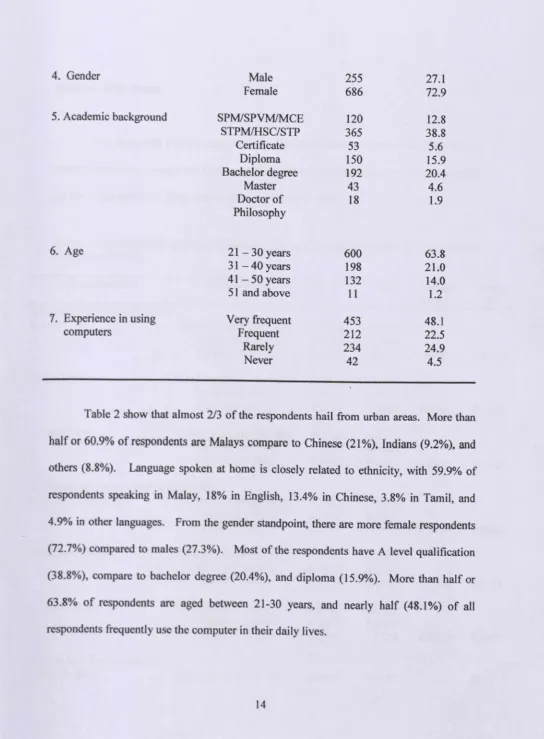
A total of 941 respondents were involved in this study, comprising 347
[image:10.561.10.549.40.775.2]undergraduates, 299 teachers and 295 parents. Their details are as shown in Table 1.
Table 1:Respondents' Profile by Location, Ethnicity, language Spoken at Home, Gender, Academic background, Age and Experience in Using Computers
Social Background (N=941) Characteristics Frequency Percentage
Urban 545 57.9
Rural 396 42.1
Malay 573 60.9
Chinese 198 21.0
Indian 87 9.2
Other 83 8.8
Bahasa Malaysia 596 59.9
English 169 18.0
Chinese 126 13.4
Tamil 36 3.8
Other 46 4.9
I.Location of home
cq: ~ ...J <C 2
I-en
cr::
w>
Z :J Z«
~ ~en
2. Ethnicity4. Gender Male 255 27.1
Female 686 72.9
5. Academic background SPMlSPVMlMCE 120 12.8
STPMlHSC/STP 365 38.8
Certificate 53 5.6
Diploma 150 15.9
Bachelor degree 192 20.4
Master 43 4.6
Doctor of 18 1.9
Philosophy
6. Age 21 - 30 years 600 63.8
31-40 years 198 21.0
41 - 50 years 132 14.0
51 and above 11 1.2
i.
Experience in using Very frequent 453 48.1computers Frequent 212 22.5
Rarely 234 24.9
[image:11.559.9.553.44.783.2]Never 42 4.5
Table 2 show that almost 2/3 of the respondents hail from urban areas. More than
half or 60.9% of respondents are Malays compare to Chinese (21%), Indians (9.2%), and
others (8.8%). Language spoken at home is closely related to ethnicity, with 59.9% of
respondents speaking in Malay, 18% in English, 13.4% in Chinese, 3.8% in Tamil, and
4.9% in other languages. From the gender standpoint, there are more female respondents
(72.7%) compared to males (27.3%). Most of the respondents have A level qualification
(38.8%), compare to bachelor degree (20.4%), and diploma (15.9%). More than half or
63.8% of respondents are aged between 21-30 years, and nearly half (48.1%) of all
Findings of the Study
This study will use the mean and standard deviations to analyze the view of the
literary community toward the favorable children's reading materials that is most suitable
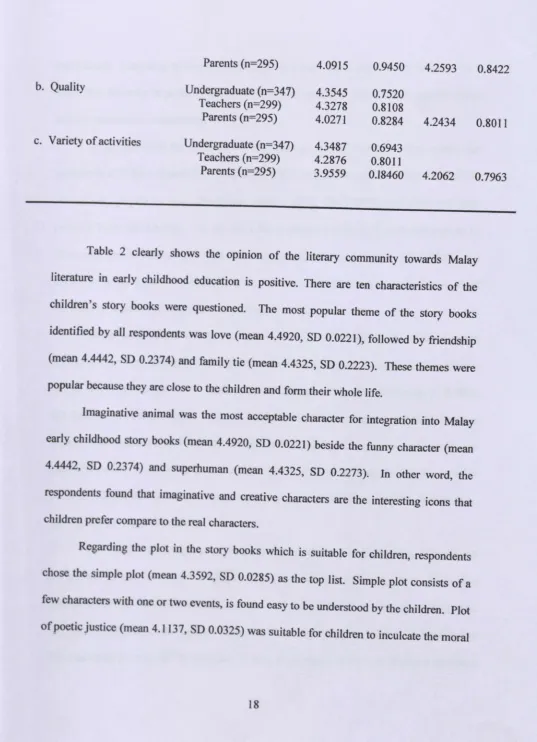
[image:12.548.8.537.35.681.2]for use as big books for Malaysian children as shown in table 2.
Table 2: Characteristics of Malay Children's Literary Materials Considered Interesting in
Malaysia (N=941)
Characteristics Respondents Mean SD AverageMean AverageSD
I.Themes which children like
a.Love Undergraduate (n=347) 4.6196 0.5933
Teachers (n=299) 4.4916 0.7480
Parents (n=295) 4.3424 0.6660 4.4920 0.6773
b. Friendship Undergraduate (n=347) 4.5072 0.7147 Teachers (n=299) 4.5017 0.6970
Parents (n=295) 4.3119 0.7589 4.4325 0.6972
c. Family tie Undergraduate (n=347) 4.5130 0.6556 Teachers (n=299) 4.4214 0.7528
Parents (n=295) 4.3492 0.6777 4.4325 0.6972
2. Characters (icon) which children like
a. Imaginative animal Undergraduate (n=347) 4.3055 0.7858 Teachers (n=299) 4.2101 0.9443
Parents (n=295) 3.9797 0.9145 4.1732 0.8890
b. Funny character Undergraduate (n=347) 4.4150 0.7258 Teachers (n=299) 4.0870 0.9584
Parents (n=295) 3.8508 0.8440 4.1339 0.8734
c. Superhuman Undergraduate (n=347) 4.2939 0.8189 Teacbers (n==299) 4.1070 1.0969
Parents (n=295) 3.8102 1.0520 4.0829 1.0072
Teachers (n=299) 4.3344 1.0241
Parents (n=295) 4.0949 0.8871 4.3592 0.8731
b. Plot of
poetic juctice
Undergraduate (n=347) 4.4121 0.7604 Teachers (n=299) 4.1204 1.0161Parents (n=295) 3.1559 1.1012 4.1131 0.9983
c. Plot of sequential Undergraduate (n=347) 4.3602 0.7252 Teachers (n=299) 4.1605 0.8942
Parents (n=295) 3.1695 0.8518 4.1116 0.8588
4. I1ustration that interest the children
a. Colourful Undergraduate (n=347) 4.5677 0.6567 Teachers (n=299) 4.4141 0.1870
Parents (n=295) 4.1661 0.8224 4.3932 0.7708
h. Fantacy world Undergraduate (0=341) 4.3115 0.1556 Teachers (n=299) 4.3512 0.8749
Parents (n=295) 3.9220 0.8982 4.2264 0.8647
c. Multi-dimension Undergraduate (n=347) 4.1499 0.8227 Teachers (n=299) 4.0134 0.9268
Parents (0=295) 3.1593 0.8205 3.9841 0.8108
5. Presentation inbooks that children like
a. Big book size Undergraduate (n=347) 4.1326 0.9122
Teachers (n=299) 4.1806 1.1296 4.0584 1.0461 Parents (n=295) 3.8475 1.0788
h. Different shape of the Undergraduate (0=341) .4.1066 0.8552
book Teachers (n=299) 3.9866 0.9830
Parents (n=295) 3.7763 0.8476 3.9649 0.9050
c. Big font Undergraduate (n=347) 3.7637 1.1026
Teachers (n=299) 3.9264 1.1027
Parents (n=295) 3.7797 0.9344 3.8204 1.0542
6. Language used
in
books that children likea. A lot of dialogue Undergraduate (n=347) 4.1671 0.8264 Teachers (n=299) 4.0569 1.0460
Parefl~ (0=295) 3.8475 0.9656 4.0319 0.9526
h. Repeat language Undergraduate (n=347) 3.4755 0.9921 Teachers (0=299) 3.7492 1.0460
c. Rhyming language Undergraduate (n=347) 3.5187 1.0009 Teachers (n=299) 3.6288 0.9997
Parents (n=295) 3.5695 0.9560 3.5069 0.9910
7. Type of published materials
a. Video(DVDNCD) Undergraduate (n=347) 4.5072 0.6556 Teachers (n=299) 4.3880 0.1922
Parents (n=295) 4.1932 0.7514 4.3709 0.7420
b. Book Undergraduate (n=341) 4.4294 0.6694
Teachers (n=299) 4.2508 0.9627
Parents (n=295) 4.0136 0.7953 4.2423 0.8282
c. Audio (CD) Undergraduate (n=347) 4.3689 0.6859 Teachers (n=299) 4.1438 0.9913
Parents (n=295) 3.9119 0.8605 4.1541 0.8610
8. ICT materials which are suitable
a. ICT interactive Undergraduate (n=347) 4.1124 0.8511 Teachers (n=299) 4.2809 0.1606
Parents (n=295) 3.9797 0.8726 4.1243 0.8382
b. Graphic in 3 dimension Undergraduate (n=34 i) 4.2133 0.1156 Teachers (n=299) 4.1538 0.8726
Parents (n=295) 3.8746 0.8697 4.0882 0.8491
c. Web page Undergraduate (n=347) 4.0836 0.8510
Teachers (n=299) 3.9532 1.0513
Parents (n=295) 3.1831 1.0210 3.9419 0.9809
9. Contents ofICT materials
a. Games Undergraduate (n=347) 4.3948 0.7733
Teachers (n=299) 4.3679 0.9404
Parents (n=295) 4.0407 1.0490 4.2752 0.9327
h. Interactive Undergraduate (n=347) 4.1816 0.8038 Teachers (n=299) 4.3545 0.7867
Parents (n=295)
4.1186
0.7668
4.2168
0.7921
c. Exercises Undergraduate (n=347) 4.2305 0.17819 Teachers (n=299) 4.1137 0.9088
Parents (n=295) 3.9458 0.8905 4.1041 0.8653
10. Weitghtage of buying
Parents (n=295) 4.0915 0.9450 4.2593 0.8422
b. Quality Undergraduate (n=341)
4.3545 0.1520 Teachers (n=299) 4.3278 0.8108
Parents (n=295) 4.0271 0.8284 4.2434 0.8011
c. Variety of activities Undergraduate (n=347) 4.3487
0.6943 Teachers (n=299) 4.2876 0.8011
Parents (n=295) 3.9559 0.18460 4.2062
[image:15.555.7.544.41.783.2]0.1963
Table 2 clearly shows the opinion of the literary community towards Malay
literature in early childhood education is positive. There are ten characteristics of the
children's story books were questioned. The most popular theme of the
story
booksidentified by all respondents was love (mean 4.4920, SD 0.0221), fol1owed by friendship
(mean 4.4442, SD 0.2374) and family tie (mean 4.4325, SD 0.2223). These themes were
popular because
they
are close to the children and form their whole life.Imaginative animal was the most acceptable character for integration into Malay
early childhood story books (mean 4.4920, SD 0.0221) beside the funny character (mean
4.4442, SD 0.2374) and superhuman (mean 4.4325, SD 0.2273). In other word, the
respondents found that imaginative and creative characters are the interesting icons that
children prefer compare to the real characters.
Regarding the plot in the
story
books which is suitable for children, respondentschose the simple plot (mean 4.3592, SD 0.0285) as the top Jist. Simple plot consists of a
few characters with one or two events, is found easy to be understood by the children. Plot
and parents. According to Maria Perers (2004), a story book becomes so personal for a
child, that the story is perfectly memorised, makes them feel safe, embody eternal values
and are windows to immortality.
In parallel with the leT era, the respondents showed that the Malay stories that
produce in leT form should first comprises of leT interactive (mean 4.1243, SD 0.0273),
second was graphic in three dimension (mean 4.0882, SD 0.0211), and third web page
(mean 3.9479, SD 0.0320). On the other hand, contents of the leT materials need to be
filled with games (mean 4.2593, SD 0.0214), interactive (mean 4.2434, SD 0.0261), and
exercises (mean 4.2062, SD 0.0260) to be done by the children as an evaluation tools of
the children's understanding of the story that they read.
Moral value (mean 4.2593, SD 0.0274) in the story books or Cl) always became
the most important weightage of buying by the buyers because it influence the children
values and personalities. This followed by the quality of the story books (mean 4.2434,
SD 0.0261) include the paper, colours, illustrations, story etc; how a children's book is
written and illustrated is, therefore a concern for each as for society as a whole. In
addition, variety of activities (mean 4.2062, SD 0.0260) in the story books also another
important factor that to be considered by the buyers. Activities here include exercises,
games, and interactive activities.
Most of the items shown that undergraduate students scored the highest mean and
the parents gained the lowest mean. Inother word, undergraduate pursue most positive
attitude toward all the characteristics compare to preschool teachers and parents, except six
items that preschool teachers gain the highest mean. The items included big book size and
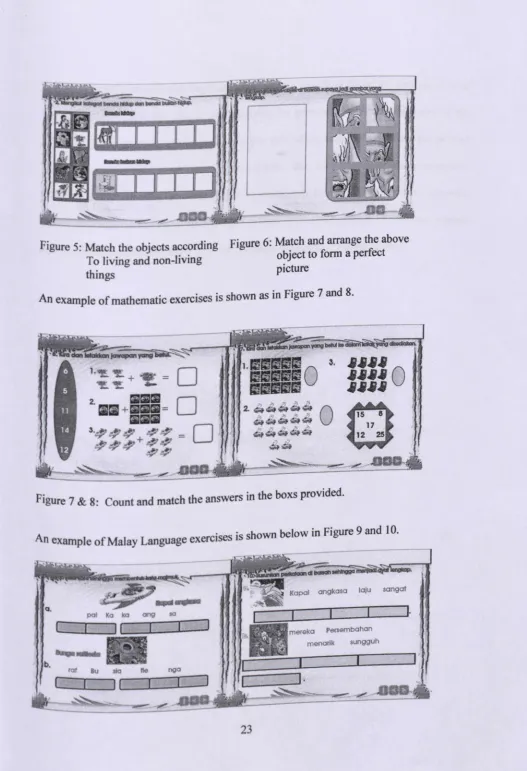
Figure 5: Match the objects according To living and non-living things
Figure 6: Match and arrange the above object to form a perfect picture
An
example of mathematic exercises is shown as in Figure 7 and 8.= 0
.-.
= 0
=0
2.
~./l.,.ik ~
J1,4l..
J;,ik;;"4
0
;:Z,~Jl.,a,~,:k~
Figure 7& 8: Count and match the answers
in
the boxs provided.for the children's interest and stages in psychological growth to fill up the absence of local
content. This fulfills the aims to pave the way for growth of this "book industry of the
future". Although there will be changes
in
the publishing world in the future, but printedpublishing will continue to play important role, due to the existing socio-economic
imbalance. Besides, there are other obstacles which may hinder the growth of multimedia
publishing, such as economy, technology, culture, and social system. Therefore, printed
References
Azizah Hamdan & Md Sidin A. Ishak. (2004). Children's Book Publishing in Malaysia. Proceeding of Seminar-cum-Workshop on Children's Book Publishing in the Nex Millennium,48-10. Kuala Lumpur: Dewan Bahasa &Pustaka.
Hadijah Rahmat. (2006).
Peranan
dan Perkembangan Sastera Kanak-kanak. KualaLumpur: Dewan Bahasa dan Pustaka.
Hamdan Yahya et.al. (2004). Report on Multimedia Publishing: The Situation and Development in East and South East Asia. Proceeding ojSeminar-cum-Workshop on Children's Book Publishing in the Nex Millennium, 29-41. Kuala Lumpur: Dewan
Bahasa &Pustaka.
Joan I. G. (2000). Literature for Young Children. 4th Edition. New Jersey: Pearson
Education.
Lynch-Brown, C & Tomlinson, C. (2008). Essentials of Children's Literature. 6th Edition. Pearson Education.
Mahzan Arshad. (2006).
Penilaian
terhadap Bahan Kesusasteraan Awal Kanak-kanak.Jurnal Pendidikan.
Misran Rokimin. (2001). Sastera Kanak-kanak dan Remaja sebagai Agen Pembangunan. Kertas kerja Seminar Sastera Kanak-kanak dan Remaja 2001. 26-27 April.
Mohd. Sharif Mohd. Saad & Hajah Alimah Salam. (2001). Pengisian dan Pengukuhan Sastera Kanak-kanak dan Remaja pada Alaf Baru: Peranan dan Cabaran Perpustakaan. Kertas kerja Seminar Sastera Kanak-kanak dan Remaja 2001. 26-27
April.
Savage,
F.
John2000.
For the Love o/Children and Books in the Elementary Years.The
McGraw-Hill Companies, Inc.
Shirley,
C.R.
&Rebecca, T.I.
(1994).Stories; Children's Literature in Early Education,
New York: Delmar Publishers Inc.
Siti Zakiah Aman. (2004). Book publishing in Malaysia with special focus on children's book publishing: a country report. Proceeding of Seminar-cum-Workshop on Children's Book Publishing in the Nex Millennium, 71-96. Kuala Lumpur: Dewan
Langerman, D. (1990). Books and boys: Gender preferences and books selection. School Library Journal 36(3): 132-136.
Sawyer, W & Comer, D.E. (1995). Children books and Literature. Wadsworth: Delma Publishers.
Worthy, J. Moorman, M., &Turner, M. (1999). What Johnny likes to read is hard to find in school. Reading Research Quarterly, 34(1),12-17.