International Journal of Emerging Technology and Advanced Engineering
Website: www.ijetae.com (ISSN 2250-2459,ISO 9001:2008 Certified Journal, Volume 4, Issue 6, June 2014)
302
Optimal Scheduling for Repetitive Construction Projects with
Multiple Resource Crews
Sanjay Bhoyar
1,
Dr. Dhananjay K. Parbat
2 1Assistant Professor, National Institute of Construction Management and Research, Pune- 411045, Maharashtra, India
2Lecturer (Selection grade) in Civil Engg, Government Polytechnic, Sakoli, Maharashtra, India
Abstract— Repetitive construction projects require schedules that ensure continuity of work for the resource crews as they move from one unit to another performing a particular task. Critical path method, the most widely used planning and scheduling method in construction, does not ensure continuity of work for resource crews while scheduling repetitive projects. Existing resource-driven techniques for scheduling repetitive projects either ensure complete crew work continuity or minimum project duration, considering same resource crew to perform a task in all repetitive units. However, repetitive construction projects with multiple crew availability for tasks are common in construction industry.
This paper presents a new model to schedule repetitive construction projects with multiple crews. The proposed scheduling model ensures minimum project duration and maximum crew work continuity for the available multiple crews for different repeating activities. The proposed model essentially consists of two stages. In first stage the model schedules all the tasks in each unit by assigning one of the multiple available crews for that task, so as to complete the project as early as possible. In second stage maximum possible crew work continuity is accomplished for each crew assigned in stage one. The model can be used by the construction project planners to decide the number of multiple crews to be deployed for each repeating task. A numerical example from the literature is analyzed to illustrate the use and capabilities of the model.
Keywords—Repetitive construction projects; Optimal scheduling; Crew work continuity; Multiple crew utilization; work-breaks.
I. INTRODUCTION
Repetitive construction projects are characterized by repetitive activities. Multi-span bridges, mass housing projects, multi-storeyed buildings, highways and pipelines are typical examples. Repetitive projects represent a large portion of the construction industry. Efficient planning and scheduling of this type of construction projects is very crucial. In repetitive construction projects, resource crews move from one unit to another, repeating same task in each unit. Therefore it is important to provide an uninterrupted work-flow for resource crews from one unit to the next.
Maximizing crew work continuity significantly improves the construction productivity and reduces crew utilization costs. However it may lead to longer project completion time and hence increase in project overhead costs (Nassar 2005, El-Rayes and Moselhi 2001). Planners need to select a construction schedule that strikes an optimal balance between minimizing the project duration and maximizing the crew work continuity.
The critical path method (CPM), the most commonly used construction scheduling method, is basically a duration-driven approach and hence not suitable for repetitive projects. CPM is widely criticized in literature for its inability to ensure work continuity for resource crews as desired in repetitive projects (Reda 1990; Suhail and Neale 1994; Harris and Ioannou 1998; Hegazy and Wassef 2001). To overcome the limitations of CPM for scheduling repetitive construction projects, many other approaches have been developed. These include ‗Line of balance (LOB)‘ method, ‗Vertical production method (VPM)‘, ‗Linear scheduling model (LSM)‘ and ‗Repetitive scheduling method (RSM)‘. These scheduling methods for repetitive construction projects focus on maximizing crew work continuity by enabling each crew to finish work in one location of the project and move promptly to the next without work breaks. Different methods are introduced for optimal scheduling of repetitive construction projects using: linear scheduling (Reda 1990, Ipsilandis 2007), dynamic programming (Eldin and Senouci 1994, El-Rayes and Moselhi 1998) and genetic algorithms (Hegazy and Wassef 2001, Nassar 2005, Hyari and El-Rayes 2006).
International Journal of Emerging Technology and Advanced Engineering
Website: www.ijetae.com (ISSN 2250-2459,ISO 9001:2008 Certified Journal, Volume 4, Issue 6, June 2014)
303
This paper presents a new model to schedule repetitive construction projects with multiple crews in an easy, non-graphical manner similar to CPM. The proposed scheduling model ensures minimum project duration and maximum crew work continuity for the available multiple crews for different repeating activities. The model can be used by the construction project planners to decide the number of multiple crews to be deployed for each repeating task.
II. PROPOSED SCHEDULING MODEL
[image:2.612.324.565.116.275.2]In case of many repetitive construction projects more than one crew, with same resources composition, are available for execution of some tasks. With multiple available resource crews for a task, its execution can be planned at multiple units, simultaneously, employing different available crews. The project tasks are so scheduled at different units that precedence logic is complied with and the first available crew is assigned.
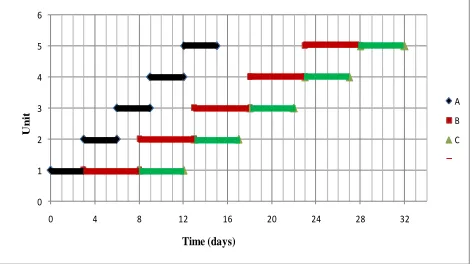
Figure 1: schedule for three tasks project with single crew per task
[image:2.612.51.287.355.487.2]When multiple crews are assigned for a task at different units, the project duration considerably reduces. Figure 1 shows a schedule for three tasks project with single crew per task and figure 2 shows the schedule for same project with two crews for task ‗B‘. With two available crews for task ‗B‘, project duration reduces by 4 days as task ‗B‘ is scheduled simultaneously at two units. If multiple crews are available for task ‗C‘, project duration can be further reduced.
Figure 2: schedule for three tasks project with two crews for task ‘B’
The proposed model essentially consists of two stages. In first stage the model schedules all the tasks in each unit by assigning one of the multiple available crews for that task, so as to complete the project as early as possible. In second stage maximum possible crew work continuity is accomplished for each crew assigned in stage one.
Initially all tasks are scheduled as early as possible, complying with precedence logic and the crew availability for each task and crew work continuity for a set of limited tasks, by assigning the first available crew, to determine the earliest possible project duration. Then it identifies the work-breaks for all the assigned resource crews of each task. These work-breaks are then minimized by pulling activities ahead in time without increasing the earliest possible project duration.
It is assumed that a task (i) can be performed by any one of the ‗N(i)‘ available resource crews in any unit and all available crews for a task have same production rate in each unit.
A. Stage 1: Early Start Schedule
Knowing the quantity of work (Qij) of task (i) in unit (j)
and productivity rate (Pij)of the available resource crew,
calculate the duration (Dij) of the activity (ij).
(1) 0
1 2 3 4 5 6
0 4 8 12 16 20 24 28 32
A B C
U
n
it
Time (days)
0 1 2 3 4 5 6
0 4 8 12 16 20 24 28 32
A B C
U
n
it
International Journal of Emerging Technology and Advanced Engineering
Website: www.ijetae.com (ISSN 2250-2459,ISO 9001:2008 Certified Journal, Volume 4, Issue 6, June 2014)
304
Now, beginning with the tasks without any predecessor(s) in the first unit and proceeding through successive units (1 to J), the possible start times complying with precedence logic and crew availability are determined.
Possible start time according to precedence logic, For other tasks, (i.e. when NP (i) > 0)
(2)
For task without any predecessor, (i.e. when NP (i) = 0)
(2a)
Start time according to crew availability is governed by the first available crew. This requires to scan all available crews for task (i) which are assigned to previous units (1 to ‘j-1’) to know which crew (n) can be transferred to unit ‗j‘.
(3)
Earliest possible start time (without any crew work continuity) complying with both, precedence logic and crew availability,
[ ] (4)
Corresponding earliest possible finish time,
(5)
The comparison of the earliest possible start due to precedence logic and that according to crew availability reveals the crew work continuity or discontinuity. If ( ), the crew of a task (i) will remain idle
and waiting as the crew of the preceding task has not finished its work in the particular unit. This idle time for the crew (n) of a task (i) while moving from previously assigned unit (x) to unit (j) is given by,
[
]
(6)
If the task does not require mandatory crew work continuity,
Start time,
(7)
If the task requires mandatory crew work continuity, the unforced idleness is removed by shifting the task at each unit, starting at the last unit and working backwards.
For this, finish time of task ‗i‘ in unit ‗j‘ where crew ‗n‘ is assigned (i.e. activity (i,j,n)) is pulled forward till the early start of the same task in unit ‗z‘ where same crew is next assigned. This pull results in shifting the activity ahead of its earliest possible start time. The corresponding start time of that task at each unit is given by,
(8)
Corresponding earliest start time,
(9)
Then earliest start and finish times for the succeeding tasks are determined in the same manner (using equation 2 to equation 9). The earliest possible time to complete the project is given by the finish time of the tasks without successors in the last unit.
--- for, i = 1 to I (10)
As crew work continuity for each task is not targeted at this stage, the resulting schedule contains the work-breaks for some of the crews of some tasks to start work at a particular location after completing the same task at the previous location. Crew work-breaks for specific activities is given by,
(11)
B. Stage 2: Schedule with Minimum Work-breaks for Multiple Crews
The scheduling calculations in the previous section, 3.4.1, give the earliest possible time to complete the project, which ensure crew work continuity for all assigned crews of select tasks. If the project completion is to be limited to the earliest possible project duration, complete crew work continuity may not be ensured for each task. This stage reschedules the activities with the objective of reducing the work-breaks of tasks, without mandatory work continuity, without extending the project duration.
International Journal of Emerging Technology and Advanced Engineering
Website: www.ijetae.com (ISSN 2250-2459,ISO 9001:2008 Certified Journal, Volume 4, Issue 6, June 2014)
305
For the last assigned unit for crew ‗n‘ of task (i),
(12)
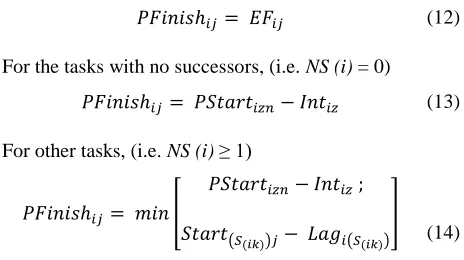
For the tasks with no successors, (i.e. NS (i) = 0)
(13)
For other tasks, (i.e. NS (i) ≥ 1)
[
( ) ( )
]
(14)
Pulling the possible finish time till ‗ ‘
will ensure crew work continuity, whereas, limiting possible finish to ‗ ( ) ( ) ‘ will preserve
the precedence logic. Possible start time
(15)
These possible start and finish times establish the maximum possible continuity of work for all crews of task (i) under the constraint of earliest possible project completion.
If a task is one of the multiple predecessors of its successor(s) and ‗ ‘ is less than
‗ ( ) ( ) ‘, the crew ‗n‘ of task (i) will
have complete crew work continuity. Such task in units where crew ‗n‘ is assigned can be further pulled ahead in time without altering the schedule for succeeding task(s). The amount of this pull is limited to the least value of the pull time between the task and all its successors at units where crew ‗n‘ is assigned.
( ) ( ) (16)
--- for k =1 to NS(i) and j = units where crew ‗n‘ is assigned
Shifting the entire task further by this least time retains the accomplished continuity of work for the crews ‗n‘ of task (i) and creates additional room for pulling its predecessor(s) for achieving corresponding continuity of work.
Hence, start time with minimum work-breaks,
(17)
Corresponding finish time,
(18)
The computations are repeated for the other crews of a task. After scheduling a task at all units to have maximum possible work continuity for each crew, the computational procedure is continued for preceding task, till the first task is scheduled for maximum possible continuity of work.
Minimum crew work-breaks can now be determined as
(19)
Total work-breaks for all crews assigned to a task is calculated by
∑
(20)
Total work-breaks for crews of all tasks can be obtained by adding the work-breaks of crews of individual tasks.
∑
(21)
III. ILLUSTRATIVE EXAMPLE
[image:4.612.58.290.150.280.2]The proposed scheduling formulation has been applied to a number of serial as well as non-serial repetitive projects. To demonstrate the utility of the proposed formulations a specific example project has been analyzed.
Figure 3: Network representation of tasks sequencing in sample project
The project involves six discrete tasks to be repeated into six repetitive units. All task dependencies are finish-to-start as shown in Figure3. The durations of each task at each unit is given in Table 1.
A
F
E
D
International Journal of Emerging Technology and Advanced Engineering
Website: www.ijetae.com (ISSN 2250-2459,ISO 9001:2008 Certified Journal, Volume 4, Issue 6, June 2014)
306
Table I
UNIT-WISE DURATIONS OF TASKS
Task Maximum available crews
Duration (days)
Uni
t
1
Uni
t
2
Uni
t
3
Uni
t
4
Uni
t
5
Uni
t
6
A 2 6 6 8 8 6 6
B 1 2 2 2 2 2 2
C 2 4 4 4 4 4 4
D 2 7 7 7 7 7 7
E 3 8 8 8 8 8 8
F 2 6 6 6 6 6 6
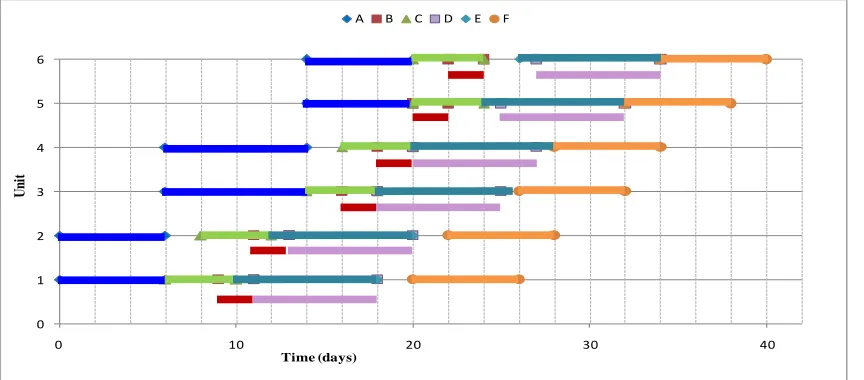
[image:5.612.41.297.155.304.2]Considering only one crew for each task, the earliest possible project completion time is 64 days. When the proposed scheduling methodology is used, considering multiple crew availability as given in table 1, the earliest possible project duration is 40 days. The most suitable multiple crew assignment for each task in respective units is given in table 2.
Table II
MOST SUITABLE CREW ASSIGNMENT FOR SAMPLE PROJECT
Task Crew assignment (crew number)
Un
it
1
Un
it
2
Un
it
3
Un
it
4
Un
it
5
Un
it
6
A 1 2 1 2 1 2
B 1 1 1 1 1 1
C 1 2 1 2 1 2
D 1 2 1 2 1 2
E 1 2 1 2 3 1
F 1 2 1 2 1 2
[image:5.612.95.527.392.582.2]The resultant optimal schedule is shown in figure 4. Correspondingly, crews of task ‗B‘ and ‗C‘ remain idle for 3 days and 10 days, respectively.
Figure 4: Schedule with minimum work-breaks for sample project with multiple crews
IV. CONCLUSION
In this paper a new model for optimal scheduling of repetitive construction projects with multiple resource crews is presented. The proposed scheduling model no just complies with precedence logic and resource crew availability, but also ensures minimum project duration and maximum crew work continuity for the available multiple crews for different repeating activities.
For each task in a repetitive unit, the model determines the scheduled start and finish times, the crew assignment and the work-break duration for each crew, if any. The model incorporates following practical considerations in scheduling of repetitive construction projects:
All types of repetitive tasks (typical as well as atypical)
Multiple crew assignments to work simultaneously 0
1 2 3 4 5 6
0 10 20 30 40
A B C D E F
U
n
it
International Journal of Emerging Technology and Advanced Engineering
Website: www.ijetae.com (ISSN 2250-2459,ISO 9001:2008 Certified Journal, Volume 4, Issue 6, June 2014)
307
Mandatory crew work continuity for select tasks Time lag between successive activities
Mandatory work interruption for crews to move from one unit to the next.
The model is applicable for serial as well as non-serial repetitive projects.
This analytically comprehensive model schedules repetitive construction projects with multiple crews in an easy, non-graphical manner similar to CPM. The model can be used by the construction project planners to decide the number of multiple crews to be deployed for each repeating task.
REFERENCES
[1] El-Rayes, K., and Moselhi, O. (2001). ―Optimizing Resource Utilization for Repetitive Construction Projects.‖ Journal of Construction Engineering and Management, ASCE, 16(4), 433-446. [2] Harris, R.B. and Ioannou, P.G. (1998). "Scheduling Projects with
Repeating Activities." Journal of Construction Engineering and Management, ASCE, 124(4), 269-278.
[3] Hegazi, T., and Wassef, N. (2001). ―Cost optimization in projects with repetitive nonserial activities.‖ Journal of Construction Engineering and Management, ASCE, 127(3), 183–191.
[4] Ipsilandis, P.G. (2007). ―Multiobjective linear programming model for scheduling linear repetitive projects‖. Journal of Construction Engineering and Management, ASCE, 133 (6) 417–424.
[5] Reda, R. M. (1990). ‗‗RPM: Repetitive project modeling.‘‘ Journal of Construction Division, ASCE, 116(2), 316–330.
[6] Suhail, S.A., and Neale, R.H. (1994). ―CPM/LOB: New methodology to integrate CPM and Line of Balance.‖ Journal of Construction Engineering and Management, ASCE, 120(3): 667– 684.
[7] Nassar, K. (2005). ―Evolutionary optimization of resource allocation in repetitive constructions schedules‖. IT in Construction Vol. 10, 265-273.
[8] Hyari, K., and El-Rayes, K (2006). ―Optimal planning and scheduling for repetitive construction projects.‖ Journal of Management in Engineering. 22 (1),11–19.
[9] Eldin, N. N., and Senouci, A. B. (1994). ‗‗Scheduling and control of linear projects.‘‘ Can. J. Civ. Engrg., Ottawa, 21, 219–230. [10] El-Rayes, K., and Moselhi, O. (1998). ‗‗Resource-driven scheduling