International Journal of Emerging Technology and Advanced Engineering
Website: www.ijetae.com (ISSN 2250-2459, ISO 9001:2008 Certified Journal, Volume 9, Issue 10, October 2019)
43
Reducing Image Denoising by Kernel Detection and
Applying Transformation
Sonika Bhawsar
1, Megha Jain
2, Dr Rachana Dubey
3 1,2,3Computer Science & Engineering, Lakshmi Narain College of Technology Excellence, Bhopal, India
Abstract— Here in this manuscript an effective Image
Denoising model is implemented which reduces noising effect or blurriness from images. The framework implemented here is based on the hybrid concept by first applying kernel padding for the detection of noisy effect in the image and then image denoising effect is applied using wavelet transformation. The algorithm applied here is more efficient in comparison with the existing image denoising framework [1]. The Experimental results are performed on various standard images and the proposed framework gives efficient results in terms of denoising effects, Peak Signal to Noise Ratio and Structural Similarity.
Index Terms—Cloud Computing, Virtaul Machines,
Load Balancing, Naïve Bayes Clustering, Ant based Clustering, Active Monitoring.
I.INTRODUCTION
With the help of image denoising the inventive image is recovered from the noisy dimension,
( ) ( ) ( ) ( )
Where y(i) is considered as the pragmatic assessment and x(i) is considered as the accurate or existent assessment and n(i) is the clatter level at pixel at i. The effective way to sculpt the consequence of clatter on a digital illustration is to append a gaussian white blare. For that casing, n(i) are i.i.d. gaussian standards with zero represent and inconsistency σ2.
Various techniques are implemented and proposed for the elimination of noise and recuperate the true image u. Although there is a possibility of using diverse tackle it must be emphasize that an extensive division distribute the same essential statement: denoising is implemented by considering mean. This mean may be executed close by: the Gaussian filtering representation (Gabor [2]), the anisotropic filtering ( Perona-Malik [3], Alvarez et al. [4]) and the neighbor-hood filtering (Yaroslavsky [5], Smith et al. [6], Tomasi et al. [7] ), by totaling of dissimilarity: the entirety dissimilarity minimization (Rudin-Osher-Fatemi [8]), or in the occurrence province: the experiential Wiener filters (Yaroslavsky [5]) and wavelet thresholding procedures (Coiffman-Donoho[9,10]).
Officially we describe a Noise elimination technique Dh as a disintegration
( ) ( )
Where y is considered as raucous image and h is a smoothing pixels stricture which regularly relies on the ordinary divergence of the clamor. Preferably, is much more noise free than y and ( ) looks like the comprehension of a white noise. The putrefaction of an image involving a smooth ingredient and a non horizontal or oscillatory part is a contemporary question of investigates (for exemplar Osher et al. [11]). In [12], Y. Meyer has given a mixture of apposite and determined places for this crumbling. The principal extent of this concluding learning is not just removing blare since the oscillatory part carries both noise and consistency.
[image:1.595.333.549.528.707.2]The denoising procedures ought to not modify the innovative image y. Now, the majority denoising processes humiliate or eliminate the fine particulars and consistency of y. For the enhanced thoughtful of the amputation is introduce and explore the development of noise. The technique noise is distinct as the divergence linking the inventive (constantly faintly noisy) image y and its denoised adaptation. The interior disagreement of the NL-means progression with veneration to curbed filters or reliability prefecture filters is the controlled use of all practicable self calculation the image can endow with, in the fortitude of [13]. For an additional meticulous investigation on the NL-means procedure and a more inclusive evaluation, see [14].
International Journal of Emerging Technology and Advanced Engineering
Website: www.ijetae.com (ISSN 2250-2459, ISO 9001:2008 Certified Journal, Volume 9, Issue 10, October 2019)
Image Deblurring
It is basically blur parameters in which a suitable Point specific function is computed. This vague impression kernel can be used to renovate an estimate of the inventive prospect out of the imprecise image [15]. Regrettably, conventional processes like the one implement by Wiener brings a fabricate supplementary process in the artifacts of images that are deconvoluted [16]. There may be various artifacts possible that gives a transpire for strapping of boundaries and relieving all other boundaries in the image. Several Processes are urbanized which trounce the problem [17]. Nevertheless the implemented processes are occupied with various variety of repetitive optimization progression and help them during the time based applications. On the other hand there is no such artifacts in which the controlled sequence of image can be predicted, while the possibility of detection procedure based on convolution of artifacts may increase it.
II.LITERATURE SURVEY
In this manuscript [18], by considering an image disintegration model that proposes an original outline for image denoising. The representation of the model proposed here calculates the apparatus of the reflection to be processed in a affecting casing that changed its restricted geometry (instructions of gradients and stage lines). So the approach developed is to denoise the mechanism of the image in the touching surround in organize to safeguard its controlled geometry, that may have been additional overstated if indulgence the image reliably.
In the above manuscript [19] the boundaries of the blurred image, the drumming consequence can be pinged using Canny Edge uncovering technique and then it can be uninvolved before re-establishment development. Blind Deconvolution process is a functional to the blurred image. It is potential to refurbish the innovative representation devoid of having detailed acquaintance of squalor filter, preservative noise and PSF. For the successful consequences, the Penalized
A process accessible for unsighted image deblurring. The process varies from nearly all other obtainable procedures by only magnificent weak boundaries on the blurring strain, being able to recuperate descriptions which have suffered from a spacious assortment of minimizations. High-quality predictions for both the likeness and the blurring operative are reached by primarily allowing for the most important image boundaries. The reinstallation eminence of our scheme was graphically and quantitatively superior than those of the other procedure such as Wiener Filter algorithm, Regularization procedure, and Lucy-Richardson with which it was analyze and compared.
They projected [20] a vigorous image restitution technique using two-dimensional wedge Kalman filter with tinted powerful resource.
The process objective can be achieved using a high superiority image re-establishment for blur and noise commotion from the canonical condition break framework with (i) a position computation which is collected of the inventive image, and (ii) an inspection computation which is poised of the inventive image, blur, and noise. The extraordinary characteristic of the planned technique is consciousness of towering presentation image restitution without sacrificing inventive image regardless of uncomplicated image re-establishment using only Kalman strain algorithm, while many conformist processes based on the Kalman filter speculation typically execute the image restitution, using the restriction inference algorithm of AR (auto regressive) system and the Kalman filter algorithm.
An image restitution procedure using the two-dimensional block Kalman riddle with decorated pouring foundation planned in this employment. They have exposed by algebraic consequences and prejudiced assessment consequences that the planned algorithm is moderately successful for blur and preservative clamor that may also completed that the planned procedure realizes undemanding and tough image reinstallation.
In this [21] vocation a new two-dimensional routine for blind image reinstallation, based on an 𝐿1 regularization cost occupation is presented. A collective ascent process is projected by using a pathetic plagiaristic of the supreme value utility to switch with the non-differentiable holder. Coordinated with the NAS-RIF advance, this process doesn’t require the image entity with a known assessment.
Original two-dimensional process for blind image restitution, based on an 𝐿1 regularization cost occupation was projected in this work. A widespread grade process is planned by using a scrawny an unoriginal of the complete assessment occupation to touch with the non-differentiable holder. In Comparison with the NAS-RIF advance, the projected scheme doesn’t necessitate the image purpose with a known sustain. Distinct the DR advance, the anticipated scheme uses the 𝐿1 assessment and is apposite for blind image reinstallation under non-Guassian noise surroundings.
International Journal of Emerging Technology and Advanced Engineering
Website: www.ijetae.com (ISSN 2250-2459, ISO 9001:2008 Certified Journal, Volume 9, Issue 10, October 2019)
45 An original IBD process which is based on adaptive mixture of regularization parameters planned in this vocation, which by resources of making an inaccuracy cost occupation in spatial vicinity and introducing conjugate ground is to decrease the error cost gathering. This regularity province mandatory two constraint to renovate image, after that iterate instead flanked by frequency province and spatial realm with these parameters till the process congregate. Based on the experiment’s consequences significance the narrative algorithm has good capability in union, attractive the image’s PSNR.
Non-blind reflection deconvolution [23] is a progression that captures a jagged concealed image from a hazed illustration when a position stretch function (PSF) is notorious. In other supply, drumming and noise growth are inevitable artifacts in image deconvolution since perfect PSF assessment is unattainable. The conventional regularization to dwindle these artifacts cannot conserve image particulars in the de-convolved representation when PSF judgment mistake is huge, so burly regularization is requisite.
The most disreputable artifacts at likeness deconvolution are humming and noise augmentation. These artifacts can be concentrated by regularization using the illustration former that represents inclusive information of the illustration, but strapping regularization for dropping ruthless artifacts at illustration deconvolution does not safeguard representation particulars well. In the picture deconvolution, regularization potency referring to the orientation map representing the textured district and the horizontal district to conserve image particulars were proscribed, while suppressing artifacts. In calculation, the projected manner is convenient allowing for complication by fast FFT computation. The untried results show that this advance restores the high superiority concealed representation from the hazed image very rapid compared to other non-blind image deconvolution procedures.
III.PROPOSED METHODOLOGY
The proposed methodology implemented here is based on the concept of restoring blurry and noisy images. Since the main source of degrading any image is blur and noise in image, hence for the minimizing or remove the effect of noise kernel padding is applied to detect the amount of noise level in the image and the portion where denoising is required.
Kernel Image
Kernel helps for the detection of location of noisy effect in the image. It first spreads the blur over image and detects the information from each of the surrounding pixels in image. We used “Convolution” function for this task and finally a kernel is applied using variance (v) and means (mi).
( ( ) ( )
[image:3.595.304.584.142.512.2]
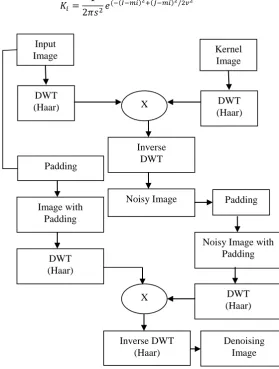
Figure 2. Process flow is the Proposed Framework
1. For the Categorization of image to be filtered the essence part of DWT needs to be incremented with DWT part of Illustration, hence for this the kernel needs to be positioned somewhere in the position where the chances of minimizing degradation is improved. The Controlled part is put at the position where it does actually effect. After positioning of the kernel in the image 2Dim DWT is effective and hence applied on the actual image and the kernel affected portion. Customization of kernel portion needs to be done for the presence of zero standards available in the image.
2. The procedure for applying DWT introduces the effect of padding for the introduction of blur effect in the image.
3. For the removal of this effect from the image the reverse procedure is applied to get the resultant filtered image.
Input Image
DWT (Haar)
Kernel Image
DWT (Haar)
Padding
Image with Padding
DWT (Haar)
X
Inverse DWT
Noisy Image Padding
Noisy Image with Padding
DWT (Haar) X
Inverse DWT (Haar)
International Journal of Emerging Technology and Advanced Engineering
Website: www.ijetae.com (ISSN 2250-2459, ISO 9001:2008 Certified Journal, Volume 9, Issue 10, October 2019)
IV.RESULT ANALYSIS
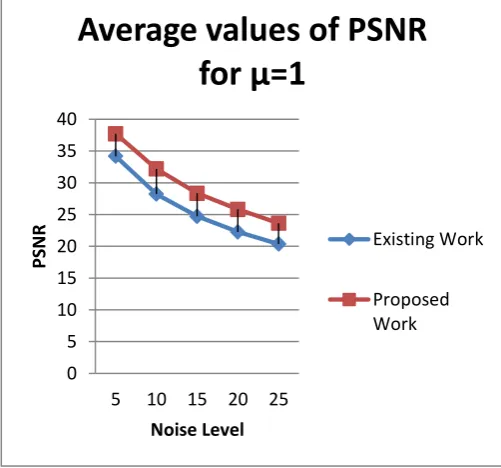
[image:4.595.314.572.167.307.2]The Experimental analysis performed on some of the standard images and on the basis of comparison between Mean level of Peak Signal to Noise Ratio in the image can be performed on various levels of Noise. The analysis done here is for Noise Levels and it is observed that the proposed work provides high PSNR value as compared to the existing work.
Table 1.
Average values of PSNR for the Image I for different levels of Noise for
[image:4.595.43.275.267.415.2]The table shown below is the analysis and comparison of Standard approach of the moving frame by considering for different levels of noise. The analysis is done on the basis of Peak Signal to Noise Ratio. The Proposed methodology gives efficient Peak Signal to Noise ratio in comparison to existing standard techniques.
Table 2.
Comparison of PSNR at different levels of noise for for moving frame
Approach \ Noise variance
5 10 15 20 25
PSNR
Standard 40.35 36.5 34.32 32.83 31.72
PSNR Moving
Frame
40.38 36.53 34.36 32.88 31.77
Proposed
Work 41.2 37.4 35.5 34.1 33.4
The table shown below is the analysis and comparison of Standard approach of the moving frame by considering for different levels of noise. The analysis is done on the basis of Structural Similarity Index. The Proposed methodology gives efficient Structural Similarity Index in comparison to existing standard techniques.
Table 3.
Comparison of SSIM Index at different levels of noise for for moving frame
Approach \ Noise variance
5 10 15 20 25
SSIM Index
Standard 97.05 94.22 91.49 88.89 86.5
SSIM Index Moving
Frame
97.08 94.26 91.62 89.06 86.71
Proposed
Work 98.2 95.4 92.8 90.3 87.6
The figure shown below is the analysis and comparison of Average values of Peak Signal to Noise Ratio for various levels of Noise in the image. The analysis done here is for Noise Levels and it is observed that the proposed work provides high PSNR value in comparison to the existing work.
Figure 3. Average values of PSNR for the Image I for different levels of Noise for
V.CONCLUSION
Image restoration with alias as Denoising included the procedure of withdrawal by increasing the intensity level of the actual image. The main objective of filtering images is to apply functions based on deconvoltuion which automatically removes the chances of degradation with point specific criteria and allow minimization of distortion in the image.
0 5 10 15 20 25 30 35 40
5 10 15 20 25
P
SNR
Noise Level
Average values of PSNR
for µ=1
Existing Work
Proposed Work
Noise Level Existing Work
Proposed Work
5 34.19 37.71
10 28.21 32.19
15 24.73 28.34
20 22.27 25.82
[image:4.595.315.566.393.627.2]International Journal of Emerging Technology and Advanced Engineering
Website: www.ijetae.com (ISSN 2250-2459, ISO 9001:2008 Certified Journal, Volume 9, Issue 10, October 2019)
47 The proposed methodology applied here for Image Denoising is based on the combinatorial method of applying kernel padding for the detection of noisy effect in the image and then image denoising effect is applied using wavelet transformation. The proposed methodology when compared with the existing Image Denoising methodology by experiential that the proposed work transforms high Peak Signal to Noise Ratio for different levels of Noise as well as provides improved Structural Similarity Index.
REFERENCES
[1] Gabriela Ghimpe¸teanu, Thomas Batard, Marcelo Bertalmío, and Stacey Levine,” A Decomposition Framework for Image Denoising Algorithms”, IEEE Transactions on Image Processing, Vol. 25, No.1 January 2016.
[2] M. Lindenbaum, M. Fischer, and A. Bruckstein. On gabor contribution to image enhancement .Pattern Recognition,27:1–8, 1994.
[3] Perona and J. Malik. Scale space and edge detection using an isotropic diffusion .IEEE Trans. Patt. Anal. Mach. Intell.,12:629– 639, 1990.
[4] L. Alvarez, P.-L. Lions, and J.-M. Morel. Image selective smoothing and edge detection by nonlinear diffusion (ii).Journal of numerical analysis, 29:845–866, 1992.
[5] L. Yaroslavsky .Digital Picture Processing - An Introduction. Springer Verlag, 1985.
[6] S. Smith and J. Brady. Susan - a new approach to low level image processing .International Journal of Computer Vi-sion, 23(1):45– 78, 1997.
[7] C. Tomasi and R. Manduchi. Bilateral filtering for gray and color images. In Proceedings of the Sixth Internatinal Conference on Computer Vision, pages 839–846, 1998.
[8] L. Rudin, S. Osher, and E. Fatemi. Nonlinear total variation based noise removal algorithms .Physica D, 60:259–268,1992. [9] D. Donoho. De-noising by soft-thresholding .IEEE Transactions
on Information Theory, 41:613–627, 1995.
[10] R. Coifman and D. Donoho .Wavelets and Statistics, chapter Translation-invariant denoising, pages 125–150. SpringerVerlag, 1995.
[11] S. Osher, A. Sole, and L. Vese. Image decomposition and restoration using total variation minimization and theh−1norm.Multiscale Modeling and Simulation, 1(3):349– 370,2003.
[12] Y. Meyer. Oscillating Patterns in Image Processing and Nonlinear Evolution Equations, volume 22. AMS University Lecture Series, 2002.
[13] A. Efros and T. Leung. Texture synthesis by non parametric sampling. In Proc. Int. Conf. Computer Vision, volume 2, pages 1033–1038, 1999.
[14] A. Buades, B. Coll, and J. Morel. On image denoising methods. Technical Report 2004-15, CMLA, 2004.
[15] Felix Krahmer, Youzuo Lin, Bonnie McAdoo, Katharine Ott, Jiakou Wang, DavidWidemann, and Brendt Wohlberg. Blind image deconvolution: Motion blur estimation. Technical report, University of Minnesota, 2006.
[16] Sergey Chalkov, Natalie Meshalkina, and Chang-Su Kim. Post-processing algorithm for reducing ringing artefacts in deblurred images. In 23rd International Technical Conference on Circuits/Systems, Computers and Communications, ITC-CSCC, pages 1193{1196. School of Electrical Engineering, Korea University Seoul,2008.