© 2016, IRJET | Impact Factor value: 4.45 | ISO 9001:2008 Certified Journal | Page 748
EFFECT OF WIRE EDM PROCESS PARAMETERS ON SURFACE
ROUGHNESS OF AISI-1045 (CARBON STEEL)
Prof. Mahammadumar
1Nimish Kothari
2Pritish Patil
3Sujit Patil
4Rahul Pawde
51
Asst. Professor, Department of Mechanical Engineering, Theem college of Engg., Boisar, MH, India
2,3,4,5
BE, Students, Department of Mechanical Engineering, Theem college of Engg., Boisar, MH, India
---***---Abstract -
Wire cut EDM is a cutting process usedwidely where conventional machining processes are not useful. A metal wire with a Dielectric medium travels through a path and perform machining procedure. WEDM is used for cutting intricate or complicated shapes which are not possible with conventional machining methods. The main objective of the present work is to investigate the effects of various WEDM process parameters on the machining quality and to obtain the optimal sets of process parameters like Pulse-ON time, Pulse-OFF time, current, wire feed are studied by conducting an experiment. Taguchi Method is to design the experiment. L16 orthogonal array is used to conduct the experiment. An AISI-1045 (carbon steel) is used as a workpiece material in the form of square bar. The surface roughness (SR) is selected as response variable.
Key Words: Wire EDM, Surface Roughness, Taguchi method, Orthogonal Array.
1. INTRODUCTION
WEDM is one of the most extensively used non-conventional, thermo electric metal removal process. The workpiece is submerged in the tank of dielectric fluid usually water. It uses a wire electrode to initialize sparking precise, corrosion and wire resistant surface. There is no direct contact between the workpiece material and the wire eliminating the mechanical stresses during machining. WEDM is generally useful for making complicated jobs of desired shapes. The workpiece is holded by minimum clamping pressure. In this process the material is eroded by a series of discrete electrical discharges between the workpiece and the tool. These discharges causes sparks and result in very high temperatures. These temperatures are high enough to melt and vaporize the workpiece metal and the eroded debris cools down swiftly in working liquid and flushed away. In WEDM operations, material removal rate determine the economics of machining and rate of production, surface roughness is the measure of quality. Proper selection of process parameters is essential to obtain good surface finish and higher MRR. In setting the
machining parameters, particularly in rough cutting operation, the goal is the maximization of MRR, minimization of SF. The machine tool builder provides machining parameter table to be used for setting optimal machining parameters, but in practice, it is very difficult to utilize the optimal functions of a machine owing to there being too many adjustable machining parameters. This process relies heavily on the experience of the operators.
1.1 WORKING PRINCIPLE
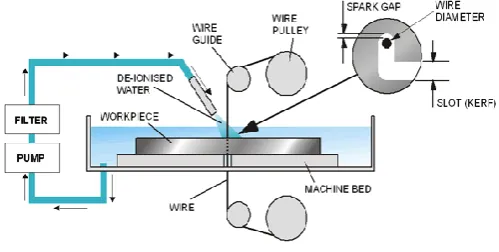
[image:1.595.309.559.607.733.2]The WEDM machine tool comprises of a main table (X-Y) on which the workpiece is clamped; an auxiliary table (U-V) and wire drive mechanism. The main table moves along X and Y axis and it is driven by the D.C. servo motors. The travelling wire is continuously fed from wire feed spool and collected on take up spool which moves through the workpiece and is supported under tension between a pair of wire guides located at the opposite sides of the workpiece. The lower wire guide is stationary where as the upper wire guide, supported by the U-V table, can be displaced transversely along U and V-axis with respect to lower wire guide. The upper wire guide can also be positioned vertically along Z-axis by moving the quill. The wire is connected to the negative charge and the workpiece is connected to the positive charge. Now series of electrical pulses generated by the pulse generator unit is applied between the workpiece and the wire electrode so the spark occurs. This material is removed from workpiece by electro-erosion.
© 2016, IRJET | Impact Factor value: 4.45 | ISO 9001:2008 Certified Journal | Page 749
1.2 LITERATURE REVIEW
Pradeep Singh et al. conducted an experimental investigation of WEDM to optimize dimensional deviation of EN8 Steel through Taguchi's technique. Wire feed, Pulse-OFF time and servo voltage were used as input parameters and dimensional deviation was selected as response variable. From this experimentation it is clear that among the three parameters, Servo voltage has greatest effect on dimensional deviation and is followed by Pulse-OFF time and Wire feed in that order.
S.B.Prajapati et al. had experimented to study the effect of process parameters such as Pulse-ON time, Pulse-OFF time, voltage, wire feed and wire tension on performance measures of wire EDM such as MRR, S.R, Kerf for AISI A2 tool steel. From this experimentation it is clear that for cutting rate and surface roughness, ON and Pulse-OFF time as most significant parameters. The spark gap set voltage is most important significant for Kerf.
R.Nagaraja had conducted an experiment for optimization of process parameters for Al2O3 metal matrix composite in Wire EDM. Pulse-ON, Pulse-OFF and wire feed are selected as input parameters. MRR and S.R. as response variables. Wire feed rate is the most significant machining parameter for surface roughness (SR) for machining of bronze-alumina (Al2O3) MMC.
H.Singh et al. had experimented to study the effect of process parameters on material removal rate in WEDM with Pulse-ON time (Ton), Pulse-OFF time (Toff), gap voltage (SV), peak current (IP), wire feed rate (WF) and wire tension (WT) have been investigated to reveal their input on MRR of hot dies Steel(H-11) using one variable at a time approach and concluded that MRR increases with the increase in Pulse-ON time. MRR decreases with the increase in Pulse-OFF time and MRR remains nearly constant with variation in wire tension.
2. DESIGN OF EXPERIMENT
Dr. Genichi Taguchi has developed a method based on orthogonal array experiments which gives much reduced variance for the experiment with optimum settings of control parameters. Thus the marriage of Design of Experiments with optimization of control parameters to obtain best results is achieved in the Taguchi Method. "Orthogonal Arrays" (OA) provide a set of well balanced (minimum) objective functions for optimization; it helps in data analysis and prediction of optimum results.
Genichi Taguchi, an international consultant in the field of total quality control and assurance formulated both a philosophy and a methodology for the process of quality improvement that depends on statistical concepts,
especially statistically designed experiments. Taguchi defined quality as the loss imparted to the society from the time a product is shipped to the market. The primary goals of the taguchi methodology can be described as:
1. A reduction in the variation of a product design to improve quality and lower the loss imparted to society.
2. A proper product or process implementation strategy which can further reduce the level of variation.
2.1 SELECTION OF ORTHOGONAL ARRAY
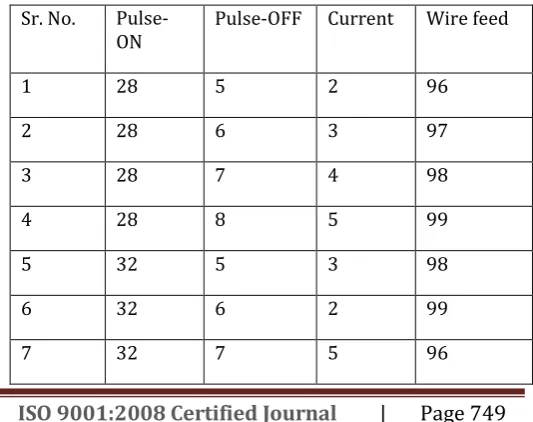
[image:2.595.298.565.580.791.2]Taguchi method is used to design the experiments. This technique has been widely used in different fields of engineering experimental works. The control factors considered for the study are Pulse-ON, Pulse-OFF, Wire feed and current. Four levels for each control factor were selected. Based on number of control factors and their levels, L16 orthogonal array (OA) was selected to design the experiments.
Table -1: Levels of various process parameters
Levels
Process
Parameters 1 2 3 4
A Pulse-ON 28 32 36 40
B Pulse-OFF 5 6 7 8
C Current 2 3 4 5
D Wire feed 96 97 98 99
Table -2: Experimental plan with assigned values
Sr. No.
Pulse-ON Pulse-OFF Current Wire feed
1 28 5 2 96
2 28 6 3 97
3 28 7 4 98
4 28 8 5 99
5 32 5 3 98
6 32 6 2 99
© 2016, IRJET | Impact Factor value: 4.45 | ISO 9001:2008 Certified Journal | Page 750
8 32 8 4 97
9 36 5 4 99
10 36 6 5 98
11 36 7 2 97
12 36 8 3 96
13 40 5 5 97
14 40 6 4 96
15 40 7 3 99
16 40 8 2 98
2.2 SELECTION OF MATERIAL
[image:3.595.288.557.58.315.2]The workpiece material used in this study was AISI-1045 medium carbon steel and chemical composition is given below in table-3
Table -3: Chemical Composition of AISI-1045 steel
Sr. No. Element % of composition
1 Carbon (C) 0.420 – 0.50%
2 Iron (Fe) 98.51 – 98.98%
3 Manganese (Mn) 0.60 – 0.90%
4 Phosphorous (P) ≤ 0.040 %
5 Sulphur (S) ≤0.050 %
3. EXPERIMENTAL SETUP
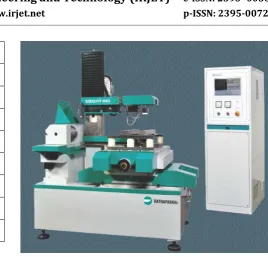
The experiments were performed on EZEECUT NXG-3240 four axis CNC Wire-cut electrical discharge machining (WEDM). The basic parts of the WEDM machine consists of a Electrode, a work table, and a servo control system, a power supply and dielectric supply system. Various components used in EZEECUT NXG-3240 wire cut EDM is shown in fig.
Fig -2: Wire-cut EDM Machine with Controller
4. RESULT AND DISCUSSION
As shown in Chart -1 Main Effects Plot for SR , Ton vs SR , as the Ton increases S.R value also increases.
Chart -2 is the Main Effect Plot for SR, Toff vs SR, as Toff changes from value 5 to 7, the SR value is decreases. Further when Toff is increasing from 7 to 8, we are getting the SR value is increasing in small manner.
Chart -3 is the Main Effect Plot for SR, IP vs SR. as the S.R value is increases with increase in I.P
Chart -4 is the Main Effect Plot for SR, WF vs SR. as the WF value ranges between 96 to 97 we are getting result in increasing of SR, further when WF value increases to 97 to 98, it results in decreasing of SR value. And further when the value of WF is increases from 98 to 99 again we are getting result of increasing value of SR. Hence, we can conclude here that every input parameters can affect on the SR value. As every input parameters has its own properties and characteristics.
Table -4: Result table
Sr. No. Pulse-ON time
Pulse-OFF time
Curren t
Wire feed
Surface Roughness
1 28 5 2 96 2.449
[image:3.595.30.299.436.583.2]© 2016, IRJET | Impact Factor value: 4.45 | ISO 9001:2008 Certified Journal | Page 751
3 28 7 4 98 6.128
4 28 8 5 99 7.222
5 32 5 3 98 4.306
6 32 6 2 99 2.736
7 32 7 5 96 7.329
8 32 8 4 97 6.297
9 36 5 4 99 6.450
10 36 6 5 98 7.516
11 36 7 2 97 2.864
12 36 8 3 96 4.514
13 40 5 5 97 7.894
14 40 6 4 96 6.655
15 40 7 3 99 4.628
16 40 8 2 98 2.930
Chart -1: Response graph for mean
Chart -2: Response graph for mean
Chart -3: Response graph for mean
© 2016, IRJET | Impact Factor value: 4.45 | ISO 9001:2008 Certified Journal | Page 752
5. CONCLUSIONS
In this work, an attempt was made to determine the important machining parameters for performance measure like surface roughness of wire EDM process. From this experimental work it is concluded that the input process parameters like Pulse-ON time and current are the most influencing parameters on surface roughness of AISI-1045 (carbon steel). From the graph it is also concluded that surface roughness increases with increase in Pulse-ON time and current.
REFERENCES
[1] Pradeep Singh, Arun Kumar Chaudhary, Tirath Singh, Amit Kumar, “Experimental investigation of Wire EDM to optimize dimensional deviation of EN8 steel through taguchi’s technique.”International Research Journal of Engineering and Technology (IRJET), volume 02, 2015, pp. 1753-1757.
[2] S.B.Prajapati, N.S.Patel, “Effect of process parameters on performance measures of Wire EDM for AISI A2 tool steel.”International Journal of Computational Engineering Research (IJCER), volume 03, 2013, pp. 274-278.
[3] R.Nagaraja, K.Chandrashekharan, S.Shenbhgaraj, “Optimization of parameters for metal matrix composite in Wire EDM.”International Journal of Engineering Sciences and Research Technology (IJESRT), 2015, pp. 570-574.
[4] H.Singh, R.Garg, “Effect of process parameters on material removal rate in Wire EDM.”Journal of achievement in materials and manufacturing engineeing (JAMME) volume32, 2009, pp. 70-74. [5] S.V.Subrahmanyam, M.MM.Sarcar, “Evaluation of
optimal parameters for machining with Wire EDM using grey taguchi method.”International journal of scientific and research publication, volume 03, 2013, pp. 01-09