© 2016, IRJET ISO 9001:2008 Certified Journal
Page 1225
Comparative Study on Performance Evaluation of Routing Protocols in
MANETs
Tegegn Getinet Tesfaye
1, Li Yao Hui
2Tianjin University of Technology and Education, School of Information Technology and Engineering
Add: 1310 Dagu Nan Road, Hexi District
Tianjin, P.R.China
Abstract: A mobile ad hoc network (MANET) is a collection of wireless mobile nodes communicating with each other using multi-hop wireless links without any existing network infrastructure or centralized administration. Due to varying network topology the most common challenging factor in MANET is routing [1][2]. The purpose of this paper is to study, understand, analyze and to evaluate the performance between four mobile ad-hoc routing protocols: Ad-hoc On-demand Distance Vector (AODV), Destination sequenced distance vector (DSDV), Dynamic Source Routing (DSR) and Zone Routing Protocol (ZRP). DSR has the optimum performance in terms of mobility and speed in small scale networks but it loses its performance when the network size is increased. AODV is best suited when the load of the network is increased. ZRP is hybrid nature and comparable performance in average end-to-end delay and average throughput; but it is the worst performance in packet delivery ratio. This simulation results were analyzed by graphical manner and trace file based on different metrics; such as average throughput, packet delivery ratio (PDR) and average end to end delay.
Keywords: MANET, AODV, DSDV, DSR, ZRP, throughput, delay and PDR.
1.
INTRODUCTION
In recent years MANET has gained popularity and lots of research is being done on different aspects of MANET. It is an infrastructure less network having no fixed base stations MANET is characterized by dynamic topology low bandwidth and low power consumption. All the nodes in the network are moving i.e. topology of the network is dynamic so the nodes can act both as host as well as router to route information unnecessary for its use. This kind of
infrastructure-less network is very useful in situation in which ordinary wired networks is not feasible like battlefields, natural disasters etc. The nodes which are in the transmission range of each other communicate directly otherwise communication is done through intermediate nodes which are willing to forward packet hence these networks are also called as multi-hop networks
2.
Characteristics of MANETS
Some of the major characteristics of these protocols are:
Topology: Since the nodes are mobile, the topology may change rapidly and the connectivity within the network varies with time.
Limited Resources: MANETs are bandwidth and power constrained [3]. Moreover the battery life of mobile nodes is also a limiting factor in their operation.
Distributed Operation: There is no central control and nodes collaborate them to implement functions.
Security: The wireless links lack defense against threats. Various attacks such as denial of services, eavesdropping, replay attacks are possible. MANETs are resource constrained and the network topology changes dynamically. Therefore routing must be done effectively and hence the need of efficient routing protocols.
3. MANET Routing Protocols 3.1 Protocol Classifications
© 2016, IRJET ISO 9001:2008 Certified Journal
Page 1226
3.1.1 Proactive Routing ProtocolsProactive routing protocols are those protocols, in which the routes are maintained to all the nodes, including those nodes to which packets are not sent. An example of proactive routing protocols in ad hoc networks is: Destination sequenced distance vector (DSDV), Optimized Link State Routing Protocol (OLSR).
3.1.2
Reactive Routing Protocols
Reactive routing protocols are those protocols in which the route between the two nodes is constructed only when the communication occurs between the two nodes. Such type of routing protocols is ad hoc On Demand Distance Vector Routing Protocol (AODV) and Dynamic Source Routing Protocol (DSR) [5].
3.1.3
Hybrid Routing Protocols:
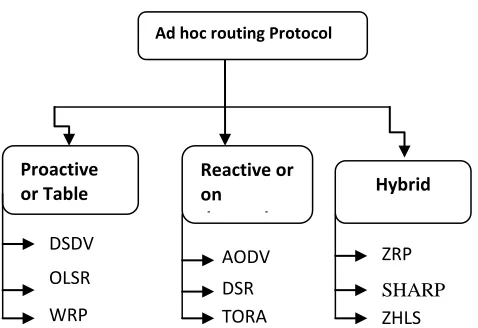
[image:2.612.23.262.425.589.2]Hybrid routing protocols are those protocols in which the combined approach of proactive routing and reactive routing are used for the route generation between the nodes. The Zone Routing Protocol (ZRP) is such a hybrid reactive/proactive routing protocols.Figure 2.1 shows the categorization of various mobile ad hoc network routing protocols and their subtypes [6].
Fig 2.1 Classification ad hoc routing protocols
3.2 Overview of Routing protocols
In this section, a brief overview of the routing operations performed by the familiar protocols ad hoc On Demand Distance Vector Routing Protocol (AODV) and Dynamic Source Routing Protocol (DSR), Destination sequenced
distance vector (DSDV), and Zone Routing Protocol (ZRP) are discussed.
3.2.1 Ad hoc On Demand Distance Vector (AODV)
The AODV [7] routing protocol is based on DSDV and DSR [8] algorithm. It uses the periodic beaconing and sequence numbering procedure of DSDV and a similar route discovery procedure as in DSR. However, there are two major differences between DSR and AODV. The most distinguishing difference is that in DSR each packet carries full routing information, whereas in AODV the packets carry the destination address. This means that AODV has potentially less routing overheads than DSR. The other difference is that the route replies in DSR carry the address of every node along the route, whereas in AODV the route replies only carry the destination IP address and the sequence number. The advantage of AODV is that it is adaptable to highly dynamic networks. However, node may experience large delays during route construction, and link failure may initiate another route discovery, which introduces extra delays and consumes more bandwidth as the size of the network increases.
3.2.2 Dynamic Source Routing (DSR)
It uses the concept of [10] source routing in which the node create routes only when source requires [11]. It maintains the Route cache which contains the recently discovered routes. As it is on demand routing protocol, the routing overhead is less. This Protocol is composed of two essential parts of route discovery and route maintenance. Route Discovery: When a source node S wants to send a packet to the destination D, it checks its route cache first. If it finds the route, then the source uses the available route in cache. If route not found or the route cache has an expired route, then it initiates the route discovery process. Route discovery requires 7 fields during this process such as sourceId, destnationId, RequestID, Addresslist, Hoplimit, Network Interface List, Acknowledgment list. Then source node broadcasts the packet to its neighbor. Moreover, source node also maintains a replica of send packet in its send buffer. Packets can be dropped if send buffer is overflow or the time limit for route discovery is over. Any intermediate node having route to destination can
Ad hoc routing Protocol
protocols
Proactive or Table driven
Hybrid Reactive or
on demand DSDV
OLSR
WRP
AODV DSR TORA
ZRP
© 2016, IRJET ISO 9001:2008 Certified Journal
Page 1227
generates route reply [11] else process continues andpacket eventually reaches the destination and it replies to the source node. Route Maintenance: Route maintenance includes monitoring the routes against failure through route error packets and route cache [10]. There is no need of keeping routing table in DSR [9] protocol. Route cache can further decrease route discovery overhead. However DSR is not scalable to large networks and packet size grows with length of the route due to source routing.
3.2.3Destination Sequence Distance Vector (DSDV)
The Destination-Sequenced Distance-Vector (DSDV) Routing Algorithm is based on the idea of the classical Bellman-Ford. Routing Algorithm. Routing Loop problem is solved which is present in Bellman-Ford algorithm. To solve the routing loop problem, this routing makes use of sequence numbers.
Each mobile node maintains a routing table that includes the number of hops to reach the destination, all available destinations and the sequence number tagged by the destination node. The sequence number is used to distinguish stale routes from new ones and thus avoid the formation of loops. So, the update is both time-driven and event-driven. A "full dump" or an incremental update technique is used to update the routing table.
A full dump sends the full routing table to the neighbors and could span many packets whereas in an incremental update only those entries from the routing table are sent that has a metric change since the last update and it must fit in a packet. When the network is relatively stable, incremental updates are sent to avoid extra traffic and full dump are relatively infrequent .If there is space in the incremental update packet then those entries may be included whose sequence number has changed. DSDV protocol guarantees loop free paths and Count to infinity problem is reduced in DSDV.
3.2.4 ZRP (Zone Routing Protocol)
ZRP is [11] hybrid routing protocol with both a proactive and a reactive routing. ZRP reduce the control overhead of proactive routing protocols and decrease the latency caused by route discovery in reactive routing protocols. In ZRP the nodes in the network are divided into various zones. The routing within the Zone is done using Intra
Zone Routing Protocol (IARP) while packets between various zones are routed using Inter Zone routing Protocol (IERP). When the node has to send a packet, it checks the destination’s zone first. Routing within zone is done with IARP. When the destination is in different zone, the node sends the route request [12] to the peripheral Node. If the node receiving the request has the route to the destination, it returns with route to the destination otherwise the process continuous till the destination
is reached.
Duringthis process, routing information is stored in route request packet to enable route reply when needed.
4. Simulation Result and Performance
Evaluation
4.1 Simulation Environment
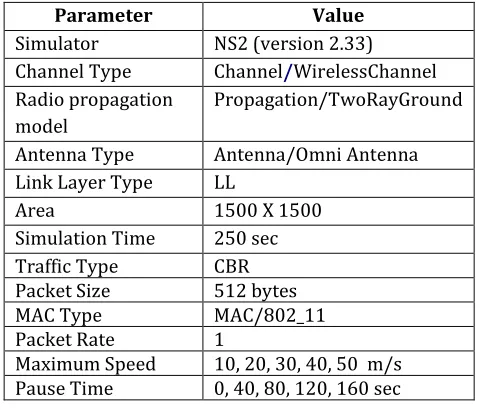
Network simulator (version 2.33), widely known as NS2, is simply an event driven simulation tool that has proven useful in studying the dynamic nature of communication networks. Simulation of wired as well as wireless network functions and protocols (e.g., routing algorithms, TCP, UDP) can be done using NS2.
A simulation study was carried out to study and evaluate the performance of routing protocols in MANET such as AODV, DSDV, DSR and ZRP based on following metrics:
[image:3.612.322.562.512.717.2]Average throughput, Packet delivery ratio and End to End delay with the following parameters:
Table 4.1 Simulation parameters
Parameter Value
Simulator NS2 (version 2.33)
Channel Type Channel/WirelessChannel
Radio propagation model
Propagation/TwoRayGround
Antenna Type Antenna/Omni Antenna
Link Layer Type LL
Area 1500 X 1500
Simulation Time 250 sec
Traffic Type CBR
Packet Size 512 bytes
MAC Type MAC/802_11
Packet Rate 1
Maximum Speed 10, 20, 30, 40, 50 m/s
© 2016, IRJET ISO 9001:2008 Certified Journal
Page 1228
Protocols AODV, DSDV, DSR, ZRP
Number of Nodes 25, 50, 75, 100
4.2 Analysis and Results Comparison
In this section we evaluate the performance of AODV, DSDV, DSR and ZRP protocols on the following parameters:
4.2.1 Average Throughput
Throughput: It is the rate of successfully transmitted data packets in a unit time in the network during the simulation.
Table 4.2 Average Throughput versus Network Load
No. of
nodes AODV DSDV DSR ZRP
25 7.06 1.35 7.12 24.4
50 50.46 18.12 30.82 30.16
75 85.85 19.51 34.69 21.28
100 98.16 5.61 75.36 18.59
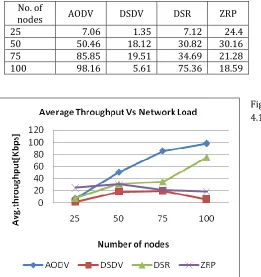
Fig. 4.1
Average Throughput by varying network loads.
Result:
In this simulation we use the constant maximum speed 10m/s and pause time 0 sec and number of nodes from 25-100.
As we see in figure 4.1 the average throughput of the ad-hoc routing protocols under varying network load. It is seen that AODV performs the best compared to
the other protocols with a peak throughput of 98.16 kbps.
[image:4.612.329.576.213.551.2]In AODV and DSR, the throughput increases with respect to number of nodes increases at all point. DSDV also increase like AODV and DSR except to node 100. DSR could not sustain the performance at higher network load. DSDV significantly has lower performance because of frequent link changes and connection failures. ZRP performs better than DSDV. Table 4.3 Average Throughput versus Pause Time
Pause
Time AODV DSDV DSR ZRP
0 50.46 18.12 30.82 42.62
40 51.16 20.02 60.32 37.31
80 38.93 14.98 49.73 32.55
120 45.21 16.15 22.94 29.21
160 31.58 19.95 33.16 53.69
Fig 4.2 Average Throughput by varying mobility
Result:
[image:4.612.26.287.279.556.2]© 2016, IRJET ISO 9001:2008 Certified Journal
Page 1229
and DSR maintains consistency in varying mobility and [image:5.612.31.288.159.450.2]performs better than the proactive and hybrid protocols DSDV and ZRP.
Table 4.4 Average Throughput versus Maximum Speed
Max speed AODV DSDV DSR ZRP
10 50.46 18.12 30.82 34.39
20 27.57 8.67 15.81 24.69
30 40.08 2.7 24.79 15.67
40 16.37 0.84 17.81 2.92
50 17.45 6.91 16.47 19.24
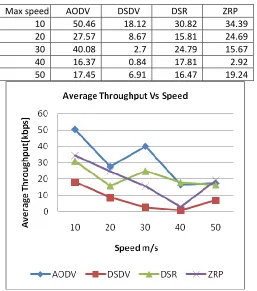
Fig 4.3 Average Throughput with varied speed
Result:
In this simulation, the number of nodes is kept constant at 50 and the maximum speed of the nodes is varied. The pause time is taken as 0 seconds so that maximum mobility variance can be considered. Based on this the AODV protocol perform best throughput and the DSR protocol also perform well but both are fluctuated result when the speed changes. DSDV suffers decrease in throughput close to 0.84 kbps at maximum speed (40 sec). ZRP again performed better than DSDV as its performance closely matched with the reactive protocols
4.2.2 Packet Delivery Ratio
It is the ratio of data packets received to packets sent. It tells us about the fraction of the packets delivered from source to destination when the network is subjected to
different traffic conditions. It also gives an idea about the number of packets dropped or forwarded by the routing protocol.
Table 4.5 Packet delivery ratio Vs Network Load
No of odes AODV DSDV DSR ZRP
25 0.1593 0.0562 0.1877 0.0512
50 0.6422 0.2445 0.6976 0.1458
75 0.8945 0.389 0.9459 0.16731
100 0.7039 0.1476 0.6105 0.08264
Fig 4.4 Packet Delivery Ratio with varied network load.
Result:
Figure 4.4 gives the packet delivery ratio of all the protocols when the nodes are varied. Looking at the trend, it can observe when the network load is increased; the entire packet delivery ratio (PDR) for all the protocols gets reduced.
DSR has a peak packet delivery ratio of close to 95 % when number of nodes is 75. But as the load is increased, the performance degrades.
[image:5.612.317.573.169.436.2]© 2016, IRJET ISO 9001:2008 Certified Journal
Page 1230
DSDV has a low packet delivery ratio throughout the [image:6.612.318.571.56.269.2] [image:6.612.32.286.162.429.2]different scale of networks as compared to AODV, and DSR. But in case of ZRP, it gives lowest packet delivery ratio. Table 4.6 Packet delivery ratio versus pause time
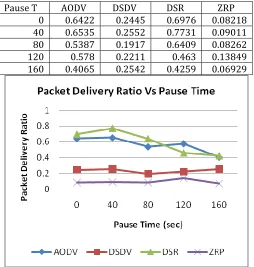
Pause T AODV DSDV DSR ZRP
0 0.6422 0.2445 0.6976 0.08218
40 0.6535 0.2552 0.7731 0.09011
80 0.5387 0.1917 0.6409 0.08262
120 0.578 0.2211 0.463 0.13849
160 0.4065 0.2542 0.4259 0.06929
Fig 4.5 Packet delivery ratio with varied mobility
Result:
[image:6.612.31.285.566.644.2]The packet delivery ratio is shown in figure 4.5. DSR and AODV perform much better than DSDV and ZRP. ZRP delivers only 13 percent of all CBR packets initiated by the source at pause time. While AODV and DSR delivers almost 70 to 80 percent of packets
Table 4.6 Packet delivery ratio versus maximum speed
speed AODV DSDV DSR ZRP
10 0.6422 0.2445 0.6976 0.0913
20 0.761 0.1173 0.7056 0.0373
30 0.6618 0.0736 0.7722 0.0193
40 0.7259 0.1959 0.6198 0.0934
50 0.6301 0.1252 0.6097 0.1205
Fig.4.6 Packet delivery ratio by varying speed. Result:
In the above simulation, the number of nodes is kept constant at 50 and the maximum speed is varied.Based on simulation results the PDR of AODV and DSR is high and zigzag when the speed increases to 50 m/s the PDR of AODV and DSR is reduced.
Packet delivery ratio in ZRP drops to as low as 12 % in high speed. DSDV again performed better than ZRP.
4.2.3 Average End to End Delay:
This delay includes processing and queuing delay in each intermediate none i.e. the time elapsed until a demanded route is available. Unsuccessful route establishments are ignored.
Table 4.8 Average End to End delay versus number of nodes
No.
node AODV DSDV DSR ZRP
25 1988.4 2.33747 4699.29 2277.12
50 611.427 41.3168 556.927 1081.31
75 203.31 15.7116 1573.25 256.274
© 2016, IRJET ISO 9001:2008 Certified Journal
Page 1231
Fig 4.7 Average End to End delay by varying network loadResult:
[image:7.612.316.566.105.378.2]In Figure 4.7 we noticed that the performance of DSR is degrading due to increase in the number of nodes in the networks. The performance of the ZRP and AODV is slightly better. Average delay is less for DSDV routing protocol and remains constant as the number of nodes increases.
Table 4.9 Average End to End delay versus speed
Speed AODV DSDV DSR ZRP
10 611.427 41.3168 556.927 2114.08
20 699.912 234.385 1440.56 1772.574
30 640.017 27.8547 1366.87 1226.58
40 341.542 218.938 1984.9 826.382
Fig. 4.9 Average End to End delay by varying speed.
Table 4.10 Average End to End delay versus pause time
Pause time AODV DSDV DSR ZRP
0 611.427 41.3168 556.972 698.855
40 784.958 18.6658 2807.31 1440.86
80 1564.42 134.842 5152.07 2135.75
120 1086.45 67.7411 2122.499 1239.12
160 1151.2 66.0885 4536.65 712.573
Fig 4.9 Average End to End by varying mobility. Result:
From the above two graph (fig 4.8 and fig 4.9) the average End to End delays versus speed and average end to end delay versus pause time shows that average end-to-end network delay. We didn’t see much difference between the delay values of AODV and DSDV. But DSDV performed slightly better than AODV and showed a constant performance with an average delay. Comparatively, DSR showed high delay values at speed 40 m/s and pause time 80 sec. ZRP also showed a high delay values as compared to DSDV and AODV especially at maximum speed of 10 and 50 sec.
5. Conclusion
In this paper, the performance of the four MANET Routing protocols such as AODV, DSDV, DSR and ZRP was analyzed using NS-2 Simulator. We have done comprehensive simulation results of Average End-to-End delay, packet delivery ratio and average throughput and over the routing protocols AODV, DSDV, DSR and ZRP by varying network size, mobility and speed.
[image:7.612.36.287.426.685.2]© 2016, IRJET ISO 9001:2008 Certified Journal
Page 1232
load, speed and mobility this is because of the route tableentry mechanism employed. DSDV is a proactive routing protocol and suitable for limited number of nodes with low mobility and speed due to the storage of routing information in the routing table at each node.
The performance of end to end delay is high for large number of nodes in terms of ZRP and end to end delay performance is high for less number of nodes in DSR. When we conclude DSR should be the first preference in terms of small scale networks with any mobility or speed. AODV is best suited when the load of the network is increased. ZRP is hybrid nature and comparable performance in average end-to-end delay and average throughput; but it is the worst performance in packet delivery ratio.
ACKNOWLEDGEMENTS
First of all we acknowledge to Mr. Juma Joram for his support to complete this research successfully. Then we would like to thank our parents, friends for their invaluable suggestion and who helped us a lot in finalizing this thesis within the limited time frame.
REFERENCES:
[1]
Akshai Aggarwal, Savita Gandhi and Nirbhay Chaubey “A Study of Secure Routing Protocol in Mobile Ad hoc Networks” in Proceedings of National Conferences on Advancement in Wireless Technology and Applications, 18-19 December 2008, SVNIT, Surat, India.[2] Akshai Aggarwal, Savita Gandhi and Nirbhay Chaubey “Key Management Consideration in MANETs” in Proceedings of National Conference on Cryptography and Network Security (NCCNS),18-19 February 2009, VIT Unviersity, Vellore, India.
[3] Robinpreet Kaur & Mritunjay Kumar Rai “A Novel Review on Routing Protocols in MANETs”, Undergraduate Academic Research Journal (UARJ), ISSN : 2278 – 1129, Volume-1, Issue-1, 2012
[4] P. Misra, “Routing Protocols for Ad Hoc Mobile Wireless Networks,” 2006. http://www.cse.wustl.edu/~jain/cis788-9/adhoc_routing/
[5] D. Johnson, D. Maltz and J. Broch, “DSR the Dynamic Source Routing Protocol for Multihop Wireless Ad Hoc
Networks,” In: C. E. Perkins, Ed., Ad Hoc Networking, Addison-Wesley Longman Publishing Co., Inc., Boston, 2001, pp. 139-172.
[6] C. E. Perkins, E. M. Belding-Royer and S. R. Das, “Ad Hoc On-Demand Distance Vector (AODV) Routing,” 2nd IEEE Workshop on Workshop Mobile Computing Systems and Applications, New Orleans, 25-26 February 1999, pp. 90-100.
[7] S. Das, C. Perkins, E. Royer, Ad hoc on demand distance vector (AODV) routing, Internet Draft, draft-ietf-manetaodv-11.txt, work in progress, 2002.
[8] D. Johnson, D. Maltz, J. Jetcheva, The dynamic source routing protocol for mobile ad hoc networks, Internet Draft, draft-ietf-manet-dsr-07.txt, work in progress, 2002.
[9] Sunil Taneja and Ashwani Kush “A survey of Routing Protocols in Mobile Ad Hoc Networks” , International Journal of Innovation, Management and Technology, Vol. 1, No. 3, August 2010 ISSN: 2010-0248
[10] Dr.D.Siva Kumar “Review: Swarm Intelligent based routing Protocols for Mobile Adhoc Networks” International Journal of Engineering Science and Technology Vol. 2 (12), 2010, 7225-7233
[11] Elizabeth M. Royer, “A Review of current routing protocols for Ad-Hoc Mobile Wireless Networks”, IEEE Personal Communication, April 1999
[12]http://en.wikipedia.org/wiki/Zone_Routing_Protocol [20th Jan. 2013,7:09 pm IST]
[13] Nicklas Beijar “Zone Routing Protocol (ZRP)”, Networking Laboratory, Helsinki University of Technology P.O. Box 3000, FIN-02015 HUT, Finland
[14] L. Abusalah, A. Khokhar and M. Guizani, “A Survey of Secure Mobile Ad Hoc Routing Protocols”, “IEEE Communications Surveys & Tutorials”, vol. 10 no. 4, 4th Quarter 2008.
[15] T. Clausen, P. Jacquet, A. Laouiti, P. Muhlethaler, A. Qayyum,L.Viennot, “Optimized link state routing protocol for ad hoc networks,” in: “Proceedings of IEEE INMIC”, December 2001, pp.62–68.