© 2016, IRJET | Impact Factor value: 4.45 | ISO 9001:2008 Certified Journal | Page 191
Vector Controlled Sensorless Estimation and Control of
Speed of Induction Motors
Gayatri Gite
Electrical Engineering Department
SSSIST Sehore
Bhopal, India
Prabodh Khampariya
Electrical Engineering Department
SSSIST Sehore
Bhopal, India
---***---Abstract -
In this paper, speed estimation of vectorcontrolled induction motor drive based on Model Referencing Adaptive Controller (MRAC) is represented. Requirement of no additional sensors makes the drive suitable for retrofit applications. It do not require computation of fluxes and uses both voltage and current in rotating reference frame. MRAC is formed using instantaneous and steady-state values. This makes the drive stable in all four quadrants of operation. This method is simulated in MATLAB/SIMULINK.
Key Words: Induction Motor, MRAC, Sensorless Drive,
Stator Resistance Estimation, Vector Control, Model reference Adaptive System.
1.
INTRODUCTION
The induction motors are relatively cheap and rugged machines because their construction is realised without slip rings or commutators. Controlling the speed of Induction Motor is far more difficult than controlling the speed of DC motor since there is no linear relationship between the motor current and resulting torque as there is for a DC motor. The control system of the drive calculates the corresponding current component references from the flux and torque references given by the drive's speed control. The technique called Vector Control can be used to vary the
speed of an Induction Motor over a wide range. The Vector
controlled induction motor (IM) drive is widely used in high performance industrial applications since it is simple and provides fast dynamics. Vector control, also called field-oriented control (FOC), is a variable-frequency drive (VFD) control method in which the stator currents of a three-phase AC electric motor are identified as two orthogonal components that can be visualized with a vector. This control is strongly influenced by the machine parameters variation. In these schemes both torque and rotor flux, are controlled by decomposing the stator current.The implementation of the vector control scheme requires the knowledge of the rotor speed and other machine parameters. In this area, the use of extended Kalman filter is
popular due to its robustness and the need of reduced numbers of PI controllers. Finally, a combination of well-known open loop observers, voltage model and current model, is used to estimate the rotor flux and rotor flux angle which are employed in direct field orientation. The motor is initially made to rotate in the clockwise direction and when the speed reversal command is obtained, the control goes into clockwise regeneration mode which brings the rotor to standstill position. Hall Effect sensors are used to obtain the rotor position and from the hall sensor outputs it is determined whether the machine has reversed its direction which is the ideal moment for energizing the stator phase so that machine can start motoring in the counter clockwise direction.
Fig. 1 Four quadrants of operation
Different techniques for estimation of speed for IM drive are available. These are mainly classified as:
(i) Rotor flux based,
(ii) Frequency signal injection based, (iii)Artificial Intelligence,
(iv)Observer based,
(v )Artificial Intelligence (AI) based, (vi) Rotor slot harmonics based, and
© 2016, IRJET | Impact Factor value: 4.45 | ISO 9001:2008 Certified Journal | Page 192
Among all these methods, MRAC is simple, requires lesscomputation time and has good stability.MRAC is stable in all the four quadrants, operates very well at low speed including zero speed, does not require flux computation and very easy to implement. However, the pure-integrator (which is used in the voltage model of F-MRAC) related problems are the major drawback of the F-MRAC. The pure-integrator is replaced by a low-pass filter (LPF). Back-emf-based MRAC also suffers from the deteriorating performance at low speed due to the presence of derivative operator, which lowers the signal-to-noise ratio. A reactive power-based MRAC overcomes all such problems.
The influence of noise characteristic, the absence of criteria for tuning, and the computational burden of this stochastic observer are major limitations for wide acceptability. The use of LPF introduces gain and phase angle error in the flux estimation below cutoff frequency of the filter. The major drawback of using rotor flux as functional candidate is the presence of integrator which makes it unattractive for operation at near zero speeds. The speed estimation algorithm (i.e., speed estimating MRAS) depends on stator resistance making it sensitive to stator resistance variation. This is compensated by another MRAC making the speed estimation algorithm independent of stator resistance. The proposed method is simulated in MATLAB/SIMULINK and simulation results are obtained.
1.1
Speed Estimation
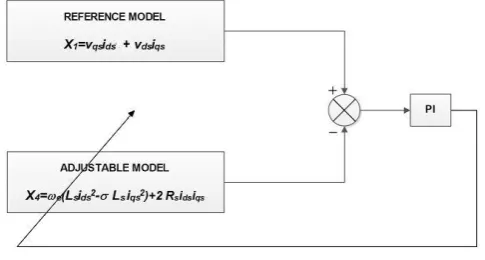
The structure of such MRAC for speed estimation is shown in Fig. 1. Selection of _v∗ ×_i is a major success in the sense that the proposed system is now stable in all the four quadrants modes of operation. This cross product is denoted by X, which is neither active power nor reactive power. It can be clearly seen that at no-load condition i.e. when isq=0, X-MRAS becomes independent of stator resistance. Therefore, injecting only a small amount of d-axis current is not sufficient for speed estimation; a sufficient amount of q-axis current is required for estimation of stator resistance.
[image:2.595.41.284.576.706.2]Fig. 2 Speed Estimation Based on MRAC
Instantaneous value of X ( i.e.,_v ×_i ) is known as,
X1 = vsq*isd + vsd*isq ……….……… (1)
The stator voltages of induction motor in the synchronously rotating reference frame are,
Vsq = Rsisq+ ωeσLsisd + pσLsisq + Lm/Lr(ωeψrd+pψrq) ………..…….……..(2)
Vsd = Rsis d− ωeσLsisq + pσLsisd – Lm/Lr(ωeψrq−pψrd) ………...(3)
Inserting Eqn (2) & (3) in Eqn (1), we get X as,
X2 = [ Rsisq + ωeσLsisd + pσLsisq + Lm/Lr (ωeψrd + pψrq) ]
isd + [ Rsisd – ωeσLsisq + pσLsisd.− Lm/Lr (ωeψrq − pψrd)]
isq ……….(4)
At Steady state it becomes,
X3 = [ Rsisq + ωeσLsisd + Lm/Lr (ωeψrd) ] isd+[Rsisd − ωeσLsisq – Lm/Lr (ωeψrq) ]isq ………….(5)
For a rotor flux-oriented drive, substituting ψrd = Lmisd, and ψrq = 0, the simplified expression of X becomes X4 ,
i.e.,
X4 = ωe [Lsi2sd - σLsi2sq]+ 2Rsisdisq …………..…(6)
The expression of X1 is selected as a reference model and od
X4 is selected as a adjustable model as it does not involve
flux estimation and any derivative operations but it is dependent on rotor speed unlike X1.
1.2 MRAC Based Speed Estimation using MATLAB
Simulation
© 2016, IRJET | Impact Factor value: 4.45 | ISO 9001:2008 Certified Journal | Page 193
results.Fig.3 Vector Control Drive with the proposed X-MRAC
The algorithms have been found to be stable in all the four quadrants of operation. The vector controlled induction motor drives are easily adoptable to algorithm. The X-MRAC can also be used for stator resistance estimation, if speed signal is available from speed encoder. For the stability analysis, the investigation is carried out around a nominal speed, and the dynamics for the mechanical equations for a perturbation of Δωr is neglected as the mechanical time constant is much larger than the electrical time constant. Ensuring the ablity of the system to reach or cross the chosen sliding line is the next stage of a control algorithm. With the correct value of rotor speed, the fluxes determined from the two models should match. The simulation of sensorless speed control of Induction Motor is done byusing MATLAB/SIMULINK. we can get the expressions of Δisd/Δωr
and Δisq/Δωr. The X-MRAC error ε is given by,
ε =X1 − X4 ………..……..(7)
ε =vsqisd + vsdisq – ωe[Lsi2sd− σLsi2sq]− 2Rsisdisq……(8)
Considering the perturbed signals, Δε can be expressed as,
Δε = K2Δisd + K3Δisq + k4Δωsl + k5Δˆωr ………(9)
where
K2 =vsq0 − 2Rsisq0 − 2Lsωe0isd0 − r3isq0
K3 =vsd0 − 2Rsisd0 + 2σLsωe0isq0 − r2isd0,
K4 =(σLsi2sq0− Lsi2sd0)
K5 =σLsi2sq0− Lsi2sd0− r1r2isd0.
Any small increase in the estimated rotor speed (ˆωr
+Δˆωr) leads to decrease of the slip speed (ωsl − Δωsl). If it
is assumed that the speed of the rotor flux (i.e., ωe) remains the same after the perturbation, then
Δˆωr = −Δωsl ………(10)
Substituting Eqn (10) in Eqn(9)
Δε = K2Δisd + K3Δisq + (k5 − k4)Δˆωr
Dividing both sides by Δˆωr
Δε/Δˆωr= K2Δisd/Δωr+ K3Δisq/Δωr+ (k5 − k4) = G(s) ………..….(11)
Using Eqn (11), the stability is checked for many operating
points in the speed-torque domain. The parameters of the machine are given in the Table I :
INDUCTION MACHINE RATINGS AND PARAMETERS
Symbol Meaning Value
- Rated Shaft Power 1.3 kW - Line to Line Voltage 400 V - Rated Speed 1430rpm
P Pole Pair 2
Ls Stator Self Inductance 0.6848 H Lr Rotor Self Inductance 0.6848 H Lm Magnetising Inductance 0.6705 H Rs Stator Resistance 5.71Ώ Rr Rotor Resistance 4.0859Ώ J Machine Inertia 0.011Kg-m2
2. RESULTS
© 2016, IRJET | Impact Factor value: 4.45 | ISO 9001:2008 Certified Journal | Page 194
Fig. 4. (a) Reference speed and actual speed [rad/s] versustime [s].
(b) Actual speed and estimated speed [rad/s] versus time [s].
(c) d-axis and q-axis rotor flux [Wb] versus time [s].
Fig. 5. (a) Reference speed and actual speed [rad/s] versus time [s].
(b) Actual speed and estimated speed [rad/s] versus time [s].
(c) d-axis and q-axis rotor flux [Wb] versus time [s].
[image:4.595.277.564.50.645.2] [image:4.595.36.292.67.467.2]© 2016, IRJET | Impact Factor value: 4.45 | ISO 9001:2008 Certified Journal | Page 195
A. Step Change of Rotor Speed and Zero Speed
Operation
The response of the induction motor for step change and zero speed operation are shown in Fig. 4. A step change in speed of 5 rad/s is applied every 4 s from 0 rad/s and the actual speed is found to track the reference speed [Fig. 4(a)] satisfactorily. The estimated speed is very close to the actual rotor speed [Fig. 4(b)]. Flux orientation is well maintained as depicted in Fig. 4(c). The load applied to the motor is through a DC generator as detailed in simulation.
B. Regenerative Mode Operation
Simulation (Section IV) and stability study (Section III) have confirmed that the drive is stable in all the four quadrant modes of operation. Here, the same is verified through experiments for an operating point, which is located in the second quadrant. Load torque is applied through a DC motor which drives the induction machine. The torque generated by the induction machine is shown in Fig. 5(d). A reference speed of −5 rad/s is applied to the machine [Fig. 5(a)]. Hence, the induction machine is now running in second quadrant (regenerating mode). The estimated and actual speeds of the machine are observed in Fig. 5(b) which shows that the proposed MRAC can estimate the rotor speed satisfactorily even in the regenerating mode of operation. The flux orientation is available in Fig. 5(c).
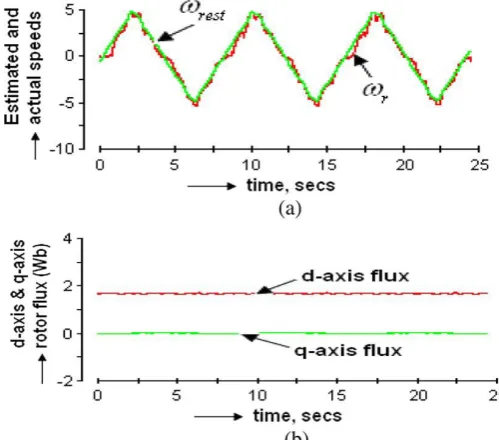
Fig. 6. (a) Actual speed and estimated speed [rad/s] versus time [s].
(b) d-axis and q-axis rotor flux [Wb] versus time [s].
C. Response to Ramp Command in Speed
The performance of the algorithm for a ramp command in speed reference is shown in Fig. 6. The estimated speed is matching with the actual speed, as shown in Fig. 6(a). The flux orientation is not disturbed, as observed in Fig. 6(b).
This validates the proposed speed estimation algorithm experimentally making it suitable for low speed applications.
Fig. 7. (a) Actual speed and estimated speed [rad/s] versus time [s].
(b) d-axis and q-axis rotor flux [Wb] versus time [s].
D. Low Speed Operation
The hardware result corresponding to the operation of the proposed controller at 1 rad/s reference can be seen from Fig.7(a) which shows that the estimated speed matches with the actual speed satisfactorily. The flux is oriented as seen from Fig. 7(b).
3. CONCLUSIONS
The principle of Sensorless control of induction motor is given elaborately. This paper has presented X-MRAC based speed estimation with stator resistance updation.The X-MRAC based speed estimation technique is stable in all four quadrants of operation suitable for low speed and zero speed operation. This is confirmed for an X-MRAS based speed sensorless drive. Extensive simulation in MATLAB/SIMULINK is carried out to validate the proposed technique. Computation of flux is no longer required.
References
[image:5.595.307.559.128.405.2] [image:5.595.45.295.426.646.2]© 2016, IRJET | Impact Factor value: 4.45 | ISO 9001:2008 Certified Journal | Page 196
[2] R. Verma, V. Verma, and C. Chakraborty, “Ann basedsensorless vector controlled induction motor drive suitable for four quadrant operation”, in Students' Technology Symposium (TechSym), IEEE, 2014, pp. 182-187.
[3] B..Karanayil, M.F.Rahman, and C. Grantham; “Online Stator and Rotor Resistance Estimation Scheme Using Artificial Neural Networks for Vector Controlled Speed Sensorless Induction Motor Drive”; IEEE Transactions on Industrial Electronics, Vol. 54, No. 1, pp. 167-176,February 2007.
[4] Orłowska-Kowalska T., Dybkowski M., Stator Current-based MRAS Estimator for Wide Range Speed-Sensorless Induction Motor Drive, IEEE Trans. on Industrial Electronics, 2010,Vol. 57, No. 4, pp. 1296–1308.
[5] L. Zheng, J. E. Fletcher, B.W.Williams, and X. He, “A novel direct torque control scheme for a sensorless five-phase induction motor drive,” IEEETrans. Ind. Electron., vol. 58, no. 2, pp. 503–513, Feb. 2011.
[6] B. K. Bose, “Modern Power Electronics and AC Drives.”; Englewood Cliffs, NJ: Prentice-Hall, 2002.
[7] E. Levi, M. Wang, “Impact of parameter variations on speed estimation in sensorless rotor flux oriented induction machines,”
[8]S.MaitiandC.Chakraborty,“Anewinstantaneousreactivepo werbasedMRASforsensorlessinductionmotordrive,”Simul.Mo dell.Pract.Theory,vol.18,no.9,pp.1314–1326,Oct.2010J.
![Fig. 5. (a) Reference speed and actual speed [rad/s] versus time [s].](https://thumb-us.123doks.com/thumbv2/123dok_us/8183335.811339/4.595.36.292.67.467/fig-reference-speed-actual-speed-rad-versus-time.webp)