http://dx.doi.org/10.4236/ijmpcero.2015.41006
How to cite this paper: AL-Hamamy, H.R., et al. (2015) Evaluation of Effectiveness of Diode Laser System (808 nm) versus Intense Pulse Light (IPL) in the Management of Unwanted Hair: A Split Face Comparative Study. International Journal of Medical Physics, Clinical Engineering and Radiation Oncology, 4, 41-48. http://dx.doi.org/10.4236/ijmpcero.2015.41006
Evaluation of Effectiveness of Diode Laser
System (808 nm) versus Intense Pulse Light
(IPL) in the Management of Unwanted Hair:
A Split Face Comparative Study
Hayder R. AL-Hamamy1, Anmar Z. Saleh2, Zahra A. Rashed2*
1Department of Dermatology and Venereology, College of Medicine, University of Baghdad, Baghdad, Iraq 2Department of Medical Physics, College of Medicine, University of Baghdad, Baghdad, Iraq
Email: *[email protected]
Received 29 December 2014; accepted 19 January 2015; published 27 January 2015
Copyright © 2015 by authors and Scientific Research Publishing Inc.
This work is licensed under the Creative Commons Attribution International License (CC BY). http://creativecommons.org/licenses/by/4.0/
Abstract
We have evaluated and compared the effectiveness of diode laser system (808 nm) and Intense Pulse Light (IPL) system (690 - 1200 nm) by studying the change in hair density, and the time of regrowth the hair. A total of 26 have completed three months’ treatment, aged 16 - 50 years. Pa-tients were treated by diode laser 808 nm and IPL 690 - 1200 nm devices. Pulse repetition rate for both was 1 Hz and short pulse width for diode laser and the IPL pulse width was 15 ms. The flu-ence was (33 - 41 and 30 - 41) J/cm2 respectively. A split face treatment method was used. The
treatment was carried out on monthly bases for three months. Hair density and regrowth duration were recorded before and after each session. After the third session, the hair density was de-creased by (58%) for diode laser versus (49%) for IPL p = 0.366. The time of hair regrowth was increased to (327%) for diode laser versus IPL (339%) p = 0.821. Pain appeared more during the treatment with IPL than with diode laser. Post treatment side effects such as erythema, hyper pigmentation, and burn appeared on patients treated with diode laser more than those treated with IPL. In conclusion both diode laser and IPL were effective in reduction of hair density, and prolongation of the time of hair regrowth.
Keywords
Unwanted Facial Hair, Diode Laser, IPL
1. Introduction
Some people complained from unwanted excess of hair and from hair grown in abnormal sites of the body that causes embarrassment for them [1]. Many reasons cause unwanted hair growth, for example, genetic, systematic disease, or drug reactions [2]. Excessive hair was categorized as either hirsutism [3] or hypertrichosis depending on the cause [4] [5].
Many methods were used for unwanted hair epilation. They are mainly divided into two categories, either temporary or permanent. The temporary methods include threading [6], bleaching [7], shaving, waxing and plucking, while permanent methods include electrolysis [8], laser and IPL [9].
Nowadays, laser and IPL are considered the best and the most effective methods for epilating the unwanted hair with fewer side effects [10]. Many laser systems have been devised including the normal mode and long- pulsed such as ruby lasers (694 nm) [11], the long-pulsed alexandrite lasers (755 nm), the diode laser systems (800 - 810 nm) [12], the Q-switched Nd: YAG laser system (1064 nm) [13], and non-laser light source the in-tense pulsed light (IPL) which gives a broad range spectrum between (500 - 1200 nm) [14]. Many papers re-ported the characteristics of laser and (IPL), others have compared between the two modalities [15].
2. Materials and Methods
The study conducted at a private clinic in Al-Karrada district, Baghdad, Iraq in the period from January to No-vember in 2013.
A total of 26 patients participated in the study and completed three month treatments. Their age ranged be-tween 16 - 50 years with (average ± SD) 29.95 ± 8.05 years. Patients attending the clinic during the specified time of the study were included. Hormonal evaluation was performed. Any patient with a suspected hormonal cause of hirsutism was excluded. Only patients with familial and racial hirsutism are included. Laser treatment was carried by using diode laser 808 nm generated by a diode laser device (Epilogue supplied by Class IV In-terface); spot size 10 × 12 mm2. The device was set as short pulse (3.2 ms), pulse rate (1 Hz) and the fluence range from (33 - 41 J/ cm2).
The IPL device used in this study was obtained from (Quanta Electronics Co.). The wavelength (690 - 1200 nm), spot size 8 × 40 mm2, with a pulse duration of 15 ms, pulse rate 1 Hz, and fluence 30 to 41 J/cm2. A split face method was used. After explaining the procedure to the patient. The patient was instructed to lie on a com-fortable couch, under good light, goggles were worn by the patient, a gel applied to the area to be treated. Diode laser was applied first at right side of the face. All area was treated in a sequence with minor overlap in adjacent areas. The fluence was increased gradually with the patient pain tolerance, the fluence is increased slightly. Af-ter treating the right side of the face, the patient was moved to the IPL device and the left side was treated in the same manner Figure 1. Ice cold gel was used before and after treatment completion for about 10 minutes. The patient was instructed to rest for a few minutes and avoid sunlight for the next two days. The next visit was scheduled 1 month later. The patient was told to record any side effects and to call the doctor if she needed. The number of sessions depends on the response. Usually no more sessions were scheduled while a few fine hair re-mains.
[image:2.595.154.476.576.704.2]All the patients were evaluated before the treatment and at each visit; the following observations were rec-orded:
2.1. Hair Density
The number of hair in one square was calculated, for this purpose a square was drawn on a transparent paper which has an area of one square centimeter. This transparent paper was applied on the skin. A digital camera (Sony 18.2 Mega Pixels) was used to take photographs of this area, and the number of hairs inside it were counted.
2.2. Time of Regrowth the Hair
The patient was instructed to epilate the hair after the treatment, and records the interval of time from the hair epilation until the hair appear and became cosmetically unacceptable necessitate a second hair epilation was recorded.
2.3. Patient’s Satisfaction
Patient opinion with the results of treatment was recorded at each visit as fully satisfied, satisfied or unsatisfied.
2.4. Side Effects
Side effects were recorded immediately after treatment such as pain, itching, burning, erythema, and swelling. The patient was also asked about side effect from previous treatment, long term side effect such as hypo or hy-per-pigmentation and scar.
Statistical analysis
The results are expressed as numbers, percent, range and average ± SD. The data were analyzed using excel program taking two tailed, “t” test, the probability level ≤ 0.05 as the lowest limit of significant difference be-tween percentages and simple correlation test has also been calculated.
3. Results
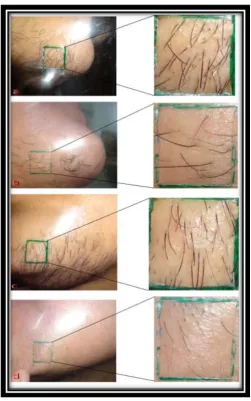
The hair density was decreased after each session. For diode laser it decreased by 30%, 45% and 58% after the first, second, and third session, respectively compared with IPL in which the hair density was decreased by 38%, 44% and 49% after the first, second, and third, respectively Table 1. The reduction of hair density resulted from the two modalities after third session was not significant P-value > 0.366. Figure 2 showing the decrease in hair density after three treatments for each modality.
The period of hair regrowthwas increased at subsequent sessions. The increase in the regrowth duration after diode laser treatment was 11.19 ± 5.83, 15.85 ± 7.02, and 19.54 ± 9.07 days for the first, second, and third ses-sion, respectively and after IPL treatment was 12.12 ± 6.49, 16.73 ± 7.62, and 20.12 ± 9.23 days, respectively
Table 2, Figure 3. The difference in hair diameter was not significant, p-value (0.821).
Patient satisfaction was shown in histogram Figure 4. After the first session (35%) preferred diode laser and (65%) preferred IPL. After second session (35%) preferred diode laser, while (65%) preferred IPL. After third session (31%) preferred diode laser, while (69%) preferred IPL. Many reasons found for preferring the patients each type of devices. Some of them relied on the treatment outcome, others preferred IPL because of the short treatment time and some of them preferred the less side effects.
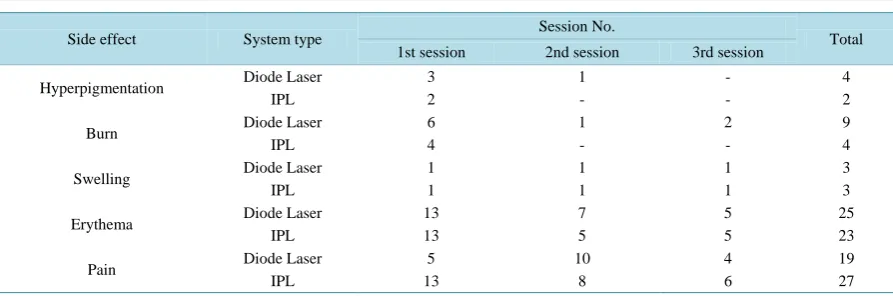
It appears to be that diode laser treatment gives more side effect than what IPL. Such results can be drawn from the overall side effect observed for the three sessions collectively and for each side effect Table 3. The hyperpigmentation (4, 2), and burn (9, 4) were higher in diode laser than the IPL. In contrast the number of pa-tients felling pain is significantly higher with IPL (27) treatment than those treated with diode laser (19), while side effect of swelling is the same (3, 3) and for erythema is about the same except the difference in the second session Table 3.
4. Discussion
Table 1. Average (AV) and standard deviation (SD) of hair density (hair No./cm2).
Comparison between Pretreatment and First session
System type Pretreatment (AV ± SD)
First session
(AV ± SD) Difference
٭P-value ¤%Reduction °P-value
Diode laser 21.58 ± 11.59 15.04 ± 9.17 6.54 0.00894 30%
0.597
IPL 21.73 ± 14.1 13.58 ± 10.63 8.15 0.00584 38%
Comparison between Pretreatment and Second session
System type Pretreatment (AV ± SD)
Second session
(AV ± SD) Difference
٭P-value ¤%Reduction °P-value
Diode laser 21.58 ± 11.59 11.77 ± 7.55 9.81 0.000172 45%
0.9
IPL 21.73 ± 14.1 12.08 ± 9.99 9.65 0.00691 44%
Comparison between Pretreatment and Third session
System type Pretreatment (AV ± SD)
Third session
(AV ± SD) Difference
٭P-value ¤%Reduction °P-value
Diode laser 21.58 ± 11.59 8.96 ± 6.77 12.62 0.0000214 58%
0.366
IPL 21.73 ± 14.1 11.15 ± 10.19 10.58 0.00277 49%
¤ difference 100 pretreat Reduct men ion t
[image:4.595.87.539.338.528.2]%= × . ٭P-Value: between sessions for the same system. °P-Value: between two systems for each session.
Table 2. Average and standard deviation of time of regrowth the hair (day).
Comparison between Pretreatment and First session
System type Pretreatment (AV ± SD)
First session
(AV ± SD) Difference
٭P-value ¤% Increasing °P-value
Laser 4.58 ± 3.32 11.19 ± 5.83 6.61 0.000506 144%
0.591
IPL 4.58 ± 3.32 12.12 ± 6.49 7.54 0.000131 164%
Comparison between Pretreatment and Second session
System type Pretreatment (AV ± SD)
Second session
(AV ± SD) Difference
٭P-value ¤% Increasing °P-value
Laser 4.58 ± 3.32 15.85 ± 7.02 11.27 0.00000343 246%
0.665
IPL 4.58 ± 3.32 16.73 ± 7.62 12.15 0.00000273 268%
Comparison between Pretreatment and Third session
System type Pretreatment (AV ± SD)
Third session
(AV ± SD) Difference
٭P-value ¤% Increasing °P-value
Laser 4.58 ± 3.32 19.54 ± 9.07 14.96 0.00000387 327%
0.821
IPL 4.58 ± 3.32 20.12 ± 9.23 15.54 0.00000187 339%
¤ difference
×100 pretreat % incre
ment
asing = . ٭P-Value: between sessions for the same system. °P-Value: between two systems for each session.
Table 3. Side effect in right and left side.
Side effect System type Session No. Total
1st session 2nd session 3rd session
Hyperpigmentation Diode Laser 3 1 - 4
IPL 2 - - 2
Burn Diode Laser 6 1 2 9
IPL 4 - - 4
Swelling Diode Laser 1 1 1 3
IPL 1 1 1 3
Erythema Diode Laser 13 7 5 25
IPL 13 5 5 23
Pain Diode Laser 5 10 4 19
[image:4.595.90.537.572.720.2]Figure 2. Hair density pre and post treatment for patient 28 years old: (a) R-side pretreatment; (b) R-side after three session; (c) L-side pretreatment; (d) L-side after three session.
Figure 3. Relation between session No. and average of time of re-growth the hair on R-side and L-side.
A
v
er
ag
e of
t
im
e o
f
re
gr
ow
th
th
e h
air
(d
ay)
25
20
15
10
5
0
Session No.
1 2 3 4
[image:5.595.186.441.526.697.2]Figure 4. Patient satisfaction on follow-up (month) for both diode laser and IPL.
In laser and IPL treatment we should be vigilant about the heat increase in the skin. When we apply laser or IPL to the skin electromagnetic energy will be absorbed. We are concerned with three types of chromophore hemoglobin, water, and melanin. The discrimination among their absorption resulting in a better treatment. Upon the entrance of laser or IPL into the skin, it will be absorbed in any of them depending on the wavelengths of laser or IPL [18].
In our treatment we are targeting the melanin i.e. we are aiming to deliver the maximum amount of heat to melanin to be transferred to the hair bulb and a consequent hair removal. To perform this task we have to be careful to deliver maximum heat to the hair follicle melanin. Melanin is composed of eumelanin and pheomela-nin, different proportion can give different colors [18]. Melanin absorption change gradually with wavelength i.e.
the slope of its curve on the graph is much less steep than what we can see in the case of hemoglobin or water, so within this wavelength range (700 - 1000 nm) the highest heat absorption will be in melanin and the least will be in water and hemoglobin [19].
The wide range of melanin absorption with a little absorption in the other chromophores has enabled us to use different types of lasers with different wavelengths such as ruby 694 nm, alexandrite 755 nm, diode laser 810 nm, and Nd:YAG 1064 nm also the broad band IPL (500 - 1200) nm. Again, if the treatment is out of this range (700 - 1000) we may get unnecessary skin heating with less benefit in hair removal. Obviously the increase in the concentration of melanin leads to an increase in the laser or IPL absorption [20].
The pulse duration must be less than the thermal relaxation time of the target (melanocytes in hair follicle) [19]. Heat produced into the target must destroy stem cells in hair bulge to induce permanent hair follicle death. The heat produced in hair bulb which contains most of the melanocyte must dissipate to the hair bulge [2].
A more successful treatment with fewer side effects can be achieved if we are able to discriminate between the heat delivery to the epidermis and the hair follicle. The epidermis is protected from the heat produced by la-ser and IPL by cooling the skin surface which is achieved by applying a cooling gel, also the sapphire contact surface of the hand piece has cooling effect during laser treatment when laser energy is absorbed in the skin. Se-lecting a longer wavelength will lead to more penetration of laser energy reaching the deeper (hair follicle), this can enable us to accomplish our treatment with the least of side effects [21].
The present study is comparing between the treatment with diode laser and IPL. Results reveal that both mod-alities are effective in hair reduction. These results are expected because the mechanism of action of diode laser and IPL is the same (destruction of stem cell in hair bulge by the heat produced by the absorption of light energy in melanosomes).
Cameron et al. showed that diode laser (810 nm) superior to IPL (625 - 1100 nm). The average hair counts in a 16 cm2 area before and after treatment were, respectively, 42.4 and 10.4 (laser), 38.1 and 20.4 (IPL), 45.3 and 44.7 (control). His results were different between laser and IPL but both laser and IPL reduced the hair count substantially with respect to control, p-value was significant for laser (P = 0.028), but insignificant for IPL (P = 0.13) [10]. This result differs from that of the present study.
p
atie
n
t s
at
is
fa
cti
o
n
80%
70%
60%
50%
40%
30%
20%
10%
0%
follow-up (month)
1 2 3
Amin and Goldberg have shown that no difference between diode laser and IPL efficacy. They compared four different hair removal systems a light source (IPL) used with two filters and two types of lasers. 1) IPL red filter (650 - 1200 nm), 2) IPL yellow filter (525 - 1200 nm), 3) diode laser (810 nm), and 4) alexandrite laser (755 nm). The hair counts were reduced by almost 50% after 2 sessions compared with initial value. No statistical difference for all modalities used [22]. The results more comparable to the present study.
Hair removal by laser or IPL resulted from the disability of the generating cells from producing new hair growth. The procedure accomplished by the introducing heat into the area or into the vicinity of the area con-taining the generating cells (bulge or hair shaft) through several sessions. In each session there is some damage inflicted to the cells, the amount of damage and the treatment outcome depends mainly on the stage of hair growth. Hairs in anagen phase absorb more energy because of the higher melanin content. As a consequence af-ter each session the hair follicles become weaker and weaker. The first sign for damage is appeared on the hair thinning.
Pain during treatment was more with IPL probably because more radiation can be absorbed by water. Haak, et al. study spilt face when compared between IPL (525 - 1200 nm) and Long pulse diode laser (810 nm). Pain scores were higher for IPL (median 6) than long pulse diode laser (LPDL) (median 3) (P<0.001). Minor tran-sient hyperpigmentation was seen after IPL (six patients) and LPDL treatments (two patients) (P = 0.255). Tran-sient hypopigmentation was seen at 1 month in one patient with skin type IV in both the IPL- and LPDL-treated sides [23].
Toosi, et al. was performed as a clinical trial on 232 persons to study the efficacy and side effect for three modalities (diode laser: 810 nm), (IPL: cut-off filter of 650 nm wavelength), and (alexandrite: 755 nm) in re-moval unwanted hair. The comparison of the treatment results after 6 months did not show any significant statis-tical difference between alexandrite, IPL, and diode (P = 0.194), although hair reduction was observed to be higher with the last. The statistical comparison of the incidence of side effects based on the light sources showed a significant statistical difference (P = 0.0001) with the diode laser 22 (28.9%) being higher than the alexandrite 8 (9.5%) and IPL 11 (15.3%) [24].
5. Conclusion
Both diode laser and IPL were effective in hair reduction, hair density, hair diameter, and prolongation of the time of hair regrowth. More pain was observed during the treatment with IPL than with laser. While post treat-ment side effects such as erthyma, hyperpigtreat-mentation, and burn appeared on patients treated with laser more than those treated with IPL.
References
[1] Kamal T. (2006) Long-Pulsed Nd:YAG Laser and Intense Pulse Light Therapy for Idiopathic Facial Hirsutism. A Comparative Study. Journal of Pakistan Association of Dermatologists, 16, 205-209.
[2] Lepselter, J. and Elman, M. (2004) Biological and Clinical Aspects in Laser Hair Removal. Journal of Dermatological Treatment, 15, 72-83. http://dx.doi.org/10.1080/09546630310023152
[3] Oakley, A.M.M. (2005) Hypertrichosis and Hirsutism. NZFP, 32, 106-109.
[4] Swingler, R., Awala, A. and Gordon, U. (2009) Review Hirsutism in Young Women. The Obstetrician & Gynaecolo-gist, 11, 101-107. http://dx.doi.org/10.1576/toag.11.2.101.27483
[5] Sanchez, L.A., Perez, M. and Azziz, R. (2002) Laser Hair Reduction in the Hirsute Patient: A Critical Assessment.
Human Reproduction Update, 8, 169-181. http://dx.doi.org/10.1093/humupd/8.2.169
[6] Kumar, G.S. and Narang, N. (2010) Hirstism—A Symptom Rather than a Disease: A Review. International Journal of Pharma and Bio Sciences, 1, 1-7. http://dx.doi.org/10.5138/ijaps.2010.0976.1055.01001
[7] Azziz, R. (2003) The Evaluation and Management of Hirsutism. Obstetrics & Gynecology, 101, 995-1007.
http://dx.doi.org/10.1016/S0029-7844(02)02725-4
[8] Oner, G.V., Eapen, V., Faure-Brac, G., Ward, P., Hazell, P., Barton, G., et al. (2012) Hirsutism: Diagnosis and Treat-ment. Journal of Metabolic Syndrome, 1, 1-6. http://dx.doi.org/10.4172/2167-0943.1000e104
[9] Halachmi, S. and Lapidoth, M. (2012) Low-Fluence vs. Standard Fluence Hair Removal: A Contralateral Control Non-Inferiority Study. Journal of Cosmetic and Laser Therapy, 14, 2-6.
http://dx.doi.org/10.3109/14764172.2011.634421
Comparison of Diode (810 nm) Laser Therapy and Intense Pulsed Light Therapy for Hair Removal. Lasers in Medical Science, 23, 393-397. http://dx.doi.org/10.1007/s10103-007-0510-6
[11] Sarkar, P. and Hirsch, R.J. (2010) Update on Laser Hair Removal. Journal of Cosmetic Dermatology, 20, 440-444. [12] Lanigan, S.W. (2001) Management of Unwanted Hair in Females. Clinical and Experimental Dermatology, 26, 644-
647. http://dx.doi.org/10.1046/j.1365-2230.2001.00908.x
[13] Lapidoth, M., Dierickx, C., Lanigan, S., Paasch, U., Campo-Voegeli, A., Dahan, S., et al. (2010) Best Practice Options for Hair Removal in Patients with Unwanted Facial Hair Using Combination Therapy with Laser: Guidelines Drawn up by an Expert Working Group. Dermatology, 221, 34-42. http://dx.doi.org/10.1159/000315499
[14] Johnson, F. and Dovale, M. (1999) Intense Pulsed Light Treatment of Hirsutism: Case Reports of Skin Phototypes V and VI. Journal of Cosmetic and Laser Therapy, 1, 233-237. http://dx.doi.org/10.1080/14628839950516733
[15] Babilas, P., Schreml, S., Szeimies, R.M. and Landthaler, M. (2010) Intense Pulsed Light (IPL): A Review. Lasers in Surgery and Medicine, 42, 93-104. http://dx.doi.org/10.1002/lsm.20877
[16] Anderson, R.R. and Parrish, J.A. (1983) Selective Photothermolysis: Precise Microsurgery by Selective Absorption of Pulsed Radiation. Science, 220, 524-527. http://dx.doi.org/10.1126/science.6836297
[17] Lin, T.Y., Dierickx, C.C., Campos, V.B., Farinelli, W.A., Rosenthal, J. and Anderson, R.R. (2000) Reduction of Re-growing Hair Shaft Size and Pigmentation after Ruby and Diode Laser Treatment. Archives of Dermatological Re-search, 292, 60-67. http://dx.doi.org/10.1007/s004030050011
[18] Altshuler, G.B. and Yaroslavsky, I. (2004) Absorption Characteristics of Tissues as a Basis for the Optimal Wave-length Choice in Photodermatology. Palomar Medical Technologies, Burlington, 1-4.
[19] Dierickx, C.C. (1999) Laser Hair Removal: Scientific Principles and Practical Aspects. Coherent Medical, USA, 1-8.
[20] Patil, U.A. and Dhami, L.D. (2008) Overview of Lasers. Indian Journal of Plastic Surgery, 41, 101-113.
[21] Welch, A.J., Torres, J.H. and Cheong, W.F. (1989) Laser Physics and Laser-Tissue Interaction. Texas Heart Institute Journal, 16, 141-149.
[22] Amin, S.P. and Goldberg, D.J. (2006) Clinical Comparison of Four Hair Removal Lasers and Light Sources. Journal of Cosmetic and Laser Therapy, 8, 65-68. http://dx.doi.org/10.1080/14764170600717902
[23] Haak, C.S., Nymann, P., Pedersen, A.T., Clausen, H.V., Feldt, R.U., Rasmussen, A.K., et al. (2010) Hair Removal in Hirsute Women with Normal Testosterone Levels: A Randomized Controlled Trial of Long-Pulsed Diode Laser vs. Intense Pulsed Light. British Journal of Dermatology, 163, 1007-1013.
http://dx.doi.org/10.1111/j.1365-2133.2010.10004.x
[24] Toosi, P., Sadighha, A., Sharifian, A. and Razavi, G.M. (2006) A Comparison Study of the Efficacy and Side Effects of Different Light Sources in Hair Removal. Lasers in Medical Science, 21, 1-4.