© 2016, IRJET | Impact Factor value: 4.45 | ISO 9001:2008 Certified Journal | Page 1132
A Review on Document Image Binarization Technique for Degraded
Document Images
Prachi K. More
1, Mr. D. D. Dighe
21 ME VLSI and Embedded system, Matoshri College of Engineering and Research Center, Nashik-422105,
Maharashtra India
2
Department of E & TC, Matoshri College of Engineering and Research Center, Nashik-422105, Maharashtra India
---***---Abstract -
Improvement in a degraded document images is one of the salient and challenging research now days. Image get degraded due to unbalance illumination spread over document including smearing of text, bleeding of ink to the other side of page, degradation of paper ink due to aging, manuscript characters from background side appear as noise on the lead side and get blend with the lead side characters etc. Image document binarization technique is used to perform in the pre-processing level for document analysis, to extract and segment out the fore text from the document flipside. In the previous year’s numerous binarization techniques are proposed, none of them is suitable for all types of degradation. The previous studies revels that there is no automatic and robust system, competent of choosing the most useful method of binarization for various types of inputs. Whereas various binarization approaches are used to enhance the degraded image with pros and cons. This paper accomplishes a comprising survey of better binarization techniques. Also focus on the problems being encountered and the related issues in the area of document image binarization.Key Words: Image processing, Document analysis, Post processing, degraded document image binarization, segmentation
1. INTRODUCTION
In Human society, the dominant information medium is document. Hence document image analysis is a considerable research task in the area of image processing and pattern recognition. The text extraction is a segmentation of text from degraded background which is normally used to asset boundaries lines, curves etc of document image. This segmentation of degraded text document image have certain issues to solve such as how to extract clear text strings on the leading side of page from the seriously sipping, dominating, overlapping and interfering images originating from the back side. [5][16]
This document degradation can be restored using image binarization technique. Primarily image binarization approach is a segregation of pixel values in two different
groups, white as background and black as foreground. The thresholding technique plays essential role in restoration of foreground from background of document image. Due to high inter/intra change enclosed in the text stroke and document background across different document images, a single thresholding technique is not suitable to solve the different issues. On a large scale Binarization techniques are classified as global and local thresholding. [5][15]
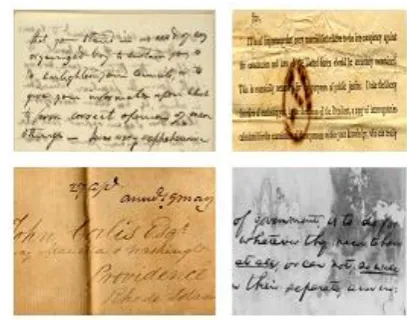
Fig -1: Degraded document image examples from DIBCO dataset
Global thresholding is preferred when the images are having equal contrast spreading on background and foreground. Local adaptive thresholding is used for restoring the foreground pixel from document image with background large contrast variation and noise. [5]
[image:1.595.329.533.356.516.2]© 2016, IRJET | Impact Factor value: 4.45 | ISO 9001:2008 Certified Journal | Page 1133
The next section explains special and efficient details aboutdifferent thresholding techniques for binarization of degraded document images. It includes different global and local robust thresholding technique with their benefits and limitations.
2. DEGRADED DOCUMENT IMAGE BINARIZATION
TECHIQUES
In Processing of documents that are fair in quality due to seeping of ink from the other side of the page. Generally degradation is occurring due to background noise or variation in contrast and illumination. However, pictures taken in real-life situations may contain different artifact. In such cases, different image enhancement methods are applied like binarization and thresholding, to improve the quality of document image. The binarization can become a challenging job under varying illumination. The document image binarization is done to separate foreground and background information, converts the captured document into pixels with intensity level 1 or 0. [18] Proper binarization of these degraded document images is very necessary for separating the foreground object from the background which results in high recognition accuracy.
The Fig 2 shows the basic approach of binarization of degraded document images. The next is thresholding method, shows effective result in ambient illumination condition. The proper selection of threshold value is necessary otherwise it may misrepresent the fore object pixel and can categorize it as background pixel and vice versa, resulting in overall degradation of system performance. The thresholding is perform by choosing an intensity value as a threshold level and the values below this threshold become 0 (black) and the values above this threshold become 1 (white). The output of the thresholding is a binary image whose gray level of 0 (black) will indicate a pixel foreground and a gray level of 1 (white) will indicate the background.
There are numerous techniques were proposed by various authors. In this section, we discuss certain techniques which are efficient and robust.
The First is Otsu’s [1] method which is very popular and well known. It is global thresholding technique which is most efficient as compare to other. The method is based on
clustering determination to the grayscale data of degraded image and design two clusters of Gaussian distribution of pixels of the image. The class variance of the both classes of pixels is minimized by obtaining optimal threshold value using iterative application of algorithm. Later perform a conversion of gray level image to a binary image by histogram shape-based image thresholding. The optimum threshold is computed with disjoining two classes (e.g. foreground and background) so that their joined spread (intra class variance) is minimal.
W. Niblack et. al [3] proposed a technique called niblack’s algorithm. In this approach the pixel wise threshold is calculated by moving a rectangular window of different size over the grey level image. Adaptive threshold value is obtained in accordance with the local mean m (i, j) and standard deviation (i, j) and computed a window size of b× b. The threshold T is as:
(1)
Here, k is a constant has a value between 0 and 1, which conclude how many of the total print object edge is retained. The quality of binarization determines with the value of k and the size of the moving window. With small value of k binarization gives thick and blurry strokes, and with large value of k gives slim and broken strokes. Niblack’s method is adaptive threshold method, but some noises are exist in non-text regions, so to remove this noise few preprocessing, post processing methods are require.
Local-variance-based robust method is proposed by Sauvola [2]. This approach calculates local threshold value using local mean and local standard deviation for each pixel separately. This method gives improvement over the method proposed by Niblack, especially when the background contains light texture, big variations, stained and badly and unevenly illuminated documents. It adapts the contribution of the standard deviation.
(2)
The typical suggested value for k = 0.5 and R = 128. Here m is mean and is standard deviation of the entire window. The value of k and window size gives large effect on quality of image. The drawback of method is, reactive to the selection of window size and free parameter values and computationally slow.
The modified Local adaptive method proposed by Bernsen [4] which estimates the local threshold with mean value of minimum and maximum intensities of pixels within a window. The threshold value is set using midrange intensity value of pixel within a local window, which is the mean of the
minimum and maximum of gray values.
(3)
[image:2.595.47.271.407.484.2]© 2016, IRJET | Impact Factor value: 4.45 | ISO 9001:2008 Certified Journal | Page 1134
background and vice-versa. The method, not perform well ondegraded document images with a complex background.
The improvement on Bernsen’s method is LMM method [6] which well handles the documents with a complex background. The method comes out with local image contrast and normalization factor. Here normalization factor is compensates for the image variation in the document background. The local image contrast is evaluated as,
(4)
Here, is a positive value which is added in case the local maximum is equal to 0. First find contrast of image on area over the text stroke boundaries. So to find contrast of image consider pixel within both bright and dark region, image pixels inside bright regions, the denominator is large, which results in a relatively low image contrast, for image pixels in dark regions, the denominator is small, which give high image contrast. The limitation of the technique is, it cannot handle document images with bright text having bright background properly. [6]
The disadvantages of the LMM method are overcome by Gatos’s [5] method. This method is local adaptive thresholding technique for image binarization, enhances the quality of degraded document images, and does not need any parameter tuning. In this technique, a background surface calculation is done by interpolating neighboring background intensities. The thresholding technique is applied by integrating the estimated background surface with the original image. The up-sampling technique is include, to obtain efficient greater quality binary image. It is very easy and useful method for binarization of degraded document, but gets fail in binarization of low resolution images.
Christian wolf [7] gives a local thresholding approach by estimating the contrast and the mean gray value of image
(5)
Where K =0.5, M is the minimum gray amount of the image and R is highest gray value standard deviation. The calculation of local threshold value is done using minimum gray value and maximum standard deviation of local gray values of whole document image. However, the values of M and R are calculated from the whole image because technique is not performing well in a sharp change background gray level values across the image, the small noisy patch could significantly influence M and R values.
The method introduced by Khurshid et al. [19] is the next and modified version to Niblack’s method. It shift the thresholding value down to overcomes the issue of black noise in niblack method and to give solution to low contrast image difficulty in Sauvola’s method. T calculated as,
(6)
Where k range from [-0.2, -0.1], Pi is the gray-scale pixel value of the image, and N exist total number of pixels inside the image and window of suggested size. The author suggested that the value of k must be -0.1 for optical character recognition application and k should be -0.2 where we don’t desire any noise. This method gives solution to black-noise and low contrast in image, but it get fail in very small and low contrast condition of thin pen stroke text.
Bilal Bataineh [9] proposed a robust local thresholding approach in which thresholding value is calculate by applying mean and standard deviation to gray image along with effective factors that require to address all binarization challenges. The effective factors are gray level value given by mean and standard deviation for each current window and global image respectively. This method gives a solution to problems of low contrast in foreground and background image. It also overcome challenges of thin pen stroke text in the image. In this approach to binarize the image, image is divided into windows of particular size and then threshold value is calculated using mean and standard deviation within each window. Compare to earlier method such as Niblack’s, Sauvola’s, and NICK’s method the Bilal’s method gave the best performance. It solved the difficulty of identifying the various factors and size of windows while in earlier methods these factors are decided by user.
Feng et al. [8] proposed a local thresholding technique. This method considers two local windows which is one contained within other (i.e. primary and secondary window). It locally calculates gray value standard deviation from whole image using both windows. To find t the threshold value T, The values of standard deviation s, the minimum gray-level M and local mean m are calculated in the small window i.e. primary local window and the standard deviation Rs is calculated in the larger window.
(7)
Where 𝛼2=𝑘1 𝑠𝑅𝑠 𝛾 and 𝛼3=𝑘2 𝑠𝑅𝑠 𝛾. Author set the value of 𝛾 is 2. Values of other parameters 𝛼1 k1 and k2 are proposed to be in the ranges 0.1-0.2, 0.15-0.25 and 0.01-0.05 respectively. It is a modified wolf’s method, give solution to problem of low performance due to sharp variation in background. The limitation is if there minimum change in parameter values could drastically affect the binarization results.
© 2016, IRJET | Impact Factor value: 4.45 | ISO 9001:2008 Certified Journal | Page 1135
This is accomplished in linear time using the next equationfor each pixel.
(8) After converting the given image into integral image, total of the function for any rectangle with upper left corner (𝑥1 , 𝑦1)
and lower right corner (𝑥2,𝑦2).This method is a improvement
of wellner’s method. In wellner’s method only single pass through image is required where every pixel is consider to be a moving average of last s pixels seen, where as proposed technique require two passes for applications like real time video stream.
The method proposed by Kapur et al. [13] is an entropy-based method. It considers a two distinct signal source for image foreground and background. Then calculate sum of both class entropies, if sum reaches to its maximum value then image is under optimal threshold. In this method, from the grey level of input image it derived two probability distributions for object distribution and background distribution. Thresholding can be deliberate as a classification problem. The author proposed that if the gray-level distributions of the foreground object and background pixels is estimated then using statistical theory an optimal and minimum error threshold value is obtain. The disadvantage of this method is it involves lots of computation. Therefore assume pixels are distributed with distinct mean and standard deviation then find out its grey level histogram using estimated optimal threshold value.
The method derived by kittler et al. [14] gives less calculation as relate to problem in kapur method [13] for minimum error thresholding. It assumes the normal distribution for foreground object and background class probability density function. This method use either complete search or iterative search algorithm to optimize the fair pixel categorization error rate with the assumption of unequal Gaussian density function which solves minimum error Gaussian density fitting problem. The estimated threshold value separates the pixels of object and background. This approach provides satisfactory results only if background and object are isolated otherwise it fails because the distribution is not close to Gaussian model. It is applicable in multi-threshold selection.
The method [11] gives a thresholding approach for degraded document images by applying fuzzy logic. An author estimate a technique depends on a fuzziness measure for finding automatic histogram threshold approach. The histogram equalization is used in image having small or low contrast. The problems of searching the minimum of a criterion function are skipped using this fuzzy logic. Compare the correspondence between gray levels of the image to discover the optimal threshold value. After that it defines two starting areas at the margins of the histogram. This similarity finding process is beneficial to conclude the threshold point using index of fuzziness, by assuming the contrast between objects and background.
Pai, Y.T. et al and Chang [12] proposed an adaptive thresholding algorithm for degraded document images with high performance and low computational complexity. The author proposed global and local thresholding approach to separate the document image into the several blocks. The binary image is formed by estimating the threshold value with diversity and the intensity of each block. This method is used in PDA, mobile phones like portable devices which have their limited memory space and low computation capability.
B. Su, S. Lu [15] proposed adaptive contrast technique for binarization of degraded document images. This method beat the over normalization problem in local maximum and minimum binarization method [6] with both local image contrast and local image gradient which commit excellent result when there is a text and background variation in various types of degraded document images. The adaptive contrast is give as,
(9) Using this equation modified contrast map is constructed for input degraded document images. After that binary map is formed and get together with canny edge detector which clearly recognizes the text stroke edge pixels. In local window, on the basis of detected intensities of text stroke edge pixels the document is segmented using local thresholding technique. This technique is robust and simple, require minimum parameter tuning.
3. DISCUSSION
Otsu’s method is a global thresholding technique, which provide good results but it need much time to for multilevel threshold selection.
In Niblack’s approach, the resulting binary image shows some issues in background noise particularly in considering size of the windows (i.e. empty window). For large size window it gives better results because it consist maximum portion of text and for that user have to set parameters manually.
In Sauvola’s method, by neglecting the size of window it produces better result with minimum binarization noise. However, it was not able to identify low-quality text like highly illuminated text, text in low contrast or thin pen stroke text.
Bersen’s method, it is simple, but not works properly on degraded document images with a complex background. LMM method, the bright and dark document regions are
assemble close to each other and this helps to detect high contrast image pixels lying around the text stroke boundary. The limitation of method is it cannot handle document images with bright text having bright background properly.
© 2016, IRJET | Impact Factor value: 4.45 | ISO 9001:2008 Certified Journal | Page 1136
The Darek Bradley’s method is a extention of Wellner’sMethod. In uneven illumination the proposed method gives best results. In method, image is processed twice for real time video stream application which increases the computational time.
The algorithm proposed by Wolf’s achieved good results for images with disappear characters or break in low intensity variations. The method not perform well if sharp change in background gray value is occurred and only gives 85.4% recognition rate.
The method proposed by Feng’s method generally works very well and archives 90.8% correct character recognition rate but if there is small change in parameter could highly affects the binarization result.
In previous methods like Niblack, Sauvola, and NICK, the window size is either decided by author or user. The Bilal’s method solves such problems of fixed parameter value and gave the excellent results. The method is adaptive to deal with problems in low contrast images and thin pen stroke.
The Kapur method obtains good result by but the method involves lots of computation. The Kittler method gives a computationally efficient solution as compare to kapur’s method.
The author N. V. Lopes proposed a threshold technique using fuzzy measures. The similarity process using index
of fuzziness is carried out to conclude threshold point, so the correct initialization of initial intervals is necessary. The adaptive thresholding algoritm for intelligent block detection is proposed by Yu-Ting Pai gives lower computational complexity and high performance. The algorithm requires more computational time when the block size is much smaller than the height of characters. B. Su, S. Lu proposed a novel document image binarization technique that addresses different document analysis issues by using adaptive image contrast. The adaptive image contrast is a combination of the local image contrast and the local image gradient that is tolerant to text and background variation caused by different types of document degradations. On different DBICO dataset it achieves accuracies of 93.5%, 87.8%, and 92.03% that are considerably higher than or near to that of the previous best performing methods.
[image:5.595.38.557.437.799.2] From this above discussion we say that Bilal’s method give best results and solve the problems occurred in Niblack, Sauvola, and NICK thresholding techniques. The B. Su, S. Lu‘s adaptive contrast method gives a better performance compared to previously proposed different thresholding techniques. The Bilal’s method and Adaptive contrast method does not require any parameter tuning and produce a result with excellent character recognition rate in degraded document images.
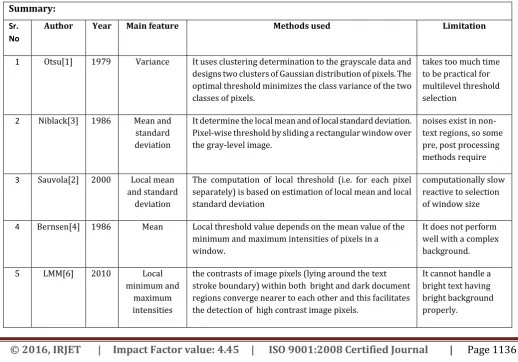
Table -1: Comparison of Different Methods
Summary:
Sr. No
Author Year Main feature Methods used Limitation
1 Otsu[1] 1979 Variance It uses clustering determination to the grayscale data and designs two clusters of Gaussian distribution of pixels. The optimal threshold minimizes the class variance of the two classes of pixels.
takes too much time to be practical for multilevel threshold selection
2 Niblack[3] 1986 Mean and
standard deviation
It determine the local mean and of local standard deviation. Pixel-wise threshold by sliding a rectangular window over the gray-level image.
noises exist in non-text regions, so some pre, post processing methods require
3 Sauvola[2] 2000 Local mean and standard
deviation
The computation of local threshold (i.e. for each pixel separately) is based on estimation of local mean and local standard deviation
computationally slow reactive to selection of window size
4 Bernsen[4] 1986 Mean Local threshold value depends on the mean value of the
minimum and maximum intensities of pixels in a window.
It does not perform well with a complex background.
5 LMM[6] 2010 Local
minimum and maximum intensities
the contrasts of image pixels (lying around the text stroke boundary) within both bright and dark document regions converge nearer to each other and this facilitates the detection of high contrast image pixels.
© 2016, IRJET | Impact Factor value: 4.45 | ISO 9001:2008 Certified Journal | Page 1137
6 Gatso[5] 2006 Background Intensities
It interpolates neighboring background intensities to calculate background surface. Then apply thresholding technique in combination with original image.
It does not perform well in low resolution images.
7 Wolf[7] 2003 Mean
And background
intensities
It organizes contrast and the mean gray value of image to calculate local threshold value. the local threshold value is depend on the minimum gray value and maximum standard deviation of local gray values determined from whole image
It gets fail when a sharp change in background gray values across image
8 NICK 2009 Mean and pixel value of gray
image
It shift thresholding value down to overcomes the issue of black noise in niblack method and to give solution to low contrast image difficulty in Sauvola’s method.
it get fail very low contrast condition of thin pen stroke text
9 Bilal[9] 2011 Mean and standard deviation
It is dynamic method to divide the image into the windows based on the characteristics of the image and determine the appropriate threshold value within each window in order to binarize the image.
-
10 Feng[8] 2004 Gray value contrast and
standard deviation
Method considers two local windows which is one contained within other (i.e. primary and secondary window). It locally calculates gray value standard deviation from whole image using both windows.
A small change in parameter values could highly affect binarization results.
11 Darek Bradley[10]
2007 Thresholding using integral
image
A method for adaptive thresholding using the integral image of the input. After that sum of the function for any rectangle with upper left corner) and lower right corner can be computed in constant time
It used in real time video stream where we must process the image twice.
12 Kapur[13] 1985 Entropies of foreground, background intensity
Considers a two distinct signal source for image fore and background, calculate sum of both class if that sum of two class entropies reaches to its maximum value then image is under optimal thresholding
It involves lots of computation
13 Kittler[14] 1986 Mean and Gaussian density
It assumes that foreground object and background class probability density function are normal distribution. It use either complete search or iterative search algorithm to optimize fair pixel categorization error rate
The method gets fail when probability distribution is not close to each other
14 Lopes N.V., Mogadouro do Couto
[11]
2010 Gray level value and fuzzy logic
Compare the correspondence between gray levels of the image to discover the optimal threshold value. After that it defines two starting areas at the margins of the histogram. This similarity finding process is beneficial to conclude the threshold point using index of fuzziness.
The correct
initialization of initial intervals is necessary
15 Pai, Y.T., Chang, Y.F.,
Ruan, S.J [12]
2010 Mean, standard deviation, image intensity
Global and local thresholding approach is use to separate the document image into the several blocks. After that, binary image is formed by estimating the threshold with diversity and intensity of each block.
algorithm require additional processing time when the block size is much smaller
16 B. Su, S. Lu[15]
2013 Local image contrast and local image
gradient
In this method first generate adaptive contrast map then binarized that contrast map using otsu method with canny edge detector then text are segmented by local thresholding method after that post processing is done for better result
© 2016, IRJET | Impact Factor value: 4.45 | ISO 9001:2008 Certified Journal | Page 1138
3. CONCLUSIONS
The paper discusses about a various degraded document image binarization techniques. A comparative study made on various binarization methods which will help to an individual to select the suitable binarization technique as per need of problem. The binarization is important aspect for document image analysis and recognition system. The main goal is to segment the fore text from the document background to achieve highest performance. In the previous year’s numerous binarization techniques are proposed, none of them is suitable for all types of degradation. The previous studies revels that there is no automatic and robust system, competent of choosing the most useful method of binarization for various types degraded document images. Whereas various binarization approaches are used to enhance the degraded image with their advantages and limitations. So there is need to propose a fast and accurate binarization technique which suitable for all types of degraded document images or a system which will automatically select and apply the suitable binarization technique depending on the document image for better performance.
4. ACKNOWLEDGEMENT
I am very much thankful to the Mr. D.D. Dighe department of electronics and telecommunication MCOERC who at very discrete step in study of this subject contributed his valuable guidance and helped to solve every problem that arise. I am very much thankful to Prof. S. D. Pable, for his persistent inspiration. I would like to extend my special thanks to Principal Dr. G. K. Kharate for spending his valuable time to go through my report and providing many helpful suggestions.
5. REFERENCES
[1] N. Otsu, “A threshold selection method from gray level histogram,” IEEE Trans. Syst., Man, Cybern., vol. 19, no. 1, pp. 62–66, Jan. 1979.
[2] J. Sauvola and M. Pietikainen, “Adaptive document image binarization,” Pattern Recognit., vol. 33, no. 2, pp. 225–236, 2000.
[3] W. Niblack, An Introduction to Digital Image Processing. Englewood Cliffs,NJ:Prentice-Hall, 1986. [4] J. Bernsen, “Dynamic thresholding of gray-level images,” in Proc. Int.Conf. Pattern Recognit., , pp. 1251–1255, Oct. 1986.
[5] B. Gatos, I. Pratikakis, and S. Perantonis, “Adaptive degraded document image binarization,” Pattern Recognit., vol. 39, no. 3, pp. 317–327, 2006. [6] B. Su, S. Lu, and C. L. Tan, “Binarization of historical
handwrittendocument images using local maximum and minimum filter,” in Proc.Int. Workshop Document Anal. Syst., Jun. 2010, pp. 159–166. [7] Wolf, J-M. Jolion, ―Extraction and Recognition of
Artificial Text in Multimedia Documents‖, Pattern Analysis and Applications, 6(4):309-326, (2003).
[8] Meng-Ling Feng and Yap-Peng Tan, ―Contrast adaptive binarization of low quality document images‖, IEICE Electron. Express, Vol. 1, No. 16, pp.501-506, (2004).
[9] B. Bataineh, S. Norul Huda, S. Abdullah, K. Omar, “An adaptive local binarization method for document images based on a novel thresholding method and dynamic windows”, Pattern Recognition Letters Vol. 32, pp. 1805-1813, 2011. [10] Bradley, D., Roth, G.: Adaptive thresholding using
integral image. J. Graph. Tools 12(2), 13–21 (2007). [11] Lopes, N.V., Mogadouro do Couto, P.A., Bustince,
H., Melo-Pinto, P.: Automatic histogram threshold using fuzzy measures. IEEE Trans. Image Process. 19(1), 199–204 (2010).
[12] Pai, Y.T., Chang, Y.F., Ruan, S.J.: Adaptive thresholding algorithm: efficient computation technique based on intelligent block detection for degraded document images. Pattern Recogn. 43(9), 3177–3187 (2010).
[13] Kapur, N.J., Sahoo, P.K., Wong, C.K.A.: A new method for gray-level picture thresholding using the entropy of the histogram. J. Comput. Vis. Graph. Image Process. 29(3), 273–285 (1985).
[14] Kittler, J., Illingworth, J.: Minimum error thresholding. Pattern Recogn. 19(1), 41–47 (1986). [15] B. Su, S. Lu, and C. Lim Tan, “Robust Document Image Binarization Technique for Degraded Document Images,” IEEE TRANSACTIONS ON IMAGE PROCESSING, vol. 22, no. 4, pp 1408-1417, April 2013.
[16] N. Chaki et al., Exploring Image Binarization Techniques, Studies in Computational Intelligence,” A Comprehensive Survey on Image Binarization Techniques,” DOI: 10.1007/978-81-322-1907-1_2, © Springer India 2014.
[17] S. Rachmawati Yahya, S. N. H. Sheikh Abdullah,” Review On Image Enhancement Methods of Old Manuscript with the Damaged Background,” International Conference on Electrical Engineering and Informatics 5-7 August 2009, Selangor, Malaysia
[18] U. D. Dixit and M. S. Shirdhonkar,” a survey on document image analysis and retrieval system,” International Journal on Cybernetics & Informatics [19] K. Khurshid1, I. Siddiqi1, C. Faure2, N. Vincent,”
Comparison of Niblack inspired Binarization methods for ancient documents,” SIP, Université Paris Descartes 45, rue des Saints-Pères, 75006 Paris France.
![Fig -2 : Binarization of degraded document image [17]](https://thumb-us.123doks.com/thumbv2/123dok_us/8201968.815843/2.595.47.271.407.484/fig-binarization-degraded-document-image.webp)