© 2016, IRJET | Impact Factor value: 4.45 | ISO 9001:2008 Certified Journal | Page 1331
VISIBLE LIGHT COMMUNICATION IN DEFENCE AND SECURITY
Meera Rapheal, Varsha Vargheese, Shanto Joy
,Sebin Xavi
Meera Rapheal, Electronics and Communication Engineering, Mets School of Engineering
Varsha Vargheese, Electronics and Communication Engineering, Mets School of Engineering
Shanto Joy, Electronics and Communication Engineering, Mets School of Engineering
Sebin Xavi, Electronics and Communication Engineering, Mets School of Engineering.
---***---Abstract -
The solid-state LED lighting is revolutionizingthe indoor illumination. The incandescent and fluorescent lamps are being replaced by the LEDs at a very high rate. The advantages of LEDs include high energy efficiency, longer life span, lower heat generation and improved color rendering without using harmful chemicals. One additional specialty of LEDs is that they are capable of switching to different light intensities at a very fast rate. This specialty has given rise to a new communication technology (known as Visible Light Communication - VLC) where LED luminaires can be used for high speed data transfer .In simple words it is optic fiber transmission , without the fiber. This paper provides a overview and review of existing literature of visible light communication and sensing and how it can be used in defense and security. Currently defense and security uses optic fibers for wiring in planes, and other vehicles and also for field networking. This could be replaced by visible light technology LEDs. This paper is a study of (1) visible light communication system and characteristics of its various components such as transmitter and receiver, (2) the opportunities and limitations in using visible light communication in defense and security.
Key Words: defence and security, visible light communication, visible light communication technology, secure data transfer, lifi.
1. INTRODUCTION
Visible light is only a small portion of electromagnetic spectrum.It has an unlimited bandwidth of 400 to 700 nm.In 1880, Alexander Graham bell invented the photophone. This was the first step towards visible light communication technology. Since the number of wireless devices keep increasing each year, the wireless congestion problem has become significant. Visible light spectrum is 10000 times larger than the RF spectrum.Shifting towards the right side of the frequency spectrum, reduces the wavelength of the electromagnetic waves. The propogation range of short wavelength signals is very limited. As the signal spreads over longer distances, the error rate increases due to the weakening of the energy . Therefore, this technology is intended to be used for data communication at high speeds in more enclosed areas. In future visible light communication
technology can provide network access to homes, offices, hospitals, shopping centres, planes etc. Visible light communication is useful at places where RF is not available, like in hospitals and planes. Visible light communication is safe for health and has very high speed. There is no matter of interference like in RF signals. It is confined to a small geographical area and it is secure. Security of visible light communication is very high. Data transferred is data light visible, so the security is guaranteed. Visible light communication is an upcoming and growing technology which uses the LED light bulbs to transmit data. LEDs have a special characteristics that makes it unique and different from incandescent and fluorescent lamps. The LEDs are capable of switching to different light intensity levels at a very fast rate. The switching rate is fast enough to be imperceptible by human eye. This characteristics can be used for communication where data can be encoded in the emitting light. . A photodetector (also referred as a light sensor or a photodiode) or an image sensor (matrix of photodiodes) can receive the modulated signals and decode the data. This makes LEDs useful for both illumination as well as communication. In last couple of years, VLC research has shown that it is capable of achieving very high data rates (nearly 100 Mbps and up to multiple Gbps in research). With the exponential increase of mobile data traffic in last two decades has identified the limitations of RF-only mobile communications. The RF spectrum is facing a challenge of spectrum. This problem can be solved by using visible light spectrum. The visible light spectrum includes hundreds of terahertz of license free bandwidth which is completely usable for communication.
TRANSMITTER
© 2016, IRJET | Impact Factor value: 4.45 | ISO 9001:2008 Certified Journal | Page 1332 RECEIVER
The receiver consists of a photodetector and equipments for demodulation of the data sent. A camera sensor also could be used to receive the data sent by the LED luminaire. In a camera sensor, if image frames should be acceptable, a large number of photodetectors must be used (photodetector arranged in matrix.) There are some important requirements that an ideal photodetector should cover:
Sensitive to the wavelength interval associated Operation life should be long
Temperature fluctuations shouldn’t affect the photodetector.
Efficient accomplishment of noise such ambient, dark, etc. Noiseless physical structure
Size should be small Reliable
Cost effective
The rolling shutter property of camera sensor can be used to get data at a faster rate. It is not possible to read the output of each pixel in parallel, so the output is read row by row or column by column and is referred to as rolling shutter process.
WHY LED?
LEDs are safe and is low cost. Less consumption and ability to switch to different intensities at a very fast rate that is jmpersceptable to human eye makes it the best option. It even has higher tolerance to humidity and generates minimum heat than incandescent and fluorescent lamps. One of the functionalities which makes LEDs unique is its high energy conversion efficiency. White LEDs with luminous efficiency as high as 200lm/w are now available.
Comparing RF and VLC: The electromagnetic interference and hazard related with visible light communication is completely nil. Unlike RF technology, visible light communication technology has line of sight. Radio Frequency technology has poor security, while Visible light communication technology has very high security. Unlike RF, VLC can be used for dual purposes- both for illumination and communication. The noise sources which could interfere with the VLC includes, sunlight and other ambient lights. This can be easily solved by using this technology in closed areas.
LED used; Blue light with yellow Phosphor is used in this technology as it is less costly and less complex. Blue and yellow light mixed in a specific proportion gives out white light. This involves the use of blue LED coated with a phosphor layer which emits yellow light.
Secondly, white light can be formed by combining the three primary colors- red, green and blue. This method of white
light formation offers the possibility of using wavelength division multiplexing(WDM).It is quite convenient to accurately control the dimming level of LEDs. The Luminous intensity and transmitted optical power of LEDs should be defined. The transmitted optical power refers to the total energy radiated by the LEDs. Brightness of the LED is specified by the Luminous intensity. Luminous intensity is the luminous flux per solid angle.
Luminous flux is calculated from the energy flux.
Where V (λ) is the standard luminosity curve, and Km is the maximum visibility, which is ~683 lm/W at 555 nm wavelength.
Luminous flux which can be provided by a single LED is very limited. Therefore LED clusters would be needed to light a larger environment.
2. The need for VLC in defense and security
The main role of Defense and Security Corps is to ensure the protection and security of designated Defense Installations against sabotage and pilferage. It provides security for various other corporations. National security is the main aim of the corporation.
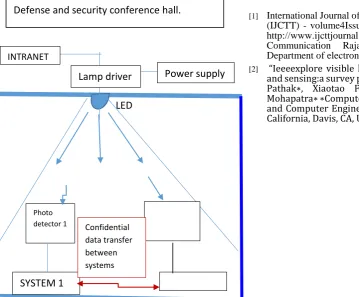
Loss of data or data leakage is a serious threat to the national security. Defense and security services uses Intranet (private network) services for data storage and data transfer. One of the main problems faced by defense and security is the data breaching or data leakage. Many forms of communication are being utilized within the organization, such as Instant Messaging; VOIP; etc., beyond traditional email, more chances for data leakage have emerged. Every year a lot of confidential data are getting leaked or spilled. Data might get hacked or exploited while confidential data are being transferred from one system to another. If we are able to implement visible light communication technology in defense and security, then the smallest pilferage and sabotage of data during the confidential data transfer can be avoided.
© 2016, IRJET | Impact Factor value: 4.45 | ISO 9001:2008 Certified Journal | Page 1333 DIMMING- While performing different types of activities,
different levels of illumination is required. It is possible to dim the LED lights to an arbitrary level depending upon the application requirement. The dimming should be in such a way that the human eye cannot perceive the dimming affect. If the dimming while modulation is perceivable to human eyes, it is very inconvenient to the pupil of eye. Data should be modulated in such a way that any desired level of dimming is supported.
FLICKERING- It is the change in the light intensity that occurs while modulation of data is done. The flickering should be done at a very fast rate such that human cannot perceive the change in intensity. If flickering is at slow rate, then it is very undesirable for human eye. Modulation can be done at very fast rates such that flickering is not perceived by human eye. Continuous runs of 0’s and 1’s can cause the rate at which light intensity changes to reduce.Run length limited codes should be used such that continuous use of 0’s and 1’s can be mitigated.
2.1 conference halls in defense and security.
Visible light communication is the most secure way of communicating data as it cannot be tapped from outside the walls of the room. Optical signals cannot pass through walls like radio waves penetrate. Therefore, the signals emitted in a room provides significant benefits in terms of security by staying in that room. For long-distance communications Line-of-Sight (LoS) is essential, that is, the sender and the receiver must see each other directly. Any intervening situation or barrier can be easily recognized. Thus, it is significantly preferred in the military and state mechanisms that require high information privacy and security.Simple remote content sharing of any application, from any personal computer, to anyone, anywhere is now not only possible, it’s a requirement for today’s defense and security officials. Visible light communication will revolutionize the conference halls of defense and security corps.
While it can be useful for the data transfer, it has a disadvantage of shadowing. Currently if radio waves are used to transfer data then there are a lot of challenges. Radio waves penetrate through walls. They can be intercepted and a third person could make use of the network and untap the data quite easily today, But light doesn’t penetrate through walls so no third person from other side of the walls of the hall can tap the data without notice.
2.2Shadowing
The receiver of the downlink or uplink might get shadowed by different objects or humans in the indoor environment of the hall. If the receiver is placed on a table then the nearest chair could result in shadowing. Similarly movements of human near the link can cause shadowing. Studies suggest that in case of the conference halls, human movement can be
avoided or usage of multiple spatially separated LED sources could be used in order to solve the frequent disconnections due to human shadowing. if needed for special purposes. In case of defence and security conferences, the human movement is very minimal and so the systems can communicate easily without shadowing problems.
National security data can be transferred between different systems without any external intervention. Moreover, data can be transferred within seconds as the modulation and demodulation of the light is very fast.
One another problem while transmission is the multipath effects which limits the bandwidth of this technology.
Chart -1: multipath effect.
The delay between the two paths is determined by room geometry and size.
Visible light communication technology has a problem of lack of connectivity while moving. The users need to be connected while moving in the indoor environment. This problem doesn’t arise when we use this technology in conference halls as human movement is very minimal in this case.
2.3Physical design of visible light communication
links
© 2016, IRJET | Impact Factor value: 4.45 | ISO 9001:2008 Certified Journal | Page 1334 to achieve signal transmission, wide beam transmitters are
required. The main drawbacks of this configuration is the need for high power levels to combat with the high optical loss and the multipath-induced distortions. Although, multipath fading is overcomed by means of the immense ratio of the detector size and signal wavelength. The other link configuration of this type of classification is the hybrid design method in which the transmitter and receiver can have different levels of directionalities, such as a narrow beam transmitter directed to a specific point and a wide FOV receiver which are not aligned to a particular direction. The second type of design choice is the existence of a LOS path between the transmitter-receiver pair. There are two options in this category of configuration. First is the Line of Sight (LOS) configuration in which no interruption or obstacles are present between the transmitter and receiver. Thus, no reflection consideration is considered that simplies the path loss calculation. Besides, high power efficiency is achievable. In contrast, in the Non-LOS architectures, signals emerge from the source do not directly arrive at the receiver. They are reflected from different surfaces or objects and arrive in different time intervals to the receiver. This causes multipath distortions and make the estimation of path loss much more difficult. The Non-LOS architecture with nondirected transmitter-receiver pair is called diffuse systems which is the most robust system and easy to implement for especially the mobile communication scenarios.
Fig -1: defense and security conference hall.
3. Conclusion and other applications.
Applications of visible light communication are: In hospitals the RF technology cannot be used as there are radiations which cause health issues for patients. Whereas, LED lights can be used without any health hazard in the hospitals to transfer data easily. The aircrafts don’t allow the usage of RF technology as it causes technical issues. Whereas, visible light technology can be easily used in the planes. Moreover this technology can be used in other areas like military and homes and offices for data transmission. Visible light communication has capacity to provide high speed data communication with high energy efficiency and communication security in defense and security .In future the RF technology and VLC Technology can work hand in hand to give humankind a explosion of possibilities. VLC technology could be commercialised to be used in defense and security area. Soon communication of national security datas could be communicated between different systems without the worry of external intervention.
ACKNOWLEDGEMENT
Shiju Jose, Assistant Professor, electronics and communication department, Mets School of engineering, Trissur, Kerala.
REFERENCES
[1] International Journal of Computer Trends and Technology
(IJCTT) - volume4Issue4 –April 2013 ISSN: 2231-2803 http://www.ijcttjournal.org Page 906 Visible Light
Communication Rajan Sagotra, Reena Aggarwal
Department of electronics engineering
[2] “Ieeeexplore visible light communication,networking and sensing:a survey potential and challenges”Parth H. Pathak∗, Xiaotao Feng,†, Pengfei Hu,∗, Prasant Mohapatra∗ ∗Computer Science Department, †Electrical and Computer Engineering Department, University of California, Davis, CA, USA.
SYSTEM 1
SYSTEM 2
Photo detector 1 INTRANET
Photo detector 2 Confidential
data transfer between systems
Lamp driver
Power supply
LED
[image:4.595.59.419.437.734.2]© 2016, IRJET | Impact Factor value: 4.45 | ISO 9001:2008 Certified Journal | Page 1335
BIOGRAPHIES
“Meera Rapheal, electronics and communication department, METs school of engineering, Trissur, Kerala, India”
“ Varsha Vargheese, electronics and communication department, METS school of engineering, Trissur, Kerala, India“
“Shanto Joy, electronics and communication department, METS school of engineering, Trissur, Kerala, India “
“Sebin Xavi, electronics and communication department, METS school of engineering, Trissur, Kerala, India. “