International Journal of Emerging Technology and Advanced Engineering
Website: www.ijetae.com (ISSN 2250-2459, Volume 2, Issue 8, August 2012)218
Trust Based Routing Algorithms for Mobile Ad-hoc Network
Mohana ¹, N.K. Srinath ², Amit L.K
3¹ Lecturer, Department of Telecommunication Engineering, R.V. College of Engineering, Bangalore-59, India
2
Professor, Department of Computer science & Engineering, R.V College of Engineering, Bangalore-59,India
3 Design & verification Engineer, Enventure Technologies, Bangalore, India
Abstract - Mobile Ad-hoc Networks (MANETs) comprises of a set of nodes connected by wireless links. The network is ad hoc because it does not rely on a preexisting infrastructure, such as routers in wired networks. Routing in MANETs is a challenging task due to dynamic topology and error prone shared environment.
Data is sent between nodes in a MANET by hopping through intermediate nodes, which must make decisions about where and how to route the data. MANET faces several problems because of node mobility, network traffic, network size, and the possibility of node faults. The efficiency and behavior of a MANET depends on how well information can be passed around and delivered.
In today’s world the security vulnerabilities are increasing day by day. It is really difficult to route the packet with minimum packet loss. In this paper three routing algorithms are presented namely disjoint multipath routing (DMR), Trust based multipath routing (TMR), and message trust based multipath routing (MTMR). All the three routing protocols have their own way in order to establish the trust and transmit packet securely.
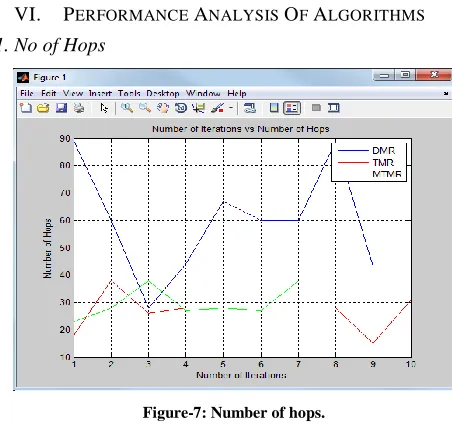
The performance metric considered are, number of hops, route discovery time and packet loss, The simulation results show that MTMR protocol works much better and provides less number of hops, less route discovery time and less packet loss.
Keywords - Classes of Traffic, Dynamic Source Routing,
Route Discovery Time, Routing protocols, Simulation analysis, Trust Level.
I. INTRODUCTION
A Mobile Ad Hoc Network (MANET) is a network consisting of a collection of nodes capable of communicating with each other independent of the network architecture. MANETs have a wide area of applications in battlefield, rescue work, as well as civilian applications like an outdoor meeting, or an Ad-hoc classroom. With the increasing number of applications to harness the advantages of Ad Hoc Networks, more concerns arise for security issues in MANETs.
With the wide range of applications of MANET security challenges also have to be dealt. The wireless network with their easy to access as an advantage is bound to have some target areas in it.
These networks are easy to tap, have limited capacity, and are dynamic in its nature and prone to attacks from the third party. Such attacks can be broadly classified into passive and active attacks. In passive attacks the intruder remains undetected and captures the data while the message is being transmitted over the network. Eavesdropping and traffic analysis mainly fall in this category. Unlike passive attacks, in active attacks the intruder/attacker can affect the communication by modifying the data, misleading the nodes in the network [1].
With the major concern in secure routing in the mobile Ad-hoc network the proposed routing algorithms help in deciding the secure route from the source to the destination. The routing algorithms namely disjoint multipath routing, trust based multipath routing, and multipath and message trust based routing, efficiently find the secure route from source to destination considering different parameters like coverage area, trust of the nodes, trust of the message and malicious nodes present in the network.
The basis of routing technique for the algorithms is Dynamic Source Routing (DSR) algorithm wherein the
source node will send the route request message to the
intermediate nodes. The intermediate nodes will forward
route request message to other intermediate nodes. This
process repeats until the route request message has reached
the destination. The destination node will send a route
reply message which will contain the routeto the source node. Now the actual data packet will be sent from source to destination. [2] Further, the above proposed algorithms modify the general approach of DSR to route the packets in the network between the intended nodes securely.
II. DISJOINT MULTIPATH ROUTING (DMR)
International Journal of Emerging Technology and Advanced Engineering
Website: www.ijetae.com (ISSN 2250-2459, Volume 2, Issue 8, August 2012)219
This protocol takes advantage of the shortest path between the source node to destination node. Then it routes the four encrypted parts through four different routes. In this method to decrypt the original message all the encrypted parts are required. The security of this method lies in the fact that enemy node needs all the encrypted parts to decrypt the original message.
III. TRUST BASED MULTIPATH ROUTING (TMR)
TMR provides a method of message security using trust based multipath routing. In this approach, less trusted nodes are given lesser number of self encrypted parts of a message, thereby making it difficult for malicious nodes to gain access to the minimum information required to break through the encryption strategy [5]. Using trust levels, it makes multipath routing flexible enough to be usable in networks with “vital” nodes and absence of necessary redundancy. In addition, using trust levels, it avoids the non trusted nodes in the routes that may use brute force attacks and may decrypt messages if enough parts of the message are available to them.
Secure connection has been established between source node to destination node. The TMR algorithm will find out the multiple routes from source to destination using DSR algorithm. After finding multiple routes, all the routes are sorted based on the trust level. Then it will choose the best route which is having maximum trust level. In this method the message is split into parts. Then it routes the encrypted parts through best single route. The following table gives the description about the trust levels and the trust levels are varied between -1 to 4 [6] [7].
TABLE I TRUST LEVELS Sl No Trust Value
Meaning Description
1 -1 Distrust Completely untrustworthy.
2 0 Ignorance Cannot make trust-related
judgment about entity.
3 1 Minimal Lowest possible trust.
4 2 Average Mean trustworthiness.
5 3 Good More trustworthy than most
entities.
6 4 Complete Completely trust this entity.
IV. MESSAGE TRUST BASED MULTIPATH ROUTING.
MTMR uses a trust assignment and updating strategy which can be used to identify and isolate malicious nodes. The MTMR algorithm will find the routes by using the DSR algorithm. If the route has been fined for the first time then the MTMR algorithm will have the all routes obtained from DSR with trust level of zero. The MTMR algorithm will then choose a route with minimum time delay. Then if the route contains the malicious node then the trust level of the node is decremented otherwise the trust levels of all the nodes in the best route will be incremented [9][10].
Unlike TMR MTMR routing algorithm does not assign random trust levels instead the trust levels are assigned only to those nodes which behave properly and deliver the packets successfully.
V. SIMULATION ANALYSIS
[image:2.612.323.567.415.626.2]The simulations have been performed using IDE, java eclipse Galileo. Database used My SQL and some of the software packages used are Jdk 1.6, Jre6 and Jar files of Structs framework. Data is exported using Toad software and performance graphs are plotted using MATLAB.
Table 2
Inputs to Routing Algorithms
Source Node Destination Node Coverage Area
2 40 50
1.DMR Algorithm Output
Output of Stage1 for DMR Algorithm
International Journal of Emerging Technology and Advanced Engineering
Website: www.ijetae.com (ISSN 2250-2459, Volume 2, Issue 8, August 2012)220
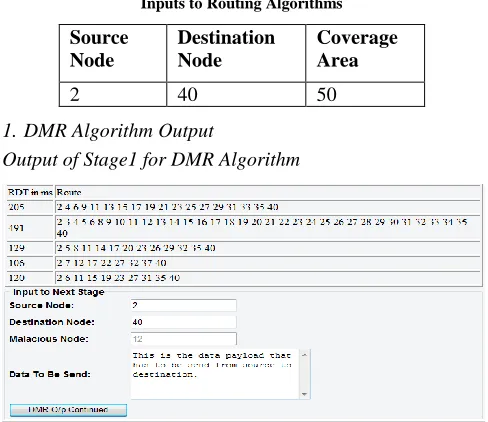
Figure 1 shows the multiple routes that have been discovered from source node to a destination node using DSR (Dynamic Source Routing) algorithm and there corresponding Route Discovery time as well. The user is also entering the data payload that has to be sent from source node to destination node.
Output stage 2 of DMR Algorithm
Figure2: Packet Formation Output and Routes Chosen by DMR
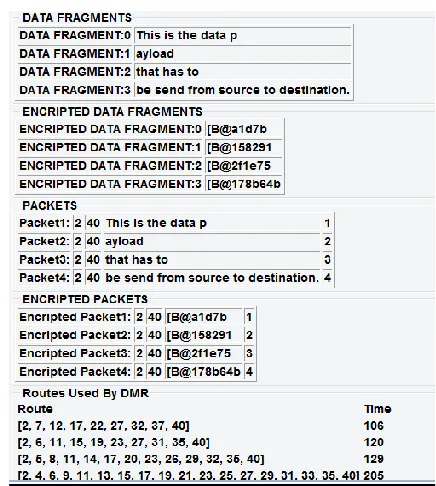
Figure 2 shows the Packet Formed using the Triple Des Encryption for the data fragments. These data fragments would be sent over multiple independent routes from source node to destination node. DMR will select best four routes which is having a less route discovery time.
2.TMR Algorithm Output
Figure-3: TMR Algorithm Output
[image:3.612.328.553.145.422.2] [image:3.612.57.275.219.462.2]International Journal of Emerging Technology and Advanced Engineering
Website: www.ijetae.com (ISSN 2250-2459, Volume 2, Issue 8, August 2012) [image:4.612.325.553.125.694.2]221
3. MTMR Algorithm OutputFigure-4: Routing table for MTMR algorithm before execution.
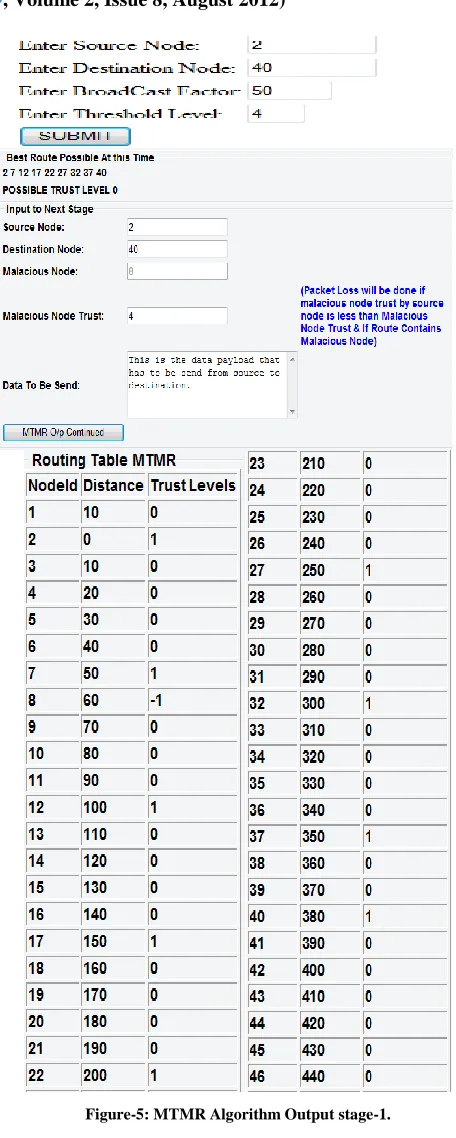
Figure 4 shows the routing table for MTMR algorithm. Initially all the trust levels are zero. MTMR routing algorithm takes an additional parameter as input i.e threshold trust of a route. Threshold Trust=4.
[image:4.612.55.273.149.579.2]International Journal of Emerging Technology and Advanced Engineering
Website: www.ijetae.com (ISSN 2250-2459, Volume 2, Issue 8, August 2012) [image:5.612.52.285.121.694.2]222
Figure-6: MTMR Algorithm Output stage-2.MTMR uses a trust assignment and updating strategy which can be used to identify and isolate malicious nodes. Figure-5 shows the MTMR algorithm having multiple routes from source node to the destination node but The MTMR algorithm will choose a best route which is having a minimum route discovery time from Source Node to Destination node in the network. Here trust levels are generated randomly using random generator function. If the route contains the malicious node then the trust level of the node is decremented otherwise the trust levels of all the nodes in the best route will be incremented by 1. Figure 6 shows the output stage 2 of MTMR algorithm it will choose a best route which is having a maximum trust level. Packet loss will be done, if malicious node trust by source node is less than malicious node trust and if route contains malicious node.
VI. PERFORMANCE ANALYSIS OF ALGORITHMS
[image:5.612.327.553.330.542.2]1. No of Hops
Figure-7: Number of hops.
International Journal of Emerging Technology and Advanced Engineering
Website: www.ijetae.com (ISSN 2250-2459, Volume 2, Issue 8, August 2012) [image:6.612.50.278.137.276.2]223
2. Route Discovery TimeFigure-8: Route Discovery Time.
Figure-8 shows the route discovery time taken from source to destination for all the three algorithms. It is observed from the graph that the route discovery time for the MTMR algorithm is least.
[image:6.612.54.278.345.501.2]3. Packet Loss
Figure-9: Packet Loss
Figure 9 shows the packet taken from source to destination for all three algorithms. DMR is having a more number of packet losses. Packet drop is minimal and almost zero in MTMR algorithm, as it will detect more malicious nodes. But other multipath routing protocols drop a larger number of packets as they route through a greater number of nodes and thus increasing the chances of routing data through malicious nodes. It is observed from the figure that the packet loss for the MTMR algorithm is nil or zero.
VII. CONCLUSION AND FUTURE WORK
Mobile Ad-hoc network (MANETs) has many challenges due to its dynamic nature. Some of the major challenges are number of malicious nodes detected, number of hops, route discovery time and packet loss.
Routing algorithms namely DMR, TMR and MTMR have their own way in order to establish the trust and transmit packet securely. But message trust based multipath routing protocol proved to be best in terms of number of malicious nodes detected, number of hops, route discovery time and packet loss.
In future we plan to implement the secure routing protocols such as the ARIADNE and ARAN and compare
them with the trust based routing protocols. The system
handles only text as message for data packets does not
handle multimedia data packets. In future it can be
enhanced to include multimedia packets.
REFERENCES
[1 ] D.Umuhoza, J.I.Agbinya,andC.W.Omlin,“Estim tion of Trust Metrics for MANET using QoS Parameters and Source Routing Algorithms” Second International Conference on Wireless Broadband and Ultra Wideband Communications, Sydney NSW, ISBN: 978-0-7695-2846-5, DOI: 10.1109/AUSWIRELESS.2007.3, IEEE Computer Society 10 September 2007.
[2 ] Ming Yu, Mengchu Zhou, and Wei Su, “A Secure Routing Protocol against Byzantine Attacks for MANETs in Adversarial Environments” IEEE Transactions on Vehicular Technology,
Volume: 58, Issue: 1, ISSN: 0018-9545, DOI:
10.1109/TVT.2008.923683, pp. 449-460, 13 January 2008. [3 ] Xu Yi, Cui Mei, Yang Wei, and Xan Yin, “ A Node-disjoin
Multipath Routing in Mobile Ad hoc Networks”, IEEE International Conference on Electric Information and Control Engineering (ICEICE-2011), School of Computer Science and Technology, Wuhan University of Technology Wuhan, China, ISBN: 978-1-4244-8039-5, pp. 1067-1070, DOI: 10.11O9/ICEICE.2011.5777190, IEEE 27th May 2011.
[4 ] SungHwi Kim, SeungMin oh, HoSung Park, Jeongcheol Lee, and SangHa Kim, “Disjoint Multipath Scheme with Hole Detouring Strategy in Wireless Sensor Networks” IEEE Vehicular Technology Conference (VTC Fall), San Francisco, CA, ISBN: 978-1-4244-8328-0, DOI: 10.11O9/VETECF.2011.6093219, pp. 1-5, 01 December 2011.
[5 ] Jassim H.S, Yussof S, Tiong Sieh Kiong, Koh S.P, and Ismail R, “A routing protocol based on trusted and shortest path selection for mobile Ad hoc network” IEEE 9th International Conference on
Communications (MICC), Kuala Lampur, Malaysia, ISBN:978-1-4244-5531, DOI: 10.11O9/MICC.2009.5431438, pp. 547-554, 15th
March 2010.
[6 ] X. Li Z, Jia P, Zhang R, Zhang H, and Wang, “ Trust-based on-demand multipath routing in mobile ad hoc networks” The Institution of Engineering and Technology(IET), School of Computer Science & Technology, Shandong Univ., Ji'nan, China, Volume: 4, Issue: 4, ISSN: 1751-8709, DOI: 10.1049/iet-ifs.2009.0140, pp. 212-232, 20th December 2010.
[7 ] Lacharite, Y.Dang Quan Nguyen, Maoyu Wang, and Lamont L, “A Trust-based Security architecture for tactical MANETs” IEEE Military Communications Conference, (MILCOM 2008), San Diego,
CA, ISBN: 978-1-4244-2676-8, DOI:
International Journal of Emerging Technology and Advanced Engineering
Website: www.ijetae.com (ISSN 2250-2459, Volume 2, Issue 8, August 2012)224
[8 ] Thanikaivel B, and Pranisa B, “Fast and Secure data transmission inMANET” International Conference on Computer Communication and Informatics (ICCCI), Coimbatore, ISBN: 978-1-4577-150-8, DOI: 10.1109/ICCCI.2012.6158859, pp.1-5, 01 January 2012. [9 ] Sanjay K.Dhurandher, and Vijeta Mehra, “Multi-path and Message
Trust-Based Secure Routing in Ad Hoc Networks” IEEE, International Conference on Advances in Computing, Control and Telecommunication Technologies, Trivandrum, Kerala, ISBN: 978-0-7695-3915-7, DOI: 10.1109/ACT.2009.55, pp. 189-194, 12 January 2010.
[10 ] Che-YuLiu, Woungang, Han-Chieh, Dhurandher S.K, Ting-Yun Chi, and Obaidat M.S, “Message Security in Multipath Ad Hoc Networks Using a Neural Network-Based Cipher” IEEE Global Telecommunications Conference (GLOBECOM 2011), Houston,
TX, USA, ISBN: 978-1-4244-9266-4, DOI:
10.1109/GLOCOM.2011.6133519,pp. 1-5, 19th January 2012.