Adaptive Battery Equalization Algorithm for
Capacitor-based Battery Management System
Lan-Rong Dung
*, Yu-Syuan Peng
Department of Electrical and Computer Engineering, National Chiao Tung University, Taiwan
Copyright©2016 by authors, all rights reserved. Authors agree that this article remains permanently open access under the terms of the Creative Commons Attribution License 4.0 International License
Abstract
In recent years, as energy-saving and environmental protection were widely concerned around the world, the lithium iron phosphate (LFP) battery has been widely used in hybrid electric vehicle (HEV) and electric vehicle (EV). Generally the battery pack for HEV is composition of the number of cells in series. In this case, imbalance among cells due to the difference of degradation and temperature will be accelerated by the cycles of charge and discharge without an appropriate battery equalization management system. However, the balancing system only intended to reduce the difference of cell voltage or Stage of Charge (SoC) before. “Adaptive Battery Equalization Algorithm for Capacitor-based Battery Management System” this thesis proposed re-explains the meaning of battery equalization. Instead of long-term using battery equalizer on standby, this thesis equalizes the battery when charging to save much spending time. It could not only adjust the balancing mechanism automatically in order to keep the available charge but also raise the average SoC to prevent the effect of battery aging and improve the cycle number of battery. Experiment results indicate that the available charge increases 1.5% and the battery capacity efficiently improves 7.3%.Keyword
Battery Equalization, Capacitor-based Battery Balance, LFP Battery, Battery Management System1. Introduction
In recent years, lithium-ion batteries are widely used as an energy storage element and voltage source in many applications due to its high energy density, low
self-discharge rate, and high voltage each cell. Among the various types of lithium-ion batteries, the lithium iron phosphate (LFP) battery is the most popular because of safety, cost, and life span [1]. Because the applications demand high operating voltage than single cell voltage, a series connection of batteries is usually required to meet the voltage level.
However, repeatedly charge/discharge can cause battery imbalance due to the inevitable differences in battery electrochemistry characteristics caused by the variance of manufacturing environment [2]-[5]. The little variance will cause significant differences of battery characteristics, such as charge capacity, internal resistance, self-discharge rate, and etc. In addition, overcharging and over discharging of cells will cause irreversible damage or explosion. Therefore, battery should be used in appropriate region between the charging voltage limit (CVL) and the discharging voltage limit (DVL). The cell voltage should not get in the restricted area [6].
Figure 1. Cell voltages of a string battery pack.
Many techniques for cell equalization have been reported in previous research [8]-[10]. The simplest method is passive equalizer which uses parallel resistor to dissipate redundant energy through passive bypass route. However, with active cell equalization, charge can be transferred between the cells in the battery pack which uses a storage element like inductor, transformer, or capacitor. Among these equalization circuits, the switched capacitor is the promising method due to no bulky and large magnetic components. Thus, this thesis uses switched capacitor equalizer which is a power saving method as storage element [11].
In this paper, an adaptive battery equalization algorithm for capacitor-based battery management system has been proposed. The proposed method is operating when LFP battery is charging. The proposed battery equalization algorithm can not only save much balancing time but also adjust the equalization mechanism for different battery aging conditions to meet the valid and efficient results.
2. Adaptive Equalization Algorithm
Generally, the switched capacitor method is applied in lithium-ion battery when battery is standby. Cell balancing speed is slow in general because of the property of switched capacitor. The equalizer uses the difference of cells voltage to get the balancing current. When battery imbalance occurs, it balances SoC by the difference of EMF of different cells. This standby equalization method is workable for general lithium-ion battery because of its obvious change of EMF when SoC changes.
However, the conventional standby equalization is impractical for LFP battery. When the battery is standby, the open-circuit voltage (OCV) is nearly a constant form cell SoC is 40% to 80%. There is no significant change in OCV, so the balancing current from the difference of cell voltage is quite little. Therefore, the work of equalization must spend much more time to balance battery. Nevertheless, there is significant change in cell voltage when charge, so we try to equalize battery when battery is in charge.
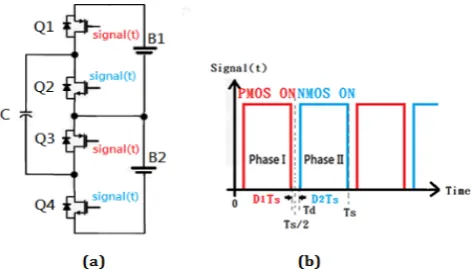
Figure 2. (a) Switch capacitor equalizer circuit. (b) Switching waveform. Before researching the equalization mechanism, we analyze the switched capacitor equalizer. Fig. 2(a) shows the switched capacitor equalizer using two pairs of n-MOSFET and p-MOSFET to implement the Single Pole Double Throw (SPDT) switches which are connected to batteries. SPDT switches are alternately connected to upper side and lower side with a proper dead time. The switch function is shown as Fig. 2(b). In periodic steady state, Vc at the start of the charge cycle is equal to Vc at the end of the discharge cycle, Vc2 and Vc at the start of the discharge cycle is equal to Vc at the end of the charge cycle, Vc1. We can get the equation:
)
1
(
)
-1
)(
1
(
)
(
2 2 1 1 2 2 1 1 2 1 2 1 τ τ τ τ S S S S T D T D T D T D b b C Ce
e
e
e
V
V
V
V
× ×× ×
×
-×
-=
-
(1)where τ1 = (R1+ESR)×C , τ2 = (R2+ESR)×C , R1 is the trace
impedance in Phase I, R2 is the trace impedance in Phase II,
ESR is the equivalent series resistance of capacitor, TS is
period of switch, D1 is the duty cycle of Phase I, and D2 is
the duty cycle of Phase II.
Then, the average balance current delivered by capacitor is:
eq b b
b
V
R
V
i
=
1-
2(2)
[image:2.595.307.549.77.416.2] [image:2.595.314.550.259.394.2])
1
(
)
1
(
1
1
) ( ) ( ) ) ( ) ( ( 2 2 1 1 2 2 1 1-×
-×
×
=
+ × × + × × + × × + + × × ESR R C f D ESR R C f D ESR R C f D ESR R C f D s eq S S S Se
e
e
C
f
R
(3)Eq. (2) shows that the direction of balance current is decided by the difference of cell voltage. It is from the higher one to the lower one. Besides that, the other factor to effect balance current is Req. We can derive the limit of Req from Eq. (3) by using the L’Hospital’s Rule:
1 2
1 2
1 0
( ) ( )
lim , when .
S
eq f C
ESR R ESR R
R D D D
D
→ ×
+ + +
= = = (4)
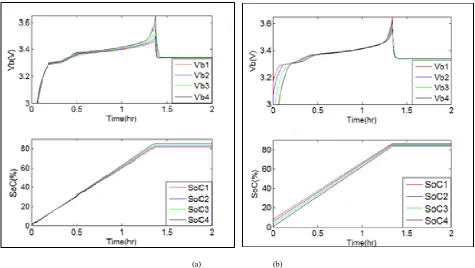
Eq. (4) shows that Req has a limit. The simulations of charge balance without/with equalization are shown as Fig. 3(a) and (b). The new cell voltage is higher than aging one at CVL. It means that new cell got too much charge from the aging cell during charge. The results will decrease the available charge of battery because of the insufficient charge of aging cell.
[image:3.595.67.543.212.480.2](a) (b)
Figure 3. Simulation of 4-cell series-connected LFP battery (a) without equalization (b)with equalization.
Because of the long-term equalization during SoC in II stage, we should avoid equalization in this region. Therefore, the equalization should be trigged after leaving II stage. According to the slope of voltage in new and aging cell separately, the slope of voltage in aging one is larger than new one at II stage. That is to say, aging cell should trig the equalization later than new one which is shown as Fig. 4(a) and 4(b).
[image:3.595.98.514.562.712.2](a) (b)
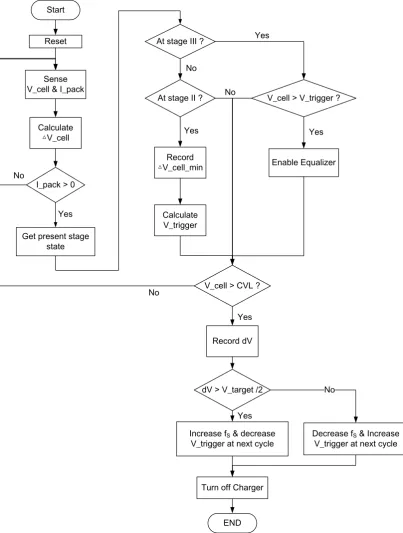
Fig. 5 shows the equalization algorithm for adaptive tuning the equalization. The mechanism keeps sensing the cell voltage and computing the cell voltage of trigger by calculating the change rate of cell voltage slope. When meeting the trigger, it starts to trig the equalization. After meeting the CVL, it will record the voltage difference immediately and tune the trigger points and switched frequency at next cycle.
Comparing with standby balance method, the charge balance method can save much time in balance. If the equalization is trigged from charge beginning till the end, the results show that the available charge will decrease. Moreover, using the proposed algorithm can not only maximize the available charge but also efficiently charge both new and aging cells more charge.
Reset Start
I_pack > 0 Sense V_cell & I_pack
Calculate △V_cell
V_cell > CVL ?
END Turn off Charger Record
△V_cell_min No
Calculate V_trigger At stage III ?
No
Enable Equalizer V_cell > V_trigger ? Yes
Yes
Yes Get present stage
state Yes
At stage II ?
Yes
No
No
Increase fS & decrease
V_trigger at next cycle Record dV
dV > V_target /2
Decrease fS & Increase
V_trigger at next cycle No
[image:4.595.101.505.187.721.2]Yes
3. Experimental Results
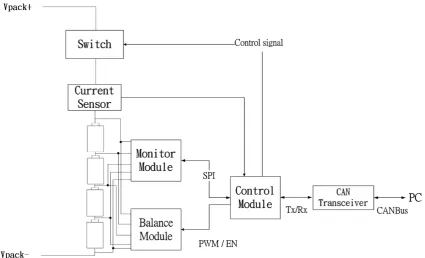
[image:5.595.93.519.191.449.2]The overall adaptive equalization algorithm for capacitor-based battery management system is shown in Fig. 6. The monitor bq76PL536A keeps sensing 4 cells voltage and returns the information to control module through SPI. In control module, the master MCU 18F4580 controls the main behavior and the slave MCU 18F67K90 is in charge of output the PWM signals. After master MCU gets battery information from monitor, it will decide whether or not to switch off the charge route and compute the charge battery has gotten. If any cell voltage isn’t higher than CVL, slave MCU would output PWM and EN signals to equalizers to equalize. Meanwhile, in order to get the whole information immediately, the BMS transmit data to PC through CAN-Bus at any time.
Figure 6. Block diagram of adaptive equalization algorithm for capacitor-based battery management system. Table 1 shows the comparisons of three experiment results.
Using the proposed algorithm can not only maximize the available charge or even increase 1.5% but also charge new 7.3% and aging cell 1.3% more respectively.
Table 1. Experiment results.
4. Conclusions
An adaptive battery equalization algorithm for capacitor-based battery management system is proposed in this paper. For LFP battery, using capacitor equalizer in charge can save much balance time. Yet, the equalization in charge may decrease the battery performance without proper management. The proposed adaptive equalization algorithm
can adjust itself with the different aging conditions and tune trigger mechanism and the switched frequency at every cycle. The proposed BMS can not only raise the SoC of cells to lower the aging rate but also maximize the available charge to achieve beneficial results after equalization.
REFERENCES
[1] S. M. Lukic, J. Cao, R. C. Bansal, F. Rodriguez, and A. Emadi, “Energy storage systems for automotive applications,” IEEE Trans. Ind. Electron., vol. 55, no. 6, pp. 2258–2267, Jun. 2008.
[2] S. Barsali and M. Ceraolo, “Dynamical models of lead-acid batteries: Implementation issues,” IEEE Trans. Energy Convers., vol. 17, no. 1, pp. 16–23, March 2002.
[3] Bo Li, Daiming Yang, Jianzheng Liu, Man Chen, and Zhigang Lu, “An Optimal Strategy of Balancing for LiFePO4
Battery in Battery Energy Storage System,” Energy Research and Power Engineering, vol. 341 - 342, July, 2013.
LiCoO2,” Journal of Power Sources, vol. 111, no. 1,
pp.130-136, 2002.
[5] K. Amine, J. Liu, and I. Belharouak, “High-temperature Storage and Cycling of C-LiFePO4/graphite Li-Ion Cells,”
Electrochemistry Communications, vol. 7, n, pp.669-673, 2005.
[6] M. Einhorn, W. Roessler, and J. Fleig, “Improved Performance of Serially Connected Li-Ion Batteries With Active Cell Balancing in Electric Vehicles,” IEEE Trans. Veh. Technol., vol. 60, pp. 2448-2457, 2011.
[7] M. Einhorn, W. Guertlschmid, T. Blochberger, R. Kumpusch, R. Permann, F. V. Conte, C. Kral, and J. Fleig “A current equalization method for serially connected battery cells using a single power converter for each cell,” IEEE Trans. Veh. Technol., vol. 60, no. 9, pp.4227 -4237, 2011.
[8] S. W. Moore and P. J. Schneider, “A review of cell equalization methods for lithium ion and lithium polymer battery systems,” SAE Technical Paper Series, pp.1 - 5, 2001.
[9] Jian Cao, Nigel Schofield, and Ali Emadi, “Battery Balancing Methods: A Comprehensive Review,” IEEE Vehicle Power and Propulsion Conference (VPPC), pp. 1-6, 2008.
[10] M. Daowd, N. Omar, P. Van Den Bossche and J. Van Mierlo, “Passive and active battery balancing comparison based on MATLAB simulation,” IEEE Vehicle Power and Propulsion Conference (VPPC), pp. 1-7, 6-9, September 2011.