Journal of Chemical and Pharmaceutical Research, 2016, 8(8):334-339
Research Article
CODEN(USA) : JCPRC5
ISSN : 0975-7384
334
Development of stability indicating RP-HPLC method and
validation for the estimation of zolpidem tartrate
Prabhat Dessai* and Manasi Prabhu Dessai
PG Department of Chemistry, Dnyanprassarak Mandal’s College and Research Centre, Mapusa Goa, India
ABSTRACT
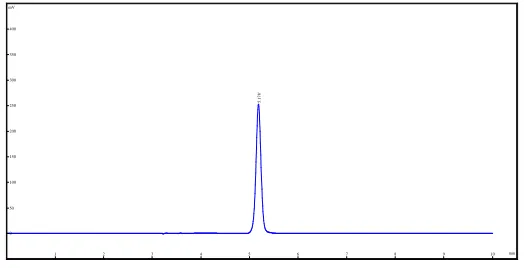
An accurate, precise, rapid and economical RP-HPLC method has been developed for the estimation of Zolpidem tartrate as per ICH guideline in pharmaceutical dosage from use ultra violet (UV) detector. Elution was carried out using a mobile phase consisting of Methanol, Acetonitrile and Ammonium acetate buffer of which pH was adjusted at 7.4 in a ratio (40:40:20v/v) and flow rate was set on 1ml/min at 254 nm, retention time for Zolpidem tartrate was found to be 5.178 min. The method was found to be linear in the concentration range of 07-13 ug/ml, in the linearity study regression equation was found to be y = 23111.46x and correlation coefficient was found to be 0.9997. This method was Rugged and Robust in different testing criteria, LOD and LOQ was found to be 0.02 µg / ml and 0.05 µg / ml respectively. Accuracy study was done in three different concentration level i.e 70, 100, 130% and % recovery of the method was found to be 99.97%, 100.02%, 100.02% respectively in 3 different levels and mean recovery was 100.00%, so method was accurate. Results of all validation parameter were within the limit as per ICH guideline.
Keywords: Zolpidem tartrate (ZOL), RP-HPLC, Method Development, Validation, Stability Indicating, ICH
guidelines
INTRODUCTION
Zolpidem tartrate (ZOL) is a non-benzodiazepine hypnotic of the imidazopyridine class and is available in 5 mg and 10 mg strength tablets for oral administration. Chemically, It is N, N, 6- trimethyl-2-p-tolylimidazo [1,2-a] pyridine-3-acetamide L-(+)-tartrate. (Fig.1) The drug is official in British Pharmacopoeia [1] and Merck Index [2]. It is a white to off-white crystalline powder that is sparingly soluble in water, alcohol, and propylene glycol. It produces agonistic effect on GABA receptors and it is used in the treatment of insomnia.
Zolpidem belongs to a class of medications called sedative-hypnotics [3]. Literature survey reveals that four HPLC methods [4–7], one potentiometric method [8] one spectrophotometric method [9] have been developed for the estimation of zolpidem tartrate in human serum and tablet formulation. Stability testing plays an important role in the process of drug development. The purpose of stability testing is to provide confirmation on how quality of a drug substance varies with time under the influence of a variety of environmental factors such as temperature, humidity, and light and enables recommendation of storage conditions, and shelf life to be established. The assay of drug product in stability test sample needs to be determined using stability indicating method, as recommended by the international Conference on Harmonization (ICH).
335
Figure no 01: Shows Chemical structure of Zolpidem tartrate
EXPERIMENTAL SECTION
Standard Drugs: Zolpidem tartrate Chemicals and Reagents:
Zolpidem tartrate (Cadila Healthcare Limited, Goa), HPLC Water (Burgoyne Burbidge’s and co.), Methanol for HPLC (Thermo Fischer Scientific India. Pvt. Ltd.), Acetonitrile for HPLC (Merck), Ammonium acetate (Acme Chemicals.) and Ammonia (Acme Chemicals).
Apparatus:
HPLC (Analytical technologies Ltd. UV detector), UV/VIS spectrophotometer (LABINDIA UV 3000+ ), pH meter (EQUIP-TRONICS, EQ-614A), Analytical balance (Sartorius, BSA2245-CW), SonicatorPipettes and Burettes (Borosil), Beakers Borosil.
Preparation of Standard Solution:
About 100 mg of Zolpidem tartrate is weighed and transferred to 100 ml volumetric flask, and was dissolved in mobile phase and the volume was made up to the mark with the same solvent. Further 10 ml of above solution was diluted to 100ml with mobile phase. Further 5ml is diluted to 50ml with mobile phase to get 10 µg/ml Zolpidem tartrate.
Preparation of Sample Solution:
A composite of 20 (Zolfresh) tablets was prepared by grinding them to a fine, uniform size powder. Weight equivalent to 100 mg of ZOL was accurately weighed and quantitatively transferred into a 100 ml volumetric flask, it was dissolved with mobile phase and the volume was made up to the mark with mobile phase. Further 10 ml of above solution was diluted to 100ml with mobile phase. Further 5ml is diluted to 50ml with mobile phase to get 10
µg/ml Zolpidem tartrate
Preparation of Phosphate buffer:
Accurately weighed 1.54g of Ammonium Acetate was taken in a 1000ml volumetric flask, dissolved and diluted to 1000ml with HPLC water and the volume was adjusted to pH 9 with ammonia.
Preparation of mobile phase:
Accurately measured 200 ml (20%) of above buffer, 400 ml (40%) of HPLC methanol , and 400 ml (40%) of HPLC Acetonitrile were mixed and degassed in an ultrasonic water bath for 10 minutes and then filtered through 0.45 µ
filter under vacuum filtration.
Diluent Preparation:
The Mobile phase was used as the diluent.
Fig. no.2: Shows UV spectrum of Zolpidem tartrate
336
Table no.01: Optimized Chromatographic Conditions:
Instrument used Analytical technologies Ltd. Temperature Ambient
Column Symmetry C8 (4.6 x 250mm, 5µm)
Buffer 1.54g of Ammonium Acetate in 1000ml HPLC water and pH adjusted with ammonia.
pH 9.0
Mobile phase 20% Ammonium Acetate buffer, 40% Methanol and 40% Acetonitrile Flow rate 1 ml per min
Wavelength 254 nm Injection volume 20 µl Run time 10min.
Validation Parameter:
The following parameters were considered for the analytical method validation of Zolpidem tartrate in bulk form.
System Suitability:
Chromatograph the standard preparations (6 replicate injections) and peak area responses for the analyte peak was measured and the system suitability parameters are evaluated.
Accuracy:
For accuracy determination, three different concentrations were prepared separately i.e. 50%, 100% and 150% for the analyte and chromatograms are recorded for the same.
Precision:
The standard solution was injected for six times and the area was measured for all six injections in HPLC. The % RSD for the area of six replicate injections was found to be within the specified limits.
Robustness:
As part of the Robustness, deliberate change in the temperature and flow rate Variation was made to evaluate the impact on the method.
Linearity and range:
Linearity of the analytical method for assay by injecting the linearity solutions prepared in the range of 70 to 130% (7-13µg/ml) of test concentration, into the chromatograph, covering minimum 6 different concentrations.
Ruggedness:
Establish the ruggedness of the analytical method by using the assay of 6 different sample preparations of same batch by a different analyst using a different HPLC System.
RESULTS AND DISCUSSION
The developed method was validated based on ICH guidelines which detect and quantitate drug in bulk form with use of HPLC system equipped with UV detector.
5
.1
7
8'
0 50 100 150 200 250 300 350 400 mV
1 2 3 4 5 6 7 8 9 10 min
[image:3.595.175.437.566.700.2]337
Table no 02: shows Method Development Parameters
PARAMETERS ZOLPIDEM TARTRATE
Theoretical plates 11877 Tailing factor 1.00 Resolution factor 3.98 RSD of Area 0.007 RSD of Rt 0.01
Validation of developed RP-HPLC method:
Validation of an analytical method is the process to establish by laboratory studies that the performance characteristic of the method meets the requirements for the intended analytical application. Performance characteristics were expressed in terms of analytical parameters.
Accuracy:
[image:4.595.128.481.293.354.2]The RP-HPLC method developed in the present study has been used to quantify Zolpidem tartrate. The average area was taken and % accuracy was calculated. The mean recoveries were found in the range of 99.97-100.02%. The results are presented in table no 03.
Table no 03: Shows Accuracy results for Zolpidem tartrate
Concentration of solution in %
Amount spiked (µg/ml)
Mean peak area of standard
Mean peak area of sample
Amount recovered
% Recovery
70% 7 1649770 1649409 9.99 99.97 % 100% 10 2325240 2325916 10.00 100.02 % 130% 13 3032223 3033054 10.00 100.02 %
Mean % Recovery 100.00 %
Precision:
The precision of the analytical method was studied by analysis of multiple sampling of homogeneous sample. The precision results were expressed as standard deviation or Relative standard Deviation
Table no 04: Shows Method Precision Results for Zolpidem tartrate
Drug %RSD (Intraday) %RSD (Interday)
Zolpidem tartrate 0.012 0.008
Linearity and Range:
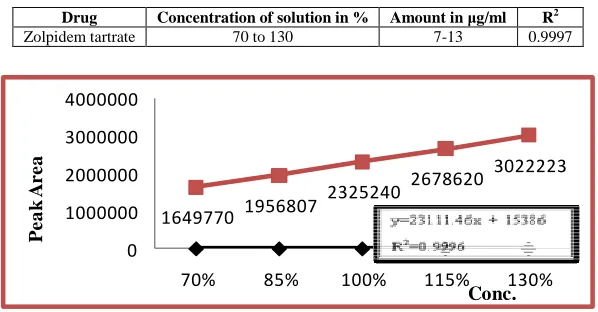
[image:4.595.157.456.521.677.2]The calibration curves were linear in the range 50-150 µg/ml. The correlation coefficient (‘r’) value was found to be >0.9997 for Zolpidem tartrate.
Table no 05: Shows Linearity results for Zolpidem tartrate
Drug Concentration of solution in % Amount in µg/ml R2
Zolpidem tartrate 70 to 130 7-13 0.9997
70% 85% 100% 115% 130%
1649770 1956807
2325240 2678620
3022223
0 1000000 2000000 3000000 4000000
P
e
a
k
A
r
e
a
Conc.
Figure no 04: Shows Calibration graph of Zolpidem tartrate
Robustness:
338
Table no 06: Shows Study of Robustness results for Zolpidem tartrate (Flow Rate)
Sr. No. Flow rate RT Area Content in mg
1 0.8 5.158 2359624 9.99 2 1.0 5.089 2325487 10.01 3 1.2 5.021 2317381 10.03
Table no 07: Shows Study of Robustness results for Zolpidem tartrate (Temperature)
Sr. No. Temperature RT Area Content in mg
1 200C 5.142 2318621 9.99
2 250C 5.027 2324718 10.02
3 300C 5.163 2327996 10.01
LOD:
The limit of detection is determined by the analysis of samples with known concentration of analyte and by establishing that minimum level at which the analyte can reliably detected, The LOD are calculated by formula LOD = 3.3 x SD/ b where, SD- standard deviation of the peak area of the drugs, b -is slope of the corresponding calibration curve. LOD for Zolpidem tartrate was 0.02µg/ml.
LOQ:
The limit of quantification is generally determined by the analysis of sample with known concentrations of analyte and by establishing the minimum level at which the analyte can be quantified with acceptable accuracy and precision, The LOQ are calculated by formula LOQ = 10 x SD/ b where, SD- standard deviation of the peak area of the drugs, b -is slope of the corresponding calibration curve. LOQ for Zolpidem tartrate was 0.05 µg/ml.
Table no 08: Shows LOD and LOQ results of Zolpidem tartrate
Parameters Zolpidem tartrate
LOD 0.02 µg/ml LOQ 0.05 µg/ml
[image:5.595.209.400.423.484.2]Degradation Results:
Table no 09: Shows degradation studies of Zolpidem tartrate
S.No Degradation Rt Area
[image:5.595.180.435.517.629.2]1 Acid degradation 5.178 2361582 2 Base degradation 5.121 2359624 3 Thermal degradation 5.179 2344791 4 Photolytic degradation 5.181 2362103 5 Oxidative degradation 5.181 2361774
Table no 10: Shows validation summary of Zolpidem tartrate
S.NO Parameter Acceptance criteria HPLC
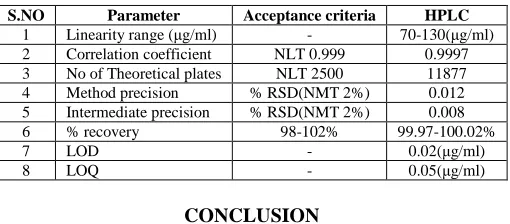
1 Linearity range (µg/ml) - 70-130(µg/ml) 2 Correlation coefficient NLT 0.999 0.9997 3 No of Theoretical plates NLT 2500 11877 4 Method precision % RSD(NMT 2%) 0.012 5 Intermediate precision % RSD(NMT 2%) 0.008 6 % recovery 98-102% 99.97-100.02%
7 LOD - 0.02(µg/ml)
8 LOQ - 0.05(µg/ml)
CONCLUSION
339
Acknowledgements
The authors are thankful to Cadila Healthcentre Pvt. Ltd. Goa, India, for supplying gift sample of Zolpidem tartrate
and to the management, Dnyanprassarak Mandal’s College and Research Centre, Mapusa, Goa for providing excellent research facilities.
REFERENCES
[1] British Pharmacopoeia, Vol. 2, United Kingdom, p. 2193.
[2] Budavari S., editor, The Merck Index, 12th ed., White house Station (NJ), Merck and Co Inc; 1996. p. 10322. [3] Timothy P., Zolpidem Forensic aspects for the toxicologist and pathologist, forensic science,Med. and Pathology, Vol. 1, Number 2, 81-90.
[4] Nirogi R.V., Kandikere V.N., Shrivasthava W., Mudigonda K., J Chromat B, 2004;811:59-63. [5] Laviana L, Mangas C., Mari F.F., Bayod M., J Pharm Biomed Anal., 2004; 36: 925-8. [6] Ring P.R., Bostick J.M., J Pharm Biomed Anal. 2000; 22:495-504.
[7] Kintz P., Villain M., Ludes B., J Chromat B. 2004; 3:1016-20. [8] Kelani K.M., J AOAC Int., 2004; 87:1309-18.
[9] Chomwal R., Amit K., Goyal A., J Pharm Bioallied Sci., 2010, Oct-Dec; 2(4): 365-368.
[10] Beckett, A. H.; Stenlake, J.B. Practical Pharmaceutical Chemistry. Fourth edition, Part 2,CBS Publishers and Distributors, New Delhi, 2002, 275-278.
[11] ICH, Q2 (R1), Harmonised tripartite guideline, Validation of analytical procedures: text and methodology International Conference on Harmonization.
[12] Mahajan M. P, Sawant S. D. International Journal of Pharmacy and Pharmaceutical Sciences, 2012, 4(5), 269-274.
[13] Kiran M, Ushasri S, Srinadth Nissankarao: Scholars Academic Journal of Pharmacy (SAJP), 2013, 2(5), 360-364.
[14] Prathikantam Pushpalatha, Rajendra Kumar Sarin, Mohd Idris, Mesineni Anand Rao, Tulsidas Ramachandra Rao Baggi, M. Satish Varma. Journal of Chemical Metrology, 2012, 6(1), 1-8.
[15] Lalitha K .G, Venkatachalam T. International Journal of Biological and Pharmaceutical Research, 2012, 3(4), 640-645.
[16] Effat Souri, Azadeh Shirvin, Nazanin Shaban Ravari, Farhad Alvandifar, Maliheh Barazandeh Tehrani: The Open Conference Proceedings Journal, 2012, 3(4), 13-17.
[17] Mahajan M. P., Sawant S. D. International Journal of ChemTech Research, 2012, 4(1), 403-408.