Journal of Chemical and Pharmaceutical Research, 2014, 6(3):1069-1076
Research Article
CODEN(USA) : JCPRC5
ISSN : 0975-7384
Table tennis defense influence factor dynamics analysis based on
simulation model
Yingwei Fu
Institute of Physical Education, Sanya University, Sanya, China
_____________________________________________________________________________________________
ABSTRACT
Make mechanics analysis on ball force status and movement states in table tennis process, and apply dynamic theory and fluid mechanic theory describe ball mechanic features. Analyze table tennis operation process as well as horizontal and vertical directions joint forces and angles, and get strength angle mathematical model. Make expansion on model, considering loop in table tennis, establish table tennis dynamics simulation model, and based on that add buoyancy force and additional mass force, establish improved table tennis simulation model, get conclusions that strong rotation speed loop can effective control flight distance and make high speed moving table tennis drops to opponent court.
Key words: Forehand smash, angular range, correlation analysis, whipping action, body center of gravity
_____________________________________________________________________________________________
INTRODUCTION
Table tennis is hailed as China “national game”; it has the basis of broad masses in our country. Table tennis possesses high speed, strong rotation as well as multiple tactical changes feature, it has great difficulties [1-3]. Among them, loop is indispensible in training. Loop is a kind of strong attack force and high power attack technology. In loop running process, what cannot be ignored is Magnus effect that was found by German G. Magnus in 1852, its essence is a kind of viscosity effect that generated when rotation objects make movements in viscous fluid [4-6].
Table tennis emergence and development is closely related to mathematics, fluid mechanics, physics and other disciplines. Table tennis running mainly is serving and receiving; main concerns in serving and receiving process are peddler’s strength and serve angle problems [7-9]. This paper establishes table tennis strength angle model. Then based on that, considering loop force in running process, establish table tennis dynamics simulation model. Make improvement on model based on that, adding consideration of loop running process force, establish table tennis dynamics simulation improved model.
TABLE TENNIS STRENGTH ANGLE MATHEMATICAL MODEL
Table tennis development is closely related to mathematics, kinematics, mechanics and other disciplines, if properly apply mechanics, mathematics and other knowledge in table tennis technique research, it can change course with its own thought and make ball technique improving to some extent. And table tennis running mainly is serving and receiving, main concerns in serving and receiving process are strength and angle problems. In the following, it makes analysis of table tennis running process bearing horizontal and vertical directions strength and angle, establish table tennis strength angle mathematical model [10-12].
Table tennis horizontal force status analysis
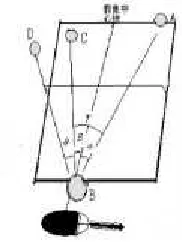
rotation cross-court shot from point A; another paddler receives the server ball at point B and hits it to opponent court point C. If ignore table tennis rotation in the process, according to image principle, then table tennis running process hypothetical center line lies in the center of angle∠ ABC that incident angle is equal to emergence angle, at
this time α = β, as Figure1 shows.
Figure 1: Table tennis running process figure
[image:2.595.261.352.125.246.2]But considering practical status, paddler in table tennis hitting process, table tennis possesses it own rotation feature, therefore if continue to consider table tennis don’t make rotation incident angle is the same as emergence angle, table tennis would deviate towards opponent court right side to a certain degree and arrive at Figure 1 point D. To let table tennis correct drop to point C, then it should let hypothetical center line left deviate to a certain angle, its angle is angle ∠CBD, and table tennis in running process should go through net and drop to opponent court range. To
make such implementation, it should also adjust racket and table included angle as well as paddler rocket hitting strength.
In order to let table tennis drop into table tennis court one anticipated point at a certain speed and strength, establish
table tennis strength angle mathematical model. Given table tennis weight as
m
1, racket weight asm
2, racketsurface rubber elastic coefficient as
d
1, racket surface rubber friction coefficient asf
1, table tennis speed asv
1,table tennis racket speed as
v
2.Let horizontal direction C point achieving joint force as
F
C−Horizontal, A direction table tennis generated reactionforce as
F
A. Table tennis rotation generated D direction friction force isF
D.Racket hits table tennis generatedelastic force is
F
M. Then joint forceF
C−Horizontal expression is as formula (1):(
)
C A D M
F
−=
F
+
F
+
F
∑
Horizontal∑
1 1
0 0
1
1 1 1 1 2
[
cos
cos
(
)
]
t t
C A
t t
dv
dwr
F
F
m f
d m
m
dt
dt
γ
θ
−
=
+
+
+
∑
Horizontal∑
1 1 1 1 2
cos
cos
(
)
C A
F
−Horizontal=
F
γ
+
m f aw
θ
+
d m
+
m a
(1)
Table tennis vertical direction force status analysis
Let table tennis arrived at C point force to be
F
C-Vertical, and then it has formula (2):2 2
C-Vertical s h
F
=
F
+
F
∑
(2)a
m
m
d
F
s=
1(
1+
2)
;
F
h=
m
1g
Racket speed is
v
0, table tennis speed that leaves out of racket isv
x, table tennis touch racket time is△t. Then
dt
dv
t
v
t
t
v
v
a
x=
=
−
−
=
0 0 (3)dt
dv
m
m
d
F
s=
1(
1+
2)
2 2
-Ver ca
[ (
1 1 2)
]
(
1)
c ti ldv
F
d m
m
m g
dt
=
+
+
(4)
Table tennis horizontal direction and vertical direction joint force status analysis
According to parallelogram law, solve horizontal direction and vertical direction joint force F, its size as formula (5):
2 2 2
-Vertical
C C
F
=
F
−Horizontal+
F
2 2
-Vertic
C C al
F
=
F
−Horizontal+
F
2 1 2 2 1 1 2 2 1 1 1
1
cos
(
)
]
[
(
)
]
(
)
cos
[
m
g
dt
dv
m
m
d
a
m
m
d
aw
f
m
F
F
=
Aγ
+
θ
+
+
+
+
+
(5)
When hits table tennis flying in A direction from paddler, if according to image theory let incident angle to be equal to emergence angle, then table tennis would drop to D point; to let table tennis drop to specified C point, it should let hypothetical center line left deviate to a certain angle, θ = C B D. ∠
Convert formula
F
C−Horizontal, it can get formula (6):1 1 1 1 2
cos
cos
(
)
C A
F
−Horizontal=
F
γ
+
m f aw
θ
+
d m
+
m a
(6)
1 1 2
1 1
cos
(
)
cos
F
CF
Ad m
m a
m f aw
γ
θ
=
−Horizontal−
−
+
So that further solves table tennis running strength and angle mathematical model formula (7):
2 1 2 2 1 1 2 2 1 1 1
1 cos ( ) ] [ ( ) ] ( )
cos
[ m g
dt dv m m d a m m d aw f m F
F= A
γ
+θ
+ + + + +(7)
1 1 2
1 1
cos
(
)
cos
F
CF
Ad m
m a
m f aw
γ
θ
=
−Horizontal−
−
+
TABLE TENNIS MOVEMENT PROCESS MODEL EXPANSION IN ACTUAL COMPETITION AND TRAINING
Combine aerodynamics and classical mechanics theory, analyze and set table tennis dynamics simulation model that including gravity, air resistance, Magnus force, on the basis of the model with consideration of buoyancy force and additional mass force, it establishes improved table tennis dynamics simulation model [8, 9].
Table tennis dynamics simulation model
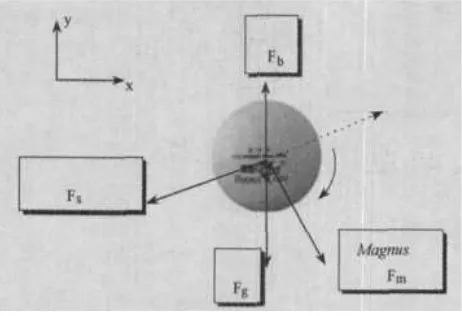
Figure 2: Table tennis force analysis figure
Gravity is G, direction is downward. Air resistance direction is opposite to table tennis movement direction, its size
is up to air density ρ、windward area A、line speed v and resistance coefficient d
C
etc., according to fluid dynamics formula, calculate formula (8) as following:
2
2
1
Av
C
F
d=
dρ
(8)
Among them, resistance coefficient
C
d is got by wind tunnel experiment. This paper assumes resistancecoefficient is only up to table tennis translational speed and angular speed, adopt following method to calculate formula (9):
5 / 2
2 / 5
) ) ( 196 . 4 053 . 22
1 (
508 . 0
ω
v Cd+ +
=
(9)
When table tennis rotates in air, it will be affected by Magnus force. When a rotational object rotation angular speed vector mismatches to object flight speed vector, it will generate a horizontal force in vertical direction of a plane that composed of rotation angular speed vector and translational speed vector. Under the horizontal force function, object flight trajectory would appear deflection. The phenomenon that objects flight trajectory appears deflection under the horizontal force function is called Magnus effect, the horizontal force is Magnus force. It can be used to explain ball type movements (table tennis, tennis, football and so on) loop generation.
Set flight speed vector as v, angular speed vector as ω, then Magnus force is
F
m, vertical to v and ω, computationalformula is as following formula (10):
v
v
v
A
C
F
m mr
r
r
r
r
r
×
=
ω
ω
ρ
22
1
(10)
Among them,
C
m is Magnus force lift force coefficient that got by experiment measuring.C
m Compares toC
d,it is quite small. Assume that
C
m is only up to linear speed v and angular speed ω, adopt below method tocalculate formula (11):
ω
v
C
m981
.
0
022
.
2
1
+
=
force as
F
m, gravity as G, translational speed v and XOY plane included angle as α, translational speed vector inXOY plane projection and x axis included angle as φ, Magnus force and XOY plane included angle as β, Magnus force projection in XOY plane and x axis included angle θ, according to Newton the second law F = ma list out following equation, get table tennis dynamics simulation model formula:
T z y x m
d
dt
dv
dt
dv
dt
dv
m
G
F
F
=
,
,
1
sin
sin
0
sin
cos
sin
cos
0
cos
cos
cos
cos
β
α
θ
β
ϕ
α
θ
β
ϕ
α
(12)
[image:5.595.191.422.505.663.2]Figure 3: Table tennis force analysis
Table tennis dynamics simulation model improvement
This model on the basis of table tennis dynamics simulation model adds buoyancy force and additional mass force to make improvement on table tennis dynamics simulation model, analyze different rotation speeds influences on loop.
Rotational table tennis in running process mainly suffers gravity, buoyancy force, additional mass force, air resistance and Magnus force effects as Figure 4 shows. Among them, gravity is vertical and downward, buoyancy force is vertical and upward, air resistance direction is opposite to table tennis movement direction.
Figure 4: Table tennis force analysis figure
Gravity
F
g expression as following formula (13):g
d
mg
F
g d 36
1
πρ
=
=
From which,
ρ
d is table tennis density,d
is table tennis diameter, table tennis diameter is 40mm
, mass isaround 2.7
g
.Buoyancy force
F
b is equal to table tennis sphere arranged same volume air mass force, its computation formula(14) is:
g
d
g
m
F
b a a3
6
1
πρ
=
=
(14)
From them,
ρ
a is air density?For induction magnetic field generated additional mass force, its size is as formula (15):
dt
dv
m
dt
dv
d
F
m a a2
1
12
1
3=
=
′
πρ
(15)
a
m
2
1
Is always recording as
m
′
, is called additional mass. Additional mass force can be ignored when table tennis speed hasn’t greatly changed.When table tennis takes movements, it always suffers a resistance that on the opposite direction of movement in the range of high Reynolds number area, its computational formula (16) is:
2 2
8
1
V
d
C
F
D=
Dπρ
a(16)
From them,
C
D is resistance coefficient,V
is absolute speed. Research found that it can expressC
Daccordingto different Reynolds number ranges with three groups of different formulas as formula (17)-(19):
a D
R
C
=
24
1
<
aR
(17)
)
6
1
(
24
a2/3a D
R
R
C
=
+
1000
1<Ra < (18)
44
.
0
≈
DC
(1000< <2×10⁵)a
R (19)
Among them,
R
a is Reynolds number? For Magnus effect, its dominant mechanisms are:1) Dissymmetry displacement thickness; 2) Dissymmetry centrifugal force; 3) Dissymmetry wall friction stress; 4) Dissymmetry transition;
5) Dissymmetry separation and body vortices; 6) Dissymmetry secondary flow.
For sphere, Magnus force can be expressed by following formula (20):
ω
πρ
d
V
Among them,
ω
is rotational speed? According to Newton the second law, it can establish rotational table tennis horizontal and vertical dynamics equations:Horizontal formula (21):
ω
πρ
π
ρ
dt dy d d
dt dx v C dt
x d m
m d
3 2
2 2
8 1 ) 2 ( 2
1 )
( + ′ =− +
(21)
Vertical formula (22):
ω
πρ
π
ρ
dt
dx
d
d
dt
dy
v
C
F
F
dt
y
d
m
m
g b d 2 32 2
8
1
)
2
(
2
1
)
(
+
′
=
−
+
−
−
(22)
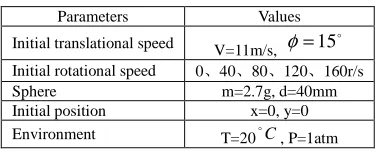
Among them, t is time. Calculation adopted border and initial condition as table 1 shows, table tennis initial speed is 11m/s, angle is 15o; sphere is the standard 40mm large ball, 2.7g weight; ambient air is in normal pressure and
[image:7.595.212.402.292.368.2]temperature; rotational speeds are calculated with different levels as 0、40、80、120、160r/s.
Table 1: Model initial parameters
Parameters Values
Initial translational speed V=11m/s, φ=15o
Initial rotational speed 0、40、80、120、160r/s
Sphere m=2.7g, d=40mm
Initial position x=0, y=0
Environment T=20 Co , P=1atm
[image:7.595.182.431.459.603.2]Through above research, it can get that table tennis movement is a gravity, buoyancy force, additional mass force, resistance and Magnus force combined action process. Rotational speed has great influences on table tennis flight trajectory, Figure 5 draws table tennis movement trajectory at different rotational speeds. From Figure5, it is clear that table tennis serves at same initial speed in the same position, different rotational speeds would let their movement trajectory different. Finally it concludes that strong rotational speed loop can control flight distance in some extent and make table tennis drop into opponent court in high speed movement.
Figure 5: Same start point different rotational speeds table tennis rotation trajectory
CONCLUSION
loop, and got the conclusion that strong rotational speed loop can control table tennis flight distance in some extent and make table tennis drop into opponent court in high speed movement.
REFERENCES
[1] Dai Zhen-qiang; Heyuan Guangdong. China Science And Technology Information, 2011, (14), 31-35. [2] Yang Hua; Guan Zhi-ming. Computer Simulation, 2011, 28(9), 230-233.
[3] Sun Zai, Yu Guang-Xin; Guo Mei; Zhu Li-Li; Yang Jun; He Zheng-bing. China Sport Science, 2008, 28(4), 69-71.
[4] Zhang Qiu-Fen; Su Jing. China Sport Science and Technology, 2005, 41(5), 90-92.
[5] Zhang Cui-Cui; Lin Lin; Hu Hong-quan. Bulletin of Sport Science & Technology, 2010, 18(3), 123-124. [6]Gao Ying. Journal of Hebei Institute of Physical Education, 2013, (4), 79-82.
[7]Zhong Yu-Jing; Wang Da-Zhong; Wang Juan. Journal of Beijing Sport University, 2008, 31(4), 456-459. [8] Zhang B.; Zhang S. and Lu G.. Journal of Chemical and Pharmaceutical Research, 2013, 5(9), 256-262. [9] Zhang B.. International Journal of Applied Mathematics and Statistics, 2013, 44(14), 422-430.