International Journal of Emerging Technology and Advanced Engineering
Website: www.ijetae.com (ISSN 2250-2459,ISO 9001:2008 Certified Journal, Volume 3, Issue 1, January 2013)
697
Efficient Framework for Deploying Information in Virtual
Datacenter with Cloud Security Application
Dr. K.V.V. Satyanarayana
1,
Radhika G
2, Tejaswi A
3 1Professor,Dept of CSE, K L University, Vaddeswaram-522502, Andhra Pradesh, India,
2,3M.Tech (CNS), Dept of CSE, K L University, Vaddeswaram-522502, Andhra Pradesh, India,
Abstract
--
The use of cloud computing has increased rapidly in many organizations. Cloud computing provides many benefits in terms of low cost and accessibility of data. In the Cloud Technology most organizations have own challenges when it comes to handle both critical and confidential information. The major challenge in cloud technology is how effectively the information is uploaded to the virtual data centers to ensure the privacy. To enhance the privacy the available existing cryptography techniques are symmetric and asymmetric in nature. By using those cryptography algorithms, built a cloud security application for encrypting the information before uploading with virtual data centers through internet. We propose to implement using as it is proved the best encryption performance results in terms of computing time.Index Terms-- Cloud Computing, Cryptography, Decryption, Encryption, Hybrid Cloud, Private Cloud, Public Cloud.
1 INTRODUCTION
Information Security within the organization has undergone with major changes. Before wide spread use of the data processing equipment, the security of information felt valuable to an organization was provided primarily by physically and administrative means .with the introduction of the computer the need for automated tools for protecting files and other information that was shared in the distributed network. The generic name for the collection of tools design to protect information from the hackers is Information Security. To ensure the privacy we have use cryptography techniques. Cryptography is concerned with methods for ensuring the secrecy and authenticity of messages. The encrypted message also called as cipher text. In most cases, two related functions are employed, one for encryption and the other for decryption. Encryption is the process of transforming information so it is unintelligible to anyone but the intended recipient. Decryption is the process of transforming encrypted information so that it is intelligible again to the intended recipient. Two forms of encryption are commonly used that is symmetric and asymmetric encryption [1]. We have focus on different type of cryptographic techniques like DES, SHA1, MD5, RSA are used in a single application for providing the best data security for information [2].
1 Cloud computing
Cloud computing gets its name as a metaphor for the Internet. Typically, the Internet is represented in network diagrams as a cloud. Cloud computing promises to cut operational and capital costs and, more importantly, Cloud technology provides computation, software, data access, and storage services that do not require end-user knowledge of the physical location and configuration of the system that delivers the services. Cloud computing is distributed processing, parallel processing and the
development of grid computing, or commercial
implementations of these concepts of computer science. In the cloud computing model is the basic structure of which, the core part is composed of more than one computer server "cloud.” It gathers all the resources together to form large data storage and processing center. Let IT departments focus on strategic projects instead of keeping the datacenter running. Cloud computing provides the most reliable and secure data storage center. Users do not have to worry about data loss, virus attack and other problems. The "cloud” manages information by a professional team. Besides, strict rights management strategy can help to share data.
1.1 Types of cloud computing
i. Public cloud
ii. Private cloud
iii. Hybrid cloud
International Journal of Emerging Technology and Advanced Engineering
Website: www.ijetae.com (ISSN 2250-2459,ISO 9001:2008 Certified Journal, Volume 3, Issue 1, January 2013)
698
i. Public cloud
Public cloud is cloud service provided by a third party (vendor). They exist beyond the company firewall, and they are fully hosted and managed by the cloud provider. Public clouds attempt to provide consumers with hassle-free IT elements. Whether it is software, application infrastructure, or physical infrastructure, the cloud provider takes on the responsibilities of installation, management, provisioning, and maintenance. Customers are only charged for the resources they use, so under-utilization is eliminated. . Another thing to keep in mind is that since consumers have little control over the infrastructure,
processes requiring tight security and regulatory
compliance are not always a good fit for public clouds [4].
ii. Private Cloud
Private cloud (also called internal cloud or corporative cloud) provides service within the enterprise. These clouds exist within the company firewall and they are managed by the enterprise. Private clouds offer many of the same benefits that public clouds do with one major difference: the enterprise is in charge of setting up and maintaining this cloud. The difficulty and cost of establishing an internal cloud can sometimes be prohibitive, and the cost of continual operation of the cloud might exceed the cost of using a public cloud.
iii. Hybrid cloud
Hybrid cloud is a combination of public and private clouds. These clouds would typically be created by the enterprise, and management responsibilities would be split between the enterprise and public cloud provider. The hybrid loud provides services that are in both the public and private space. Services from different sources must be obtained and provisioned as if they originated from a single location, and interactions between private and public components can make the implementation even more complicated. Since this is a relatively new architectural concept in cloud computing, best practices and tools about this pattern continue to emerge, and there could be a general reluctance to adopt this model until more is known.
1.2 Types of Cloud Services
In cloud technology the information is shared from clients to the organization through the virtual data centers. This virtual data centers has all the required information [5].
The cloud technology model includes: i. SaaS (Software as a service) ii. PaaS (Platform as a service) iii. IaaS (Infrastructure as a service)
Fig2:- cloud services
i. Software as a Service (SaaS)
SaaS is an application hosted on a remote server and accessed through the internet. In Saas an application is hosted by a service provider and then accessed via World Wide Web by a client. SaaS offerings feature the biggest cost saving over installed software by eliminating the need for enterprises to install and maintain hardware, pay labor cost, and maintain the applications.
ii. Platform as a Service (PaaS)
To follows the heels of SaaS, platform as a service (PaaS) is another application delivery model. PaaS supplies all the resources required to build applications and services completely from the internet without having to download or install software. Paas services include application design development, testing, deployment, and hosting. It provides infrastructure on which software developers can build new applications or extend existing ones without the cost and complexity of buying and managing the underlying
hardware and software and provisioning hosting
capabilities. PaaS generally offers some support to help the creation of user interfaces, and is normally based on HTML or JavaScript.
iii. Information as a Service (IaaS)
This offers remote delivery of an entire computer
infrastructure. Managed hosting and development
environments are the services included in IaaS. The user can buy the infrastructure according to the requirements at any particular point of time instead of buying the infrastructure that might not be used for months. IaaS operates on a “Pay as you go” model ensuring that the users pay for only what they are using.
II. EXISTING SYSTEM
International Journal of Emerging Technology and Advanced Engineering
Website: www.ijetae.com (ISSN 2250-2459,ISO 9001:2008 Certified Journal, Volume 3, Issue 1, January 2013)
699
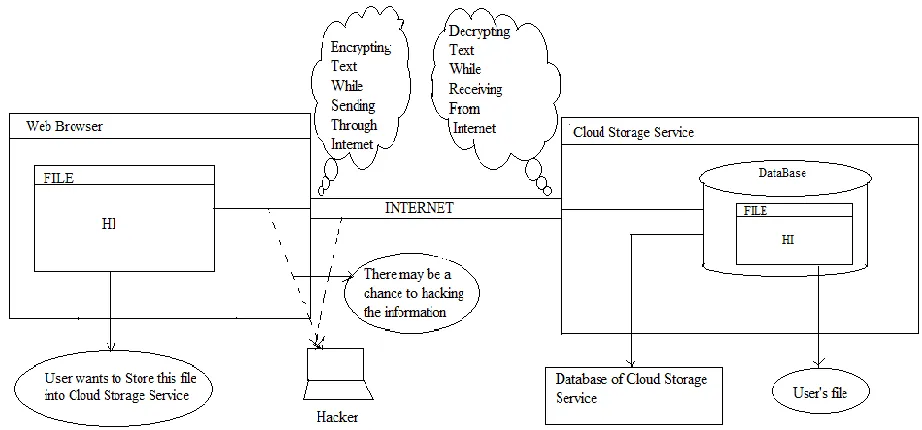
In between the transmission process, the data can be encrypts one time while sending information through internet and decrypts one time while receiving that data from internet. So, the cloud storage service stores the actual information into database. [image:3.612.75.536.198.413.2]Here, we can provide only single time encryption to data, so there may be a chance to hacking the information during transmission process. So, we are proposing a new system to overcoming this problem.
Fig 3: Storing of data in cloud with single encryption
III. PROPOSED SYSTEM
In the proposed system, we are creating a new cloud security application by using cryptography algorithms (DES, SHA1, MD5, and RSA). When the data is transferring from user to cloud storage service via internet, the data can be encrypts double time by using cloud security application.
International Journal of Emerging Technology and Advanced Engineering
Website: www.ijetae.com (ISSN 2250-2459,ISO 9001:2008 Certified Journal, Volume 3, Issue 1, January 2013)
700
Fig4: Storing of data in cloud with duel Encryption
IV. IMPLEMENTATION
5.1 Cloud Security Application:
The cloud security application maintains the
cryptography algorithms and it inbuilt gives a unique code to each algorithm. The code can be represents is in the form of binary or ASCII format. The cloud security application uses some factors (size of text, type of text, performance of an algorithm, e.t.c) for selecting one cryptography algorithm and the application using that algorithm for encrypting the text. Here, two types of encryptions and decryptions can be applied to data.
i. Internal Encryption
ii. External Encryption
iii. External and Internal Decryption
i. Internal Encryption:
The cloud security application internally selects one algorithm based on the text. Each algorithm has its own unique code. The algorithm will encrypts the file which is user wants to store in cloud storage service. That encrypted message is enveloped by unique code of algorithm. After that, the user sends the cipher text to cloud storage service through internet.
ii. External Encryption:
During the transmission process, the encrypted file (cipher text) will be encrypted again while sending information through internet.
iii. External and Internal Decryption:
At the receiver side, decrypting the cipher text while receiving data from internet and the cloud security application decrypts the cipher text by using same cryptography algorithm which is used for encryption. Now, the cloud storage provider gets original message.
V. CONCLUSION
International Journal of Emerging Technology and Advanced Engineering
Website: www.ijetae.com (ISSN 2250-2459,ISO 9001:2008 Certified Journal, Volume 3, Issue 1, January 2013)
701
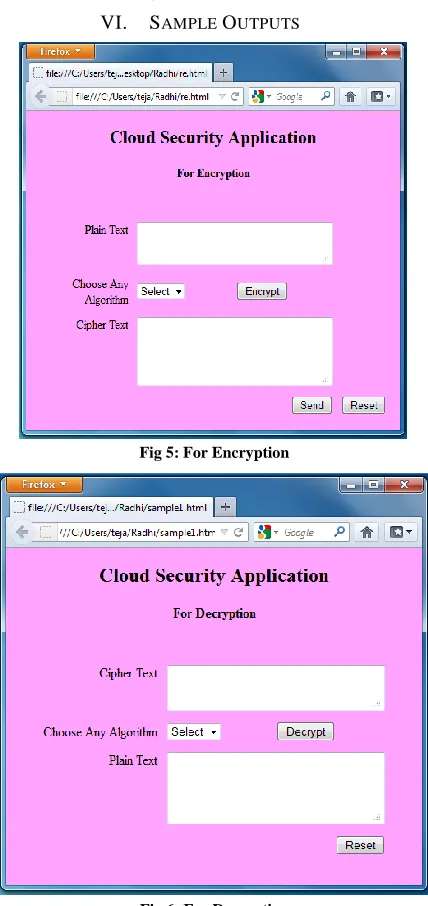
VI. SAMPLE OUTPUTS [image:5.612.61.275.130.583.2]Fig 5: For Encryption
Fig 6: For Decryption
REFRENCES
[1 ] V. Sreenivas and C. Narasimham, ”Enhancing the Security for Information with Virtual Data Centers” Future Wireless Networks and Information Systems, Vol. 143, 2012,pp.277-282
[2 ] William Stallings, “Cryptography and Network Security Principles and PracticSes”, 4th Edition, 2005.
[3 ] Tejaswi. A, Radhika. G, “Efficient use of Cloud Computing in Medical Science”, AJCM, 2012, pp.240-243.
[4 ] Borko Furht, “Cloud Computing Fundamentals”, Hand Book of Cloud Computing, Springer, 2010.