International Journal of Emerging Technology and Advanced Engineering
Website: www.ijetae.com (ISSN 2250-2459,ISO 9001:2008 Certified Journal, Volume 2, Issue 12, December 2012)
772
Enhancement over the Variant of Public Key
Cryptography (PKC) Algorithm
Mayank Jhalani
1, Piyush Singh
2, Gaurav Shrivastava
31,2,3CSE Department., RKDFIST, Bhopal, India
Abstract: In this paper, we have shown the development of a new public key cryptosystem which is the extension of the work of “Improvement over three prime RSA with two private keys and one public key”. In many cases, the decryption generation speed is required to be enhanced,e.g; in banking sector, signature generation in one day can be in a large volume as compared to only single signature verification in a day at the destination side.So,the main aim of this paper is to improve the cost of decryption generation. There are already various methods which have been developed to reduce the decryption time such as CRT-RSA,Batch RSA,Re-balanced RSA,Multi Prime RSA,R-Prime RSA,etc.We have tried the improvement over Multi Prime RSA to increase the decryption generation performance. Our proposed work has been implemented by using JDK1.6 as the programming environment. As compared to Multi Prime RSA, our new approach is much faster and secure. We have also shown the graphical comparison of our new approach with Multi Prime RSA in this paper.
Keywords: Cryptosystem, encryption, cipher text,
decryption, MultiPrime RSA, Multi Power RSA, Public Key Cryptography (PKC).
I.
I
NTRODUCTION
In the current scenario,security is an important issue to deal with as the Internet provides various ways of communication between multiple users and is the largest tool used in the field of e-commerce.One of the necessary aspect for the communication to be secure is the field of cryptography [1].Today‟s cryptography is extremely more complex than its predecessors.When modern cryptography is addressed,it generally refers to cryptosystems because it comprises of the study and practice of hiding information with the utilization of keys, which are related with web based applications, ATM‟s,e-commerce,computer password,etc. Cryptography is generally divided into two schemes: single key (symmetric/secret) key cryptography and multiple (asymmetric) key cryptography. The data which is to be encrypted in another form is known as plaintext. This original plaintext is then encrypted into cipher text which will again be decrypted into the plaintext. Public key cryptography is the most significant cryptography development in the past.
In this method, the two communication parties can get engaged in a secure communication without sharing their secret key over a non secure channel, e.g; RSA [2].In this paper our main aim is to enhance the RSA efficiency. The first section of this paper gives a brief description of RSA method. In the second section, Multi Prime RSA method is discussed which is the improved version of standard RSA.Then our new proposed approach is shown with the graphical result analysis .The paper is concluded with future scope in the last section.
II.
RSA
A
LGORITHMThe RSA [2] is a public key cryptographic algorithm which was published by Ron Rivest, Adi Shamir and Leonard Adleman publicly in 1977 at MIT.It is considered to be the first suitable public encryption algorithm and one of the great achievements in the field of cryptography. This algorithm is used to define a cryptographic system which uses a Public Key to encrypt messages, and a Private Key to decrypt them. Security [4] is the core of this algorithm, for which, if the keys are properly chosen, it's not possible, or so computationally hard to become impractical, to decrypt the data unless you have the private key. The security of the RSA cryptosystem depends mainly on a mathematical problem i.e. the problem of factoring the numbers. Full decryption of an RSA cipher text is thought to be infeasible on the assumption that this problem is difficult, i.e., no efficient algorithm exists for solving it. The addition of a secure padding scheme may be required for providing security against partial decryption.
RSA relies on the fact that it is easy to multiply two large prime [8] numbers together, but extremely hard (i.e. time consuming) to factor them back from the result. Factoring a number means finding its prime factors, Which are the prime numbers that need to be multiplied together in order to produce that number.
A.WORKING of RSA ALGORITHM
In this algorithm, the Public Key is a pair of integer numbers: e and n. (You can associate 'e' with 'e'ncryption). The Private Key is a pair of integer numbers: d and n, (you can associate‟d‟ with 'd'ecryption).
International Journal of Emerging Technology and Advanced Engineering
Website: www.ijetae.com (ISSN 2250-2459,ISO 9001:2008 Certified Journal, Volume 2, Issue 12, December 2012)
773
'd' is another prime number, bigger than p and q and 'relatively prime to p and q', for which exists an integer 'e', with this property:e * d = 1 (mod φ) Where
φ = (p - 1) * (q - 1)
that is, the product of d and e, mod φ , equals 1, and said in other terms, 'd is the multiplicative inverse of e, modulus φ „.
'd is relatively prime to p and q' means that the greatest common divisor between d and φ is 1.
If these conditions are met, then given a message m (< n) can be encrypted by computing:
C = (m exp e) mod n
This C is then transferred to the receiver and once the receiver receives C, it can decrypt it (because it knows the Private Key (d, n)) with:
D = (C exp d) mod n
D (the decrypted message) equals m (the original message).
As you can see, after having chosen the key components (n, d and e), encryption and decryption are conceptually easy.
The algorithm is secure because to compute d, the Private Key, it's not sufficient to know 'n' and 'e' (which are included in the Public Key).
This is because d can be computed only knowing p and q and to know them, an attacker should retrieve them from n, i.e. it should 'factor n'.
It can be proved that 'factor n', when p and q are large, is so hard to be considered impossible (in a reasonable amount of... years).
1) KEY GENERATION of RSA ALGORITHM: It involves
the generation of a public key and a private key. The public key is known to everyone. It is specifically used to decipher messages. Private Key is used to decrypt the messages that are encrypted using the public key. The message or the data is encrypted using the public key. Encryption involves converting the message into a coded format. The public key is accessible to everyone and anyone can encrypt the message.
i) Select 2 prime numbers, p and q. These must be kept secret.
ii) Find n, where n = p * q.
iii) Compute φ. This is where keeping the initial primes secret really comes in. Computing φ is incredibly hard without knowing these factors, since φ is really just (p - 1) * (q - 1).
iv) Select an integer, e (1 < e < φ), such that gcd (e, φ) = 1 and e and φ are relatively prime.
v) Find an integer, d (1 < d < φ), such that e * d = 1 (mod φ). This is part of our private key and must be kept secret.
vi) The public key is e and n, or (e, n), and the private key is d and n, or (d, n).
2) ENCRYPTION of RSA ALGORITHM: Once we have
generated a public/private key pair, we can encrypt a message with the public key with the following steps.
i) Take the message m to represent a piece of plaintext. In order for the algebra to work properly, the value of m must be less than the modulus n, which was originally computed as p * q. Long messages must therefore be broken into small enough pieces that each piece can be uniquely represented by an integer of this bit size, and each piece is then individually encrypted. ii) Calculate the cipher text C using the public key
containing e and n. This is calculated using the equation C = (m exp e) mod n.
3) DECRYPTION of RSA ALGORITHM:Finally, we can perform the decryption procedure with the private key using the following steps.
i) Calculate the original plaintext message from the cipher text using the private key containing d and n. This is calculated using the equation m = (C exp d) mod n
ii) Compare this value of m with the original m, and you should see that they are equal, since decryption is the inverse operation to encryption.
III. IMPROVEMENT
O
VERS
TANDARDRSA
A
LGORITHMInternational Journal of Emerging Technology and Advanced Engineering
Website: www.ijetae.com (ISSN 2250-2459,ISO 9001:2008 Certified Journal, Volume 2, Issue 12, December 2012)
774
A. MULTI PRIME RSA ALGORITHM
This technique [3] was introduced by Collins who modified the RSA algorithm so that it consists of k primes p1, p2,……, pk instead of the traditional two prime‟s p and q.Classically, an RSA modulus has been composed from two primes. However, there are very practical reasons why using more than two primes might be preferred.
a) The primes are smaller and key generation takes less time despite there being more of them. b) Private Key operations take less time if one uses
the Chinese Remainder Theorem. Using three primes vs. two primes gives a theoretical speedup of 9/4. A speedup of 1.8 to 2.0 has been achieved in practice.
The key generation, encryption and decryption algorithm are described as given below:
1) KEY GENERATION of MULTI PRIME RSA ALGORITHM: The parameter k indicates the number of primes to be used in key generation algorithm. The public and private key pairs can be generated as follows:
i) Select k primes at random, each of which is n/3 bits in length.
ii) Set n = p1*p2*………*pk and
φ (n) = (p1-1)* (p2-1)*…… *(pk-1).
iii) Pick randomly an odd integer, e (1 < e < φ), such that gcd (e, φ (n)) = 1.
iv) After that find an integer, d (1 < d < φ), such that d = e-1 mod φ (n). This is part of our private key and must be kept secret.
v) Finally compute di = d mod (pi-1) for 1≤ i ≤k
vi) The public key is e and n, or (e, n), and the private key is d and n, or (d1, d2,….., dk, n).
2) ENCRYPTION of MULTI PRIME RSA ALGORITHM: Once we have generated a public/private key pair, we can encrypt a message with the public key with the following steps.
i) Take the message M to represent a piece of plaintext. In order for the algebra to work properly, the value of m must be less than the modulus n, which was originally computed as p1 * p2 *…..* pk. Long messages must therefore be broken into small enough pieces that each piece can be uniquely represented by an integer of this bit size, and each piece is then individually encrypted.
ii) Calculate the cipher text C using the public key containing e and n. This is calculated using the equation C = (M exp e) mod n.
3) DECRYPTION of MULTI PRIME RSA ALGORITHM: Finally, we can perform the decryption procedure with the private key using the following steps.
i) The decipher first computes Mi for 1 ≤ i ≤ k such that Mi = Cidi mod pi where Ci = C mod pi.
ii) Next the message M can be obtained as M = Cd
mod n by applying Chinese Remainder Theorem [5] (CRT).
B. THE NEW PROPOSED APPROACH
This approach has been named as Multi Power RSA algorithm and through this we have generated a new variant cryptosystem by enhancing the speed of Multi Prime RSA decryption. The parameter k indicates the number of primes [8] to be used in the key generation algorithm
1) KEY GENERATION of MULTI POWER RSA
ALGORITHM:
i) Randomly generate two large prime numbers p and q, each of which is n/k bits in length.
ii) Calculate n = pk-1 * q and
φ (n) = (p-1) * (q-1).
iii) An integer, e (1 < e < φ) is chosen, such that gcd (e, φ (n)) = 1.
iv) After that an integer, d (1 < d < φ), such that d = e-1 mod φ (n) is calculated. This is part of
our private key and must be kept secret.
v) Finally dp = d mod (p-1) and dq = d mod (q-1) is
calculated.
vi) The public key is e and n, or (e, n), and the private key is d and n, or (dp, dq p, q).
2) ENCRYPTION of MULTI POWER RSA ALGORITHM:
Once we have generated a public/private key pair, we can encrypt a message with the public key with the following steps.
i) Take the message M to represent a piece of plaintext. In order for the algebra to work properly, the value of m must be less than the modulus n, which was originally computed as pk-1 * q. Long messages must therefore be broken [10] into small enough pieces that each piece can be uniquely represented by an integer of this bit size, and each piece is then individually encrypted. ii) Calculate the cipher text C using the public key
International Journal of Emerging Technology and Advanced Engineering
Website: www.ijetae.com (ISSN 2250-2459,ISO 9001:2008 Certified Journal, Volume 2, Issue 12, December 2012)
775
3) DECRYPTION of MULTI POWER RSA ALGORITHM: Finally, we can perform the decryption procedure with the private key using the following steps.
i) The decipher first computes M1 = Cdp
mod pk-1
and M2 = Cdq
mod q
ii) It implies that M1e = C mod p and M2e = C mod q.
iii) Then for constructing an M1‟ such that (M1‟)e = C
mod pk-1 ,Hensel lifting [7] is used.
iv) Finally to obtain the original plaintext M such that M = M1‟ mod pk-1 and M = M2 mod q, the CRT is
applied.
IV. RESULTS
We have compared our new proposed scheme with the Multi Prime RSA algorithm and the comparison shows that our new approach is faster than Multi Prime RSA.
The various types of graphical comparisons between Multi Prime RSA and Multi Power RSA are shown below:
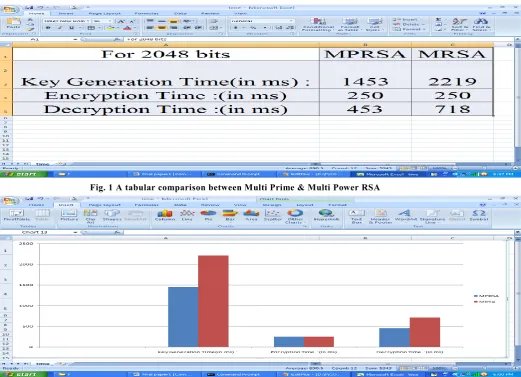
Fig. 1 shows the comparison of Key Generation Time, Encryption Time and Decryption Time of Multi Prime RSA and Multi Power RSA for n = 2048 [9] bits through a table.
Fig. 2 shows the comparison of Key Generation Time, Encryption Time and Decryption Time of Multi Prime RSA and Multi Power RSA for n = 2048 bits through a bar graph.
Fig. 3 shows the comparison of Key Generation Time, Encryption Time and Decryption Time of Multi Prime RSA and Multi Power RSA for n = 2048 bits through a line chart.
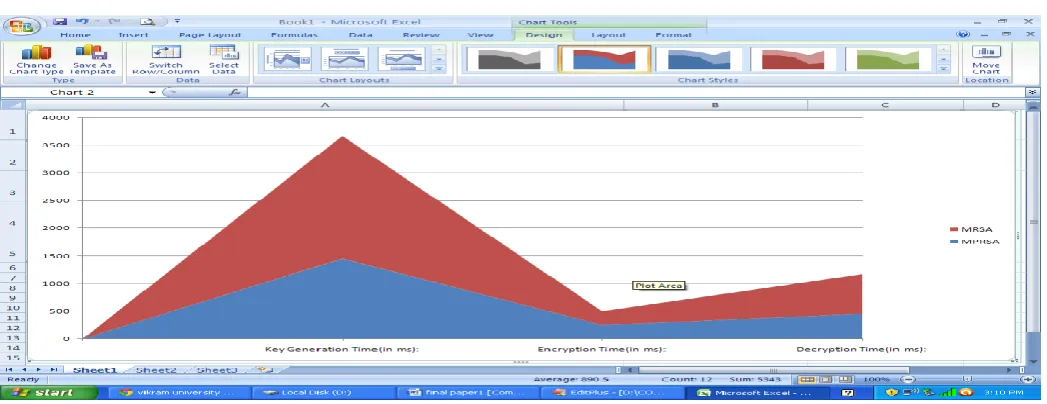
[image:4.596.61.583.372.749.2]Fig. 4 shows the comparison of Key Generation Time, Encryption Time and Decryption Time of Multi Prime RSA and Multi Power RSA for n = 2048 bits through an area chart.
Fig. 1 A tabular comparison between Multi Prime & Multi Power RSA
Fig. 2 A bar graph comparison between Multi Prime & Multi Power RSA
International Journal of Emerging Technology and Advanced Engineering
Website: www.ijetae.com (ISSN 2250-2459,ISO 9001:2008 Certified Journal, Volume 2, Issue 12, December 2012)
[image:5.596.51.577.146.335.2]776
Fig. 3 A line chart comparison between Multi Prime & Multi Power RSA
Fig. 4 An area chart comparison between Multi Prime & Multi Power RSA
V. CONCLUSION
In this paper RSA public cryptosystem is explained with its variant Multi Prime RSA and Multi Power RSA. Multi Power RSA gave the faster decryption/signature generation performance as compared to Multi Prime RSA.We have designed and developed the Multi Power RSA cryptosystem in Java [6] and analyzed the performance of our scheme with the already existing Multi Prime RSA algorithm. We have also shown the resulting comparison with the help of a table, bar graph and line chart. All these graphical comparison are based on Key Generation Time, Encryption Time and Decryption Time of the two algorithms.
REFERENCES
[1] Dan Calloway,“Introduction to Cryptography and its role in Network Security Principles and Practices”, 2009, available at http://www.danc alloway.com/.
[2] R.Rivest, A.Shamir, and L.Adleman, “A Method for Obtaining Digital Signatures and Public Key Cryptosystems”,Communications of the ACM Vol.21, No. 2, pp. 120-126,1987.
[3] T.Collins, D. Hopkins, S. Langford, and M. Sabin,”Public Key Cryptographic Apparatus and Method”, US Patent #5,848,159. Jan. 1997.
[4] Hinek M. Jason., “On the Security of Some Variants of RSA”, Waterloo, Ontario, Canada : s.n., 2007.
[5] Ou Huayin and Wei Baodian,“Multi-factor Rebalanced RSA-CRT Encryption Schemes”,IEEE, 2009.
[6] Peng Jiezhao and Wu Qi, “Research and Implementation of RSA Algorithm in Java”, IEEE, 2008.
[image:5.596.52.576.354.556.2]International Journal of Emerging Technology and Advanced Engineering
Website: www.ijetae.com (ISSN 2250-2459,ISO 9001:2008 Certified Journal, Volume 2, Issue 12, December 2012)
777
[8] Yang Shuqun, “An algorithm for generating strong primes”, Science and Technology Square, 2006, pp. 74-75.
[9] Zareen, Ajay Kumar, “Implementing Efficient RSA with BigInteger on 2048-bit”, published in National Conference on the Recent Advances in Electronics and Communication Technologies (RAECT- 11), Ludhiana, March 4-5, 2011.